Contents
- 01What Makes an Amp "Blackface" or "Silverface"?
- 02The CBS Acquisition and What It Actually Changed
- 03Circuit Differences: Where Tone Actually Comes From
- 04Model-by-Model: Blackface vs Silverface
- 05Sound Differences: What You Actually Hear
- 06Silverface to Blackface Mods: What's Actually Involved
- 07Collector Value vs. Player Value
- 08How to Date and Verify Your Amp's Era
- 09Frequently Asked Questions
- 10What to Look For Before You Buy
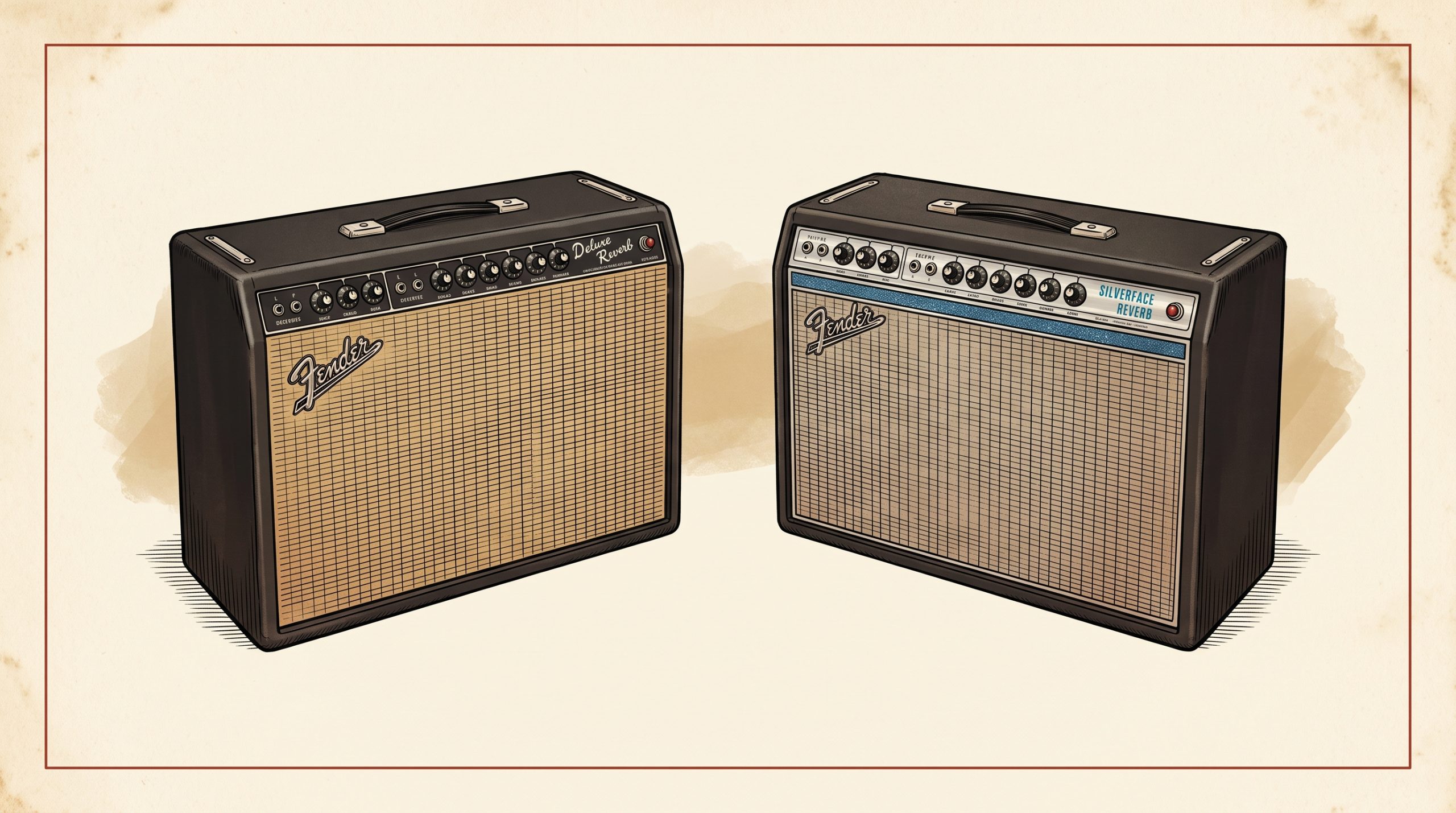
Two amps sit side by side at a dealer. Same model, same cabinet dimensions, same tube complement. One has a black panel. The other has a silver one. The price difference is $1,200. That’s the fender blackface vs silverface question in its most practical form, and it comes up constantly among vintage amp buyers because the stakes are real. On the used market in 2024, a blackface Deluxe Reverb routinely trades at $2,200–$3,500, while a comparable silverface example in player condition sells for $900–$2,200. Same basic amp. Meaningfully different prices.
The fender silverface vs blackface debate is one of the most argued topics in the vintage amp world, and most of the arguments oversimplify. “Blackface is better” isn’t wrong exactly, but it’s incomplete. The reality depends on which year of silverface you’re holding, which model it is, and what you actually need the amp to do. Knowing the circuit number before you buy matters more than the panel color. You can start verifying era with the Fender tube amp serial number and dating reference before you ever open a chassis.
What Makes an Amp “Blackface” or “Silverface”?
The Blackface Era: 1963 to 1967
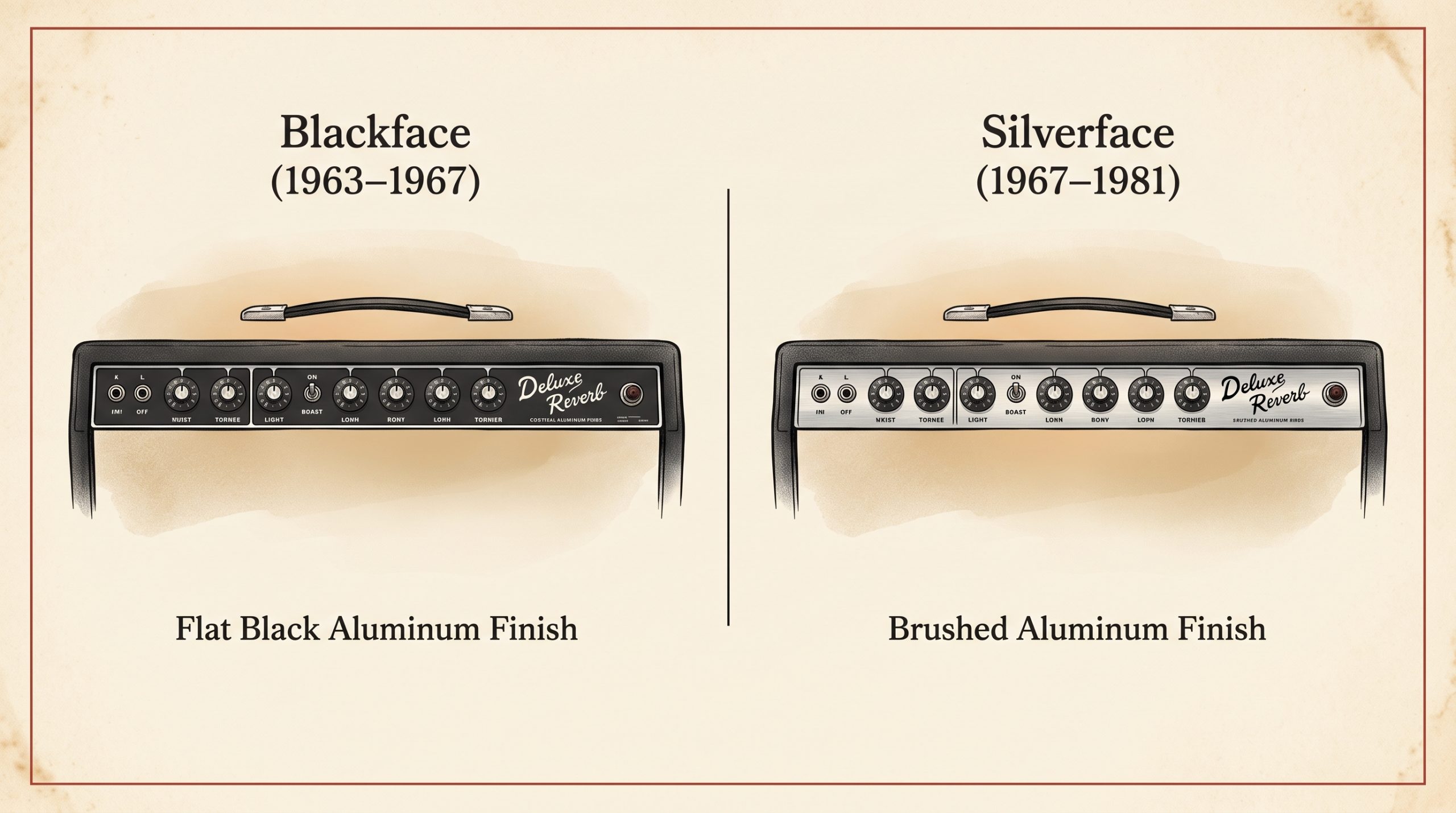
Fender began producing blackface amps in July 1963 with the AA763 circuit. That designation wasn’t marketing shorthand; it was Fender’s internal engineering code for the specific circuit revision. The AA763 didn’t disappear once the AB763 revision arrived — the two circuits ran in parallel across different models for a time. A refined version, the AB763, followed shortly after with minor but meaningful updates to the bias circuit and component values, and became the reference point for almost everything collectors talk about when they say “blackface sound.” Some models, like the Tremolux, stayed on AA763 for their entire blackface production run and never moved to AB763.
Other circuit families from this era are closely related: the AA864 (used in the Vibrolux Reverb, from late 1964) and the AA165 (used in the Pro Reverb, also from late 1964) are considered part of the blackface family and share the core AB763 topology. All of these use a flat black aluminum control panel with silver and white lettering, mounted on a black Tolex cabinet with a wheat or silver grille cloth.
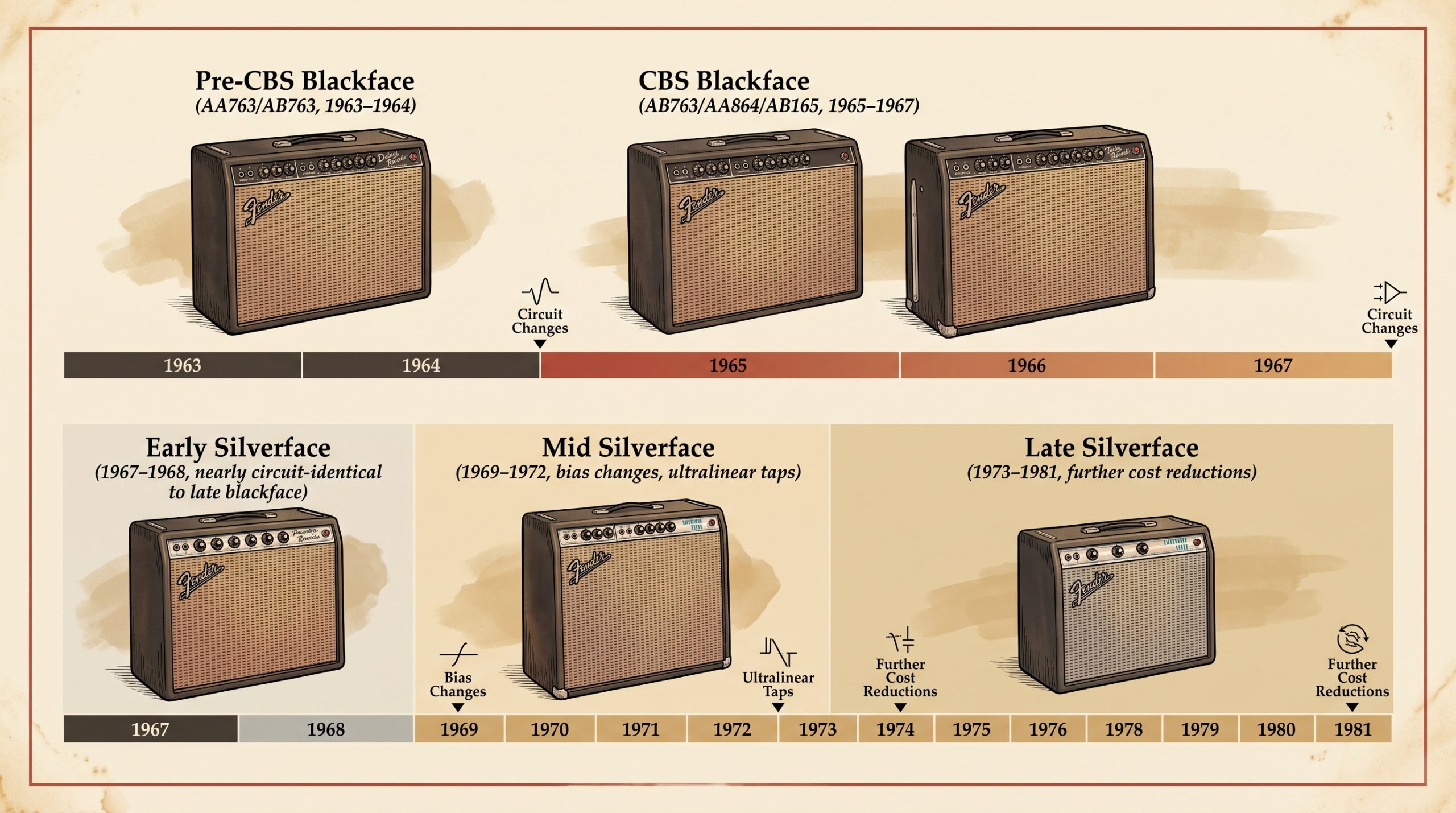
Corporate ownership split this era in two. Amps produced before January 1, 1965 carry “Fender Electric Instrument Co.” (FEI) on the front panel and are classified as pre-CBS. After CBS acquired Fender for $13 million effective January 1, 1965, panels began to read “Fender Musical Instruments” (FMI). The circuit quality held consistent through the end of the blackface run in 1967, regardless of ownership. “Pre-CBS blackface” commands a collector premium, but circuit-for-circuit, late blackface production is generally regarded as equally good.
The Silverface Era: 1967 to 1981
Silverface production began in mid-1967 and ran until approximately 1981. That’s roughly 14 years of production versus about 4 for the blackface run. The name comes from the brushed aluminum control panel, often paired with a blue sparkle fabric strip on the cabinet front in early examples. Later silverface models dropped the sparkle detail and simplified the cosmetics further.
Not a monolithic era. The silverface period contains at least three meaningfully distinct sub-phases: an early period (1967–1968) that’s nearly circuit-identical to late blackface; a mid period (1969–1972) where bias network and phase-inverter revisions took hold, culminating in the master volume control introduced in 1972; and a late period (1973–1981) defined by that master volume becoming standard across the lineup, pull-boost switches, ultralinear output transformers (from 1977 onward on some models), and increasing use of printed circuit boards.
Visual Identification at a Glance
| Feature | Blackface (1963–1967) | Silverface (1967–1981) |
|---|---|---|
| Panel Color | Flat black aluminum | Brushed aluminum/silver |
| Tolex | Black (most models) | Black with silver/blue accents (early); black later |
| Grille Cloth | Wheat or silver | Aluminum with blue sparkle (early), silver later |
| Front Panel Logo | “Fender Electric Instrument Co.” (pre-’65) or “Fender Musical Instruments” | “Fender Musical Instruments” always |
| Key Circuit Codes | AA763, AB763, AA864, AA165, AA1164 | AA270, AA568, AB568, AC568, AA964, and others |
One common trap: early 1980s Fender amps with black panels are not vintage blackface amps. These were Paul Rivera-designed models (the Concert, Super Champ, and related designs) with master volumes, channel switching, and entirely different circuit architectures. No vintage blackface amp ever had a master volume or channel switching. There are also solid-state Fenders with black-painted panels from this period. Both are decent amps, but neither has anything to do with the AB763 era.
The CBS Acquisition and What It Actually Changed
Leo Sells, and Component Philosophy Shifts
Leo Fender’s sale to CBS in 1964 is treated as a dividing line in vintage amp collecting, but the immediate effect on circuit quality was minimal. The 1965, 1966, and 1967 blackface amps built under CBS ownership are regarded as essentially equivalent to FEI-era production. What the acquisition changed was the long-term trajectory: CBS brought a profit-focused management structure that Leo’s direct oversight never had. The circuit changes that define the silverface era didn’t arrive until CBS engineers began modifying designs for reduced distortion and improved headroom, targeting cleaner tones and a more versatile pedal platform.
Component Sourcing and Manufacturing Drift
Blackface amps typically shipped with Jensen (EIA code 220), Oxford (465), JBL (73), or CTS (137) speakers, depending on the model and year. Silverface production saw increased use of Oxford and Utah drivers as Jensen phased out guitar speaker manufacturing in the late 1960s. Transformer sourcing was dominated by Schumacher (EIA code 606) throughout the vintage production run. Later silverface amps introduced printed circuit boards in place of the hand-wired turret and eyelet boards used in blackface construction.
These changes were gradual, not sudden. No CBS memo overnight transformed a great amp into a lesser one. The shift happened across years of small component substitutions and circuit revisions.
The FEI vs. FMI Panel as a Dating Tool
You don’t need to open the chassis to get an era fix. “Fender Electric Instrument Co.” on the front panel means pre-1965 with certainty. “Fender Musical Instruments” means 1965 or later, because FEI panels were sometimes installed on amps built into mid-1965 as existing stock was depleted. If you see FEI, you’re looking at pre-CBS production. If you see FMI, you need the tube chart and transformer codes to narrow it down further.
Circuit Differences: Where Tone Actually Comes From
The AB763 Circuit
The AB763 is the circuit designation most associated with the blackface sound. It covers a range of models including the Deluxe Reverb, Twin Reverb, Super Reverb, Vibroverb, and Bandmaster Reverb. Defining characteristics include specific negative feedback loop resistor values, bright cap and presence control voicing, and a tremolo/vibrato circuit topology that remained largely unchanged from the AA763 original. The bias circuit targets approximately 70–75% of maximum plate dissipation in the power tubes, a setting that produces the characteristic compression and “bloom” players associate with the blackface sound.
The Bias Circuit Difference
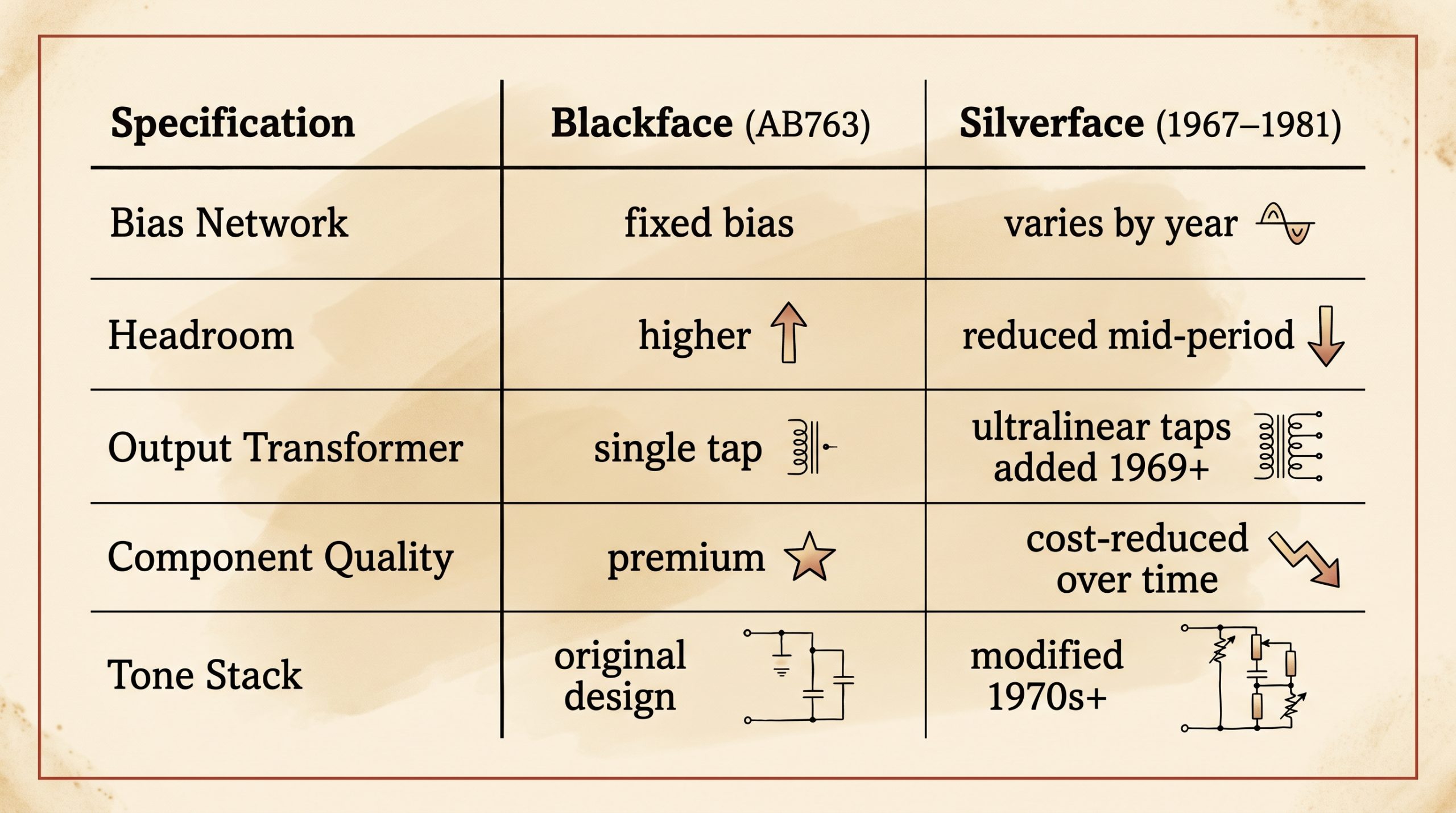
Amp techs and collectors, including discussions across forums like The Gear Page, commonly identify the bias circuit as the primary sonic difference between blackface and silverface amps. Early silverface amps retained bias settings close to AB763 specs. From 1969 onward, bias networks on many models were revised, running the output tubes cooler. Cooler bias means more headroom and a stiffer, more open response. Less natural compression. The “spongy” breakup and warm clean tones that characterize the blackface sound come partly from that hotter bias setting, not just component quality.
That stiffness isn’t necessarily worse. Players who run clean with pedals often prefer the extra headroom of a mid-to-late silverface amp. The bias shift gave CBS engineers what they wanted: reduced distortion, more clean volume. Whether that serves you depends entirely on how you play.
Year-by-Year Silverface Circuit Changes
| Year Range | Panel Era | Notable Circuit Change | Collector/Player Sentiment |
|---|---|---|---|
| 1963–1967 | Blackface | AA763 to AB763 baseline; AA864 and AA165 variants | Highest collector demand and pricing |
| 1967–1968 | Early Silverface | Cosmetic changes only on most models | Strong player value; easiest mod candidates |
| 1969–1972 | Mid Silverface | Bias network and phase-inverter revisions; AB568 circuit family; master volume introduced late in period (1972) | Moderate; modifiable at reasonable cost |
| 1973–1981 | Late Silverface | Master volume standard, pull-boost switches, ultralinear output transformers (1977 onward on some models), PCB construction on many models | Lowest vintage premium; excellent player value |
The Ultralinear Output Transformer Controversy
Starting in the late silverface run (1977 onward), Fender introduced ultralinear output transformer taps on the Twin Reverb and Super Reverb among other models. Ultralinear tapping connects a portion of the output transformer’s primary winding back to the screen grids of the output tubes, functioning as a form of local feedback. The effect is reduced harmonic distortion and increased headroom. Cleaner. Stiffer. Better for a pedal-forward player who wants the amp to stay transparent at volume.
For players wanting natural amp breakup, it’s the wrong direction entirely. A silverface-to-blackface mod on a Twin Reverb or Super Reverb will often address this transformer situation specifically, either by reconnecting the screen grids to the standard tap or by swapping the transformer outright.
Model-by-Model: Blackface vs Silverface
Deluxe Reverb
The blackface Deluxe Reverb runs circuit AB763, produced 1963–1967, with 22 watts from a pair of 6V6GT output tubes and typically a 12-inch Oxford or Jensen speaker (documented sources vary on the exact Jensen designation for this model — verify against the speaker’s own EIA stamp rather than assuming a single code). The silverface version (circuit AB763 carryover, then AA1172 and AA1270, plus a push-pull Boost variant introduced 1977–79) ran 1968–1982 at nominally the same wattage, with the component and bias changes described above filtering in across the production span.
Tone-wise, the blackface DR has a tighter low end and more natural compression as the amp is pushed. The silverface can sound more open and less compressed, particularly in mid and late production. Current market: blackface Deluxe Reverb in good original condition trades at $2,200–$3,500+ (pre-CBS 1963–64 examples can run meaningfully higher). Silverface examples in player condition run $900–$2,200, with early AB763-carryover units (1968–71) toward the top of that range. Full model context is covered in the Fender Deluxe Reverb complete guide.
Twin Reverb
Blackface Twin Reverb: circuit AB763, produced 1963–1967, 85 watts from four 6L6 output tubes, typically with 2×12-inch JBL or Oxford speakers. The silverface Twin went through significant changes, with a master volume added in 1972 and ultralinear output transformer variants appearing in the late silverface run (1977 onward). Late silverface Twins were rated at 135 watts in some configurations. The Fender Twin Reverb guide covers each circuit revision in detail.
| Spec | Blackface Twin Reverb (AB763) | Late Silverface Twin Reverb |
|---|---|---|
| Power Output | 85W | Up to 135W (some versions) |
| Output Transformer | Standard push-pull | Ultralinear tap on many units (1977 onward) |
| Master Volume | None | Added 1972 |
| Output Tubes | 4x 6L6GC | 4x 6L6GC |
| Construction | Hand-wired eyelet board | PCB on later units |
Princeton Reverb
Blackface Princeton Reverb: circuit AA1164, produced 1964–1967, approximately 12 watts from a pair of 6V6GT tubes, 10-inch speaker (Jensen C10R/C10N or Oxford 10L5/10J4 depending on year — Fender used multiple factory-approved speakers for this model). The silverface Princeton Reverb (circuit AB1270, with AA1164 carried over in early production) ran 1968–1981 with similar power stage specs and relatively minor component changes compared to other models in the silverface lineup.
Separately. The Princeton Reverb silverface is one of the more respected amps in the silverface range, and many experienced players and techs consider it an excellent buy at its price point relative to the blackface equivalent. The circuit changes are less dramatic than on the larger models, and silverface Princeton Reverbs hold up well in direct comparison. The Fender Princeton Reverb guide breaks down the AA1164 vs. AB1270 differences circuit by circuit.
Super Reverb
Blackface Super Reverb: circuit AB763, produced 1963–1967, 40 watts, 4×10-inch Jensen C10R, Oxford 10L6, or CTS speakers. Spanky attack, warm clean tones with real stiffness in the low end, and one of the more revered platforms for blues and R&B playing from this era.
The silverface Super Reverb picked up the ultralinear output transformer treatment on some later units, and speaker substitutions moved toward Oxford and Utah drivers as Jensen’s guitar-speaker manufacturing wound down. A 1965 blackface Super Reverb compared directly to a 1969 silverface example in stock condition shows audible differences in compression behavior and low-end tightness, with the blackface exhibiting more natural bloom when pushed. The silverface version, depending on year, can be an excellent and substantially more affordable alternative for working players. Full model context is covered in the Fender Super Reverb guide.
Sound Differences: What You Actually Hear
The Blackface Sound Signature
The blackface circuit voicing is often described as “scooped” in the midrange relative to the brownface and tweed amps that preceded it. Leo Fender’s stated goal was a cleaner, more “hi-fi” result, and the AB763 circuit delivers exactly that: tight low end, present highs, and a midrange contour that sits back in the mix without fighting for space. The amp compresses naturally as it’s pushed, producing that characteristic bloom and warmth.
That guitar-volume sensitivity is a hallmark. Roll the volume down and you’re clean. Bring it up and the amp barks when pushed without requiring a pedal to get there.
The Silverface Sound Signature
Early silverface amps (1967–1968) are often indistinguishable from late blackface in direct comparison. The circuit changes that create meaningful sonic differences don’t fully arrive until 1969 and later. Mid and late silverface models tend toward a more open, less compressed character. More headroom. Less natural sag. The ultralinear output transformer versions take this further, producing clean tones that stay clean at higher volumes.
For pedal-forward playing, that’s not a disadvantage. A silverface Twin Reverb with an ultralinear OT is an exceptionally transparent pedal platform. It doesn’t color the signal, doesn’t add its own compression, and stays clean at stage-loud volumes where a blackface Twin might start to compress slightly.
Blind Test Reality Check
Here’s the inconvenient truth: experienced players frequently can’t distinguish an early silverface from a blackface in blind listening tests. Reports of this result circulate widely among collectors and techs, including on forums such as The Gear Page. The price premium on blackface amps is partly justified by circuit differences and partly by collectibility, rarity, and the psychological weight of owning the “original” version.
Not imaginary. But not the whole story either. If you’re buying a vintage Fender to play it, the year of the silverface matters more than the panel color itself.
Silverface to Blackface Mods: What’s Actually Involved
What a Blackface Mod Actually Changes
A proper silverface-to-blackface conversion changes specific circuit elements: the bias network to target the higher AB763 plate dissipation percentage, negative feedback loop resistor values, presence and bright cap values, and, where applicable, the output transformer connection or replacement to eliminate the ultralinear tap. It does not mean swapping the panel to a black one. A modded silverface with a cosmetic panel swap is not a blackface amp. Any seller describing it that way is either uninformed or being misleading.
Which Silverface Amps Are Best Candidates
1967–1968 silverface amps are the most cost-effective mod candidates because so little has changed from AB763 specs. The bias adjustment and a handful of resistor and cap changes bring them very close to blackface circuit behavior. Late silverface amps with PCB construction require more involved work, and the cost-benefit calculation changes significantly. The Princeton Reverb silverface is one that many experienced technicians recommend leaving stock: the circuit difference from the blackface original is small, and the Princeton SF holds its own without modification.
Mod Cost vs. Buying Blackface
A qualified silverface-to-blackface mod from a reputable amp tech typically runs $400–$700 depending on the model and the scope of work involved, reflecting current 2026 shop labor rates. Compare that to the $1,000–$2,000+ price gap between a silverface and blackface Deluxe Reverb in comparable condition, and the math still favors a well-executed mod on a good early silverface, though by a narrower margin than it once did. The caveat: a modded amp is not a blackface. If provenance and collectibility factor into your purchase decision, a mod doesn’t address that.
Collector Value vs. Player Value
When Blackface Is the Right Buy
If you’re approaching vintage Fender amps as a long-term investment, or if you want an all-original unmodified circuit that matches a specific studio or recording context, the blackface premium is justified. Original condition matters here: a blackface Deluxe Reverb with replaced transformers, reconed speakers, and modded bias circuit is not a collectible in the same sense as an all-original example, even if it sounds identical.
When Silverface Is the Right Buy
A working musician who needs a reliable, roadworthy Fender platform at a lower entry price should look hard at silverface. Parts availability is excellent across the whole silverface run, given the 14-year production span and the number of units built. A late silverface Twin Reverb with an ultralinear OT is a superb pedal platform. An early silverface Deluxe Reverb is a near-blackface experience at a significant discount. For bedroom use, recording, or gigging, silverface makes genuine sense for most budgets.
Red Flags When Buying Either Era
Panel swaps happen. A silverface chassis with a blackface panel installed is a cosmetic fake, not a blackface amp. Verify with the tube chart circuit number and transformer EIA codes before trusting the panel color. Other red flags: heavily modded amps sold as “original,” early 1980s Rivera-era CBS amps with black panels misrepresented as vintage blackface production, and silverface amps with replaced transformers where the original EIA codes are gone. For a full breakdown of the Fender amp dating process, including tube chart codes and transformer verification, use a documented field method before committing to any purchase price.
How to Date and Verify Your Amp’s Era
Tube Chart Circuit Numbers: The Definitive ID Method
The tube chart inside the back panel of any vintage Fender carries the circuit designation. This is the most reliable single identifier. Key blackface circuit codes: AA763, AB763, AA864, AA165, AA1164. Key silverface codes: AA270, AA568, AB568, AC568, AA964. The tube chart also carries a two-letter production date code: the first letter indicates the year, the second indicates the month. “OA” = 1965, January. Fender used a standard alphabetical system starting from “A” = 1951, running through “S” = 1969.
EIA Speaker and Transformer Codes
The Fender amp speaker date codes guide covers this in full, but the short version: EIA date codes on speakers follow the format: three-digit manufacturer code, then a three or four digit year-week number. Jensen is 220, Oxford is 465, CTS is 137, JBL is 73. A code of 220-640 decodes as Jensen, year-digit 6 (1966 on a blackface/early-silverface amp), week 40. Transformers use the same EIA system: Schumacher is 606, and it was Fender’s dominant, near-exclusive transformer supplier through the vintage production run. Transformer codes are documented in depth at the Fender amp transformer date codes guide, which covers the full EIA 606 decoder for all major Fender-era suppliers.
Pot Date Codes and Chassis Stamping
Potentiometers carry a six or seven digit EIA code: manufacturer identifier followed by year and week. A pot stamped 1377643 decodes as CTS (manufacturer code 137), 1976, week 43. Pot codes give a “no earlier than” date rather than a precise production date, since pots could sit in inventory before installation. Use them in conjunction with the tube chart date and transformer codes for cross-verification. Chassis serial numbers tell you the production sequence but need the supporting evidence of tube chart and EIA codes to pin down the year precisely. The Fender amp potentiometer codes guide walks through more worked examples, and the Fender amp dating cheatsheet puts all three dating methods on one reference page.
What to Look For Before You Buy
The “blackface equals better” framing collapses quickly when you examine 1967–1968 silverface examples. The circuit changes that actually affect tone didn’t arrive until 1969 and later; early silverface amps frequently pass blind listening tests against their blackface equivalents. The genuine dividing lines are the ultralinear output transformer (polarizing for players who want natural breakup), the master volume (a different gain architecture, not an upgrade), and late-era PCB construction (more labor-intensive to service, lower vintage interest).
Before buying any vintage Fender, pull the tube chart and read the circuit code. Cross-reference it with the transformer EIA codes. If the circuit code matches the panel era and the EIA dates are consistent, you’re looking at an original-specification amp. If the codes don’t align, find out why before the money changes hands. The price difference between a verified original and a misrepresented modified example can easily exceed $1,000 on the more desirable models, and the circuit number is the one data point that doesn’t lie.
Frequently asked questions
When did Fender switch to Silverface?
Fender began transitioning to silverface cosmetics in mid-1967. Some blackface-panel amps were still produced into early 1967 as tooling and panels were phased out. The silverface era ran until approximately 1981, when Fender briefly returned to black panels on a new generation of CBS-era amps that share no circuit lineage with the vintage blackface production.
What are the differences between a Fender Twin Reverb Silverface and Blackface?
The blackface Twin Reverb (AB763) runs 85 watts from four 6L6GC tubes with a standard push-pull output transformer, no master volume, and a bias circuit targeting approximately 70–75% plate dissipation. The silverface Twin added a master volume control in 1972, introduced an ultralinear output transformer tap on many units starting in the late silverface run (1977 onward), and reached 135 watts on some late-production configurations. The ultralinear tap increases headroom and reduces harmonic distortion, making the silverface Twin a cleaner, stiffer platform but less prone to natural amp breakup.
What are the differences between the Fender Princeton Reverb Silverface and Blackface amps?
The blackface Princeton Reverb uses circuit AA1164, produced 1964–1967, with a 10-inch speaker and approximately 12 watts from a pair of 6V6GT output tubes. The silverface Princeton Reverb (circuit AB1270, with AA1164 carried over in early production) runs 1968–1981 with the same power stage and relatively modest component changes compared to the larger silverface models. The Princeton Reverb silverface is generally considered one of the better silverface value propositions; the circuit difference from the blackface original is small, and many players find the silverface version a cost-effective alternative.
Is a silverface Fender amp worth buying?
Yes, with context. Early silverface amps (1967–1968) are in many cases circuit-indistinguishable from late blackface production in blind tests, and they trade at a meaningful discount. The silverface Princeton Reverb is widely regarded as an excellent player amp at any budget. Late silverface amps with master volumes and PCB construction represent a different design philosophy, but they're durable, parts-abundant, and capable gigging platforms. Know which sub-era you're buying and verify the circuit number before committing.
What is the best Fender amp ever made?
Subjective, and heavily context-dependent. Among collectors and studio players, the AB763 Deluxe Reverb consistently ranks at the top of the discussion for its responsiveness, manageable size, and ability to cover clean and breaking-up territory with guitar volume alone. The blackface Twin Reverb holds a parallel position as an enduring live performance platform. Neither answer is universal: a player who needs bedroom-friendly volume and natural compression might rank a 5E3 tweed Deluxe above both. Genre, volume requirements, and playing style determine "best" more than era alone.