Contents
- 01What Makes an Amp a "Blonde" Fender Amp?
- 02The Blonde Era in Context: Where It Sits in Fender History
- 03Blonde Fender Amp Models: Complete Reference
- 04How to Date a Blonde Fender Amp: Identification Guide
- 05How Blonde Fender Amps Sound: Tone Characteristics
- 06Blonde vs. Blackface: Key Differences Explained
- 07Collector Value and Market Overview
- 08The Presence Control Deep Dive: Why It Disappeared
- 09Blonde Fender Amps in the Recording Studio (1960–1963)
- 10Modern Builders and Reissues: How Close Do They Get?
- 11FAQ: Blonde Fender Amps
- 12Which Blonde Amp Should You Look For?
- 13Sources
Most players assume “blonde Fender amp” just means a cosmetic variant. It doesn’t. The blonde era sits between the tweed and blackface periods as its own distinct chapter, with specific circuit features, a defined production window, and tonal characteristics that don’t simply split the difference between its neighbors. The Presence control is the giveaway. Find it on the output stage, and you’re almost certainly looking at a blonde-era amp. It’s a functional circuit element that Fender dropped when transitioning to blackface, and its absence changed the fundamental behavior of the power amp’s negative feedback loop.
If you’ve been treating blonde amps as “just another vintage Fender,” this guide will correct that.
- Production window: approximately 1960–1963 (transitional overlap with brownface and early blackface)
- Cosmetics: blonde (cream/off-white) Tolex, brown or wheat grille cloth, black control panel
- Defining circuit feature: Presence control on the output stage (all models except the Tremolux)
- Construction: point-to-point hand-wired, eyelet board, brown or tan fiberboard
- Power tubes: 6L6GC standard; voltage rails typically 420–460V
- Circuit prefix: 6G-series (e.g., 6G8 Twin, 6G6 Bassman, 6G14 Showman)
- Collector values: $1,800–$15,000+ depending on model and originality; market fluctuates
- The Fender Mini ’65 Twin Blonde is a miniature headphone amp novelty. It is NOT a circuit-accurate reissue of a blonde-era amplifier.
- Re-covered amps and blackface-converted blondes are common in the used market. Always verify EIA codes before purchase.
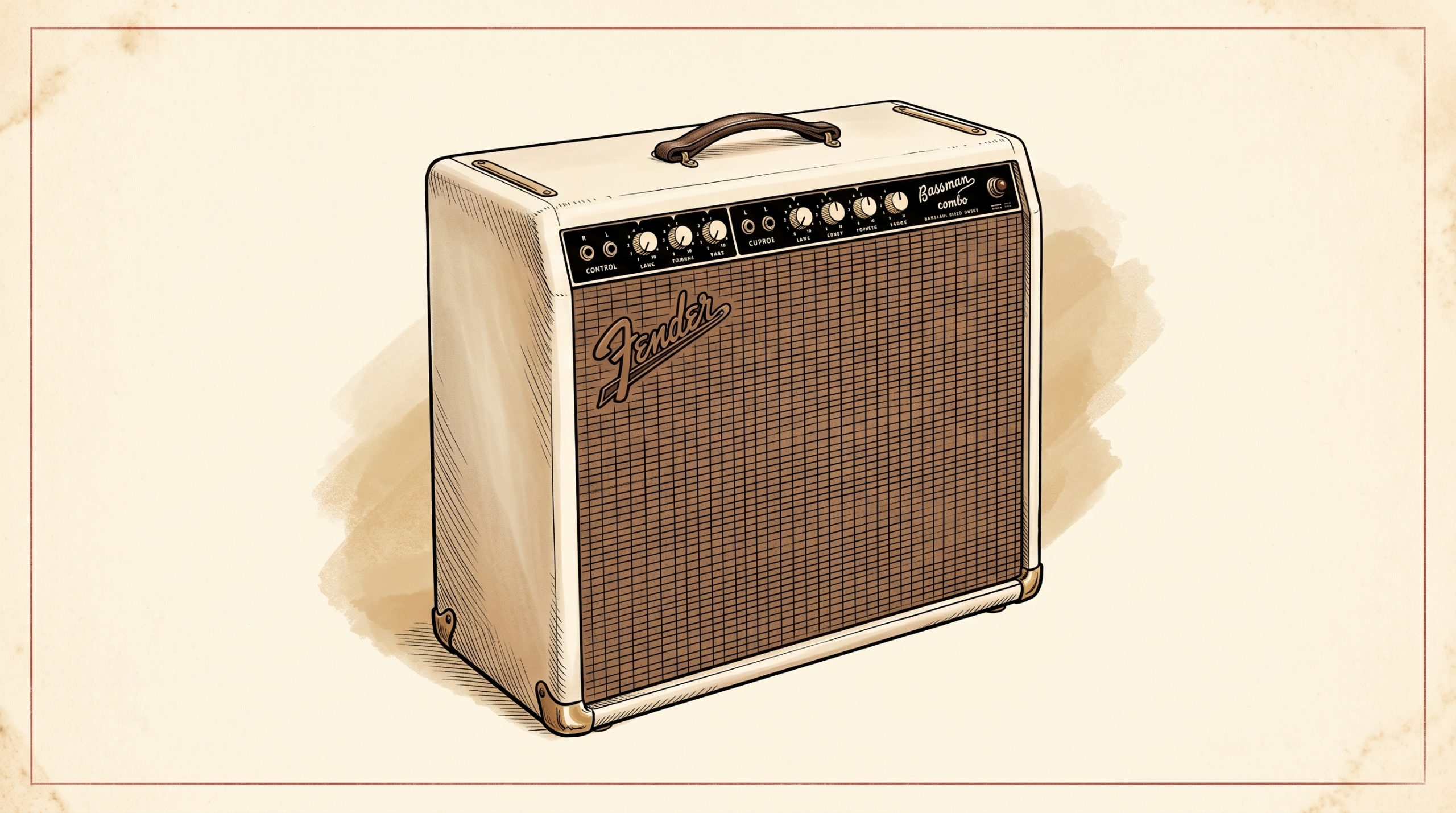
What Makes an Amp a “Blonde” Fender Amp?
The Visual Identifiers
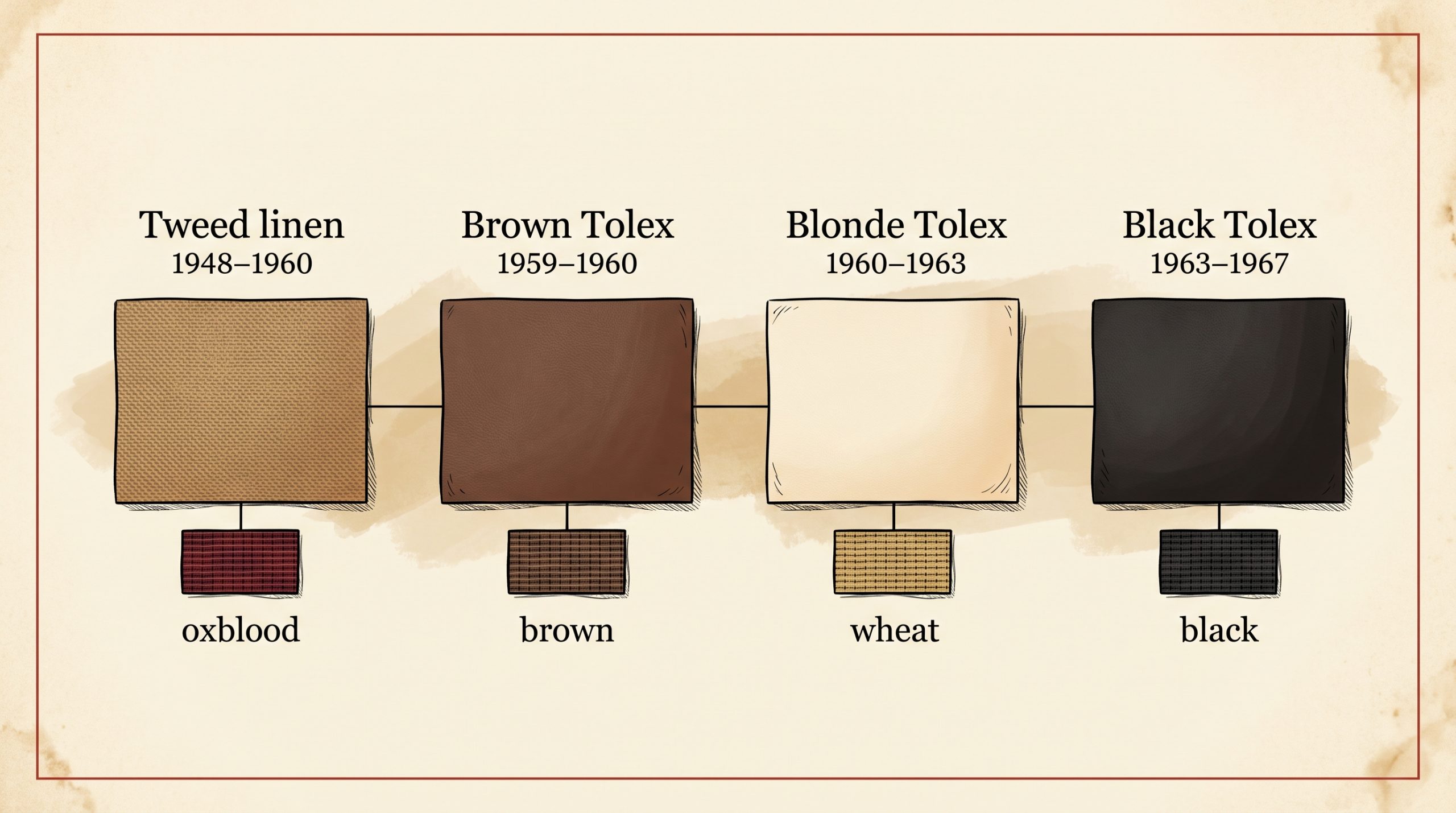
The blonde Tolex covering is the first thing you’ll notice. It’s a cream or off-white vinyl, distinctly warmer than plain white and clearly different from the black Tolex of the subsequent blackface era. Early blonde production used oxblood grille cloth, which quickly gave way to brown and then wheat grille cloth as production settled into its stride around 1961. Chassis stamps and EIA component codes confirm that both oxblood and wheat variants appear within the 1960–1963 window. The control panel is black metal, which it shares with some late brownface models, so the panel alone isn’t sufficient for era identification.
Cabinet proportions are more refined than tweed-era boxes. The blonde-era cabinets are squarer, tighter, and more finished-looking than their tweed predecessors, reflecting Fender’s move upmarket in the early 1960s. The Fender logo changed during this period too: early blonde amps carried a brown Fender flat logo, which shifted to a black flat logo on later production.
The Circuit Identifiers: The Presence Control
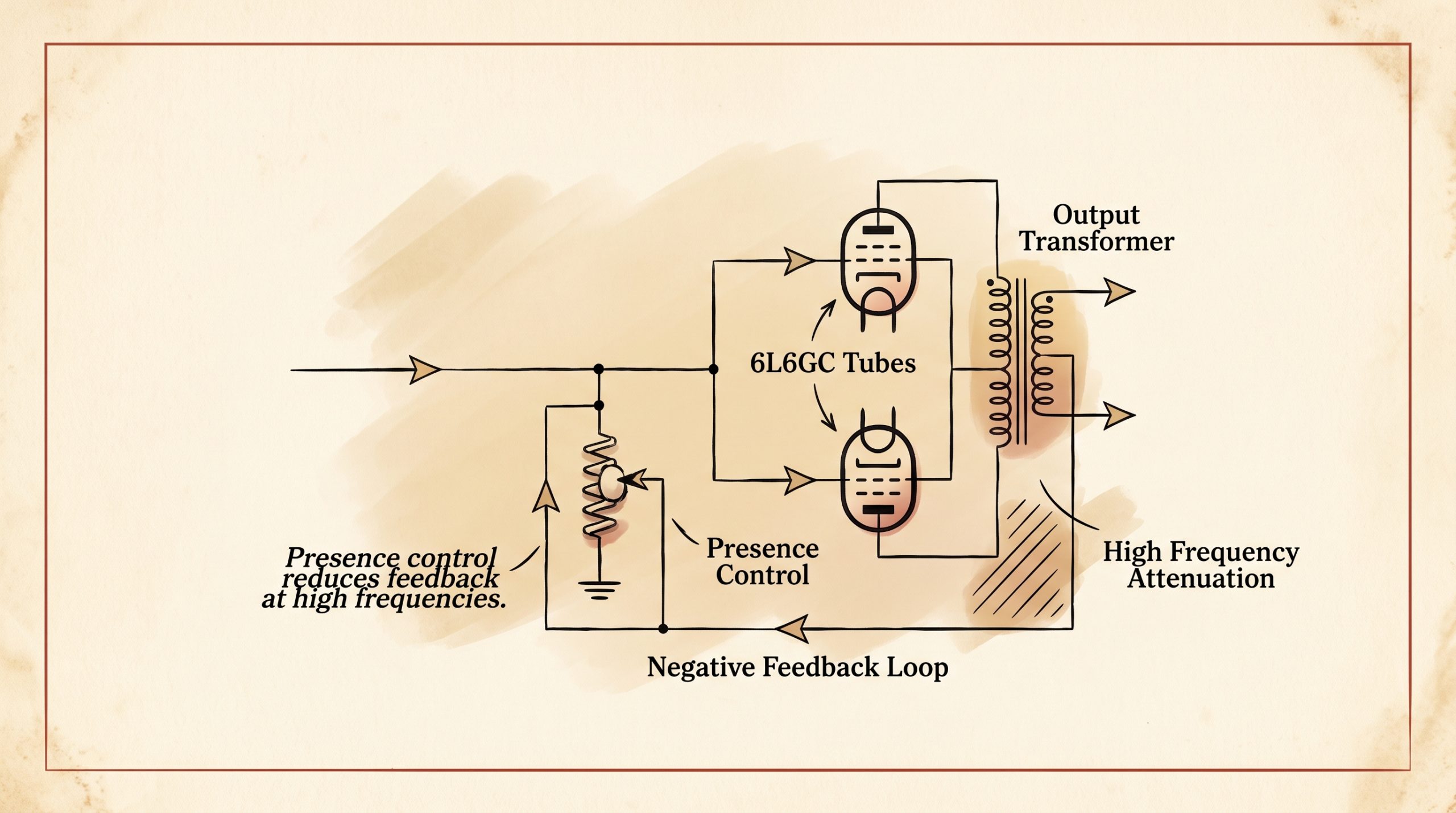
Here’s where blonde amps separate from every other Fender era. All blonde-era amplifiers except the Tremolux include a Presence control on the output stage. This isn’t a simple treble boost. The Presence control manipulates the negative feedback loop of the power amp by reducing feedback at high frequencies, which allows the output stage to produce more harmonic complexity and upper-mid “air” without thinning the overall midrange body. It acts in the power amp, not the preamp, which is why it affects the amp’s core character rather than just its tone stack voicing.
For collectors and authenticators, the Presence pot is a primary verification marker. A blonde-era amp missing its Presence control (other than a Tremolux) warrants close inspection. Circuit swaps were common in the 1970s and 1980s, and a blackface conversion can remove the Presence control entirely while leaving the blonde cosmetics intact. Always check the schematic against what’s actually in the chassis.
Date Range and Production Overlap
The blonde era starts firmly in 1960, when Fender transitioned away from the brownface aesthetic. The end point is less clean: most blonde production wrapped up in 1963, but some examples show transitional features extending into early 1964. Brownface-to-blonde overlaps also occur in early 1960 runs, where some amps show brown Tolex cosmetics with circuit elements that read as early 6G-series. Don’t rely on cosmetics alone for edge-case dating.
The reliable resolution method is EIA date codes on transformers and speakers. Those component codes establish hard date boundaries regardless of what the Tolex or grille cloth suggests. The Fender tube amp dating reference covers EIA decoding in full, including manufacturer codes and the week-year format used across this period.
The Blonde Era in Context: Where It Sits in Fender History
Fender’s amp production from 1948 through the 1980s breaks into five broadly recognized eras. The blonde period is the shortest and, arguably, the least understood.
| Era | Approx. Years | Cover | Grille Cloth | Control Panel | Presence Control |
|---|---|---|---|---|---|
| Tweed | 1948–1960 | Tweed linen | Woven brown burlap | Blonde metal | No |
| Brownface | 1959–1960 | Brown Tolex | Wheat/tan | Tan/brown | Partial (transitional) |
| Blonde | 1960–1963 | Blonde Tolex | Brown/wheat | Black | Yes (except Tremolux) |
| Blackface | 1963–1967 | Black Tolex | Silver/blue sparkle | Black | No (most models) |
| Silverface | 1967–1981 | Black Tolex | Silver | Silver/aluminum | No |
The brownface-to-blonde transition trips up even experienced collectors. Both eras used similar grille cloth, and the circuit evolution from 5G-series to 6G-series happened gradually rather than on a single date. Some brownface examples from early 1960 are functionally closer to blonde amps than to the tweed-era circuits they nominally followed. Teagle and Sprung’s Fender Amps: The First Fifty Years documents this overlap in production detail and remains the standard reference for resolving transitional examples.
Why Fender Made the Change
By 1960, Fender was positioning its amplifier line for the professional market. The blonde aesthetic projected a premium, finished appearance that the tweed line couldn’t match at studio or stage level. Leo Fender’s production philosophy during this period emphasized reliability and clean power, and the 6G-series circuits reflected that: higher voltage rails, more output, and cleaner headroom than tweed-era amps could deliver. The target customer was the working studio musician and the touring professional, not the garage player.
Blonde Fender Amp Models: Complete Reference
Fender Tremolux (Blonde)
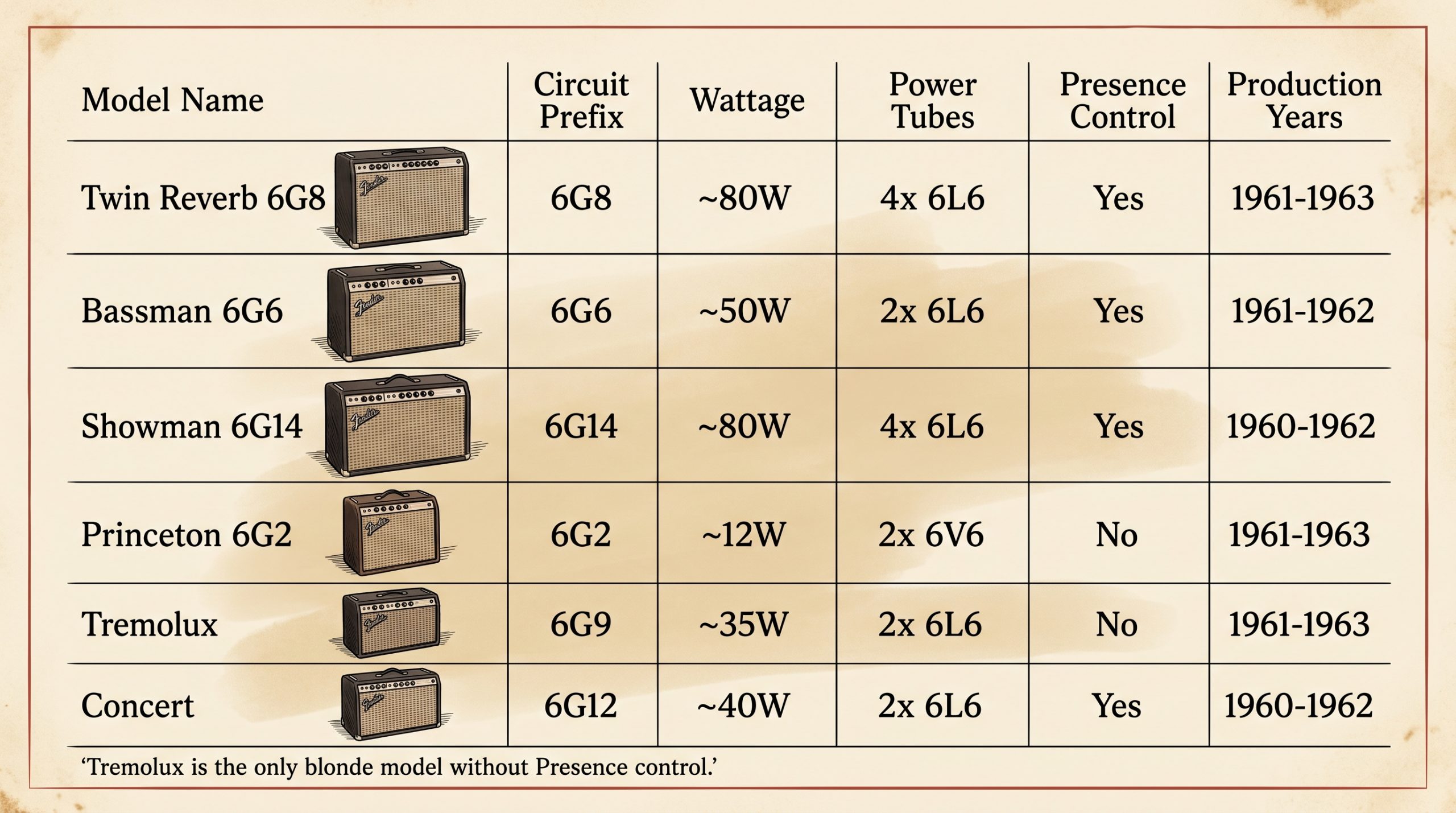
Production years: 1961–1963. Circuit designations: 5G9 (carry-over from late brownface), then 6G9 and 6G9-A. Power output runs approximately 35 watts through a pair of 6L6 power tubes. Early Tremolux examples used a single Jensen P10R in a combo configuration; later production moved to a 2×10″ setup.
The Tremolux is the one genuine exception to the Presence control rule. It doesn’t have one. That’s not a modification or a missing part; it’s factory spec. The 6G9 and 6G9-A schematics confirm the absence. Era classification still holds: the Tremolux earns its blonde designation from production dates, cosmetics, and circuit series prefix. Just don’t use it as a Presence control reference when buying.
Fender Bassman (Blonde)
Production years: 1960–1963. Circuit designations: 6G6, 6G6-A, and 6G6-B. Power output is approximately 50 watts through four 6L6 tubes. Speaker complement: 4×10″ Jensen P10R. Presence control: yes. The 6G6-B is the most collector-sought variant, with differences in the bias circuit and phase inverter stage that affect dynamic response. The 6G6-B schematic shows a notably different PI stage compared to the blackface AB165 that followed, and that difference is audible. You’ll find the full model history in the Fender Bassman guide, which covers all production variants including the blackface and silverface transitions.
Fender Twin (Blonde)
Production years: 1960–1963. Circuit designations: 6G8 and 6G8-A. Power output: approximately 80 watts through four 6L6 tubes, making it the highest-output amp of the blonde era. Speaker complement: 2×12″ Jensen P12N (standard) with JBL D120F as an optional upgrade. Presence control: yes.
Collector values are high. Player-grade blonde Twins regularly move in the $2,800–$4,200 range; collector-grade all-original examples push $4,500–$7,000 and beyond at auction. The 6G8-A is widely considered one of the best-sounding clean amps Fender ever produced. That’s not hyperbole; it’s the consistent verdict in Greg Gagliano’s research documented in the Wayback Machine archives of the 20th Century Guitar Magazine series.
Fender Showman (Blonde)
Production years: 1960–1963. Circuit designation: 6G14. Power output: 100 watts through four 6L6 tubes. The Showman was Fender’s first amp designed from inception as a head/cabinet system rather than a combo. Its standard cabinet pairing was a 1×15″ loaded with a JBL D130F. Presence control: yes.
The historical context matters here. The Showman was developed at Dick Dale’s request for an amp that could fill large venues without breaking up. The surf music explosion of 1961–1963 happened largely through Showman rigs. That connection is documented, not embellished.
Other Blonde-Era Models: Quick Reference
| Model | Circuit | Wattage | Speaker Config | Presence Control | Years |
|---|---|---|---|---|---|
| Vibrolux | 6G11, 6G11-A | ~15W | 1×10″ | Yes | 1961–1963 |
| Pro Amp | 6G5, 6G5-A | ~26W | 1×15″ | Yes | 1960–1963 |
| Super | 6G4, 6G4-A | ~35W | 2×10″ | Yes | 1960–1963 |
| Bandmaster | 6G7, 6G7-A | 40W | 1×12″ (1961), 2×12″ (1962–1963) | Yes | 1961–1963 |
| Concert | 6G12, 6G12-A | ~40W | 4×10″ | Yes | 1961–1963 |
| Vibroverb | 6G16 | ~35W | 1×15″ or 2×10″ | Yes | 1963 only |
The 1963 Vibroverb deserves a separate note. It’s the only blonde-era amp with onboard reverb, and it ran for less than a year before the blackface transition ended production. That scarcity drives collector premiums into the $8,000–$15,000+ range for verified original examples. The complete production history is documented in the Fender Vibroverb guide. Don’t confuse it with the reissue Vibroverb that appeared in the 1990s; that’s a different circuit entirely.
How to Date a Blonde Fender Amp: Identification Guide
EIA Date Codes on Transformers
Transformer codes are the most reliable dating evidence in the blonde era. The EIA source code format runs as a multi-digit stamp on the transformer bell housing: manufacturer code, followed by a year digit or two-digit year, followed by a two-digit week number. The dominant transformer supplier for blonde-era Fenders was Schumacher Electric, appearing under EIA source code 606.
A stamp reading 606-2-35 decodes as: Schumacher, 1962, 35th week. That date tells you the transformer left the factory no earlier than late August or early September 1962. The amp can’t predate its latest-coded component. For a thorough breakdown of the full EIA decoding system across all eras, the Fender amp transformer date codes guide walks through the manufacturer code database and examples from multiple production periods.
EIA Date Codes on Speakers
Speaker codes follow the same YYWW (year-week) pattern. Common blonde-era speaker manufacturers and their EIA codes:
| Manufacturer | EIA Code | Common Blonde-Era Models |
|---|---|---|
| Jensen | 220 | P10R, P12N, P15N |
| Oxford | 465 | Various 10″ and 12″ |
| CTS | 137 | Various 10″ |
| JBL | 67 | D120F, D130F (optional upgrades) |
A stamp reading 220-231 decodes as Jensen, 1962, 31st week. Critical rule: the speaker date establishes the earliest possible build date for the amp. An amp cannot have left the factory before its latest-dated component was manufactured. The Fender amp speaker date codes guide covers the full EIA speaker database with additional examples from Jensen, Oxford, and CTS production.
Tube Chart and Date Stamps
The tube chart is typically located inside the back panel or on the chassis. Look for a hand-stamped or inked two-character date code. Fender’s system for this era uses a letter for the year and a digit for the month. The year letters for blonde production: J = 1960, K = 1961, L = 1962, M = 1963. A stamp reading “L 6” indicates the amp was checked out or completed in June 1962.
Serial numbers are not reliable primary dating tools for this production period. They’re useful context but shouldn’t override component code evidence. Always cross-reference the tube chart date against transformer and speaker codes before drawing conclusions.
For quick-reference tables spanning every Fender production era side by side, see the Fender Amp Dating Cheatsheet.
Circuit Board and Wiring Cues
All blonde-era amps are point-to-point hand-wired. No PCB. The eyelet boards use brown or tan fiberboard, distinct from the white or green boards that appeared in later production. Ground wiring patterns in 6G-series circuits follow specific layouts that differ from blackface wiring, and an experienced technician can identify them at a glance.
Period-correct solder joints show specific flow characteristics. Re-soldered joints from later service work are generally obvious if you know what to look for. Fresh bright solder on a blonde-era board is a flag, not a positive sign.
How Blonde Fender Amps Sound: Tone Characteristics
Where Blonde Sits in the Tonal Spectrum
The “halfway between tweed and blackface” description gets cited constantly, and it’s accurate as far as it goes. Blonde amps have more clean headroom than tweed-era circuits. The voltage rails run higher (420–460V versus the lower rails in tweed amps), the output transformers are better matched to the speaker loads, and the fixed-bias output stage is more controlled than cathode-biased tweed designs. You won’t get the spongy compression and early breakup of a 5E3 at moderate volumes.
But blonde amps aren’t as clean and controlled as blackface. The Presence control adds harmonic complexity and upper-mid richness that the tighter negative feedback of blackface circuits deliberately eliminates. Warm clean tones with an edge. That’s the sweet spot.
Power Amp Characteristics
All major blonde models run Class AB push-pull topology. The major models (Twin, Bassman, Showman, Concert) use fixed bias, which is adjustable, providing better plate dissipation control and consistency than cathode bias. The Triad output transformers used in this period are consistently cited by restorers as among the best Fender ever sourced. They have tight frequency extension at both ends with a slight warmth in the lower midrange that complements the 6L6GC’s character.
Solid. That’s the word for how a properly maintained blonde-era Twin or Bassman feels under the hands.
Preamp Circuit Character
The 12AX7 preamp is consistent across the blonde era. The tone stack uses the mid-scooping Fender configuration that carries through to blackface and silverface, but it’s voiced differently. The mid-scoop is less severe, which gives blonde amps a fuller, more present midrange response than blackface equivalents. Players who find blackface amps too scooped for single-coil work often discover that a blonde circuit solves the problem without adding gain.
Reverb isn’t a factor here. Most blonde amps don’t have it. Fender reverb was available only through the separate outboard Fender Reverb Unit until 1963, when the Vibroverb became the first production amp to integrate it. The tremolo circuits vary by model: some used optical tremolo, others used bias-modulation tremolo, and the specific implementation affects depth and character noticeably.
Blonde vs. Blackface: Key Differences Explained
The shift from blonde to blackface wasn’t just a cosmetic update. The circuit changes were deliberate and consequential.
| Feature | Blonde (1960–1963) | Blackface (1963–1967) |
|---|---|---|
| Tolex | Blonde (cream/off-white) | Black |
| Grille | Brown/wheat | Silver/blue sparkle |
| Presence Control | Yes (except Tremolux) | No (most models) |
| Negative Feedback | Less (more output stage saturation) | More (cleaner, tighter response) |
| Tone Stack Voicing | Warmer midrange, less scoop | More pronounced mid-scoop |
| Circuit Prefix | 6G | AA, AB |
| Reverb (standard) | No (Vibroverb excepted) | Yes (most models) |
| Typical Street Value (comparable models) | Higher | Lower |
Removing the Presence control in the blackface era wasn’t cosmetic. It fundamentally changed the power amp’s negative feedback behavior. More feedback means a tighter, cleaner response. Less feedback (as in the blonde circuit) means more output stage bloom and harmonic saturation when pushed. Players who use blackface amps as pedal platforms often prefer the tighter circuit for that purpose. Players who want the amp itself to bark when pushed tend to favor the blonde circuit. Different tools for different goals.
Collector Value and Market Overview
Current Market Value Ranges
Prices below reflect market activity in 2023–2024. Verify current market conditions before purchase, as vintage amp values shift with demand.
| Model | Condition | Typical Price Range (USD) |
|---|---|---|
| Blonde Twin (6G8/6G8-A) | Player grade | $2,800–$4,200 |
| Blonde Twin (6G8/6G8-A) | Collector grade | $4,500–$7,000+ |
| Blonde Bassman (6G6-B) | Player grade | $2,200–$3,500 |
| Blonde Showman head | Player grade | $2,000–$3,200 |
| Blonde Tremolux | Player grade | $1,800–$2,800 |
| 1963 Vibroverb (6G16) | Collector grade | $8,000–$15,000+ |
The all-original premium is real and substantial. Fully original blonde amps with date-matched speakers, unmodified transformers, and unmolested Tolex consistently command 30–60% more than player-grade or restored examples. The speaker match matters enormously: a Twin with original P12N Jensens coded to the same production week as the transformer is worth considerably more than the same chassis with replacement speakers.
What to Watch Out For When Buying
Re-covered amps are the most common misrepresentation. Check the staple pattern under the chassis and around the cabinet edges. Original Tolex installations show specific staple spacing and corner finishing that reproduction work rarely replicates exactly. Replaced transformers are another red flag; always decode the EIA stamps and verify they’re consistent with the amp’s stated date. Blackface circuit conversions are documented practice from the 1970s and 1980s, when players didn’t understand what they had and technicians “updated” blonde amps to blackface specs. A blonde cabinet with blackface circuit codes is worth investigating carefully before paying a blonde-era premium. Reproduction knobs are cosmetically convincing and widely sold; on a player-grade amp they’re a minor issue, but on a supposedly collector-grade amp they matter for value.
The Presence Control Deep Dive: Why It Disappeared
In the 6G-series circuits, the Presence control is a variable-resistance element in the negative feedback path between the output transformer secondary and the power amp input. By reducing feedback at high frequencies, it allows the output stage to add upper-harmonic content and midrange “bloom” that full negative feedback would suppress. The control is in the power amp, not the preamp. That distinction is important: you can’t replicate its function with a treble knob or a preamp EQ.
When Fender moved to blackface circuits in 1963–1964, the Presence control came out. The evidence points to simplified serviceability and cost reduction as the primary drivers, not a deliberate tonal decision. The result was a tighter, more linear amp, which suits the blackface era’s cleaner aesthetic. Players who want that upper-mid richness from a blackface amp frequently add outboard EQ or use the amp’s natural breakup threshold to approximate what the Presence control provided in the 6G-series. It’s not quite the same thing. Not even close, if you’re honest about it.
Blonde Fender Amps in the Recording Studio (1960–1963)
The blonde era aligned with a particularly active period of West Coast studio recording. Capitol and Columbia’s Los Angeles facilities were running sessions constantly in 1961–1963, and the blonde Twin was a standard professional setup in that environment. Its clean headroom meant engineers could place a microphone in front of it without fighting premature breakup, while the Presence control gave the amp enough upper-mid presence to cut through in a mix without requiring significant post-processing.
The Showman’s role in surf music is well documented. Dick Dale’s relationship with Fender during this period shaped the Showman’s development, and the 1×15″ JBL pairing produced a level of clean volume that simply wasn’t available from any other production amp at the time. The studio applications and the stage applications converged around the same qualities: clean power, controlled headroom, and enough output transformer quality to maintain tone at stage-loud volumes.
Modern Builders and Reissues: How Close Do They Get?
Several boutique builders produce 6G-series inspired circuits, and Mojotone offers a blonde-era-inspired kit chassis that’s become a reference point for DIY builders. A circuit-accurate reproduction has to include the Presence control, correct output transformer specs (impedance and core material), eyelet board construction on appropriate fiberboard, and a matched 6L6GC complement running at period-correct voltage rails. Getting the transformer right is where most budget reproductions fall short. The Triad units in original blonde-era Fenders weren’t cheap, and appropriate replacements aren’t cheap either.
One clarification worth making directly: the Fender Mini ’65 Twin Blonde is a miniature headphone amplifier. It’s a novelty product with blonde Tolex cosmetics, not a circuit-accurate reissue of a 6G8-series amp. Readers who land here searching for information about that product are looking at a different category entirely. MusicRadar notes that Fender’s current Tone Master Blonde series includes upgrades like Celestion NEO Creamback speakers and revised cabinet designs, but these are modern digital modeling amps using the blonde aesthetic as a cosmetic reference, not 6G-series circuit reproductions. For players who need the actual 6G-series circuit character, original examples remain the only real option short of a custom boutique build.
Which Blonde Amp Should You Look For?
If your budget runs to a blonde-era amp, the entry point is typically a Tremolux or Vibrolux, both of which offer genuine 6G-series character at lower prices than the Twin or Bassman. The Tremolux’s lack of a Presence control is worth understanding before purchase, but it doesn’t make it a lesser amp. For the full blonde-era experience with Presence control intact, the Concert (6G12) offers 4×10″ configuration and approximately 40 watts without the Trophy premium of the Twin. Whatever model you’re evaluating, verify the transformer EIA codes against the tube chart date before committing to a price. A one-hour dating exercise using the methods in this guide can save you from paying collector-grade money for a player-grade amp. The tweed-era context that preceded the blonde period is covered in the tweed Fender amps era guide, which documents how the cosmetic and circuit evolution from 1948 through 1960 set the stage for everything the blonde era achieved.
Sources
- Teagle, John and John Sprung. Fender Amps: The First Fifty Years. Hal Leonard, 1995.
- Greg Gagliano, Devin Riebe, and Greg Huntington. 20th Century Guitar Magazine amp research series, 1997–2000 (archived at Wayback Machine).
- Fender service bulletins and schematics for 6G-series circuits (6G6-B Bassman, 6G8-A Twin, 6G14 Showman, 6G16 Vibroverb), available at Schematic Heaven Fender Amps archive.
- EIA manufacturer code database cross-referenced at Antique Radio EIA Source Data.
Frequently asked questions
What years were blonde Fender amps made?
Blonde Fender amps were produced from approximately 1960 to 1963, sitting between the brownface and blackface production eras. The start date is relatively firm with the 1960 cosmetic and circuit transition, but the end overlaps into early 1964 for some models due to transitional production runs. EIA component codes are the reliable method for pinning down exact build windows on specific examples.
What is the difference between blonde and blackface Fender amps?
The differences are both cosmetic and circuit-based. Blonde amps use cream/off-white Tolex and brown or wheat grille cloth; blackface amps use black Tolex and silver/blue sparkle grille cloth. On the circuit side, blonde amps include a Presence control on the output stage that manipulates the negative feedback loop for additional upper-mid harmonic complexity. Most blackface models removed this control, resulting in a tighter, cleaner power amp response. The circuit prefix also changes: blonde amps use 6G-series designations, while blackface amps use AA or AB prefixes.
Why don't blonde Fender amps have reverb?
Fender didn't integrate reverb into production amplifiers until 1963. During the blonde era, reverb was only available through the separate outboard Fender Reverb Unit, an external spring tank designed to connect to the amp's effects loop or auxiliary input. The 1963 Vibroverb (6G16) is the sole exception: it's the only blonde-era amp with factory onboard reverb, and its one-year production run makes it the rarest and most valuable model from the period.
Which blonde Fender amp is the most valuable?
The 1963 Fender Vibroverb is consistently the most valuable blonde-era amp in the collector market. Its production window ran for less than a year before the blackface transition, and verified all-original examples regularly sell above $10,000–$15,000. Collector-grade blonde Twins follow, with strong examples moving at $4,500–$7,000+. The 6G6-B Bassman is the most sought-after Bassman variant due to its phase inverter circuit differences. Originality of components drives premium pricing across all models.
Is the Tremolux really a blonde amp if it doesn't have a Presence control?
Yes. The Tremolux is classified as a blonde-era amp based on its production dates (1961–1963), its cosmetics (blonde Tolex, brown grille cloth, black control panel), and its 6G-series circuit designation (6G9 and 6G9-A). The absence of the Presence control is a notable factory-spec exception to the era's defining circuit characteristic, not a disqualifier from era classification. It's the one model where the Presence control rule doesn't apply, and it's worth flagging explicitly when buying: a missing Presence pot on any other blonde model is a red flag; on a Tremolux, it's correct.