Contents
- 01What Defines the Brownface Era? Cosmetics, Circuits, and Context
- 02Complete Model-by-Model Guide to Brownface Fender Amps
- 03The Brownface Sound, Tonal Character and Why Players Seek Them Out
- 04How to Date and Identify Brownface Fender Amps
- 05Brownface Fender Amps, Collectibility, Rarity, and Current Market Value
- 06Brownface vs. Blackface vs. Tweed, Era Comparison for Buyers
- 07Frequently Asked Questions About Brownface Fender Amps
- 08Where to Start With a Brownface Purchase or Restoration
Three years. That’s how long Fender’s brown panel era lasted before the company pivoted to the black-panel cosmetics that would define amplifier aesthetics for generations. From 1960 through 1963, the 6G-series circuits sat between the saturated warmth of the tweed era and the cleaner, scooped character of the blackface amps. That narrow window produced eight distinct models, a unique tremolo topology, and the first Fender amplifier ever to ship with onboard reverb. If you’re trying to identify, date, buy, or understand brownface Fender amps, this is where to start.
- Production window: 1960–1963 (approximately 3 years)
- Circuit prefix: 6G (e.g., 6G3 = Brownface Deluxe)
- Cosmetics: Brown Tolex, oxblood grille cloth, cream/wheat control panel
- Tremolo type: Bias modulation on all models, not optoisolator
- Reverb: Vibroverb (6G16) only, first Fender amp with reverb
- Market value: $1,200 (Princeton, player grade) to $25,000+ (Vibroverb, all-original)
- Blonde Tolex ≠ Brownface, blonde Fenders (Bassman, Concert) ran concurrently and are a separate category
- “Fender Brown Derby” is not an official model name, see FAQ below
What Defines the Brownface Era? Cosmetics, Circuits, and Context
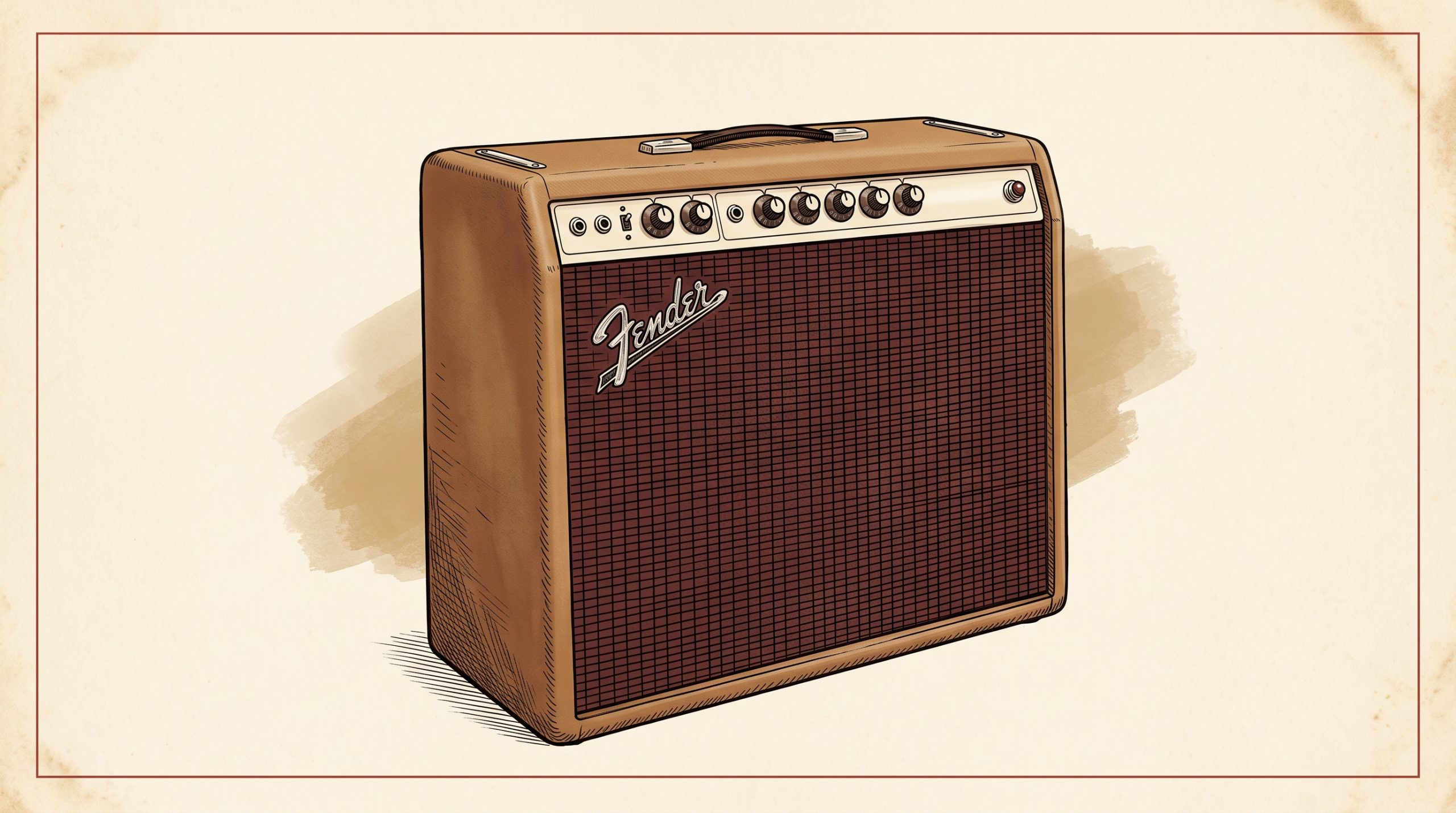
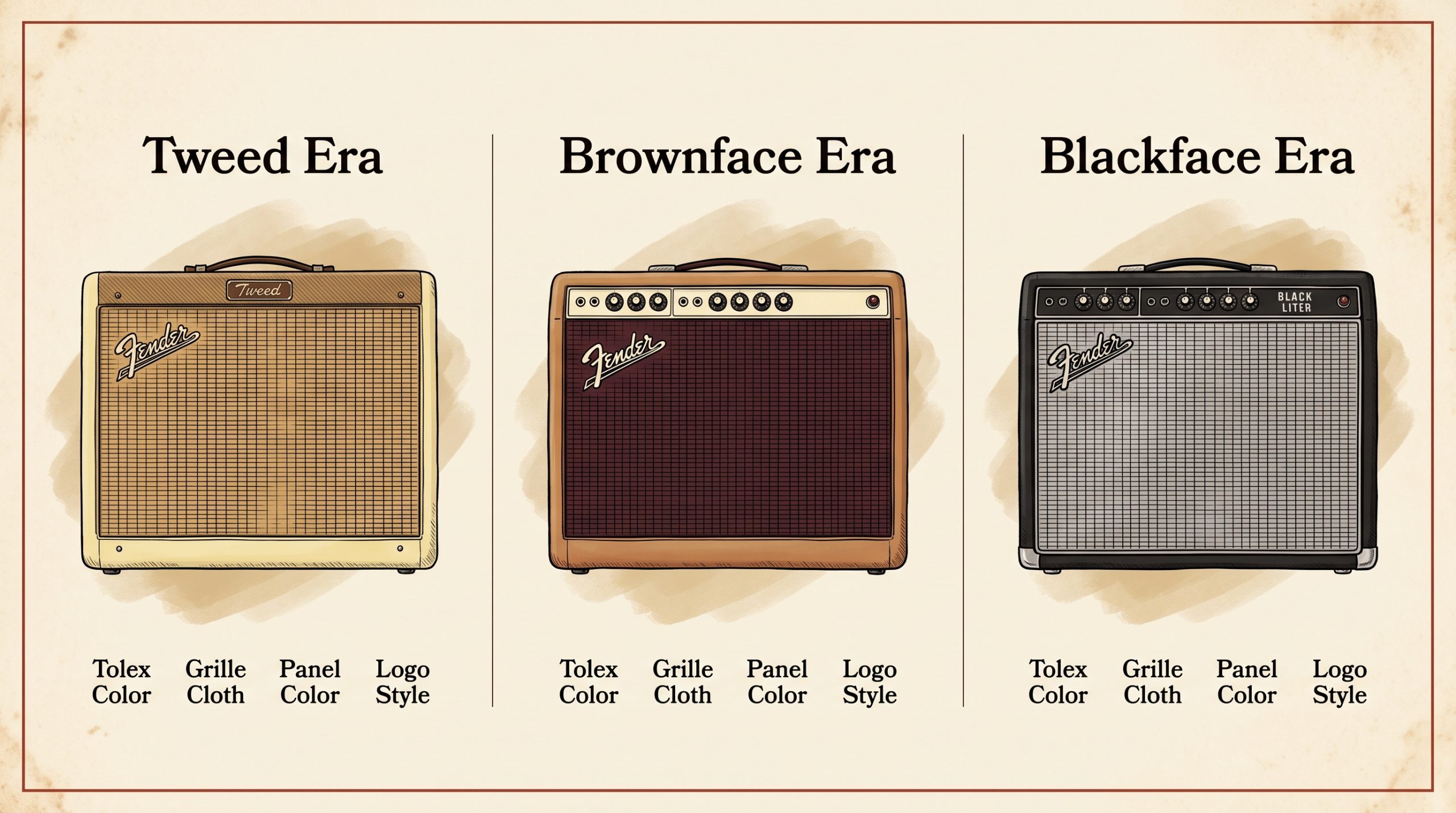
The Visual Markers, How to Spot a Brownface at a Glance
The brown Tolex used on these amps reads as a warm tan-brown in person, clearly distinct from the black vinyl of the later blackface and silverface amps, and from the lighter cream-yellow of the concurrent blonde-cabinet models. The grille cloth is oxblood, sometimes called wheat-oxblood, a dark reddish-brown weave that reads almost burgundy under stage lighting. Don’t confuse it with the lighter wheat cloth used on blonde-cabinet amps or the silver grille that appeared on blackface models.
Control panels are cream or off-white, face-up and top-mounted on most models. Knobs are the chicken-head style, typically brown or black depending on sub-era. The grille logo is script-style “Fender” in chrome or gold lettering, another detail that helps distinguish these from the later block-letter logo that appeared during the blackface transition.
A note on transitional units: some 1960 examples retained certain tweed-era construction details while adopting brownface cosmetics. If you’re dating a unit that appears to be early in the run, cross-reference the EIA source codes on speakers and transformers rather than relying on cosmetics alone.
The Chronological Position, Between Tweed and Blackface
Tweed production wound down around 1960. Blackface cosmetics arrived in late 1963, with most models fully transitioned by 1964. That puts the brownface era at roughly three years of production, a short window that explains the relative scarcity of surviving original examples compared to blackface amps, which ran through 1967.
The concurrent blonde era causes consistent buyer confusion. Blonde Tolex was used on large-cabinet models (Bassman, Concert, Tremolux, Vibrasonic) during the same years. Blonde and brownface are not the same thing. They share the 6G circuit prefix but have different cabinet dimensions, speaker configurations, and cosmetics. The distinction matters for identification and for pricing.
As documented at Premier Guitar, brownface amps are characterized by a woodiness and warm pokiness that sets them apart from both earlier and later Fender production, with a distinctive gritty overdrive character when pushed.
Complete Model-by-Model Guide to Brownface Fender Amps
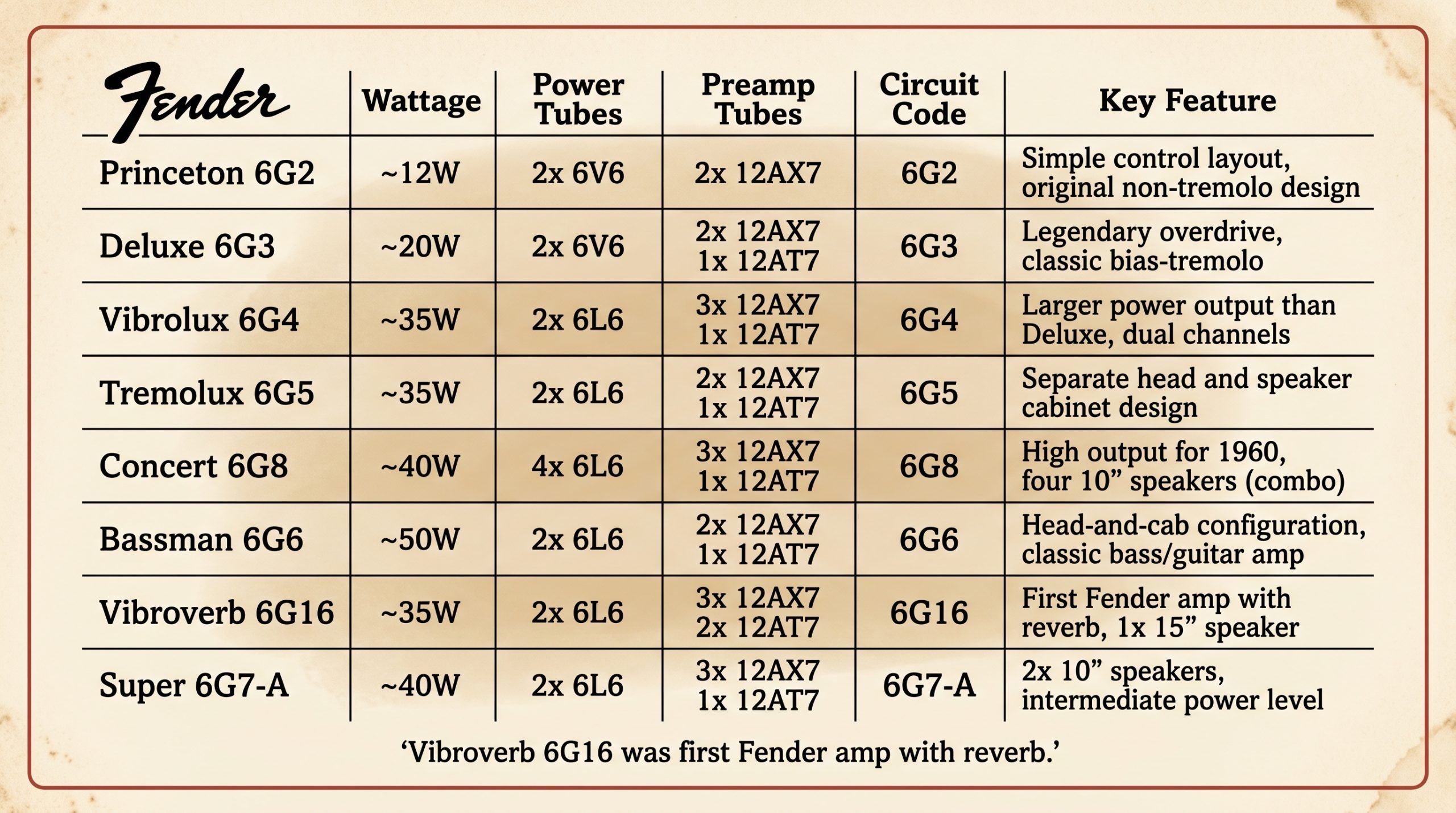
All brownface circuits carry the 6G prefix designation. That prefix is the fastest way to confirm you’re looking at a brownface amp, blackface circuits use AA or AB prefixes (AA864, AB763), and tweed circuits use earlier numerical designations. Find the circuit code on the tube chart, a paper label inside the back panel or speaker cabinet.
Fender Brownface Princeton (6G2)
The smallest amp in the brownface lineup. The 6G2 runs two 6V6-GT power tubes through a 5Y3 rectifier for around 12–14 watts, with a 12AX7 and 12AY7 in the preamp. Most shipped with a 1×10″ Oxford or Jensen speaker. Controls cover Volume, Treble, Bass, Speed, and Intensity, the Speed and Intensity pair handles the bias modulation tremolo. No reverb. Relatively common for the era, which means it’s the most accessible brownface entry point for players who don’t need to spend Vibroverb money.
Fender Brownface Deluxe (6G3)
The most commonly encountered brownface model, and the one most players encounter first. The 6G3 puts two 6V6-GT tubes through a 5Y3GT rectifier, producing approximately 15–20 watts into a 1×12″ Oxford or Jensen P12Q or P12R. Two channels: Normal and Vibrato (which carries the bias modulation tremolo). No reverb.
Warm, slightly compressed clean tones at lower volumes. Smooth tremolo when bias is properly set. The 6G3 is described across restoration literature as sitting at the tonal midpoint the brownface era is known for: darker than a blackface Deluxe Reverb, more articulate and open than a 5E3 tweed. The Mojotone Brownface Deluxe kit ($875) and the TAD 6G3 Style kit (from €799) both target builders who want this circuit new.
Fender Brownface Super (6G4 / 6G4-A)
The 6G4 steps up to two 6L6-GC power tubes and approximately 40 watts, with two 10″ Jensen or Oxford Alnico speakers in the cabinet. The circuit was revised to the 6G4-A during production; the A revision addresses minor component changes rather than a fundamental redesign. Two channels, no reverb, bias modulation tremolo. More headroom than the Deluxe at similar volumes, which makes it the better choice for players who need cleaner tones at rehearsal-loud levels. The 6L6 output stage also shifts the tonal character slightly: tighter bass response, a bit more spread in the high-mids.
Fender Brownface Pro (6G5 / 6G5-A)
The 6G5 runs two 6L6-GC tubes into a 1×15″ Jensen, at approximately 25–30 watts. Two channels. No reverb. The 15-inch speaker configuration gives the Pro a rounder, fuller low-end than the 2×10″ Super, at the cost of some high-frequency detail. Less common than either the Deluxe or Super, which pushes prices slightly above equivalent-condition Supers despite the similar circuit architecture.
Fender Brownface Vibrolux (6G11)
A bridge model between the Princeton and the Super, the 6G11 puts out approximately 30 watts from two 6L6-GC power tubes. Most examples shipped with a single 12-inch Oxford Alnico 12LN speaker. Bias modulation tremolo. No reverb. Less common than the Deluxe, which makes clean original examples harder to find and prices them accordingly.
Fender Brownface Vibrasonic (6G13)
The Vibrasonic was Fender’s top-of-the-line clean platform in the brownface era. Two 6L6-GC tubes, approximately 40 watts, into a single 15″ JBL D130F. The JBL spec is a significant detail: the D130F has extended high-frequency response and higher sensitivity than the Jensen or Oxford alternatives, which makes the Vibrasonic distinctly brighter and louder than its wattage suggests. Large cabinet. Relatively rare in the collector market. Stage-loud with serious headroom before breakup.
Fender Brownface Concert (6G12)
The Concert runs two 6L6-GC tubes (later 6G12-A production switched to 5881) producing around 40 watts into a 4×10″ Jensen configuration. Two channels. No reverb. The 4×10″ layout and higher wattage draw comparisons to the tweed Bassman, though the 6G12 circuit differs considerably. High headroom, stiff bass response, and enough volume to cut through most stage situations without breaking a sweat.
Fender Brownface Vibroverb (6G16)
The rarest and most valuable amp in the brownface lineup. The 6G16 was produced for approximately one year in 1963, making it the shortest production run of the era. More importantly, it was the first Fender amplifier to ship with onboard spring reverb. That historical position alone drives collector interest.
The circuit runs two 6L6-GC tubes for around 40 watts, with tremolo on both channels and reverb available on channel 2 only. Speaker configuration was 2×10″ Oxford or Jensen. Surviving examples in all-original condition are extremely limited. The Vibroverb is frequently cited when the conversation turns to “holy grail” Fender amps, that reputation is grounded in the combination of rarity, reverb-first status, bias modulation tremolo, and 6L6 power. The Mojotone Brownface Vibroverb kit ($1,245) exists for builders who want the circuit without the five-figure price tag. For more on this model’s production history and variants, the Fender Vibroverb complete guide covers the 6G16 and the later blackface AA763 Vibroverb in detail.
Brownface Fender Amp Models at a Glance
| Model | Circuit | Years | Watts | Power Tubes | Speaker Config | Reverb | Tremolo Type |
|---|---|---|---|---|---|---|---|
| Princeton | 6G2 | 1960–1963 | ~12W | 2x 6V6-GT | 1×10″ | No | Bias Mod |
| Deluxe | 6G3 | 1960–1963 | ~15–20W | 2x 6V6-GT | 1×12″ | No | Bias Mod |
| Super | 6G4/6G4-A | 1960–1963 | ~40W | 2x 6L6-GC | 2×10″ | No | Bias Mod |
| Pro | 6G5/6G5-A | 1960–1963 | ~25–30W | 2x 6L6-GC | 1×15″ | No | Bias Mod |
| Vibrolux | 6G11 | 1961–1963 | ~30W | 2x 6L6-GC | 1×12″ | No | Bias Mod |
| Concert | 6G12 | 1960–1963 | ~40W | 2x 6L6-GC | 4×10″ | No | Bias Mod |
| Vibrasonic | 6G13 | 1960–1963 | ~40W | 2x 6L6-GC | 1×15″ JBL | No | Bias Mod |
| Vibroverb | 6G16 | 1963 | ~40W | 2x 6L6-GC | 2×10″ | Yes (ch. 2) | Bias Mod |
The Brownface Sound, Tonal Character and Why Players Seek Them Out
Between Tweed and Blackface, How Brownface Amps Actually Sound
The framing that keeps appearing in brownface discussions, including from builders who have worked with multiple examples, is “tweed-blackface hybrid.” That’s accurate as far as it goes. Brownface amps sit darker and warmer than blackface equivalents, with more sparkle and open articulation than tweed circuits at similar wattages.
The tonal difference comes partly from circuit topology. The brownface circuits feature higher B+ voltages than equivalent tweed circuits, partly because several brownface designs use solid-state rectifiers rather than tube rectifiers, which results in stiffer, higher supply voltage and less sag on transients. More headroom at similar wattages. The negative feedback loop in brownface circuits cuts highs from the power amp section in a way that shapes the output character distinctly from the blackface versions that followed.
Mids are more forward than on blackface amps. The scooped mid character associated with the blackface era isn’t there yet. Breakup, when it comes, is smooth and compressed rather than the snappier attack of a blackface Deluxe Reverb. The sweet spot for surf, early rock and roll, fingerpicking, and studio tracking sits comfortably in this era. Barks when pushed, but it’s a woody bark, not an ice-pick treble situation.
Bias Modulation Tremolo, The Defining Brownface Effect
Every brownface model with tremolo uses bias modulation. The mechanism works by varying the bias voltage applied to the power tubes, causing the entire output stage to pulse in volume. The waveform is closer to a sine wave: a soft, organic swell and release that sounds fundamentally different from the optoisolator (LDR) tremolo used in later blackface designs.
Optoisolator tremolo is more abrupt. More on-off. The bias modulation pulse breathes. That character is exactly what players seeking the brownface sound are after.
The tradeoff: bias modulation tremolo is sensitive to power tube bias spec. When the bias drifts out of tolerance, the tremolo weakens, becomes erratic, or disappears entirely. Fender’s own production records reflect this as an ongoing service issue. Brownface restoration specialists note that the single most impactful modification on these amps is the addition of an adjustable bias pot, which allows proper bias maintenance after tube replacement without requiring fixed-resistor changes.
One historical footnote that surprises most players: the blackface Princeton Reverb retained bias modulation tremolo. It’s the only blackface model to do so. Every other blackface model with tremolo switched to the optoisolator design.
How to Date and Identify Brownface Fender Amps
EIA Source Codes on Transformers and Speakers
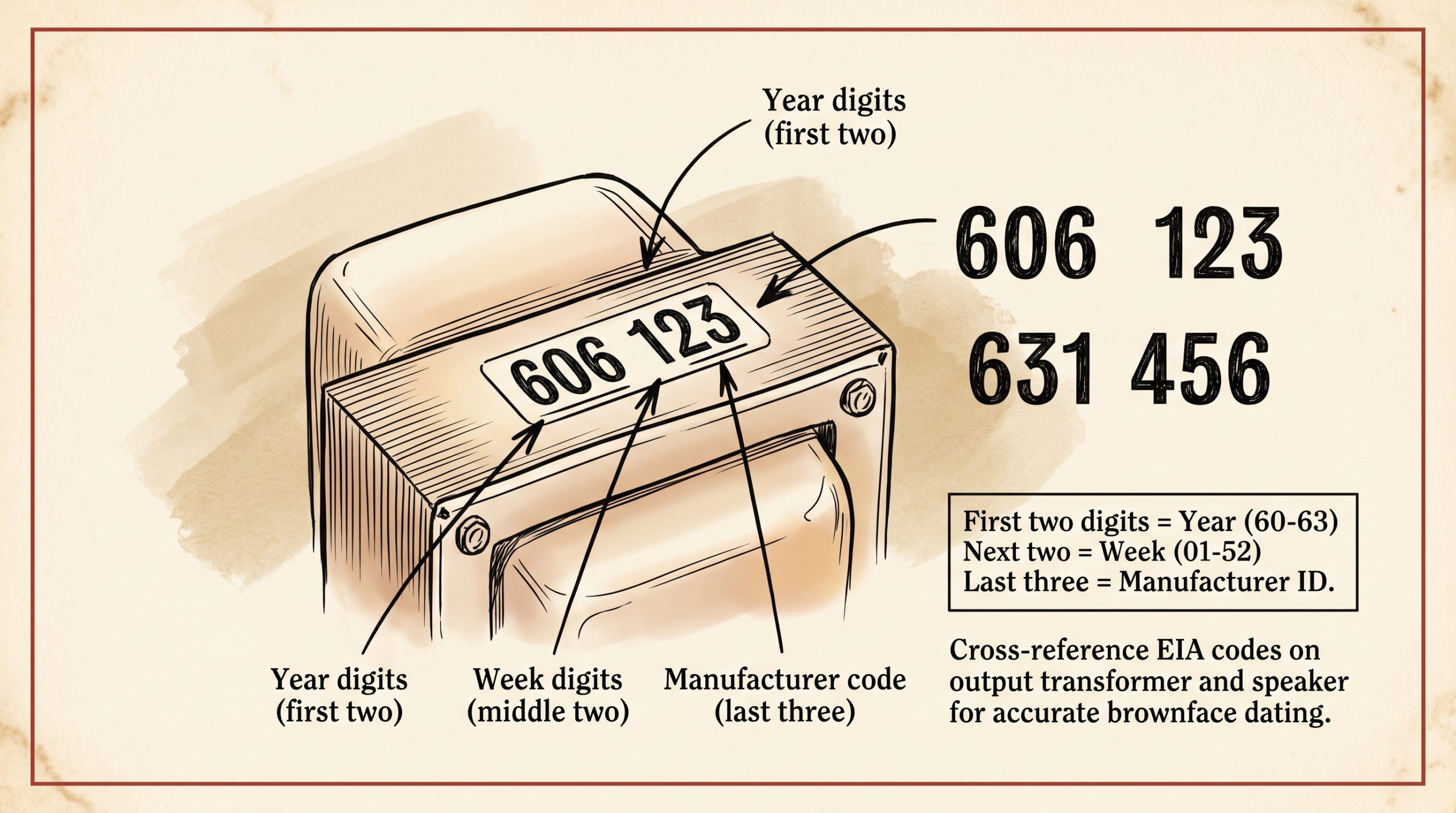
The EIA (Electronic Industries Association) source-date code system is your primary tool for dating brownface Fender amps, and it’s the method that competitors almost never cover in detail. The format is a multi-digit string stamped on the component: the first section identifies the manufacturer, the middle digits encode the year, and the final digits encode the week of production.
For example, a stamp reading 220-2-24 decodes as Jensen (manufacturer code 220), 1962, week 24.
Key manufacturer codes for the brownface era:
- 220, Jensen (Chicago), the most common speaker supplier for brownface amps
- 465, Oxford (Lafayette, Indiana), frequent alternative speaker supplier
- 137, CTS (Chicago Telephone Supply), potentiometer and speaker manufacturer
- 285, Rola, speaker manufacturer
- 606, Schumacher, the primary transformer manufacturer for Fender amps of this era
Production years to expect in the date codes: 1960 = year digit “0”; 1961 = “1”; 1962 = “2”; 1963 = “3”. On transformers, look for the stamp on the bell end of the transformer casing. On speakers, the code is stamped on the speaker frame, usually on the bottom or back of the magnet structure.
Critical caveat. EIA codes reflect the manufacture date of the component, not the final amp assembly date. Speakers and transformers could sit in Fender’s inventory for weeks or months before installation. A speaker stamped week 12 of 1962 doesn’t mean the amp shipped in week 12. Cross-reference transformer codes, speaker codes, and pot codes independently to build a reliable date range. The Fender amp transformer date code decoder on this site covers the full EIA 606 system with manufacturer code tables. For the complete approach to dating any Fender tube amp, the Fender tube amp serial number and dating guide covers all five methods in sequence.
Circuit Board and Chassis Identification Cues
The tube chart is the fastest confirmation tool on the amp itself. It’s a paper label affixed inside the back panel or inside the speaker cabinet, and it carries the circuit designation. Brownface circuits are labeled with the 6G prefix (6G2, 6G3, 6G4, etc.). If you see AA or AB followed by numerals, you’re looking at a blackface or early silverface circuit. Numerical-only designations (5E, 5F) indicate tweed-era production.
Potentiometers provide secondary dating confirmation. CTS and Stackpole pots carry date codes in the same EIA format as speakers and transformers. Check the codes on the volume, treble, and bass pots. Replacement components can skew dating significantly; a pot replaced during a 1975 repair will show a 1974 or 1975 date code in a 1962 amp. Always cross-reference at least two independent code sources before committing to a production date.
A technical note from documented brownface circuit research: these amps use higher supply voltages than their tweed predecessors, a consequence of the shift to solid-state rectifiers in several models. If you’re measuring supply voltage during a restoration and seeing higher B+ than expected for a 6V6 or 6L6 circuit, that’s consistent with original brownface design, not a fault.
Cosmetic Authentication Checklist
For quick visual authentication at a sale, dealer, or show:
- Brown Tolex exterior (not black, not blonde, not tweed cloth)
- Oxblood grille cloth (dark reddish-brown weave)
- Cream or wheat-colored control panel
- Chicken-head knobs in era-correct brown or black
- Script “Fender” logo on grille (chrome or gold)
- 6G circuit prefix on tube chart inside cabinet
- EIA component codes dating to 1960–1963
Not great if the grille cloth has been replaced with silver or wheat cloth from a blackface parts amp. Not great if the Tolex has been recovered in black. These replacements are common and drop resale value considerably on collector-grade examples.
Brownface Fender Amps, Collectibility, Rarity, and Current Market Value
Why Brownface Amps Became Collector Targets
Vintage amp market discussions from the early 2000s document brownface amps as significantly undervalued relative to tweeds. As tweed Fender prices climbed through the 2000s and blackface prices followed, collector attention shifted toward brownface examples as the next tier. The logic is straightforward: a three-year production window produces far fewer surviving units than a decade-long run. Fewer units in circulation means sustained upward price pressure as collector interest grows.
Estimated rarity ranking within the brownface lineup, from rarest to most common:
- Vibroverb (6G16), 1963 production only, estimated 200–300 units
- Vibrasonic (6G13)
- Concert (6G12)
- Vibrolux (6G11)
- Pro (6G5/6G5-A)
- Super (6G4/6G4-A)
- Deluxe (6G3), most common brownface model
- Princeton (6G2), most common overall
What to Pay, Approximate Price Ranges by Model (2024 Market)
The following ranges reflect approximate U.S. market values based on recent Reverb.com sales and vintage dealer listings as of 2024. Verify current listings before purchase, as brownface prices have trended upward consistently over the past decade.
| Model | Player Grade | Collector Grade (All-Original) |
|---|---|---|
| Brownface Princeton | $1,200–$2,000 | $2,500–$4,000+ |
| Brownface Deluxe | $2,000–$3,500 | $4,000–$6,500+ |
| Brownface Super | $2,500–$4,000 | $5,000–$8,000+ |
| Brownface Pro | $2,000–$3,500 | $4,500–$7,000+ |
| Brownface Vibroverb | $8,000–$14,000 | $15,000–$25,000+ |
| Brownface Concert | $2,500–$4,500 | $5,500–$9,000+ |
Prices reflect approximate U.S. market values as of 2024. Fully original examples with matching date codes across transformers, speakers, and pots typically command 30–50% above player-grade pricing. Provenance documentation adds further premium on Vibroverb and Concert examples.
The “Holy Grail” Question
The Vibroverb gets cited most often when the holy-grail conversation comes up, and the reasoning is defensible: it combines the rarest brownface production run, the first onboard Fender reverb, bias modulation tremolo, and 6L6 power output. It’s a single amp that checks every brownface-era box simultaneously. That said, “holy grail” is a subjective designation. The blackface Deluxe Reverb (AB763) and the tweed Bassman (5F6-A) appear with equal frequency in those discussions, for reasons that are equally well-grounded in circuit and tonal history.
Brownface vs. Blackface vs. Tweed, Era Comparison for Buyers
If you’re evaluating which era suits your needs or budget, this comparison covers the core differences across cosmetics, circuit architecture, tonal character, and collectibility.
| Feature | Tweed (1948–1960) | Brownface (1960–1963) | Blackface (1963–1967) |
|---|---|---|---|
| Cabinet covering | Tweed linen cloth | Brown Tolex | Black Tolex |
| Grille cloth | Brown/gold | Oxblood | Silver/wheat |
| Circuit prefix | Numerical (5E, 5F) | 6G | AA / AB |
| Tremolo type | Varies by model | Bias modulation (all models) | Optoisolator/LDR (most models) |
| Reverb available | No | Vibroverb only (1963) | Yes (multiple models) |
| Tone character | Warm, compressed, mid-forward | Warm-sparkle hybrid | Cleaner, scooped mids |
| Headroom (relative) | Lower | Mid-range | Higher |
| Collectibility | Highest | High | High |
For a deep look at the era immediately preceding brownface production, the tweed Fender amps era guide covers all 5E and 5F circuit models with production dates and current values.
Where to Start With a Brownface Purchase or Restoration
The 6G3 Brownface Deluxe is the right entry point for most buyers: the most common model, the widest availability, and the most accessible price range while still delivering the full brownface tonal character. Budget for a professional bias check and adjustment immediately after purchase. Bias modulation tremolo performance depends entirely on correct bias, and most used examples will have drifted. The single recommended modification documented in brownface service literature is the addition of an adjustable bias pot, which makes future tube swaps manageable without requiring resistor changes.
If originality matters for collector purposes, cross-reference every EIA code: transformer, output transformer, speaker, and pots. A mismatched speaker or replacement transformer drops the all-original premium substantially. A Vibroverb purchase at the prices these now command warrants a professional pre-purchase inspection from someone experienced specifically with 6G-series circuits. The Fender amp dating quick-reference cheatsheet is a useful companion when you’re standing in front of an amp and need to decode date codes quickly.
Frequently asked questions
What is a brownface amp?
A brownface amp is a Fender vacuum tube guitar amplifier produced between 1960 and 1963, identifiable by brown Tolex cabinet covering, oxblood grille cloth, a cream-colored top-mounted control panel, and a circuit designation beginning with the 6G prefix (for example, 6G3 for the Brownface Deluxe). The era sits between Fender's tweed period and the blackface era. All brownface amps use bias modulation tremolo. Only one model, the 6G16 Vibroverb, included reverb, making it the first Fender amplifier to ship with that feature.
How do I know if my Fender amp is a brownface?
Run a three-point check. First, confirm brown Tolex exterior covering, not black, not blonde, not tweed cloth. Second, confirm oxblood or dark wheat grille cloth. Third, locate the tube chart inside the cabinet back panel and verify the circuit designation starts with 6G. Cross-reference with EIA source codes stamped on the transformers and speaker basket to confirm components date to 1960–1963. If all three checks align, you have a brownface. If cosmetics have been changed, the tube chart and EIA codes remain the most reliable confirmation method.
What is the rarest brownface Fender amp?
The Fender Brownface Vibroverb, circuit designation 6G16, produced for approximately one year in 1963. It's also the first Fender amplifier to include onboard reverb. Estimated surviving original examples are extremely limited, with some collector estimates placing production at around 200–300 units. It commands the highest prices of any brownface model by a significant margin, with all-original collector-grade examples reaching $25,000 or more in recent U.S. market sales.
Are brownface Fender amps worth more than blackface amps?
Generally yes, though it varies by specific model. Brownface amps typically trade at a premium over equivalent blackface models, reflecting the shorter three-year production window and lower surviving unit counts. The Brownface Deluxe (6G3), for example, commands roughly double the price of a comparable Blackface Deluxe Reverb in similar condition. However, certain blackface models, particularly the Blackface Super Reverb and Blackface Twin Reverb in all-original condition, remain highly competitive in collector value, and the blackface Deluxe Reverb is among the most actively traded vintage Fender amps at any price point.
What is the "Fender Brown Derby", is it a real amp?
"Fender Brown Derby" is not an official Fender model name or factory designation. It does not appear in Fender service documentation, original price lists, or production records. The term circulates colloquially in vintage amp discussions, sometimes applied loosely to brownface-era models as a group nickname, and occasionally appearing in mislabeled listings for brownface Deluxe or Super examples. If a seller presents a "Brown Derby" as a specific named Fender model, treat that as a red flag and verify the actual circuit designation on the tube chart before proceeding.