Contents
- 01A Brief History of the 6V6 and 6L6 Tubes
- 02Datasheet Specs: The Numbers That Explain the Tone
- 03Tone Characteristics: What Each Tube Actually Sounds Like
- 046V6 vs 6L6 in Fender's Historical Lineup
- 05Can You Swap 6V6 and 6L6 Tubes?
- 06Biasing 6V6 vs 6L6 Tubes
- 07Vintage vs Modern Production Tubes: Which Brand to Buy
- 086V6 vs 6L6 for Bass Applications
- 096V6 vs 6L6 vs EL34
- 10FAQ: 6V6 vs 6L6 Common Questions
- 11Picking the Right Tube for Your Fender
You’re standing in a music store comparing a Princeton Reverb and a Twin Reverb. Same brand, same reverb tank, same basic circuit topology, but they don’t sound remotely alike. One barks when pushed at bedroom volume, the other stays glassy clean past the point where your ears give up. The tubes in the power stage explain most of that difference.
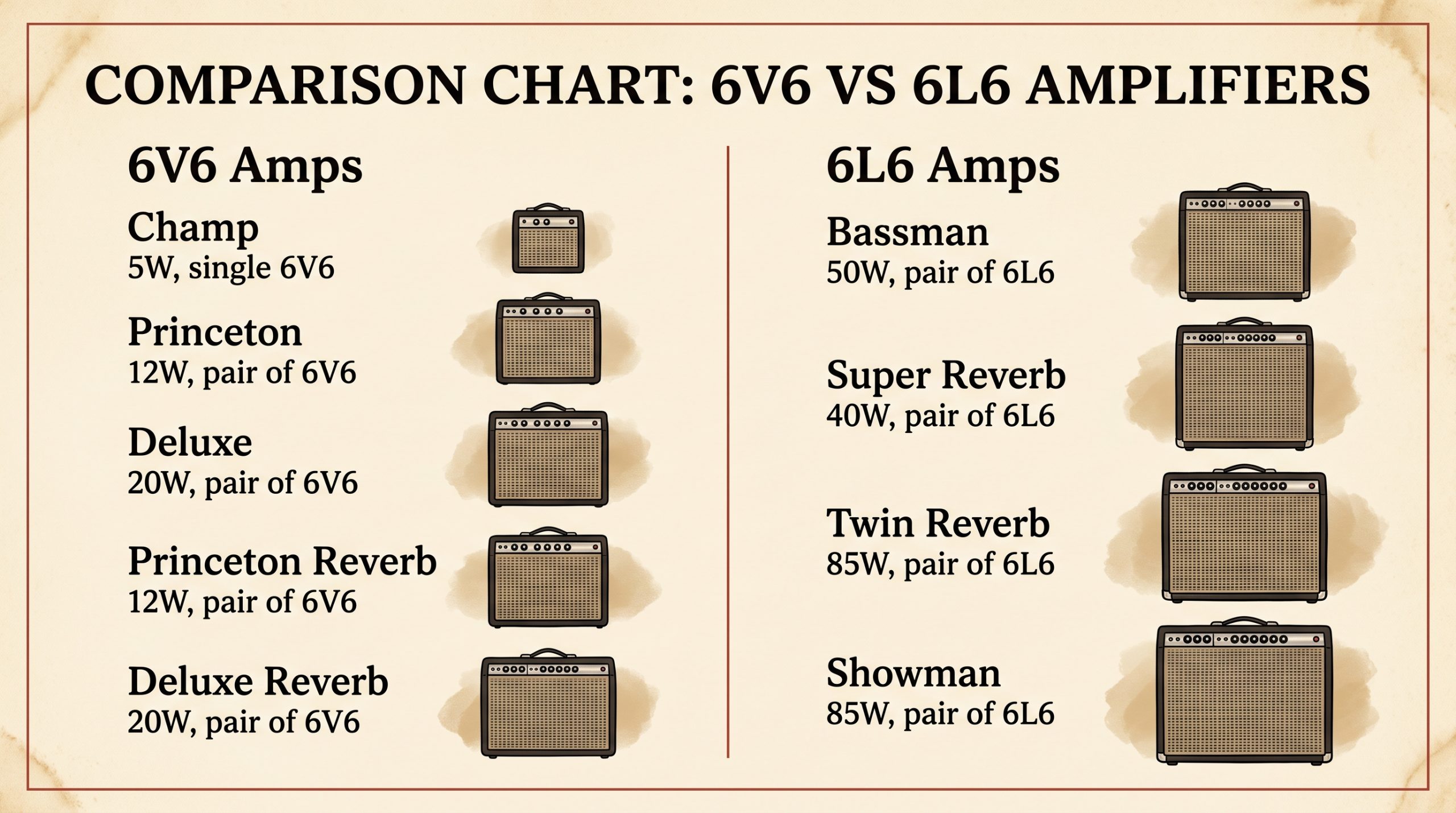
Every Fender tube amp ever produced runs on 6V6s or 6L6s. The smaller amps, Champ, Princeton, Deluxe, Deluxe Reverb, use 6V6GT tubes. The larger amps, Bassman, Super Reverb, Twin Reverb, Showman, use 6L6GC tubes. Understanding what separates these two tubes explains Fender’s entire tonal range, from 5-watt bedroom-friendly combos to 85-watt stage-loud flagships. This article covers the electrical specs, the tone differences, which Fender circuits use which tube, whether they’re interchangeable, how to bias them, and which brands are worth buying.
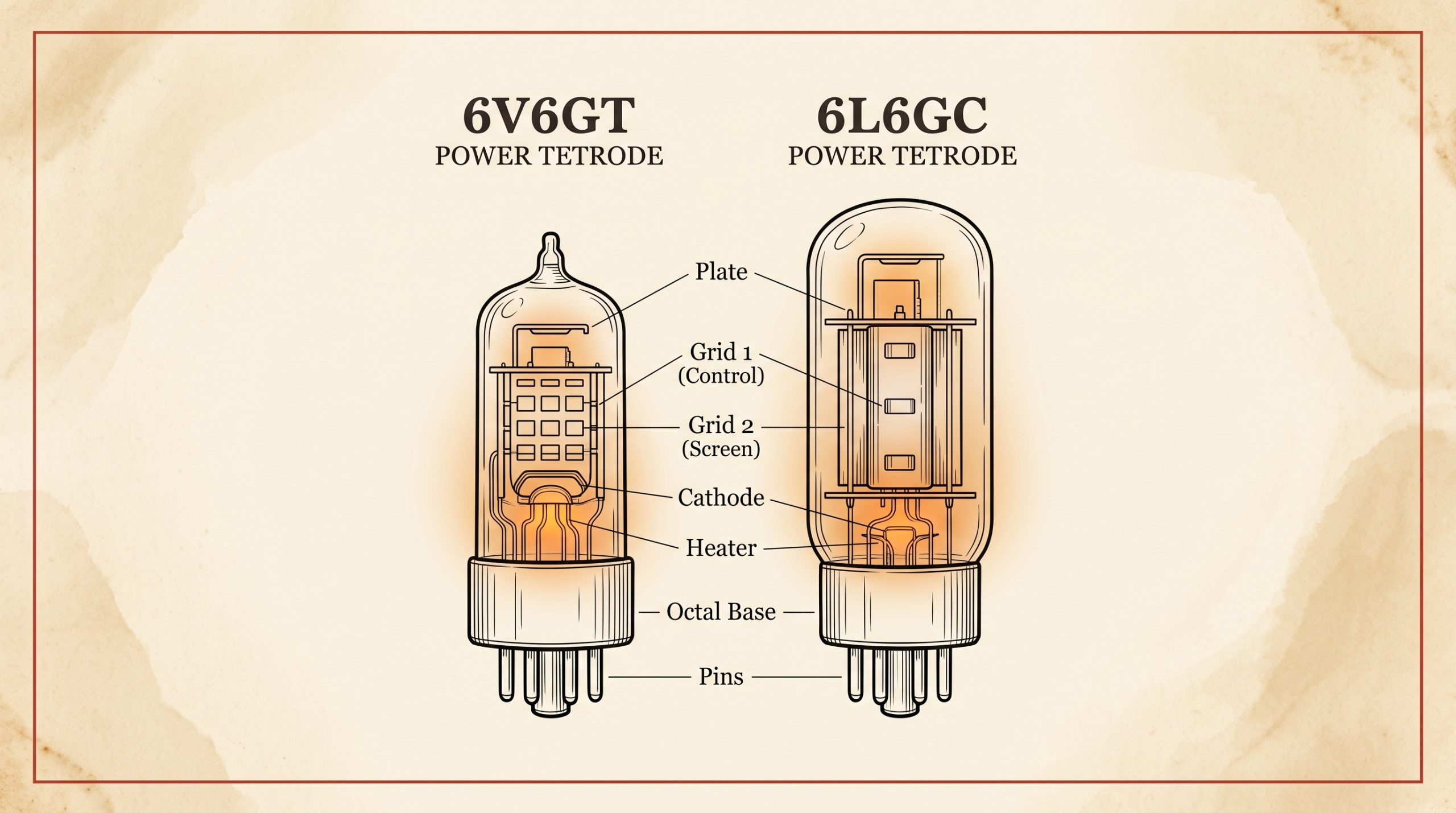
A Brief History of the 6V6 and 6L6 Tubes
Origins of the 6L6: RCA’s 1936 Breakthrough
RCA engineers introduced the 6L6 commercially in 1936, originally in a metal-envelope package. The glass-envelope 6L6G followed in 1937 with a distinctive “ST” bottle shape, and the lineage progressed through the 6L6GA and 6L6GB before arriving at the version Fender used throughout the blackface era: the 6L6GC, which entered production in the early 1950s. Plate dissipation climbed with each revision, the original 6L6 was rated at 19 watts, while the 6L6GC reached 30 watts.
Fender adopted 6L6 tubes starting with the Dual Professional, introduced in late 1946 and renamed the Super the following year, well before the narrow-panel tweed era most players associate with the brand. RCA-branded examples set the reference benchmark; GE manufactured a close second that remains highly regarded among collectors. Both are now covered in the dedicated 6L6 tube guide, which includes full NOS sourcing notes.
Origins of the 6V6: RCA’s Smaller Sibling
The 6V6 arrived in 1937, one year after the 6L6, also from RCA. It was designed for lower-power consumer radio and PA applications where the 6L6’s heater current draw was excessive. Fender put the 6V6GT (tubular glass envelope) into nearly every small-format amp from the tweed era forward: the Champ, the Princeton, the Deluxe, and eventually the Princeton Reverb and Deluxe Reverb. The RCA datasheet rates the 6V6GT at 14 watts maximum plate dissipation (some manufacturers list 12W; the RCA published maximum is 14W). The 6V6 gets its own deep dive in the dedicated 6V6 tube guide, covering the same manufacturer and NOS sourcing detail as its bigger sibling.
The Fender Champ ran a single 6V6GT in a Class A configuration, roughly 5 watts at the output transformer. The blackface Princeton Reverb (AA1164) used a pair in Class AB for approximately 12 watts. Both designs pushed the 6V6 close to its plate voltage ceiling, which contributed directly to their compressed, harmonically rich character. More on that below.
Manufacturer History
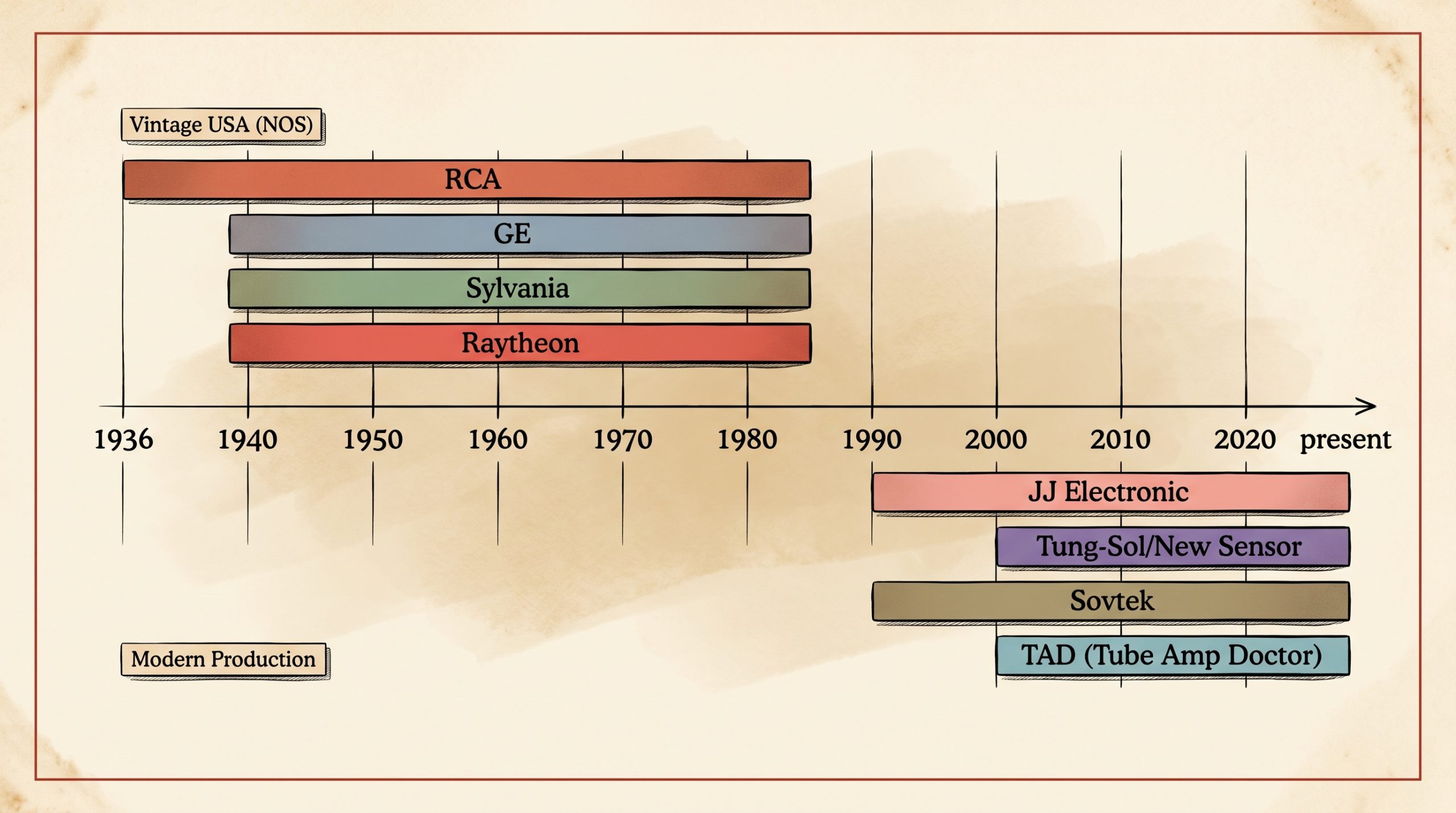
The primary American manufacturers for both tubes were RCA, GE, Sylvania, and Raytheon. Mullard produced 6V6 variants for select European and export applications. Modern production comes from JJ Electronic in Slovakia, Tung-Sol reissue tubes produced by New Sensor (Russia), Sovtek, and TAD (Tube Amp Doctor). Vintage USA-made tubes from RCA and GE remain the collector benchmark, with matched pairs commanding a significant premium over modern production, for good reason, as the consistency and feel of NOS examples is genuinely different.
Datasheet Specs: The Numbers That Explain the Tone
Forum discussions about 6V6 vs 6L6 tone almost never include the actual electrical specifications. That’s a gap worth closing, because the numbers directly explain the sonic behavior.
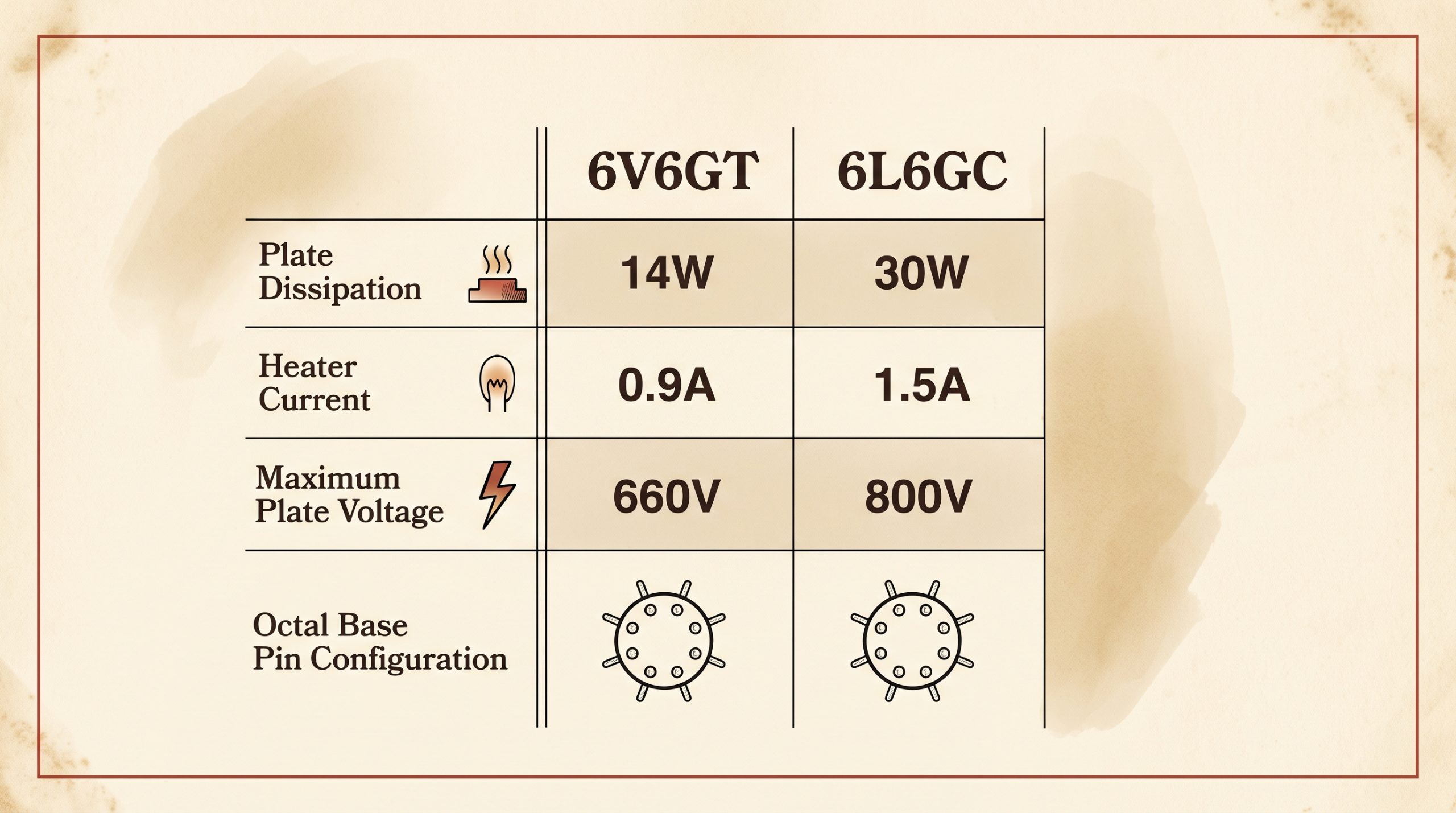
| Specification | 6V6GT (RCA) | 6L6GC (RCA) |
|---|---|---|
| Tube type | Beam power tetrode | Beam power tetrode |
| Plate voltage (max) | 315V | 500V |
| Plate dissipation (max) | 14W | 30W |
| Screen voltage (max) | 315V | 450V |
| Cathode current (max) | 65 mA | 150 mA |
| Transconductance (Gm) | 4,100 µmhos | 6,000 µmhos |
| Output (Class AB1, pair) | ~14W | ~50W |
| Heater voltage / current | 6.3V / 0.45A | 6.3V / 0.9A |
The plate voltage ceiling is the most important number here. The 6V6GT’s 315V maximum means that several Fender blackface circuits, which run plate voltages between 280V and 390V depending on the model, push the tube close to or even past its published maximum. That’s not necessarily destructive at typical bias settings, but it does mean the tube is operating with less headroom in its transfer curve, which produces earlier compression and power-stage saturation. The 6L6GC’s 500V ceiling gives it far more room before it starts to work hard.
The transconductance difference is also significant. The 6L6GC’s higher Gm (6,000 µmhos vs. 4,100 µmhos for the 6V6GT) translates directly to more “authority” at equivalent signal levels, the 6L6 responds more aggressively to input signal changes, which most players hear as tighter, more immediate attack. The heater current difference matters for amp builders considering tube swaps: the 6L6GC draws exactly double the heater current of the 6V6GT (0.9A vs. 0.45A), which can strain the power transformer of an amp designed for 6V6s.
Tone Characteristics: What Each Tube Actually Sounds Like
The 6V6 Sound
The 6V6 is midrange-forward with less extended low-frequency content than the 6L6. It compresses earlier in the power stage, and that compression is the tube’s defining personality trait. When a Deluxe Reverb (AA763) starts to break up, you’re largely hearing the 6V6GT pair reaching the limits of their operating range, the result is a warm, singing saturation with harmonic content skewed toward 2nd and 3rd order overtones. That’s the distortion character players describe as “musical” rather than harsh.
Touch response is exceptional. Pick lightly and the amp stays clean; dig in and the power stage compresses and softens into spongy compression that feels like the amp is breathing with you. This makes 6V6-loaded amps particularly suited to single-coil guitars, Stratocasters and Telecasters, where the spanky attack of the pickups pairs well with a power stage that doesn’t overly stiffen the transient.
The classic Fender examples: Deluxe Reverb (AA763), Princeton Reverb (AA1164), tweed 5E3 Deluxe, and the single-ended tweed Champ (5F1). All of these hit their sweet spot at volumes that are genuinely usable in recording and small-venue contexts. That’s not a coincidence, it’s the 6V6GT’s plate dissipation ceiling doing the work.
The 6L6 Sound
Extended low-frequency response. That’s the starting point. The 6L6GC delivers tighter, rounder bass with a full-frequency character that players describe as “glassy” on the top end and “authoritative” through the mids. The scooped midrange compared to the 6V6 is a real phenomenon, not marketing language, the higher plate dissipation and voltage ceiling mean the 6L6 pair in a Twin Reverb can stay clean through levels that would have a 6V6 amp singing in saturation.
According to Tone King’s Mark Bartel, the 6L6 produces a big, warm, balanced clean tone with a creamier overdrive and thicker mids when compared to smaller tube alternatives, while the 6V6, being the lower-dissipation variant, reaches compression and saturation at lower output levels (as documented at Reverb.com’s power tube examination feature).
Vintage Fender examples using 6L6GC tubes: the Bassman 5F6-A (four 6L6GCs, 45W), the blackface Twin Reverb (AB763) (four 6L6GCs, 85W), the Super Reverb, and the Showman. These are the stage-loud, high-headroom designs, the amps that stay clean under a humbucker-equipped Les Paul and cut through a full band without collapsing into premature breakup.
How the Circuit Shapes the Tube’s Voice
The tube doesn’t operate in isolation. The output transformer, speaker load, and bias point are all co-factors in the final sound. Fender designs output transformers to match each tube type’s output impedance requirements, you can’t transplant a 6V6 output transformer into a Twin Reverb circuit and expect functional results. A well-biased 6V6 pair in the right circuit can sound substantially bigger than a poorly-biased 6L6 pair in a circuit that doesn’t suit it. Bias matters as much as tube choice.
6V6 vs 6L6 in Fender’s Historical Lineup
No other aspect of Fender amp research benefits more from a systematic table than the amp-to-tube mapping. The Fender tube amp serial number and circuit code reference is the primary resource for confirming which circuit revision applies to a specific production example, but the table below covers the major models across eras.
| Amp Model | Circuit # | Era | Power Tube | Output | Years |
|---|---|---|---|---|---|
| Champ | 5F1 | Tweed | 6V6GT (x1) | ~5W | 1955–1964 |
| Princeton | 5F2-A | Tweed | 6V6GT (x1) | ~5W | 1957–1960 |
| Deluxe | 5E3 | Tweed | 6V6GT (x2) | ~15W | 1955–1960 |
| Tremolux | 5E9-A | Tweed | 6V6GT (x2) | ~15W | 1955–1957 |
| Bassman | 5F6-A | Tweed | 6L6GC (x4) | ~45W | 1958–1960 |
| Princeton Reverb | AA1164 | Blackface | 6V6GT (x2) | ~12W | 1964–1967 |
| Deluxe Reverb | AA763 | Blackface | 6V6GT (x2) | ~22W | 1963–1967 |
| Vibrolux Reverb | AA964 | Blackface | 6L6GC (x2) | ~35W | 1964–1967 |
| Super Reverb | AA763 | Blackface | 6L6GC (x4) | ~45W | 1963–1967 |
| Twin Reverb | AB763 | Blackface | 6L6GC (x4) | ~85W | 1963–1967 |
| Showman | AB763 | Blackface | 6L6GC (x4) | ~85W | 1963–1967 |
The Vibrolux Reverb (AA964) is worth a separate note. Despite its mid-size 2×10″ format, it runs a pair of 6L6GC tubes, not 6V6GTs, the same power tube family as the Twin Reverb and Super Reverb, just at meaningfully lower plate voltages than those larger circuits. That’s why a 35W Vibrolux Reverb feels tighter and holds more clean headroom than a 22W 6V6-loaded Deluxe Reverb despite the modest wattage gap between them. It’s a useful reminder that cabinet size and power tube family don’t always scale together, knowing your circuit code matters before making any tube decisions.
Can You Swap 6V6 and 6L6 Tubes?
Why Direct Swapping Is Not Recommended
Both tubes share an 8-pin octal base. They’ll physically fit the same socket without modification. That’s where the easy compatibility ends.
Putting a 6V6 into a 6L6 circuit means exposing the 6V6 to plate voltages that often exceed its 315V maximum by a significant margin, Twin Reverb circuits run approximately 430-460V at the plates. That’s not a marginal exceedance. You’re looking at shortened tube life, potential screen grid failure, or outright arc-over. Running a 6L6 in a 6V6 circuit produces the opposite problem: the 6L6 will be severely underbiased for the lower plate voltages involved, producing a cold, sterile tone and potential reliability issues as the tube operates well outside its design window. The output transformer impedance match is also a secondary concern, since Fender wound transformers specifically for each tube type’s output characteristics.
When a Swap Can Be Done Safely (With Caveats)
A competent amp technician can verify plate voltages and rebias the amp before committing to a cross-type swap. Not every circuit is an equally bad candidate. Some players install 6L6GCs into Deluxe Reverb circuits for more clean headroom, the Deluxe Reverb’s plate voltage is lower than the Twin’s, and with proper rebiasing, the swap can work without stressing either the tubes or the transformer. But this is a job for a tech with a multimeter and a dummy load, not a DIY pull-and-plug swap.
Never swap tube types without a professional rebias. That’s not a conservative position, it’s what the datasheet specs require.
What About KT66 as a 6L6 Substitute?
The KT66 is a British-designed octal output tube on the same base as the 6L6GC. It’s generally considered a safe swap in 6L6 circuits with a rebias, producing a slightly warmer, more compressed character that some players prefer in Bassman-style circuits. Plate dissipation specs vary by manufacturer (most rate the KT66 at 25-30W), and the heater draw is compatible with 6L6-designed power transformers. The EL34 guide includes additional context on British tube equivalents and why Fender never adopted them in factory designs.
Biasing 6V6 vs 6L6 Tubes
Bias is the quiescent current setting that determines where on the tube’s transfer curve the output stage operates. Too cold and the amp sounds stiff, sterile, and lacks touch response. Too hot and you get earlier breakup and warmth, but at the cost of shortened tube life and potential thermal runaway in severe cases.
For the 6V6GT in typical Fender circuits (plate voltages 250-315V), target bias is approximately 70-75% of maximum plate dissipation, which works out to roughly 10-10.5 mA per tube. The original Fender service documentation for the Deluxe Reverb AA763 specifies a total quiescent current of 22-25 mA for the pair, measured at the cathode resistors. That’s the factory target, not a loose guideline.
For the 6L6GC in blackface-era circuits (plate voltages 420-460V), target bias runs approximately 70% of maximum plate dissipation, or roughly 21 mA per tube at typical operating voltages. Running a 6L6GC pair above 80% of plate dissipation (above approximately 24 mA per tube at 460V) will shorten tube life noticeably and increases the risk of thermal runaway.
Cold bias (below 60%) makes any tube sound cleaner and more stiff, useful for players who want the amp’s character to come from the preamp stage rather than power-stage saturation. Hot bias produces that earlier breakup and warm clean tones that many players associate with vintage Fender character. Both extremes come with tradeoffs.
Vintage vs Modern Production Tubes: Which Brand to Buy
Vintage NOS Tubes
RCA-branded 6L6GC and 6V6GT tubes are the gold standard. Expect to pay $40-80 per tube for tested, matched examples from established dealers. GE runs a close second and is often slightly more affordable for comparable quality. Sylvania 6L6GCs are known for a clean, extended top-end character. Raytheon 6V6GTs have a warmer, earlier-breaking voice that’s well regarded for recording applications.
Buy only from dealers who supply test data (mutual conductance readings, matched current draws). Unmatched NOS pairs from unknown sources are a gamble not worth taking in a push-pull output stage.
Modern Production Tubes
Not all current-production tubes are equal. Some are genuinely good.
- JJ Electronic 6V6S / 6L6GC (Slovakia): robust build quality, good production consistency, slightly stiffer feel than vintage NOS but reliable. JJ publishes tube specifications on their product documentation pages.
- Tung-Sol 6V6GT reissue (New Sensor / Electro-Harmonix, Russia): widely cited as the closest modern production equivalent to the RCA 6V6GT character. Warm clean tones, good touch response. New Sensor’s current specifications are available via the New Sensor technical catalog.
- Sovtek 6L6WXT+: reliable, budget-friendly, slightly compressed tone. A reasonable choice for a workhorse amp that gets gigged hard.
- TAD 6L6GC-STR: higher plate dissipation tolerance, a good match for higher-voltage Fender circuits like the Super Reverb or Twin Reverb.
Modern matched pairs run $25-55 for most of these options. Worth the small premium over unbranded house tubes.
What to Avoid
Unbranded tubes with no test data attached. Unmatched pairs for push-pull circuits. And, particularly relevant for 6V6GT NOS, relabeled tubes sold as premium brands that turn out to be repackaged current production. Buy from dealers with transparent test data, not just claims.
6V6 vs 6L6 for Bass Applications
Short answer: use the 6L6. The 5F6-A Bassman’s four-6L6GC configuration wasn’t accidental, bass frequencies demand more instantaneous power headroom than guitar, and the 6V6’s 14W plate dissipation ceiling is reached faster under low-frequency signal content. The 5F6-A at 45 watts became the template for rock-and-roll bass amplification and directly influenced the early Marshall designs.
The 6V6 isn’t useless in bass contexts, it’s workable for recording-level upright bass or acoustic bass at low volumes. But for any amplified electric bass application where stage-loud output is required, the 6L6GC’s extended low-frequency headroom and higher power output are the right tool.
6V6 vs 6L6 vs EL34
The EL34 belongs to the British amp tradition, Marshall, Hiwatt, early Vox designs. It’s a true pentode (vs. the beam tetrode design of both American tubes) with approximately 25 watts plate dissipation and a pronounced upper midrange that compresses into saturation earlier than the 6L6 but later than the 6V6. Fender never used the EL34 in factory production. Understanding where it sits helps clarify the 6V6/6L6 contrast.
| Characteristic | 6V6GT | 6L6GC | EL34 |
|---|---|---|---|
| Plate dissipation | 14W | 30W | 25W |
| Headroom | Low | High | Medium |
| Bass response | Moderate | Full | Tight |
| Midrange | Forward | Scooped | Aggressive |
| Compression onset | Early | Late | Medium |
| Used by Fender | Yes | Yes | No |
The EL84, used in Fender’s Pro Junior and Blues Junior, occupies a different category entirely, it’s a nine-pin miniature pentode with 12W plate dissipation that delivers a distinctly different compression character. That comparison is handled separately in the EL84 tube guide.
Picking the Right Tube for Your Fender
The decision framework is straightforward once you know what each tube prioritizes. If you want touch-sensitive compression, earlier power-stage breakup at practical volumes, and the warm clean tones the smaller Fender designs are known for, the 6V6GT is your tube. If you need clean headroom through a full band, extended low-frequency response, and a glassy top end that doesn’t compress until you really push it, the 6L6GC is what Fender designed the larger circuits around. Neither tube is objectively better, they serve different sonic missions in different circuit contexts, and both are core to what makes Fender amps sound the way they do. Before changing tube types in any existing amp, consult a qualified amp technician who can verify plate voltages and set bias correctly for whatever tubes you’re installing. The full electrical specifications for both tubes in their respective Fender circuit contexts are documented at Schematic Heaven’s Fender amp archive, which hosts the original service schematics for nearly every model discussed here.
Frequently asked questions
Are 6L6 and 6V6 tubes interchangeable?
No, not without professional rebiasing and plate voltage verification. Both tubes share an 8-pin octal base and will physically fit the same socket, but their electrical requirements differ significantly. The 6V6GT's 315V plate voltage maximum is well below the operating voltages of most 6L6 circuits. Swapping without proper adjustment risks tube damage, reduced service life, or failure.
What do 6V6 tubes sound like?
6V6 tubes have a warm, midrange-forward character with early compression and smooth power-stage breakup. They produce harmonically rich saturation at lower output levels, with 2nd and 3rd order harmonic content that most players describe as musical and touch-sensitive. In Fender circuits, the Champ (5F1), Princeton Reverb (AA1164), and Deluxe Reverb (AA763) all demonstrate this character in practice.
What is the difference between a 6L6G and a 6V6?
The 6L6G is an early glass-envelope variant of the 6L6 family, introduced in 1937 with a large "ST" bottle shape and 19W plate dissipation. It's not the same tube as the 6V6, they're separate designs with different electrical characteristics and different physical dimensions. The 6L6GC (30W plate dissipation) is the version most commonly found in blackface and silverface Fender amps, and it's the variant the comparison tables in this article reference.
Which Fender amps use 6V6 tubes?
The Champ, Princeton, Princeton Reverb, Deluxe, Deluxe Reverb, and Tremolux all use 6V6GT power tubes. These are Fender's smaller-format designs, producing between 5 watts (single-ended Champ) and approximately 22 watts (Deluxe Reverb AA763). All of them run the 6V6GT in configurations ranging from a single tube to a push-pull pair.
Which sounds better for recording: 6V6 or 6L6?
For most guitar recording applications, the 6V6 has a practical advantage. It reaches power-stage saturation at volumes that a microphone can capture without demanding 100dB+ SPL from the room. The Deluxe Reverb and Princeton Reverb have long been studio favorites for exactly this reason, you can get driven power-amp tone at volumes that won't rattle the window glass. The 6L6 excels in recordings where clean headroom and full low-frequency response are the priority, particularly for country, clean funk, or bass applications.