Contents
- 01What Actually Makes a Tube Amp Different? The Physics, Not the Hype
- 02The Sound Difference, What the Science Actually Says
- 03Tube Amp vs Solid State, Head-to-Head Comparison
- 04When the Difference Actually Matters, Context Is Everything
- 05Famous Guitarists Who Use Solid-State Amps, Challenging the Bias
- 06Disadvantages of Tube Amps, What Nobody Tells You
- 07Are Solid-State Amps Worth It? Decision Matrix by Use Case
- 08Do Tube Amps Actually Sound Better? The Honest Answer
- 09Frequently Asked Questions
- 10Which Amp Type Should You Actually Choose
You’re in a guitar shop. The tube amp costs $900. The solid-state costs $299. The salesperson says tube is better. Full stop, no context, no caveats. That framing is wrong, and it costs players real money every day.
The tube amp vs solid state debate isn’t a question with a universal answer. It’s a question with six variables: playing volume, genre, environment, signal chain, maintenance budget, and whether natural harmonic distortion is part of your intended tone. Get those variables right, and the answer becomes obvious. Ignore them, and you’ll spend $900 on an amp that sounds worse than the $299 one in your specific situation.
This breakdown covers the physics behind both amp types, the measurable sound differences, pedal compatibility, audiophile context, actual maintenance costs, and a decision matrix that tells you which to buy.
- Tube amps: vacuum tubes amplify signal, generating predominantly even-order harmonics at saturation
- Solid-state amps: transistors (BJT, MOSFET, JFET) or op-amps amplify signal with lower distortion at clipping
- Tube amp damping factor: approximately 4-20 (high output impedance, speaker interaction)
- Solid-state damping factor: 100-1,000 (near-zero output impedance, tight bass response)
- Tube retube cost: $60-$350 depending on amp, every 2,000-5,000 hours of power tube use
- Typical tube combo weight: 40-65 lbs vs. 15-35 lbs for solid-state equivalent
- The claim that “tube always sounds better” is false, context determines which wins
- Famous metal tones (Dimebag Darrell, James Hetfield) were recorded or toured with solid-state power sections
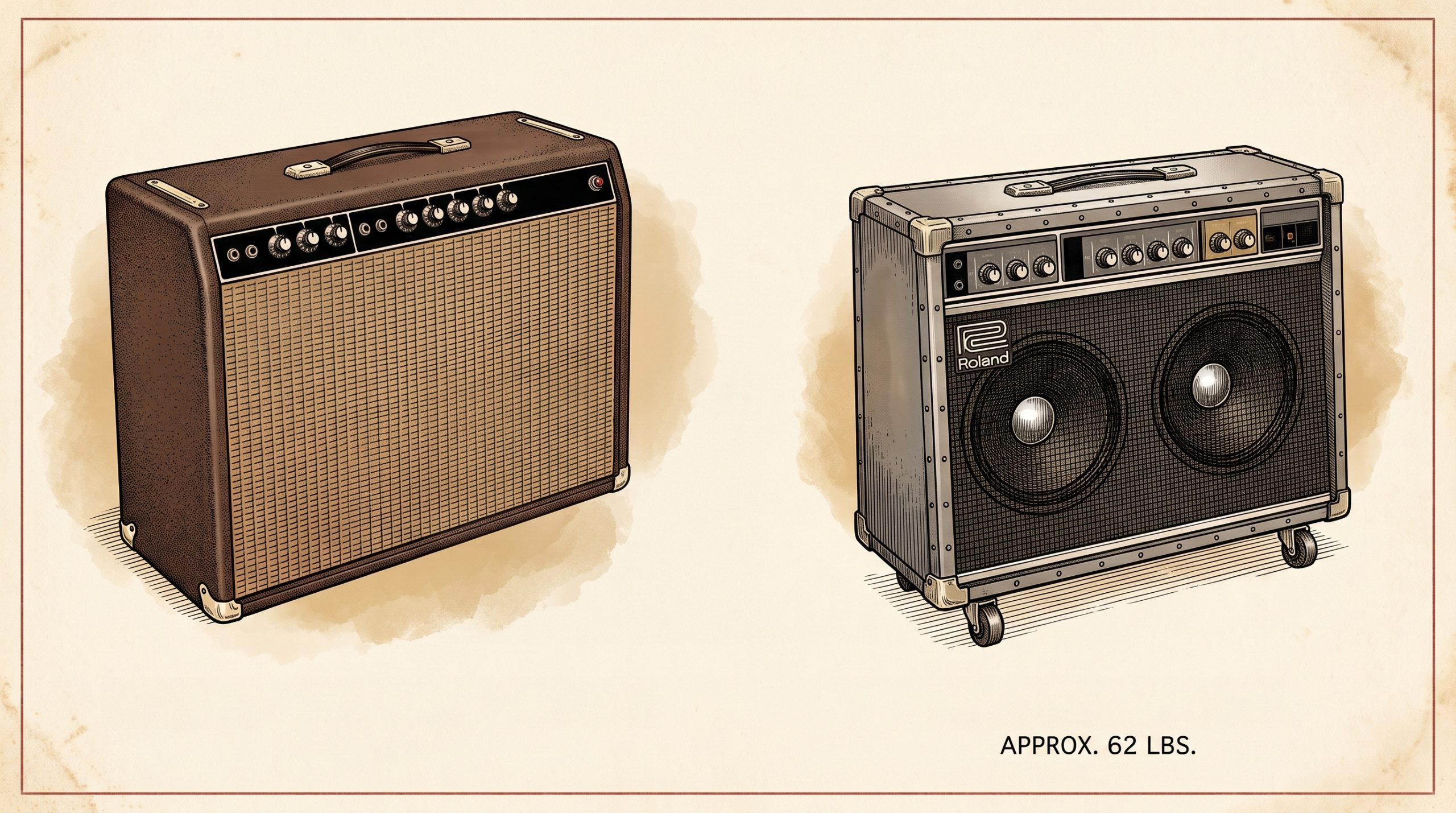
What Actually Makes a Tube Amp Different? The Physics, Not the Hype
Strip away the forum arguments and the gear-shop mythology, and the difference comes down to one thing: how each device amplifies a signal, and what byproducts that amplification creates.
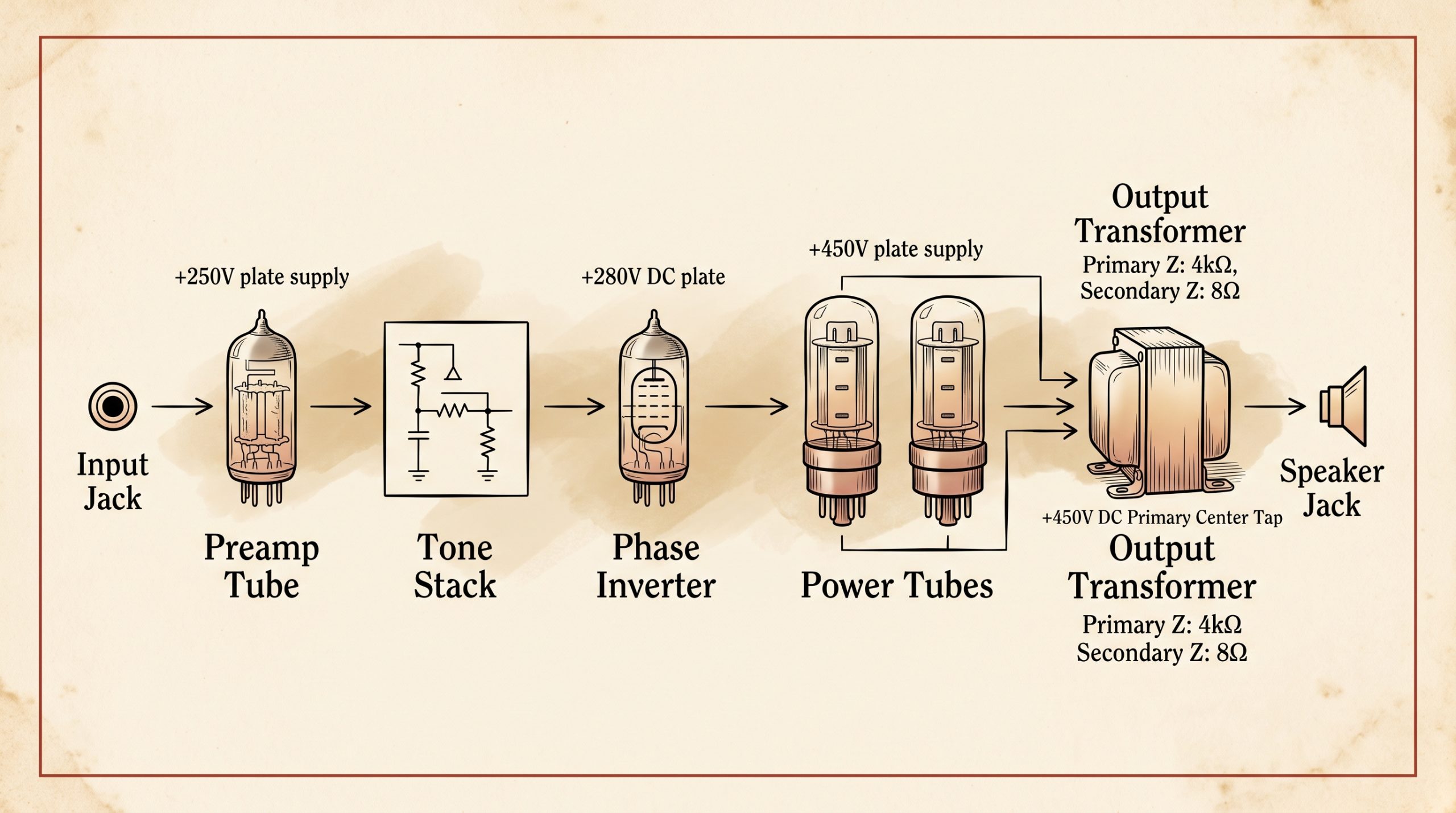
How Vacuum Tubes Amplify a Signal
A vacuum tube works by controlling electron flow between a heated cathode and a positively charged anode (plate), with a control grid in between. A small voltage change at the grid produces a proportionally larger change at the plate. That’s amplification.
Preamp tubes handle the first stages of gain. Common ones in Fender circuits include the 12AX7, which carries a gain factor (mu) of approximately 100, making it the highest-gain standard preamp tube. The 12AX7 preamp tube guide covers the full range of NOS and current-production options in detail. Lower-gain alternatives include the 12AT7 (mu approximately 60), which fills both the reverb driver and phase inverter roles in the classic Fender blackface circuit.
Power tubes take the preamp signal and drive the speaker. Common types and their plate dissipation ratings:
- 6L6GC: 30W plate dissipation, the Fender standard from tweed through silverface
- EL34: 25W plate dissipation, British amps, Marshall lineage
- 6V6GT: 14W plate dissipation, smaller Fender combos, Princeton Reverb, Champ
- EL84: 12W plate dissipation, Fender Blues Junior, Vox AC series
Class A operation runs the output tube conducting for the full 360 degrees of the signal cycle. Efficiency is roughly 20%. Class AB, the configuration used in most Fender blackface and silverface amps, runs two tubes in push-pull, each conducting for slightly more than 180 degrees. Efficiency climbs to approximately 65%. The practical implication: a Class AB amp gets more watts from its power supply but introduces crossover distortion at the transition point. Class A amps run hotter, consume more power per watt, and have a softer, more even compression character.
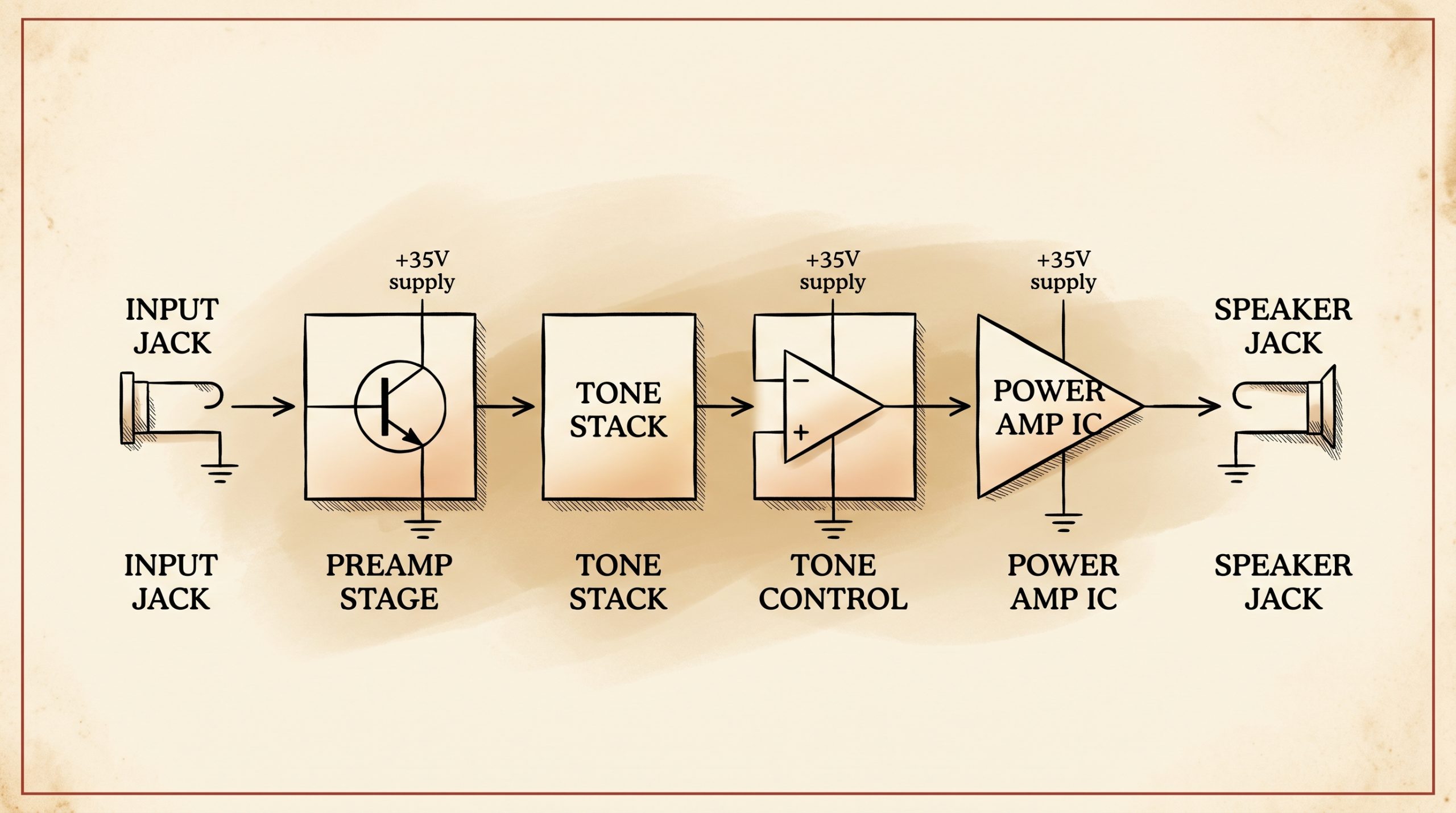
How Solid-State Amps Amplify a Signal
Transistors replace tubes in solid-state designs. Two main types appear in guitar amps: bipolar junction transistors (BJT) and metal-oxide-semiconductor field-effect transistors (MOSFET). BJTs are voltage-controlled in a way that clips signals abruptly. MOSFET transistors have a transfer characteristic closer to triode tube behavior, which is why MOSFET-based amps tend to feel less harsh when pushed into saturation.
JFET (junction field-effect transistor) designs take this further. The Roland JC-120 uses a JFET-based circuit that has made it a fixture on professional stages for decades. Robert Smith used one as his primary amp throughout The Cure’s most influential recordings. Andy Summers of The Police ran his signal through a JC-120. James Hetfield used solid-state Mesa Boogie power sections at various points in Metallica’s touring rigs. The “solid-state is inferior” argument collapses immediately when you look at who actually plays through them.
The Sound Difference, What the Science Actually Says
Harmonic Distortion: Even vs. Odd Harmonics
This is where the tube amp debate stops being subjective and starts being measurable. When a tube amp is driven into saturation, it generates predominantly even-order harmonics: the 2nd harmonic, the 4th, the 6th. Even-order harmonics are octave relationships. They’re musically consonant. They blend with the fundamental rather than clashing against it, which is why tube overdrive sounds warm and musical rather than abrasive.
Solid-state transistors in clipping, particularly BJT designs, generate predominantly odd-order harmonics: the 3rd, 5th, 7th. These intervals are dissonant relative to the fundamental. A 3rd harmonic sits a perfect 12th above the root, not an octave. Stack enough odd harmonics and the sound becomes harsh and buzzy, which is the complaint guitarists have about solid-state clipping.
The measurable numbers back this up. A typical tube amp at rated output shows total harmonic distortion (THD) of 1-5%, with the 2nd harmonic dominant. A solid-state amp clipping hard can show THD above 10%, with 3rd and 5th harmonics dominating. This isn’t audiophile mythology. It’s repeatable on a spectrum analyzer. Not imagined at all.
The important qualifier: this difference only shows up when the amp is being pushed. At low volumes, neither amp is generating significant harmonic distortion. That’s critical for the bedroom-volume discussion below.
Dynamic Response and “Feel”, Is It Real?
Players describe tube amps as “breathing with you.” The touch sensitivity is real. The explanation is output impedance.
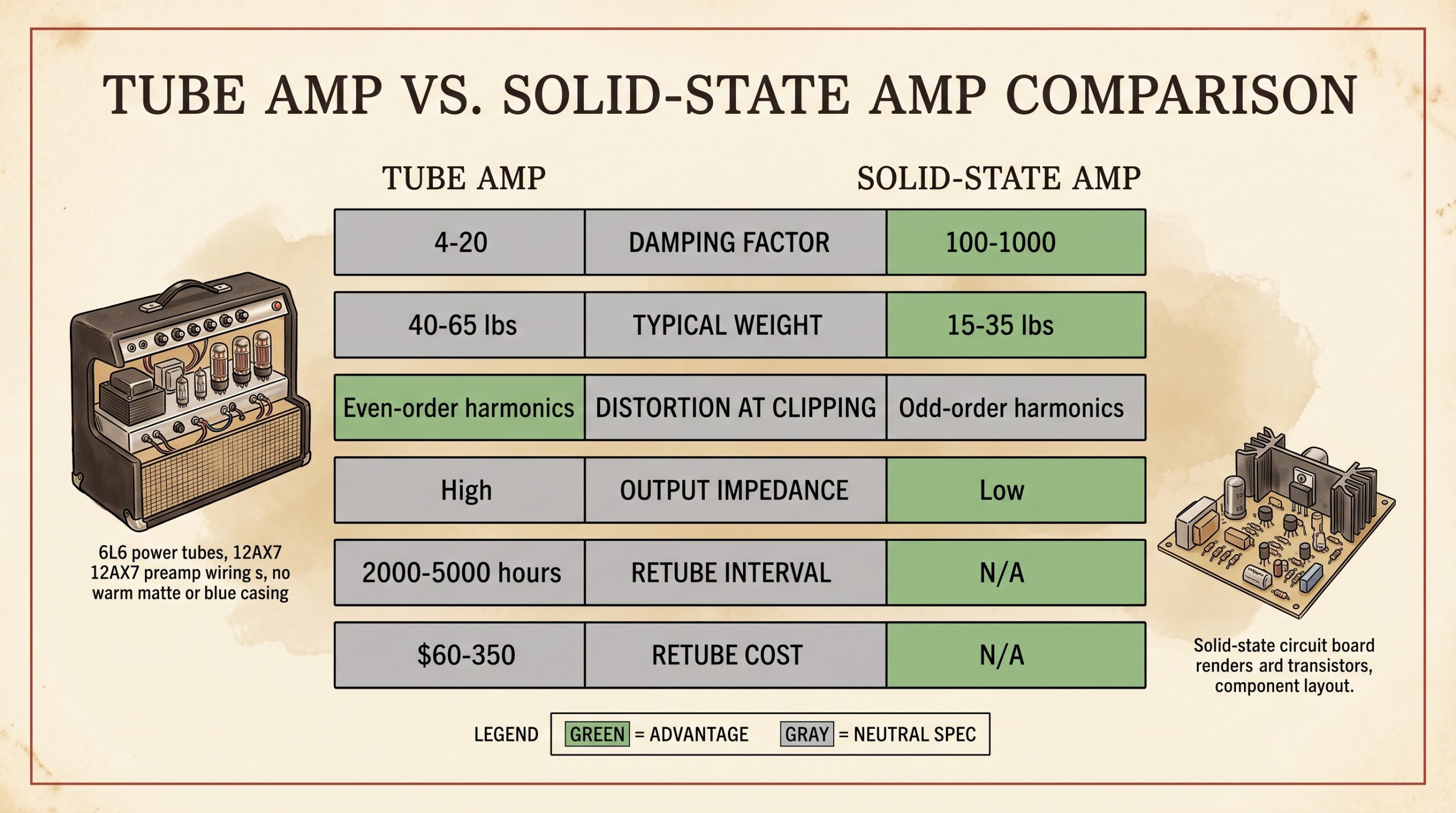
Tube amps have relatively high output impedance, typically producing a damping factor of 4-20. Solid-state amps approach zero output impedance, with damping factors of 100-1,000 or higher. The speaker’s voice coil generates back-EMF as it moves. In a high-damping solid-state amp, the amp absorbs that back-EMF completely. Tight. Controlled. Accurate. In a tube amp, the back-EMF partially returns through the circuit. The speaker interacts with the amp, and the amp interacts back. That feedback loop is what players feel as spongy compression and spanky attack when they dig in.
Neither response is inherently better. Jazz players often prefer the tight, controlled bass response of a solid-state amp under their chord voicings. Blues players want the sag. Country chicken-pickin’ depends on that springy interplay between pick attack and speaker. Genre shapes which damping factor you actually want.
Volume and the “Sweet Spot” Problem
Tube amps achieve their most harmonically rich tone when the power tubes are working hard. Push a 5E3 Fender Tweed Deluxe circuit to 60-70% of its volume range and the power tubes begin contributing their characteristic compression and even-harmonic bloom. That’s a loud level in most rooms. At bedroom volumes on the same amp, you’re hearing mostly the clean preamp stage. The amp sounds thin and unremarkable compared to its potential.
Solid-state amps don’t have a sweet spot in the same sense. They sound essentially consistent from bedroom to stage-loud levels. That consistency is an advantage when you need predictable performance, and a limitation if you want the amp itself to contribute dynamic color at low volumes.
Power attenuators exist specifically to address the tube amp sweet-spot problem, letting the power section work hard while reducing the signal before it hits the speaker. Worth researching if you’re committed to tube tone at lower volumes.
Tube Amp vs Solid State, Head-to-Head Comparison
The table below covers the primary decision factors for solid-state vs tube amplifiers across real-world use cases. These figures reflect current market pricing and typical specifications rather than cherry-picked examples.
| Factor | Tube Amp | Solid-State Amp |
|---|---|---|
| Tone at bedroom volume | Often thin and clean, power tubes are barely working | Consistent and full, sounds the same at any volume |
| Tone at stage volume | Rich, harmonically complex, dynamically responsive | Accurate, hi-fi, or colored by design intent |
| Weight (typical 1×12 combo) | 40-65 lbs (transformer-heavy) | 15-35 lbs (no output transformer required) |
| Reliability on the road | Moderate, tubes fail, rattle loose, crack from vibration | High, no fragile glass components |
| Annual maintenance cost | $50-$350 (tubes, biasing service) | Minimal, under $20 typical |
| New purchase cost | $500-$3,000+ | $100-$1,200 |
| Resale value | High, vintage models appreciate significantly | Low to moderate, depreciation is steep |
| Pedal compatibility | Excellent, high input impedance, interactive power amp | Good to excellent, MOSFET and JFET circuits best |
A note on maintenance cost: a Fender Blues Junior retube runs approximately $60-$90 in parts if you do it yourself (3 preamp tubes, 2 EL84 power tubes). A Fender Twin Reverb is a different proposition, 6 preamp tubes (4x 12AX7 + 2x 12AT7) plus 4 x 6L6 power tubes. DIY parts cost hits $120-$200, and if you pay a tech to bias the amp afterward, add $80-$150 on top. That’s a real ongoing cost that belongs in any honest comparison. The 6L6 tube guide covers current-production options at different price points if you’re weighing retube costs on a 6L6-based amp.
When the Difference Actually Matters, Context Is Everything
Here’s where most articles fail you. They compare tube vs solid state in the abstract, as if “which is better” has a universal answer. It doesn’t. The answer depends entirely on your specific variables.
Genre and Playing Style
Blues and classic rock: tube wins clearly. The even-harmonic saturation is the sound of the genre. When a Muddy Waters riff or a SRV bend compresses and blooms through a pushed tube power section, that interaction is not incidental, it’s the tone. You can’t replicate that with a solid-state amp running clean.
Metal and high-gain: the gap narrows considerably. Many of the most recognizable metal tones in recorded history ran through solid-state power sections. Dimebag Darrell built his sound through Randall solid-state heads. That tone influenced an entire generation of metal guitarists. When gain levels are high enough, the power amp character becomes largely irrelevant, the preamp or pedals are doing the heavy lifting.
Country and chicken-pickin’: a clean blackface Fender circuit is nearly mandatory for the genre’s defining snap and spank. The interaction between a Telecaster and a blackface circuit, the way the amp barks when pushed and cleans up as you back off the guitar’s volume knob, is built into the tube circuit’s behavior. The Fender Deluxe Reverb guide covers why that specific AB763 circuit became the reference standard for clean country tone.
Jazz: solid-state is often the deliberate choice. Clean headroom, no sag, accurate reproduction of chord voicings without compression artifacts. The Roland JC-120 and Polytone Mini-Brute became jazz standards precisely because they don’t add color to the signal.
Playing Volume and Environment
Home and bedroom players: solid-state wins on practicality at 60-75dB listening levels. The tube amp isn’t delivering its distinctive character at that volume anyway. Spending $1,200 on a tube combo that you’ll run at 2 on the dial is a poor allocation of gear budget.
Studio recording: depends on intent. A tube amp with its power section working is the right tool for organic breakup and touch-sensitive dynamics. A solid-state amp running clean under a complex pedal chain lets the pedals speak without the amp adding its own coloration. Neither is wrong.
Live bar gigs and rehearsal rooms: this is where the tube amp advantage is most perceptible. Room interaction, natural compression under a live drummer, the way a tube amp projects differently from a solid-state at equivalent wattage, all of it adds up. The difference is least subtle here and most subtle at home.
Pedal Platform Compatibility, Tube Amp vs Solid State for Pedals
This factor barely appears in competing articles. It belongs at the center of the conversation.
Tube amp preamp input impedance sits typically around 1MΩ. Germanium fuzz pedals, particularly vintage-spec designs like a Fuzz Face, were designed to see a high-impedance input. Run a germanium fuzz into a low-impedance solid-state input and the pedal loses output, shifts its frequency response, and loses the dynamic cleanup behavior that makes it musical. The impedance mismatch is audible and significant.
The power amp stage matters separately. A tube power amp will color and compress a clean signal from a boost or overdrive pedal in ways a solid-state power section won’t. That interaction is desirable for some players and a problem for others. If you’re running a complex modulation and reverb pedalboard as your primary processed sound, especially ambient or post-rock applications, a neutral solid-state power section or a full-range flat-response (FRFR) cabinet may actually be the smarter platform. The pedals are doing the work. Don’t fight them with a power amp that wants to add its own character.
Check input impedance specs on any solid-state amp before pairing it with boutique or germanium pedals. Some run as low as 10kΩ, which will audibly affect any pedal with an output impedance above 1kΩ.
The Audiophile Consideration, Tube Amp vs Solid State for Hi-Fi Listening
The guitar amp debate has a direct parallel in hi-fi audio. The same even-order harmonic characteristic that makes a pushed tube guitar amp sound musical is why audiophiles prize tube preamplifiers and integrated amplifiers for home listening.
The core question in hi-fi is identical: do you want accurate reproduction or euphonic reproduction? Solid-state hi-fi amplifiers from manufacturers like Pass Labs and McIntosh can measure extraordinarily well, vanishingly low THD, flat frequency response, ruler-tight bass. Audiophiles prize them for accuracy and transparency. Tube-based hi-fi gear from Audio Research or Cary Audio adds the same gentle even-harmonic coloration that tube guitar amps produce. Some listeners find it warmer and more engaging. Others consider it a distortion artifact that obscures the recording.
Neither camp is wrong. It’s a preference between measured accuracy and pleasant coloration. MOSFET-based solid-state designs, such as the Sugden A21SE Class A integrated amplifier, occupy an interesting middle ground, MOSFET transfer curves approximate triode behavior closely enough that the gap between tube and solid-state in hi-fi is narrower than the guitar world debate implies.
Guitar World and Premier Guitar have both noted that solid-state amps offer meaningful practical advantages including lower cost, reduced weight due to the absence of output transformers, and greater power density, while tube amps remain preferred for their warm organic breakup and tonal weight. The choice ultimately tracks whether a player prioritizes portability and budget or a specific character of harmonic saturation.
Famous Guitarists Who Use Solid-State Amps, Challenging the Bias
The roster of professional players who built careers on solid-state amps dismantles the “tube only” argument efficiently. Not partially. Completely.
- Dimebag Darrell (Pantera): His distorted tone was built through Randall solid-state heads. One of the most imitated metal guitar tones of the 1990s, generated entirely without tubes in the power section.
- Robert Smith (The Cure): Roland JC-120 player throughout the band’s most commercially and critically successful period. “Lovesong,” “Disintegration,” “Pictures of You, all running through a solid-state JFET circuit.
- Andy Summers (The Police): Roland JC-120 as primary amp, combined with his extensive effects chain. The clean headroom of the solid-state circuit was the point, not a compromise.
- Jonny Greenwood (Radiohead): Modeler and solid-state rigs figure prominently in live and studio applications across Radiohead’s catalog.
- James Hetfield (Metallica): Solid-state Mesa Boogie power sections appeared in Metallica’s touring rigs at various points in the band’s career.
The consistent thread: players who need clean headroom, specific dynamic control, or touring reliability choose solid-state without apology. The ones who need the power amp to be part of the tone choose tubes. Both decisions are correct for those players’ needs.
Disadvantages of Tube Amps, What Nobody Tells You
The enthusiasm around tube amps in guitar culture consistently undersells the practical costs. Here’s what the sales pitch leaves out.
Maintenance Reality, Actual Costs Broken Down
Preamp tubes (12AX7, 12AT7, 12AU7) typically last 5,000-10,000 hours before noticeable degradation. Power tubes are shorter-lived: expect 2,000-5,000 hours depending on how hard the amp runs and how much vibration it sees on the road.
Retube costs by amp type (DIY parts, current production tubes):
- Fender Blues Junior: 3 preamp tubes plus 2 EL84 power tubes, approximately $60-$90
- Fender Deluxe Reverb: 6 preamp tubes (4x 12AX7 + 2x 12AT7) plus 2 x 6V6 power tubes, approximately $70-$120
- Fender Twin Reverb: 6 preamp tubes (4x 12AX7 + 2x 12AT7) plus 4 x 6L6 power tubes, approximately $120-$200 DIY, $200-$350 with a tech biasing the output stage
- Fender Super Reverb: similar to Twin, plus any coupling cap or filter cap work on a 50+ year old amp adds $100-$300 to a full service
Bias adjustment is required after every power tube change in fixed-bias amps (the majority of Fender designs from the blackface era forward). Cathode-biased amps, like the 5E3 Tweed Deluxe, are self-biasing and don’t require a tech after a retube. Knowing which type you own matters. The Fender tube amp serial number guide can help identify your specific circuit revision and era, which in turn tells you what biasing method applies.
Budget $100-$200 per year for maintenance on a regularly gigged tube amp. That’s not a scare figure, it’s a realistic baseline for a working amp on a moderate schedule.
Weight, Heat, and Road Reliability
A Fender Super Reverb, the 40W 4×10 blackface combo, weighs 62 lbs. A Fender Twin Reverb tips the scale at approximately 65-68 lbs depending on speaker configuration. These amps weigh a ton. Literally problematic for solo load-ins across a parking lot or up a flight of stairs.
Tube amps operate at plate voltages of 300-500VDC. Lethal. Working inside a tube amp with power applied, or without proper discharge of filter capacitors, is genuinely dangerous. Any internal service beyond tube swaps should go to a qualified tech.
Heat output is real. A 100W Class AB tube amp running hard generates significant heat, which matters in rack-mounted configurations and matters for tube longevity in poorly ventilated cabinets. Road vibration is a tube amp’s enemy. Power tubes rattle loose in their sockets, preamp tubes can develop microphonic ringing from van vibration, and glass envelopes crack. Solid-state amps don’t have any of these problems. None of them.
Are Solid-State Amps Worth It? Decision Matrix by Use Case
Direct answer: yes, in the right context. Here’s the matrix.
Buy a tube amp if: you play live frequently at moderate-to-loud volumes, your genre is blues, classic rock, or country, you want the amp itself to contribute dynamic color and harmonic compression, you care about long-term resale value, or the specific circuit character of a blackface or tweed design is part of your target tone.
Buy a solid-state amp if: you play primarily at home or bedroom volumes, you use a complex pedalboard as your primary dirt and tone source, you need an amp that survives road abuse without constant maintenance, your genre is jazz or metal at extreme gain levels, or your budget is under $400 and you want reliable performance.
Consider a hybrid or modeling amp if: you need flexibility across genres or need consistent performance at any volume level. Hybrid designs like the Fender Super Champ X2 use a tube power section with solid-state or digital preamp, splitting the difference in a way that works for players who want some tube character without full maintenance overhead.
Do Tube Amps Actually Sound Better? The Honest Answer
Yes, in specific conditions. Measurably and perceptibly. At moderate-to-loud volumes where power tubes are working into the output transformer, a tube amp generates harmonic content that solid-state clipping doesn’t replicate. The impedance interaction with the speaker creates a dynamic feel that solid-state damping eliminates. Those are real differences, not audiophile placebo.
In other conditions: no. At bedroom volumes, a solid-state amp sounds more consistent and often fuller, because it doesn’t need to be pushed to reveal its character. Through a dense pedal chain, a neutral solid-state power section lets the pedals speak without adding its own coloration. For jazz requiring clean headroom, the solid-state precision is the goal.
The word “better” only has meaning with a use case attached. Better for what, at what volume, in what genre, through what signal chain. Answer those four questions and the tube vs solid state decision becomes straightforward rather than religious. Ice-pick treble from an underpowered tube amp at bedroom volume is not better than a full-sounding solid-state at the same level. A tube amp barking when pushed at a bar gig is not replicable by a solid-state without heavy processing. Both statements are true simultaneously.
Which Amp Type Should You Actually Choose
The framework is simple once you have the variables in order. Volume determines whether the tube amp’s power section is even contributing its characteristic sound. Genre determines whether that sound is the goal. Environment determines whether you can afford the weight and fragility. Signal chain determines whether the amp’s interactivity is an asset or a conflict with your pedals.
For vintage Fender tube amp research specifically, the blackface and silverface circuits that defined the clean American guitar sound, the depth goes considerably further than a general comparison can cover. The specific circuit revisions, transformer codes, and component choices that separate a 1965 AB763 Deluxe Reverb from a 1969 AA270 silverface are documented in detail across the TCguitar.com amp model guides. If you’re evaluating a specific vintage tube amp rather than the category in general, that level of circuit-specific knowledge is what actually helps you make a buying or restoration decision. Start with the Fender amp dating cheatsheet if you’re trying to identify what you’re looking at before committing to a purchase.
Frequently asked questions
Do tube amps actually sound better than solid-state amps?
At moderate-to-loud volumes where power tubes are working hard, tube amps generate even-order harmonics that are measurably more musically consonant than the odd-order harmonic content produced by solid-state clipping. That measurable difference translates to the warmth and bloom players describe. At bedroom volumes, the power tubes aren't contributing significantly, and a solid-state amp often sounds fuller and more consistent. "Better" depends entirely on volume, genre, and whether harmonic saturation from the amp itself is part of the target tone.
What are the disadvantages of tube amps?
The main disadvantages are maintenance cost (power tubes need replacement every 2,000-5,000 hours of use, with retube costs ranging from $60 to $350+ depending on amp model), weight (most tube combos run 40-65 lbs due to the output transformer), road fragility (glass tubes crack, rattle loose, and develop microphonics from vibration), high internal voltages that make DIY repair dangerous, and a "sweet spot" volume problem where the amp sounds best louder than many rooms allow. Solid-state amps have none of these practical limitations.
Do any famous guitarists use solid-state amps?
Yes, and the list includes some of the most imitated tones in guitar history. Dimebag Darrell built Pantera's signature distorted sound through Randall solid-state heads. Andy Summers and Robert Smith used Roland JC-120 JFET-based combos as primary amplifiers throughout their most influential work. James Hetfield incorporated solid-state Mesa Boogie power sections in Metallica touring rigs. The idea that professional players exclusively rely on tube amplifiers isn't supported by what actually shows up on world-class stages and records.
Are solid-state amps worth it?
Yes, for the right player. If you play at home or bedroom volumes, use heavy pedal processing, need touring reliability, play jazz or extreme-gain metal, or are working with a limited budget, a solid-state amp is often the smarter choice. The consistent performance at any volume level, lower weight, and near-zero maintenance requirements are genuine advantages that a tube amp can't match in those specific use cases. The resale value on solid-state is lower, but that matters less if you're buying to play rather than to resell.
Is a tube amp better than solid state for pedals?
It depends on the pedal types and how you're using them. A tube amp's high input impedance (typically around 1MΩ) is necessary for germanium fuzz pedals to behave as designed, those pedals lose output and character into lower-impedance solid-state inputs. The tube power amp also interacts with and compresses a clean boost or overdrive in musically useful ways. However, if you're running a complex modulation, reverb, and delay chain as your primary sound source, a neutral solid-state or FRFR power section lets those pedals speak without the amp adding its own coloration. Pedal-heavy ambient or post-rock rigs often work better into a solid-state power section for exactly that reason.