Contents
- 01The 60-Second Version: What a Tube Amp Actually Does
- 02A Brief History: From Radio Laboratories to the Fender Tweed Era
- 03How Does a Tube Amp Work? The Signal Chain Explained
- 04The Main Tube Types Used in Guitar Amplifiers
- 05What Does a Tube Amp Sound Like? The Sonic Case
- 06Tube Amp vs. Solid State: A Direct Comparison
- 07How to Tell If an Amp Is a Tube Amp
- 08Are Tube Amps Still Being Made? The 2026 Market Reality
- 09Tube Amp Maintenance Basics: What Owners Actually Need to Know
- 10Frequently Asked Questions
- 11What to Explore Next
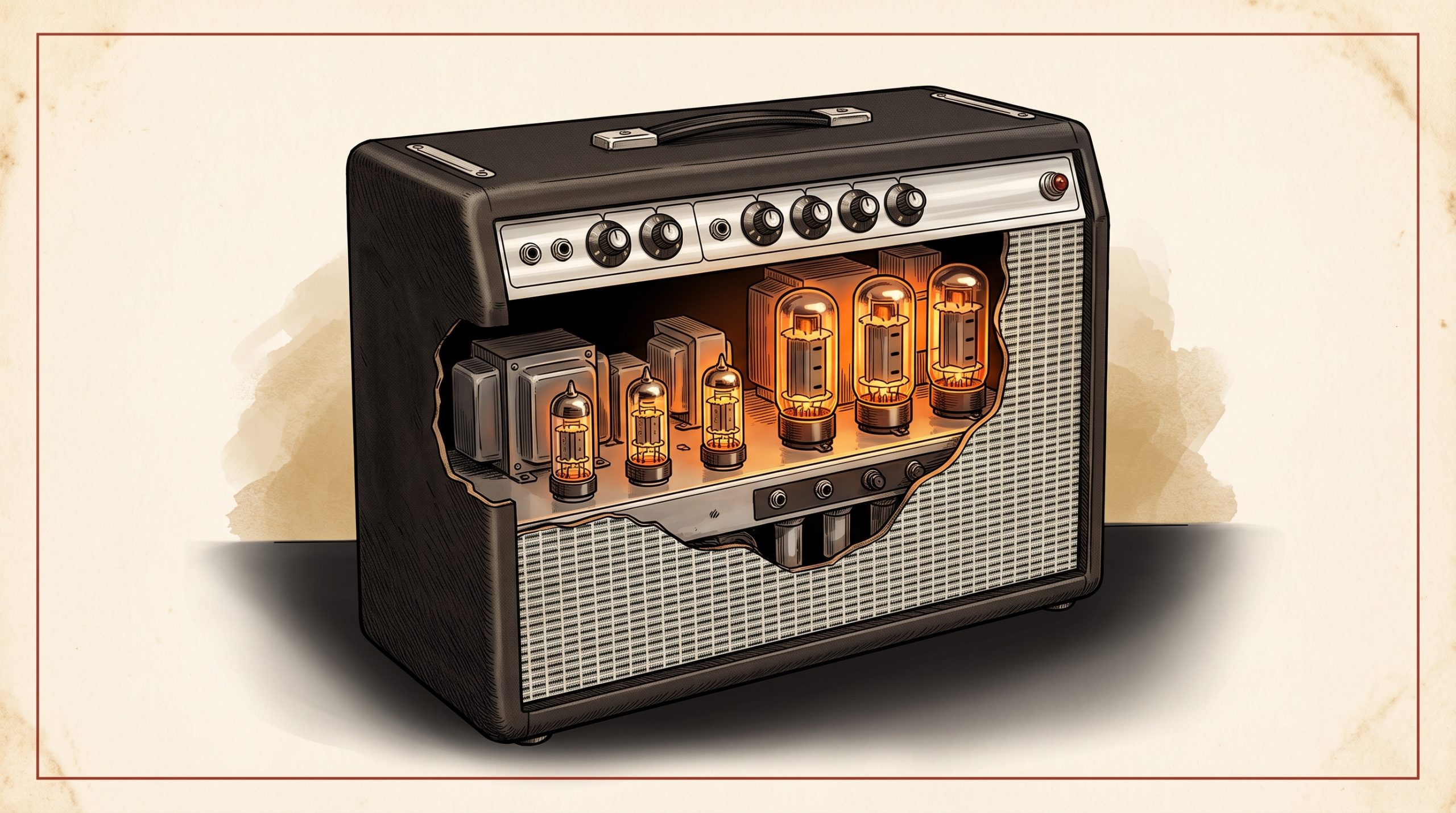
A guitar pickup generates roughly 100 to 250 millivolts of signal. That’s not enough to move a speaker cone. The glowing glass bottles inside a Fender Deluxe Reverb or a Bassman aren’t decoration or nostalgia hardware, they’re the actual amplification technology, converting that tiny voltage into the watts needed to shake air and make sound. Tube amps predate solid-state electronics by roughly four decades, and they’re still the dominant technology on professional stages in 2026. Understanding how they work isn’t just interesting, it’s the foundation for dating them, maintaining them, modifying them, and choosing between them. This guide uses Fender-specific circuits and real datasheet specs throughout, not generic descriptions.
- Amplification device: vacuum tube (triode or pentode), not a transistor
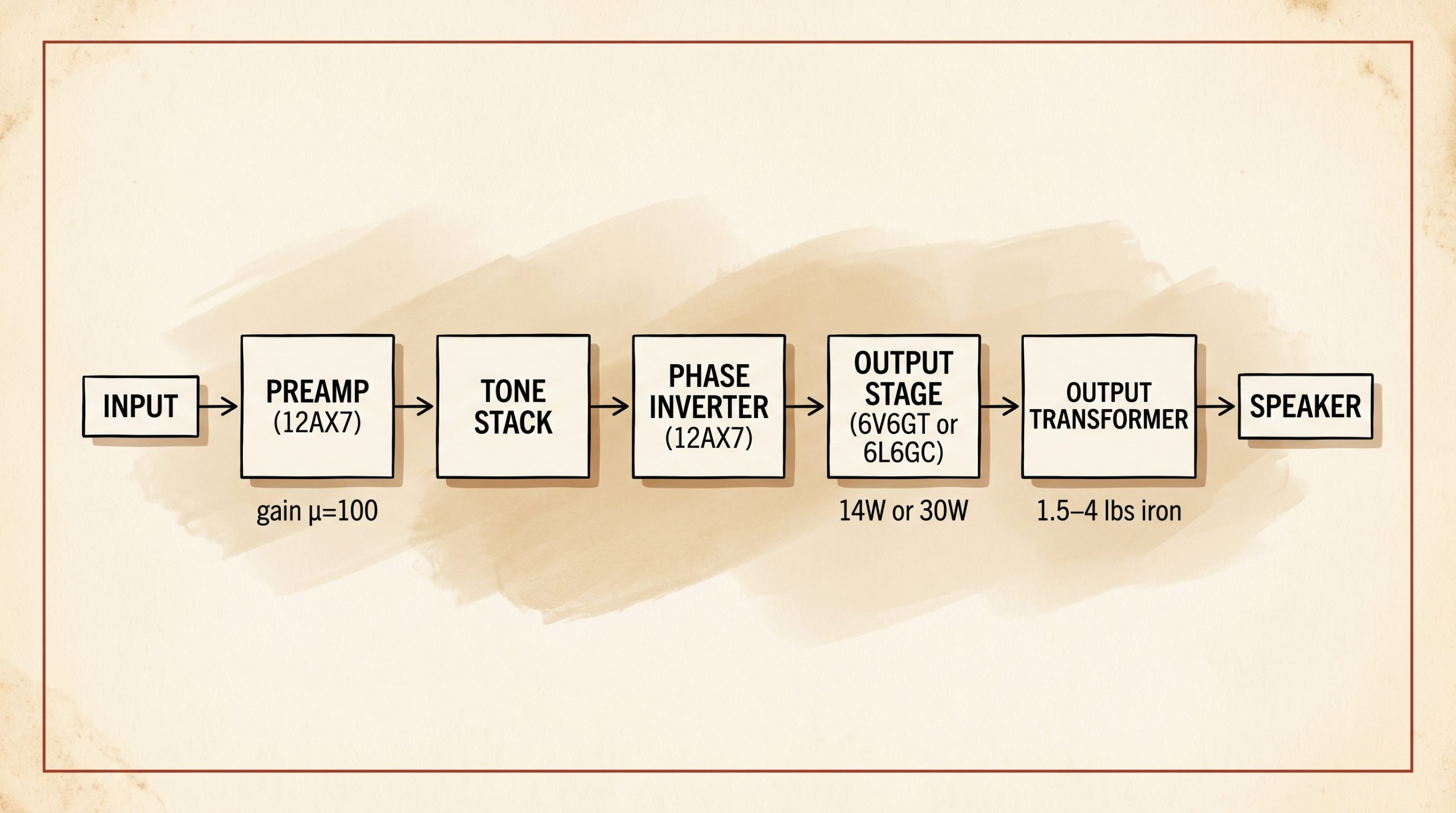
- Signal path stages: preamp, tone stack, phase inverter, output, output transformer
- Common preamp tube: 12AX7 (ECC83), gain factor µ=100
- Common output tubes: 6V6GT (14W dissipation) and 6L6GC (30W dissipation)
- Fender blackface era circuit codes: AB763, AA763, AA1164
- Output transformer adds 1.5–4 lbs of iron, main reason for high weight
- Output tubes typically last 1,000–3,000 hours; periodic replacement required
- New-old-stock tube prices elevated post-2022 due to Russian supply chain disruption
- A “warm” tone at 3% THD can sound better than solid-state at 0.1% THD, the type of distortion matters more than the quantity
The 60-Second Version: What a Tube Amp Actually Does
Signal In, Bigger Signal Out
Every amplifier, tube or solid-state, has the same job: take a weak input signal and deliver a stronger output signal with enough current to drive a speaker. A single-coil pickup produces roughly 100 to 200mV. A humbucker gets closer to 200 to 400mV. Neither moves a speaker. A tube amp’s output stage delivers voltage and current sufficient to move that cone, producing sound pressure levels that fill a room. Transistor amps do the same job, but the mechanism and the sonic byproducts of that process are different, more on that below.
Why “Vacuum”?
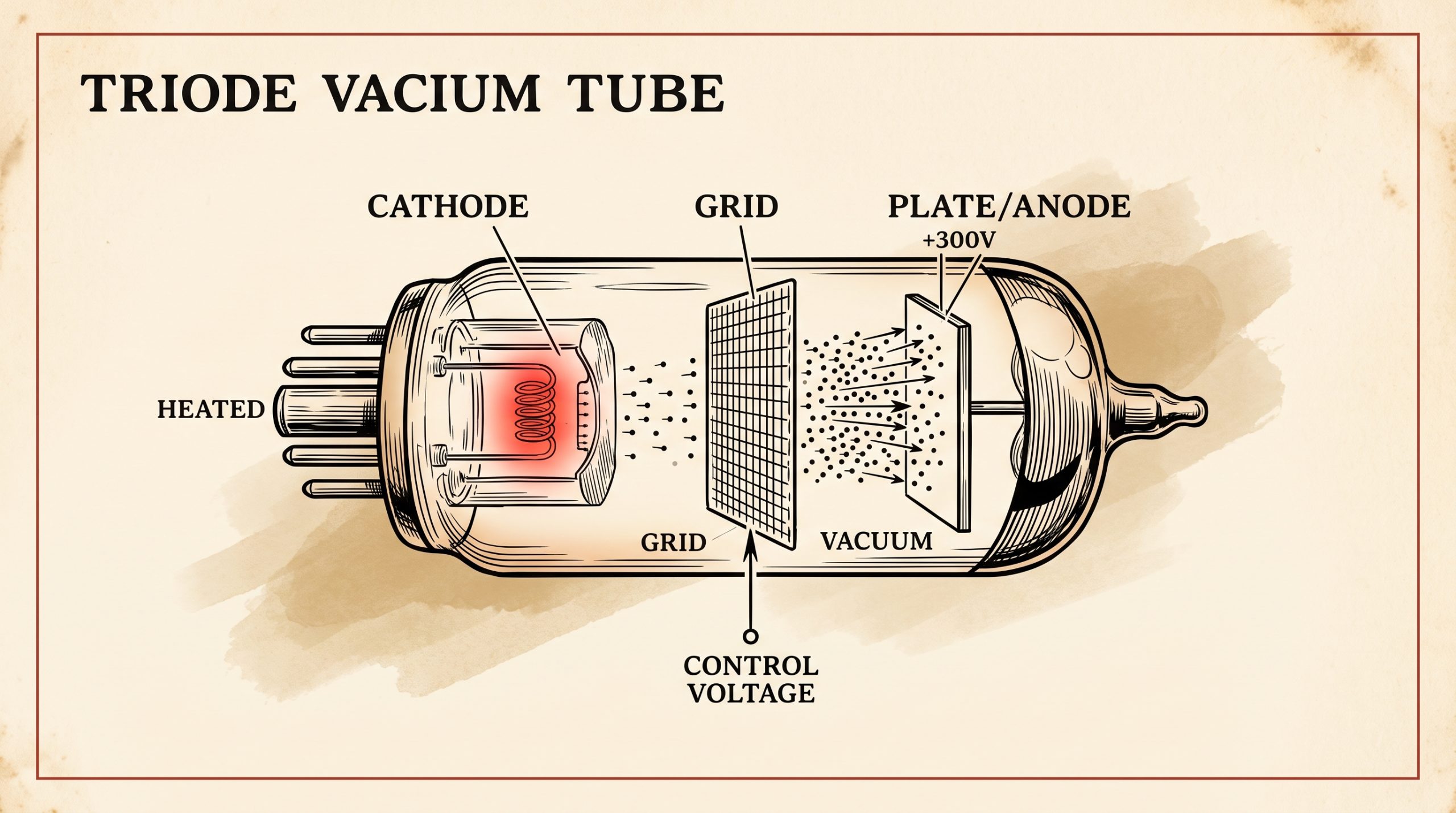
The glass envelope of a tube is evacuated, most air is removed. With no air molecules present, electrons can travel freely from a heated cathode to a positively-charged plate (anode) when a control voltage is applied to the grid between them. That grid voltage modulates the electron flow, and the variation in plate current mirrors, and amplifies, the input signal. The physics traces back to Thomas Edison’s observation of electron emission from a heated filament in 1883, refined into a practical diode by John Fleming in 1904 and into a triode by Lee De Forest in 1906. That triode topology is still what sits in the V1 socket of your Deluxe Reverb today.
A Brief History: From Radio Laboratories to the Fender Tweed Era
The Pre-Guitar Years (1904–1930s)
Tubes entered commercial life in radio receivers and military communications equipment. By the early 1920s, RCA was producing over one million tubes annually for broadcast and domestic radio use. The Fleming valve, the De Forest Audion, and the RCA commercial triode built the industrial infrastructure that would eventually supply Leo Fender’s production line. None of this had anything to do with guitars yet.
Tubes Enter the Guitar Amp (1930s–1940s)
The earliest practical guitar amplification context is the Rickenbacker “Frying Pan” lap steel and the Electro String amplifier, both circa 1932. These were crude by later standards, but they established the principle. Fender’s first commercial amps appeared with the Model 26 “Woodie” series in 1946, K&F precursor circuits in a wooden cabinet. All-tube signal paths were the only option at this point. The transistor wasn’t invented until 1947 at Bell Labs, and it didn’t appear in guitar amplification until the late 1960s and 1970s.
The Golden Age: Fender’s Tweed, Brownface, Blonde, Blackface, and Silverface Eras
The table below documents the five major production eras, their circuit designations, representative models, and output tube complements, all primary reference data.
| Era | Approx. Years | Representative Models | Circuit Code | Output Tubes |
|---|---|---|---|---|
| Tweed | 1948–1960 | Bassman 4×10, Champ 5F1, Deluxe 5E3 | 5E3, 5F6-A | 6L6GC / 6V6GT |
| Brownface | 1959–1963 | Concert, Vibrasonic, Pro | 6G15, 6G4 | 6L6GC |
| Blonde | 1960–1963 | Tremolux, Bandmaster | 6G9, 6G7 | 6L6GC |
| Blackface | 1963–1967 | Deluxe Reverb AB763, Super Reverb AA763, Twin Reverb AB763 | AA763, AB763 | 6V6GT / 6L6GC |
| Silverface | 1967–1981 | Deluxe Reverb AA1270, Twin Reverb AA769, Champ AA764 | AA1270, AA769, AA764 | 6V6GT / 6L6GC |
One important clarification: the shift from blackface to silverface cosmetics in late 1967 didn’t change the fundamental tube complement on most models. The circuit modifications were subtler, increased negative feedback on some models, revised tone stack values, a shift to solid-state rectifiers on larger silverface amps post-1970. The tubes themselves stayed largely the same. You can use the Fender tube amp serial number and dating guide to pin down exactly which circuit revision a given chassis carries based on transformer codes, tube charts, and date stamps.
How Does a Tube Amp Work? The Signal Chain Explained
Stage 1: The Input and Preamp Stage
Guitar signal arrives at the input jack at somewhere between 100mV and 400mV depending on pickup type. The first gain stage, typically one half of a 12AX7 dual-triode, amplifies that voltage. The 12AX7 has a gain factor (µ) of 100, the highest of any common dual-triode preamp tube. Signal exits that first stage at roughly 1 to 2 volts. In the AB763 Deluxe Reverb specifically, V1 (the first 12AX7 in the socket row) handles the initial voltage amplification from the instrument input, and a second 12AX7 handles the vibrato channel. The reverb driver and phase inverter are separate 12AT7 stages further down the signal chain. Exact socket numbering varies slightly across published schematics and service documentation, but the tube-type-per-function assignment (12AX7 for preamp/oscillator duty, 12AT7 for reverb-driving and phase-inversion duty) is consistent across the blackface production run.
Stage 2: Tone Stack and Effects (Mid-Chain)
The passive tone stack, those Bass, Middle, and Treble controls, actually attenuates the signal. It’s a voltage divider, not a booster. The amp has to re-amplify after the tone stack, which is one reason multi-stage preamp designs exist. Tremolo and reverb circuits in Fender blackface amps add further tube stages: the AB763 Deluxe Reverb uses a 12AT7 as the reverb driver (V4). The 12AT7 has a gain factor (µ) of 60, lower than the 12AX7, but with more available plate current, making it better suited for driving the reverb tank’s input transducer.
Stage 3: The Phase Inverter
Push-pull output stages require two out-of-phase signals, one tube conducts while its partner cuts off. The phase inverter converts the single-ended signal from the preamp into these complementary signals. Two topologies show up in Fender circuits: the cathodyne (used in some tweed-era designs) and the long-tailed pair, which is standard in blackface circuits from AB763 onward. The long-tailed pair uses both triode halves of a single 12AT7, cross-coupled through a shared cathode resistor, and is self-balancing, producing lower distortion than the cathodyne under most conditions.
Stage 4: The Output Stage (Where the Power Happens)
This is where the real voltage multiplication occurs. Two (or four) output tubes work in complementary push-pull pairs. The 6V6GT operates in Class AB at a typical plate voltage of 350 to 420V DC, with a maximum plate dissipation of 14 watts. A pair in a Deluxe Reverb delivers roughly 22 watts of output. The 6L6GC runs at higher plate voltages (400 to 450V), with a maximum plate dissipation of 30 watts. A pair in a Bassman or Super Reverb delivers around 40 watts; a quad in a Twin Reverb reaches 85 watts. Push-pull topology cancels even-order harmonics at idle, which means the primary distortion products under clipping are odd-order, but the specific behavior of tube output stages under saturation shifts that balance in interesting ways that solid-state doesn’t replicate. Bias, the DC operating point at the output tubes, determines where in their transfer curve the tubes idle, affecting efficiency, tube life, and tone. It requires periodic adjustment as tubes age.
For a deeper comparison of these two output tube families and how they affect an amp’s character, the 6V6 vs 6L6 breakdown covers the specs, the sonic differences, and the specific Fender circuits that use each.
Stage 5: The Output Transformer
Tube output stages present high impedance. Speakers don’t. A typical push-pull output stage presents a plate-to-plate impedance of roughly 2,000 to 8,000 ohms depending on the circuit; your speaker cabinet is 4, 8, or 16 ohms. Without an output transformer stepping down voltage and stepping up current, almost no power would transfer to the speaker. That transformer is a major reason tube amps weigh what they weigh: a quality output transformer from the Schumacher-era Fender production adds approximately 1.5 to 4 lbs of iron to the chassis. It’s also a major reason tube amps sound the way they do, the transformer’s frequency response, saturation behavior, and interaction with speaker impedance curves all contribute to the final sound.
Stage 6: The Power Supply and Rectifier
The power supply converts AC mains voltage into the high-voltage DC (the “B+” rail) that feeds all the tube stages. In tube-rectified Fender designs, a rectifier tube, most commonly the GZ34 (5AR4) through the blackface era, handles this conversion. The GZ34 is rated for 250mA maximum current. Under hard picking transients, when the output tubes demand sudden bursts of current, the B+ voltage momentarily sags by roughly 10 to 15 volts. That momentary sag compresses the attack slightly, then recovers. Players describe this behavior as the amp “breathing” or feeling “spongy.” It’s not a flaw, it’s a behavior many players actively seek. Larger silverface models (notably the Twin Reverb) shifted to solid-state rectifier diodes post-1967, eliminating sag in exchange for tighter, more consistent response.
The Main Tube Types Used in Guitar Amplifiers
The six tubes below cover the vast majority of what you’ll encounter in a vintage or current-production Fender circuit. Specs are from manufacturer datasheets, not approximations.
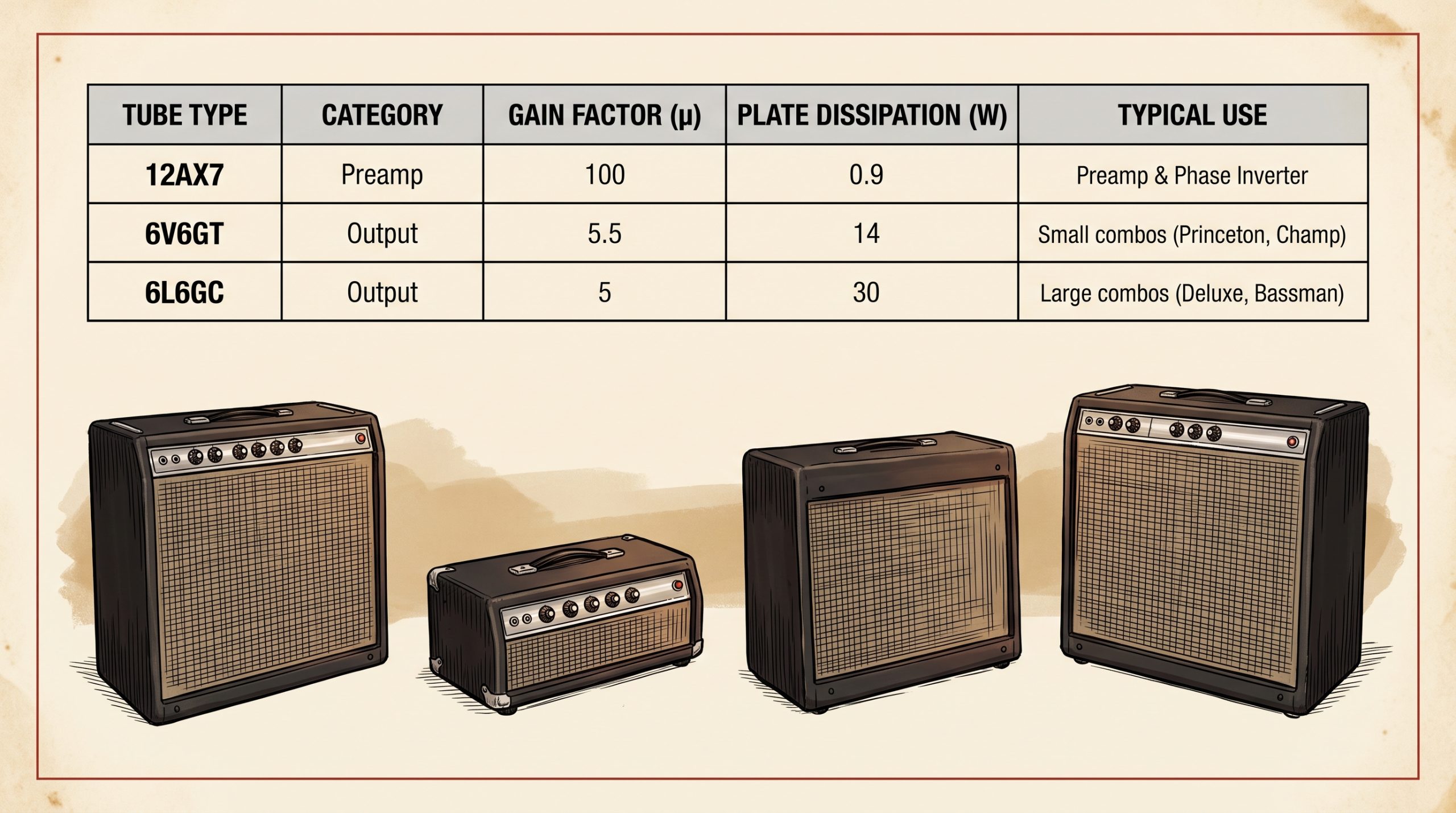
| Tube Type | Role | Gain Factor (µ) | Max Plate Voltage | Max Plate Dissipation | Typical Fender Application |
|---|---|---|---|---|---|
| 12AX7 (ECC83) | Preamp | 100 | 300V | 1.2W per triode | Normal & vibrato channel preamp, reverb recovery, and tremolo oscillator in AB763 Deluxe Reverb |
| 12AT7 (ECC81) | Reverb driver / phase inverter | 60 | 300V | 2.5W per triode | V4 reverb driver in AB763 |
| 6V6GT | Output (lower power) | N/A (pentode) | 315V (RCA spec) | 14W | Deluxe Reverb, Champ, Princeton |
| 6L6GC | Output (higher power) | N/A (pentode) | 500V | 30W | Twin Reverb, Bassman, Super Reverb |
| EL34 | Output (British-voiced) | N/A (pentode) | 800V | 25W | Not standard Fender, Marshall, Hiwatt |
| GZ34 (5AR4) | Rectifier | N/A (diode) | 1,400V PIV | 250mA max | Blackface Deluxe Reverb, Princeton |
The EL34 is included above because players researching tube amps generically will encounter it, but it has no place in a standard Fender circuit. If someone is trying to sell you an “original” blackface Fender with EL34s installed, that’s not factory spec. A complete breakdown of the 12AX7’s construction, NOS sourcing, and current-production alternatives is covered in the 12AX7 tubes guide.
Why Tube Choice Affects Tone
The 6V6GT reaches its maximum plate dissipation at lower volumes than the 6L6GC. That earlier breakup produces a more compressed, midrange-forward character, the spanky attack and spongy compression that define a Princeton Reverb pushed hard. The 6L6GC stays cleaner longer, with tighter bass response and more headroom, which is why the AB763 Twin Reverb at 85 watts can stay clean at stage-loud volumes that would have a Deluxe Reverb breaking up significantly. Swapping a 12AX7 (µ=100) for a 12AU7 (µ=17) in the first preamp position is a common technique for reducing preamp gain, useful if an amp barks when pushed too early in the volume sweep.
What Does a Tube Amp Sound Like? The Sonic Case
Even-Order vs. Odd-Order Harmonics: The Science of “Warmth”
When a tube amp clips, the dominant distortion products are second-order harmonics, one octave above the fundamental, a musically consonant relationship. Solid-state clipping under comparable conditions produces predominantly third, fifth, and seventh harmonics, odd-order content that sits at musically dissonant intervals above the fundamental. Measurably, a typical 6L6 output stage at 1 watt output shows total harmonic distortion (THD) around 1 to 3%, almost all of it second-order. A solid-state amp at the same power level might measure 0.01 to 0.1% THD, better on paper, but with a higher ratio of odd-order content at the clipping threshold. The quantity of distortion is less relevant than its mathematical relationship to the signal. That’s why tube amps at 3% THD can sound more musical than a transistor amp at 0.1%. Not opinion. Physics.
Dynamic Response and Touch Sensitivity
The output transformer’s non-linear saturation behavior, combined with rectifier sag, creates a response that varies with pick attack intensity. A light touch keeps the amp in its linear operating range. Dig in hard, and the momentary B+ droop compresses the attack, then releases, sustaining the note as the supply recovers. This behavior isn’t captured in a spec sheet. It’s why players describe tube amps as “breathing” or “responding to your playing.” Solid-state designs can approximate it, but the physical mechanism is different.
The Role of Speaker Interaction
Unlike a solid-state output section, which behaves as a near-ideal voltage source with very low output impedance, a tube output stage presents significant source impedance through the output transformer. Speaker impedance isn’t flat, a Jensen C10Q has an impedance peak around 40Hz that can be two to three times its rated impedance. When a tube output stage drives that reactive load, the interaction produces frequency-response variation that changes with volume and playing dynamics. In the AB763 Super Reverb with its four Jensen C10Q speakers, that 40Hz impedance rise contributes to what players describe as “bass bloom”, the warm, rounded low end that doesn’t tighten up under high-volume playing the way a solid-state amp into the same cabinet would.
Tube Amp vs. Solid State: A Direct Comparison
Players new to vacuum tube amplification often encounter the phrase “regular amp” to mean solid-state or digital modeling. Neither tube nor solid-state is categorically better, they’re different tools with different behaviors. Guitar World’s gear team notes that tube amps respond directly to input signal in a way that delivers tonal characteristics valued across generations of players, particularly in live and studio contexts where touch sensitivity matters (as documented at guitarworld.com). The comparison table below puts the differences in concrete terms.
| Factor | Tube Amp | Solid State Amp |
|---|---|---|
| Amplification device | Vacuum tube (triode / pentode) | Transistor / MOSFET / IC |
| Typical combo weight | 35–65 lbs (output transformer) | 15–30 lbs |
| Warmup time | 30–60 seconds minimum | None, instant on |
| Maintenance | Periodic tube replacement ($50–$200+) | Minimal, solid-state devices last decades |
| Clipping character | Even-order (musically consonant) | Odd-order (can be harsh at threshold) |
| Dynamic response | Non-linear / touch sensitive | Linear / consistent |
| Reliability | Tubes fail; fragile under physical shock | Higher, no consumable components |
| Cost (new, comparable quality) | $500–$3,000+ | $100–$800 |
| Vintage collector value | High, pre-CBS Fenders $2,000–$15,000+ | Minimal |
Tube amps remain the professional standard for electric guitar in live and studio contexts in 2026. Solid-state dominates in bass amplification (Ampeg SVT hybrid designs, for example) and in studio monitor and PA contexts where flat, accurate reproduction matters more than harmonic character. Neither is wrong for its application.
How to Tell If an Amp Is a Tube Amp
The PAA question “how do I know if my amp is a tube amp?” gets a frustratingly vague answer from most search results. Here’s a practical field method.
Visual Identification Cues
The most obvious tell is the tubes themselves. Glass bottles with visible internal metal structures, grids, plates, cathode sleeves, will be visible through chassis vents or, on open-back combos, through the rear panel. Count the tubes: a Fender Deluxe Reverb has nine total (four 12AX7 preamp/oscillator tubes, two 12AT7 reverb-driver and phase-inverter tubes, two 6V6GT output tubes, and one GZ34/5AR4 rectifier tube). The output transformer is the second major visual indicator, a large rectangular iron block bolted to the chassis, heavier and larger than anything in a solid-state design. If the amp has a tube rectifier, you’ll see a smaller bottle near the power transformer, typically on an octal (8-pin) base with a rounded top. Not subtle.
Electrical Identification Cues
Every tube amp has a standby switch. Solid-state amps never need one. The standby function allows the heater filaments to warm up and establish proper cathode emission before B+ voltage is applied, skipping this process on a cold amp can shorten output tube life. If you see a switch labeled STANDBY, STBY, or HV, it’s a tube amp. Warmup time is another tell: if an amp requires 30 to 60 seconds before producing sound, a tube rectifier or tube preamp section is present. Weight is also a useful proxy, a 1×12″ combo weighing more than 30 lbs almost certainly contains output tubes and an output transformer.
On the Label and Serial Number
Fender tube amps carry transformer codes (Triad, Schumacher, Triad/Schumacher transition, and later Tolex-era codes) that confirm the tube complement and approximate production date. The tube chart pasted inside the cabinet lists every tube type and socket position by designation. Original owner’s manuals specify the complete tube complement. For chassis-level dating using transformer EIA codes and serial number prefixes, the Fender Deluxe Reverb guide walks through exactly what each code position on the AB763 chassis means, the same methodology applies across the blackface and silverface lineup.
Are Tube Amps Still Being Made? The 2026 Market Reality
Current Production Status
Yes. Definitively. Fender, Marshall, Vox, Mesa/Boogie, Matchless, Dr. Z, Carr, and several dozen boutique builders are actively manufacturing tube amps in 2026. Fender’s ’65 Deluxe Reverb Reissue (AB763 spec) and ’65 Twin Reverb Reissue carry current street prices of roughly $1,785 and $2,200 respectively through authorized dealers as of 2026, up meaningfully from their launch-era MSRPs. At the boutique end, point-to-point handwired amps like the Matchless DC-30 and Carr Mercury V sell for $2,500 to $6,000. The market isn’t shrinking. Boutique builders specifically have expanded since the early 2000s, not contracted.
The Tube Supply Chain Question
New-old-stock (NOS) American and European tubes, GE, RCA, Mullard, Telefunken production from the 1950s through 1970s, are increasingly scarce and priced accordingly. A matched pair of NOS Telefunken 12AX7s can run $150 to $300. For current production, JJ Electronic (Slovakia) and Electro-Harmonix and Sovtek (historically Russian, supply disrupted post-2022) have been the dominant choices for Fender-style circuits. The Russia-Ukraine conflict created meaningful supply chain pressure beginning in 2022, with prices for Sovtek and EH tubes rising approximately 20 to 35% over 18 months. As of 2026, JJ’s 6V6S and the EH 6L6GC remain the most commonly recommended current-production choices for blackface Fender circuits. Chinese manufacturers (Shuguang, Psvane) offer additional options, particularly for the upper end of the boutique market. JJ Electronic’s own product specifications are available at jj-electronic.com.
Tube Amp Maintenance Basics: What Owners Actually Need to Know
When to Replace Tubes
Preamp tubes (12AX7, 12AT7) typically last 5,000 to 10,000 hours of actual use. Many players never replace them unless a tube fails outright, noise, microphonics, or dead silence from one channel being the common symptoms. Output tubes wear faster: 1,000 to 3,000 hours depending on bias point, average volume, and operating temperature. Signs of output tube wear include decreased overall volume, increased hum, or the most serious indicator: red-plating, where the plate inside the tube glows orange or red. Red-plating means the tube is dissipating far more than its rated wattage. Power down immediately if you see it. Annual inspection is a reasonable schedule for a gigging amp.
Biasing: The Most Important Maintenance Task
Output tubes require periodic bias adjustment as they age. The DC operating point (bias) drifts as the tube’s emission characteristics change. For a 6V6GT pair in a Fender Deluxe Reverb, the typical target is 70 to 75% of maximum plate dissipation, roughly 23 to 25mA per tube at the operating B+ voltage of approximately 415V DC. Fixed-bias circuits (the standard in blackface Fenders from the AB763 era forward) require a technician or an experienced DIYer with a digital multimeter and an understanding of high-voltage safety procedures. Don’t skip this. Cathode-bias designs, the tweed Champ 5F1 and the 5E3 Deluxe, are self-adjusting. Tubes can be swapped without a bias adjustment, which is one reason they’re popular platforms for tube rolling. Tung-Sol’s published datasheet for the 6V6GT covers the bias operating range in full at tubesandmore.com.
What to Explore Next
Understanding tube amp fundamentals, signal stages, tube roles, output transformer function, harmonic distortion physics, gives you the foundation for everything else: identifying which circuit is inside a vintage chassis, making informed tube swaps, reading a bias spec correctly, and knowing when an amp needs a technician versus a simple tube replacement. The Fender circuit codes referenced throughout this guide (AB763, 5E3, AA763, AA769, AA1270) all have documented service bulletins that map directly to the component-level behavior described above. For players and collectors working with specific models, the Fender amp dating cheatsheet puts the transformer codes, speaker date codes, and era classifications in one fast-reference table, the logical next stop from the era overview above. The tube supply situation in particular warrants checking current JJ Electronic and Tung-Sol availability before committing to a new set of output tubes, as pricing has shifted meaningfully since 2022 and continues to fluctuate. Tung-Sol’s current production data is maintained at tung-sol.com.
Frequently asked questions
What's the point of a tube amp?
Tube amps produce even-order harmonic distortion, primarily second-order, one octave above the fundamental, when driven hard. That's musically consonant distortion, not harsh clipping. Combined with the dynamic, touch-sensitive response created by rectifier sag and output transformer interaction, tube amps change character based on how hard you play them. That behavior has defined recorded electric guitar from the 1950s onward. For players who want warm clean tones that respond to pick attack, or natural breakup that tracks dynamics rather than a fixed threshold, tube amplification delivers something solid-state designs approximate but don't fully replicate.
What's the difference between a tube amp and a regular amp?
"Regular amp" in casual conversation typically means solid-state, transistor or MOSFET-based amplification without tubes. The comparison table in the section above covers the full picture, but the two most relevant differences for guitarists are clipping character (even-order in tubes, odd-order in solid-state) and dynamic response (non-linear and pick-sensitive in tubes, linear and consistent in solid-state). The output transformer is the key physical differentiator: tube amps need one, solid-state amps don't, which accounts for much of the weight gap between the two.
Do they still make tube amplifiers?
Yes, Fender, Marshall, Vox, Mesa/Boogie, and a large boutique sector are all actively manufacturing tube amps in 2026. Fender's reissue lineup covers the AB763 Deluxe Reverb, the '65 Twin Reverb, the Princeton Reverb, and others, all in current production. The market for handwired boutique tube amps has grown since the early 2000s, not contracted.
How do I know if my amp is a tube amp?
Look for visible glass tubes through the chassis vents or rear panel, a standby switch, and a large rectangular output transformer bolted to the chassis. If the amp requires 30 to 60 seconds to produce sound after power-on, it has a tube power stage. A 1x12" combo weighing more than 30 lbs almost always contains output tubes and an output transformer. The tube chart pasted inside the cabinet will list every tube type and socket position if you need confirmation.
Are tube amps better than solid-state for guitar?
"Better" depends entirely on context. For vintage-voiced electric guitar tones in live or studio settings, tube amps remain the professional standard in 2026. For durability, weight, consistent response, and maintenance-free operation, solid-state is the stronger choice. Bass guitar amplification has largely moved to solid-state and hybrid designs for exactly those reasons. Both technologies are valid, the question is which behavior fits your application.