Contents
- 01Spec Comparison: Pro Reverb vs Deluxe Reverb
- 02Origins and Era Classification
- 03Circuit Deep-Dive: What the Schematics Actually Tell Us
- 04Tone Character: How Each Amp Actually Sounds
- 05The Forgotten Middle Ground: Why the Pro Reverb Gets Overlooked
- 06Where the Pro Reverb Sits in the Full Fender Reverb Lineup
- 07Who Should Buy Which Amp
- 08Identifying and Dating Your Pro Reverb or Deluxe Reverb
- 09FAQ: Pro Reverb vs Deluxe Reverb
- 10Pro Reverb vs Deluxe Reverb: What the Evidence Shows
- Pro Reverb circuit: AA165 1964–66 / AB668 1966–67 (blackface), AA1069 (silverface)
- Deluxe Reverb circuit: AB763 (blackface), AA1172 / later AA1270 (silverface)
- Pro Reverb power output: ~40 watts, 2× 6L6GC, 2×12″ speakers
- Deluxe Reverb power output: ~22 watts, 2× 6V6GT, 1×12″ speaker
- Pro Reverb and Deluxe Reverb share the same 2-band (Treble/Bass) tone stack; neither has a dedicated mid control
- Pro Reverb weighs ~52 lbs; Deluxe Reverb ~42 lbs
- Vintage Pro Reverb originals: ~$900–$1,800 used; Deluxe Reverb originals: ~$1,200–$2,500+
- Reissue ’68 Custom Pro Reverb (2021–present) uses a single 12″ Celestion Neo Creamback, NOT the original 2×12″ Jensen C12N/Oxford 12L6 pairing
- The Pro Reverb is NOT a “bigger Deluxe Reverb.” The power tube family, tone stack, and speaker loading are all different.
- Forum claim that “the DR has more power” is wrong. The Pro Reverb has nearly double the wattage.
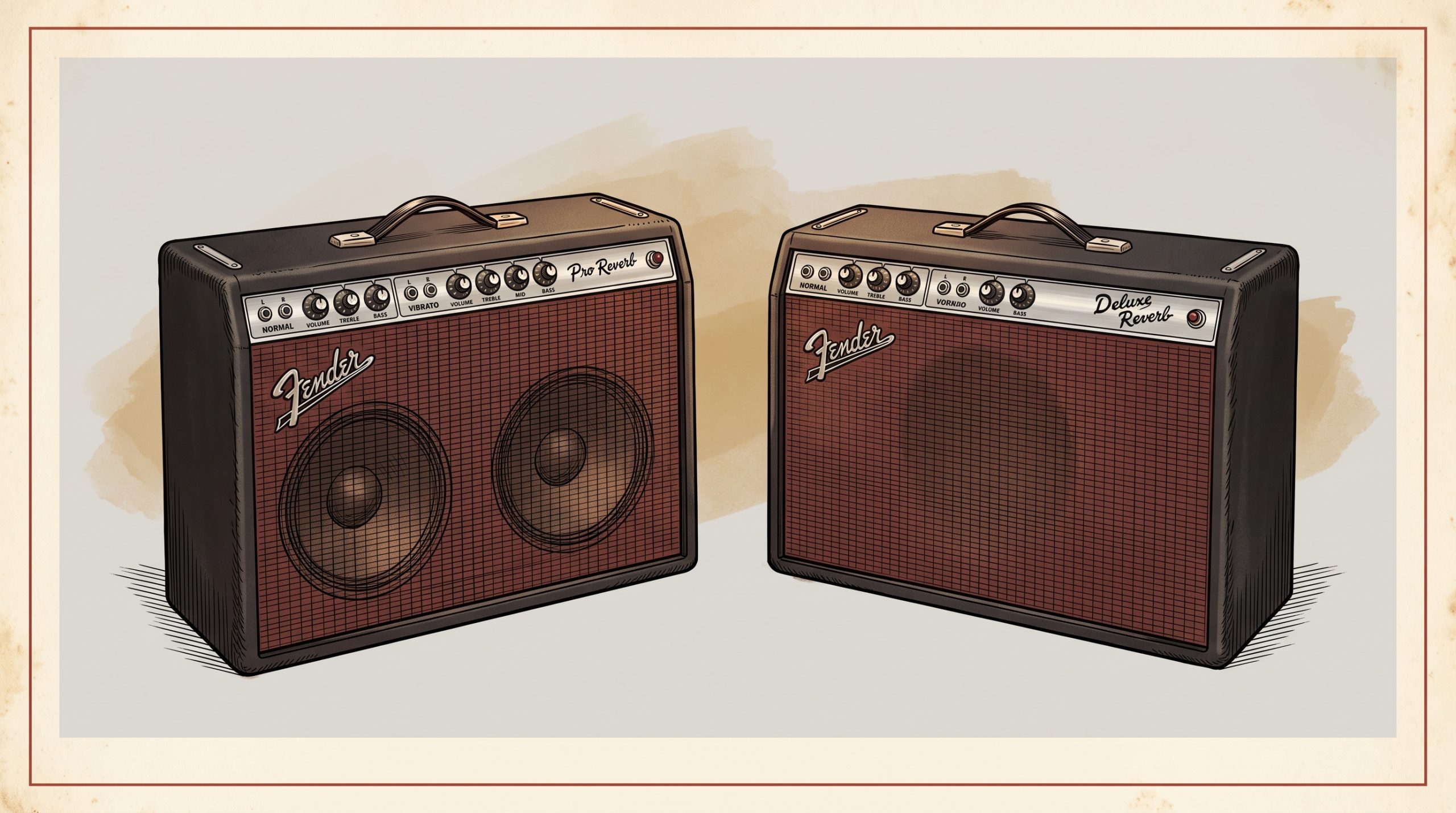
Spec Comparison: Pro Reverb vs Deluxe Reverb
These are the hard numbers, pulled from original Fender service documentation and cross-referenced with Greg Gagliano’s production research published in 20th Century Guitar Magazine (1997–2000). Circuit codes, rectifier types, and speaker complements are all documented on the factory tube charts and chassis stamps of surviving examples.
| Spec | Fender Pro Reverb | Fender Deluxe Reverb |
|---|---|---|
| Blackface Circuit | AA165 (1964–66) / AB668 (1966–67) | AB763 |
| Silverface Circuit | AA1069 | AA1172 (later AA1270) |
| Production Years (Blackface) | 1964–1967 | 1963–1967 |
| Production Years (Silverface) | 1968–1981 | 1968–1981 |
| Power Output | ~40 watts | ~22 watts |
| Power Tubes | 2× 6L6GC | 2× 6V6GT |
| Rectifier | GZ34 (early) / solid-state (later) | 5AR4 / GZ34 |
| Speaker Complement | 2× 12″ (Jensen C12N or Oxford 12L6 original) | 1× 12″ (Jensen C12N original) |
| EQ Controls | Volume, Treble, Bass | Volume, Treble, Bass |
| Channels | Normal + Vibrato | Normal + Vibrato |
| Reverb | Yes (long tank) | Yes (medium tank) |
| Vibrato | Yes | Yes |
| Weight (approx.) | ~52 lbs | ~42 lbs |
| Original 1965 List Price | ~$379.50 | ~$239.50 |
| Reissue Models | ’68 Custom Pro Reverb (2021–present) | DRRI (1993–present) |
Origins and Era Classification
The Blackface Era (1963–1967): The Golden Window
The Deluxe Reverb arrived in 1963 as a direct evolution of the non-reverb Deluxe, running the AB763 circuit that would define the blackface aesthetic for the rest of the decade. The following year, in 1964, Fender slotted the Pro Reverb into the lineup as a mid-tier option sitting above the Vibrolux Reverb and below the Super Reverb in both price and wattage. The Pro Reverb’s blackface run lasted about as long as the Deluxe Reverb’s, roughly four years, first under the AA165 circuit and then its AB668 revision, before silverface cosmetics arrived in 1968. The Deluxe Reverb built its stronger name recognition over a longer overall production run and far higher unit volume, not because the Pro Reverb’s blackface window was unusually short.
Both amps reflect the design conventions established by Fender’s engineering team in the mid-1960s: cathode-follower tone stacks, long-tailed-pair phase inverters, and fixed-bias output stages. The differences between them are deliberate product-tier decisions, not incidental. For a complete reference on identifying these circuits by chassis stamp and tube chart, the Fender tube amp dating and serial number guide covers the AA and AB prefix codes across all blackface and silverface models.
The Silverface Era (1968–1981): Diverging Paths
Both amps crossed into silverface production in 1968, but their development paths diverged. The Pro Reverb’s AA1069 silverface circuit received a solid-state rectifier from the start of the 1968 transition, trading the blackface GZ34 tube’s sag for a stiffer, more immediate attack. Players hunting a vintage Pro Reverb specifically for its blackface tube-rectifier tone need to confirm the AA165 or AB668 circuit stamp, not just the faceplate color.
The silverface Deluxe Reverb (AA1172, later AA1270) maintained a topology closer to its blackface predecessor for longer. Mid-1970s production silverfaces on both models also saw output transformer revisions that affected bass response and top-end shimmer.
The Reissue Era: ’68 Custom Pro Reverb vs. Deluxe Reverb Reissue
The Deluxe Reverb Reissue (DRRI) launched in 1993 and remains the closest production amp to the AB763 blackface circuit. It runs a Jensen C-12K 12″ speaker and delivers ~22 watts. The ’68 Custom Pro Reverb arrived in 2021, referencing silverface-era cosmetics but built on the late-blackface AB668 circuit with a “custom voiced” Normal channel rather than replicating either vintage circuit exactly. Fender also fitted it with a single 12″ Celestion Neo Creamback in place of the original 2×12″ Jensen C12N/Oxford 12L6 pairing. That switch, from two 12″ drivers to one, changes both the dispersion and the high-frequency character substantially. The Creamback is warmer and less sparkly than the original Jensens.
Neither reissue is a precise replica of its vintage ancestor. Both are useful, capable amplifiers. They’re just not direct circuit clones, and shopping for them on that basis sets up incorrect expectations. The complete Fender Deluxe Reverb guide covers the DRRI circuit deviations from AB763 in detail if you’re evaluating the reissue against an original.
Circuit Deep-Dive: What the Schematics Actually Tell Us
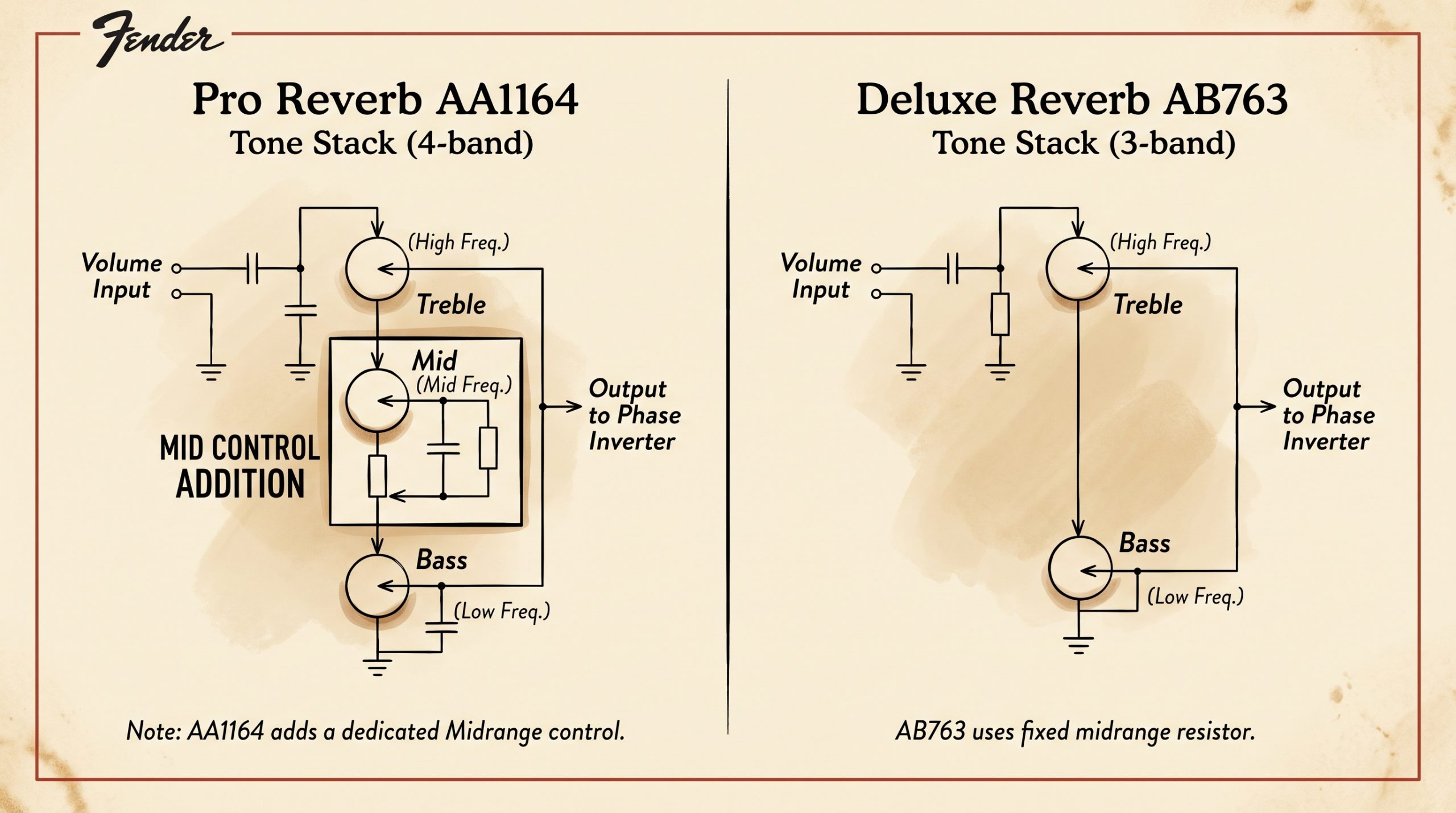
Tone Stack: A Shared Fender Two-Band Design
A persistent forum myth holds that the Pro Reverb has a dedicated mid control that the Deluxe Reverb lacks. It doesn’t. Both the AB763 Deluxe Reverb and the AA165/AB668 Pro Reverb use the same passive treble/bass tone stack with a fixed midrange scoop built into the network, no dedicated mid pot on either front panel. Techs can add a mid pot to either circuit as a mod (a 10K potentiometer wired in series with the stock 6.8K mid resistor), but that’s an aftermarket modification, not a stock difference between these two models.
Because both amps share the same fixed mid-scoop tone stack topology, the tonal differences that actually separate them come from elsewhere: power tube family (6L6GC vs 6V6GT), plate voltage, rectifier behavior, and speaker count and size. Players wanting genuine independent midrange control on a stock blackface Fender need to look outside this pair, or add an EQ pedal, or have a tech install the mid-pot mod on whichever amp they own.
Power Tube Differences: 6L6 vs. 6V6
The 6L6GC in the Pro Reverb carries a plate dissipation rating of ~30 watts per tube. The 6V6GT in the Deluxe Reverb sits at ~14 watts per tube. That’s not just a headroom number. It’s a compression and harmonic character difference. The 6V6 begins to saturate earlier, producing the spongy compression and warm harmonic content that DR players describe as “thump.” The 6L6 holds its composure longer, staying tight and clear where the 6V6 is already barking when pushed.
Plate voltage reinforces this. The DR typically runs its 6V6GT tubes at approximately 410V on the plate. The Pro Reverb runs its 6L6GC pair at roughly 420–450V. Higher plate voltage with a tube rated for it equals more clean overhead before the output stage starts adding harmonics. For a full breakdown of how these two power tube families behave across Fender’s lineup, the 6V6 vs 6L6 comparison guide covers plate dissipation, bias behavior, and substitution considerations in detail.
Rectifier and Sag Behavior
Early blackface Pro Reverbs used a GZ34 tube rectifier. Later production switched to solid-state rectification. Not great for players who want the sag. A solid-state rectifier doesn’t compress under load the way a tube rectifier does. It delivers voltage faster and more consistently, which makes the amp feel stiffer under a hard pick attack. The transient response tightens up. The DR ran tube rectification (5AR4 or GZ34) through most of its production run, which contributes to that characteristic “thump” on the attack of each note.
If you’re evaluating a Pro Reverb and you want maximum vintage character, confirm the rectifier type before buying. Tube chart stamps and the rectifier tube socket location on the chassis will tell you which version you have.
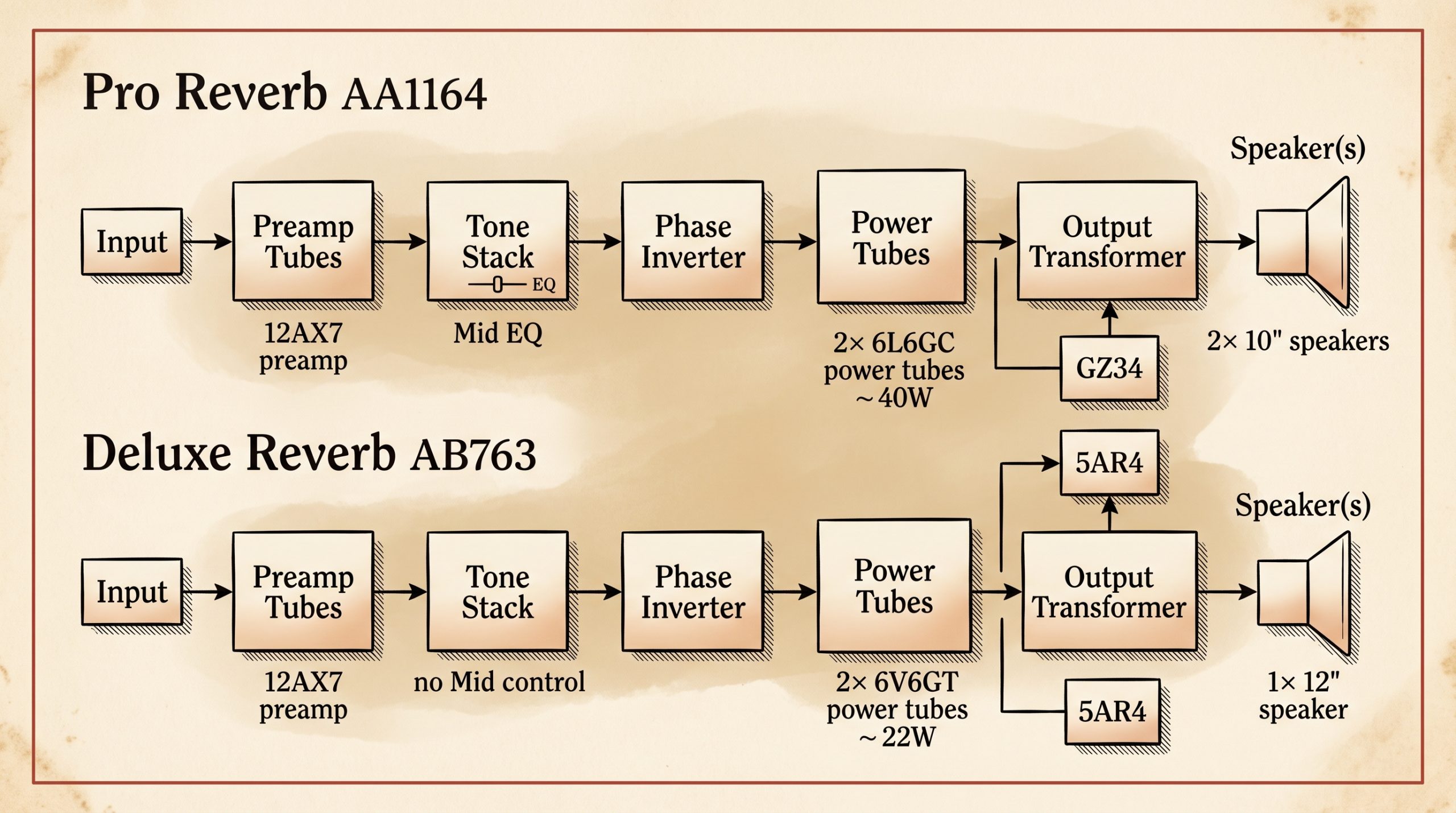
Output Transformer Loading: 2×12 vs. 1×12
Both configurations present a nominal 4-ohm total load to the output transformer, but they get there differently. The Pro Reverb’s two 12″ speakers wire together to present that combined 4Ω load; the DR’s single 12″ is a direct 8Ω load on its own output transformer tap. The two amps use the same-size driver, so the real difference isn’t cone size, it’s cone count. The Pro Reverb simply has twice the radiating surface area of the DR. Two 12″ cones move more air and disperse their sound across a wider horizontal arc on stage. The DR’s single 12″ focuses its output in a tighter, more directional pattern, with more punch straight ahead but less spread for a wider audience.
Tone Character: How Each Amp Actually Sounds
Clean Headroom: The Most Important Practical Difference
The Deluxe Reverb starts to compress and add harmonic character around 5–6 on the volume dial in a typical room. That’s where its fans live. The amp’s spanky attack turns into something warmer and more complex as the 6V6s start to work. The Pro Reverb doesn’t reach that same saturation territory until around 7–8 on the volume, and even then the 6L6s compress differently, with a less immediate onset and a more gradual transition.
Practical consequence: the DR is a bedroom-to-small-club amp when natural breakup is the goal. The Pro Reverb covers small to medium venues clean without straining. If you need to stay clean over a loud drummer, the Pro Reverb does it without requiring a separate clean boost or attenuator. If you want the output tubes doing the work naturally at manageable stage volumes, the DR is the tool.
Speaker Configuration: Why 2×12 Feels Different Than 1×12
The Pro Reverb’s 2×12 configuration doubles the DR’s radiating surface area without changing cone size. Low-end and low-mid output scale up accordingly, and the horizontal dispersion is wider, which matters in a live context where multiple people on different parts of a stage need to hear you. The 1×12 in the DR focuses its output in a tighter cone. More directional, more “punchy” in the sweet spot, but less spread for a wider audience.
The Pro Reverb’s 2×12 layout is shared with the blackface Twin Reverb, though the Twin runs nearly double the power (85W, 4× 6L6GC) and correspondingly higher headroom. The Fender Vibrolux Reverb, by contrast, uses a 2×10 configuration at ~35 watts, one step down from the Pro Reverb in Fender’s mid-tier 6L6 lineup and closer in speaker format to the Super Reverb’s 4×10 array than to the Pro Reverb’s 2×12.
Reverb and Vibrato Quality
Both amps use Accutronics spring reverb tanks. The Pro Reverb uses a longer tank than the Deluxe Reverb, which produces a longer, more diffuse decay. The DR’s medium-length tank has a somewhat tighter, more percussive spring response. Neither is objectively better. They’re matched to the amp’s intended character. The Pro Reverb’s longer tank also benefits from the 2×12 dispersion: reverb tails spread wider across the room rather than projecting in a single column. Vibrato circuits on both amps are functionally similar, sharing the optocoupler-based tremolo design common to the blackface family. The Pro Reverb’s higher headroom means the vibrato effect sits on a cleaner carrier signal, which some players prefer for a more defined modulation texture.
The Forgotten Middle Ground: Why the Pro Reverb Gets Overlooked
Production volume explains a lot. The Deluxe Reverb was built in far greater quantities than the Pro Reverb across both blackface and silverface eras. More units produced means more units surviving, more units in shops, more exposure for players who encounter them, and more secondhand demand that reinforces market visibility. The Pro Reverb never accumulated that critical mass. It’s not that it failed. It just didn’t saturate the market the way the DR did.
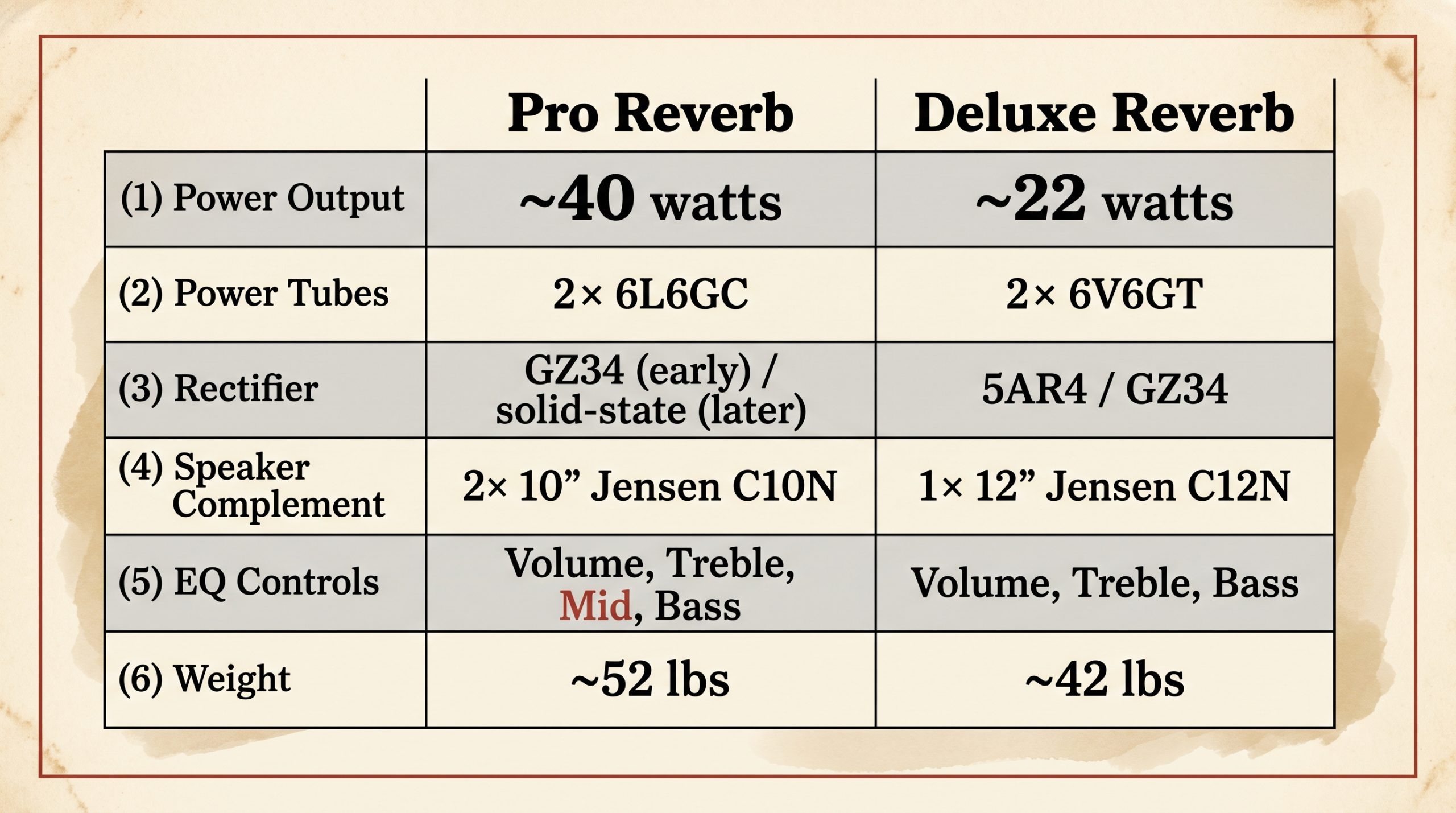
Weight is the second factor. The Pro Reverb is roughly 10 pounds heavier than the DR. Ten pounds doesn’t sound like much until you’re loading a 52-pound combo into a hatchback at midnight after a four-hour gig. The DR’s 42-pound figure is still not light, but it’s manageable solo. The Pro Reverb really wants a hand truck or a second person.
The “Goldilocks” problem finishes the job. Players shopping vintage Fender combos tend to want one of two things: the DR’s early breakup at manageable volumes, or the Twin Reverb’s headroom for loud, clean stage use. The Pro Reverb sits between both and doesn’t fit either narrative cleanly. It’s too clean for the breakup crowd and not clean enough (or loud enough) to fully replace a Twin. That middle-ground positioning is exactly where undervalued gear accumulates.
Used market pricing reflects all of this. Blackface Deluxe Reverb originals regularly fetch $1,200–$2,500 and higher depending on originality. Comparable-condition Pro Reverb originals trade in the $900–$1,800 range. You’re getting roughly double the wattage and a larger speaker configuration for less money. Premier Guitar’s coverage of the Pro Reverb, available at premierguitar.com, notes that the amp is considered a relative bargain among vintage Fenders and a capable all-around stage amp, while the Deluxe Reverb’s lighter weight and lower wattage make it more practical for home and studio use.
Where the Pro Reverb Sits in the Full Fender Reverb Lineup
Context matters here. The Pro Reverb is often compared only to the Deluxe Reverb, but it’s more accurately understood as a member of Fender’s mid-tier 6L6 lineup, sitting above the Vibrolux Reverb and adjacent to the Super Reverb in power output.
| Model | Watts | Speakers | Power Tubes | Headroom |
|---|---|---|---|---|
| Deluxe Reverb | ~22W | 1×12″ | 2× 6V6GT | Low–Medium |
| Vibrolux Reverb | ~35W | 2×10″ | 2× 6L6GC | Medium |
| Pro Reverb | ~40W | 2×12″ | 2× 6L6GC | Medium–High |
| Super Reverb | ~40W | 4×10″ | 2× 6L6GC | Medium–High |
| Twin Reverb | ~85W | 2×12″ | 4× 6L6GC | Very High |
The Pro Reverb and Super Reverb share near-identical wattage from the same 6L6GC tube complement. The difference is speaker spread: four 10″ cones in the Super Reverb produce substantially more bass weight and room-filling dispersion than two 10s. The Pro Reverb is the more focused, more portable version of that same power class. Players who find the Super Reverb too much amp for smaller venues but want more headroom than the Vibrolux Reverb provides land exactly on the Pro Reverb. Underserved. Worth it.
Who Should Buy Which Amp
Buy the Deluxe Reverb If…
- Natural power amp breakup at manageable stage volumes is the primary goal
- You play blues, rock, or country in small venues or record at home
- You’re carrying the amp without help and weight is a real constraint
- Resale value and parts availability matter to your buying decision
- Budget favors the used DRRI market at $700–$900 rather than a vintage original
Buy the Pro Reverb If…
- You need a clean platform for pedals, pedal steel, or jazz guitar at stage volumes
- You run a pedalboard-driven rig where you want the amp staying clean under you
- You want a vintage 2×12 tone that isn’t priced at a premium relative to its DR counterpart
- Medium venues where the DR can’t cut through a live drummer are your regular context
- The larger 2×12 cabinet’s extra speaker coverage and stage presence matter for your setup
What About the Hot Rod Deluxe?
The “Pro Reverb vs Hot Rod Deluxe” comparison comes up in search results, but it’s a category mismatch worth addressing directly. The Hot Rod Deluxe is a PCB-based, solid-state-rectified, channel-switching modern amplifier with no circuit lineage to either the 5E3 tweed Deluxe or the blackface AB763. Its “Deluxe” branding is cosmetic, not genealogical. The shared-cathode output stage and printed circuit board construction put it in an entirely different engineering tradition from the point-to-point wired blackface and silverface amps discussed here. For vintage tone and organic dynamics, the Pro Reverb wins that comparison without debate. For modern channel switching and effects loop features, the Hot Rod Deluxe serves a different use case entirely and doesn’t compete on the same terms.
Identifying and Dating Your Pro Reverb or Deluxe Reverb
Dating a vintage Fender combo isn’t guesswork if you know where to look. Tube chart date codes appear as a two-letter stamp inside the chassis on the tube chart itself: the first letter is the year (Q = 1966, R = 1967, S = 1968, and so on in Fender’s coding system), and the second letter is the month (A = January, B = February, etc.). A stamp reading “QA” puts the amp in January 1966 production.
Speaker EIA codes on the magnet or basket frame use a six-digit format. The first three digits identify the manufacturer: 220 = Jensen, 285 = Oxford, 137 = CTS. The remaining three digits give the year and week of manufacture. A code of 220-634 identifies a Jensen speaker from the 34th week of 1963.
Transformer codes follow the same EIA convention. Schumacher transformers carry EIA code 606, Triad uses 650. Both appear stamped on the transformer bell ends. Output transformer codes are often the most reliable dating evidence on an amp that’s had its speakers or tubes replaced.
Circuit board stamps are the most definitive identifier for era and circuit revision. Look for AA165, AB668, or AB763 on the circuit board itself, or cross-reference against the tube chart in the chassis. The Fender amp dating cheat sheet provides a quick-reference table for all these codes across blackface and silverface production runs. For a full field method covering all five identification points, the step-by-step Fender amp dating guide walks through the process in order.
Pro Reverb vs Deluxe Reverb: What the Evidence Shows
These two amps are not competing for the same role. The Deluxe Reverb, built around the AB763 circuit with 6V6GT power tubes and a single 12″ speaker, is optimized for early breakup at manageable volumes. It’s the right amp for blues, rock, and small-venue country playing where the output tubes doing the work is a feature rather than a limitation. The Pro Reverb, built around AA165/AB668 with 6L6GC power tubes and a 2×12 speaker complement, is a clean-headroom amp with more speaker coverage and more stage presence. It doesn’t try to be the DR. It solves a different set of problems.
The used market hasn’t caught up to what the Pro Reverb actually offers relative to its price. Vintage examples trade at a discount compared to Deluxe Reverbs of similar originality, despite delivering more wattage and more speaker coverage. For pedal platform players, medium-venue gigging musicians, and anyone who needs a clean foundation that holds up over a live drummer, the Pro Reverb represents one of the better-value propositions in the vintage Fender market right now. It won’t win on name recognition. It will win on the gig.
Frequently asked questions
Is the Fender Pro Reverb louder than the Deluxe Reverb?
Yes, by a significant margin. The Pro Reverb outputs approximately 40 watts through two 12" speakers. The Deluxe Reverb produces approximately 22 watts through a single 12" speaker. In a live context, the Pro Reverb maintains clean headroom at substantially higher stage volumes. The perceived volume difference is even larger than the raw wattage gap suggests because the Pro Reverb's 2×12 configuration also produces wider dispersion, making it audible across more of the stage without the volume dial going higher.
What circuit is the Fender Pro Reverb?
The blackface Pro Reverb (1964–1967) uses circuit AA165 through 1966 and its AB668 revision from 1966–1967. The silverface version (1968–1981) uses circuit AA1069. The circuit code is stamped on the tube chart inside the chassis and sometimes on the circuit board itself. The '68 Custom Pro Reverb reissue is built on the AB668 late-blackface circuit with a modified "custom voiced" Normal channel, and is not an exact replica of either vintage circuit.
Can the Pro Reverb get the same breakup tones as the Deluxe Reverb?
Not naturally at the same volume. The 6L6GC power tubes and higher wattage keep the Pro Reverb clean longer than the DR's 6V6GT output section does. Achieving DR-style power amp saturation on the Pro Reverb requires cranking the amp to volumes that are impractical in most playing environments, or using an overdrive pedal to push the preamp stage. Players who want the DR's early, organic breakup and the Pro Reverb's speaker configuration are generally better served by adding an overdrive pedal to the Pro Reverb rather than expecting the amp to self-saturate at low volumes.
How does the '68 Custom Pro Reverb compare to the '68 Custom Deluxe Reverb?
The '68 Custom Pro Reverb runs approximately 40 watts through a single 12" Celestion Neo Creamback speaker. The '68 Custom Deluxe Reverb runs approximately 22 watts through a single 12" Celestion V-Type (G12V-70). Both are built on late-blackface circuitry (AB668 and AB763 respectively) with silverface-era cosmetics and a "custom voiced" Normal channel. The Pro Reverb version delivers significantly more headroom. Neither is a precise replica of its blackface ancestor. Both use Celestion drivers rather than the Jensen or Oxford speakers in the original production amps, which shifts the tonal character toward a warmer, less sparkly top end.
Is the Fender Pro Reverb a good gigging amp?
For medium-sized venues in the 100–300 capacity range, the Pro Reverb is arguably a better fit than the Deluxe Reverb. Its 40-watt output and 2×12 speaker spread project cleanly over a drummer without the volume-induced breakup that limits the Deluxe Reverb in louder contexts. The primary trade-off is weight: at approximately 52 pounds, the Pro Reverb is noticeably heavier than the DR's 42-pound chassis. For players who gig regularly and want to stay clean at stage volumes without a pedal platform, it's a practical and underpriced option in the current used market.