Contents
- 01Quick-Reference Comparison
- 02Background: Where Did These Amps Come From?
- 03Specs Deep-Dive: What's Actually Different?
- 04Tone Comparison: How Do They Actually Sound?
- 05Build Quality, Reliability, and Known Issues
- 06Reissue Models: What Changed?
- 07Who Should Buy Which Amp?
- 08Frequently Asked Questions
- 09Which One Should You Buy?
Both amps share the same chassis, the same output section, the same series effects loop, and the same basic signal architecture. What separates them sits in the preamp: a single resistor value in the tone stack and an extra gain stage on the Hot Rod Deluxe’s third channel. Those differences add up to two amps that feel and behave distinctly despite being platform siblings. The Blues Deluxe leans warm and round, the Hot Rod Deluxe leans brighter and more versatile. Picking the wrong one is easy. Here’s how to pick the right one.
Quick-Reference Comparison
| Spec | Hot Rod Deluxe | Blues Deluxe |
|---|---|---|
| Power output | 40W | 40W |
| Power tubes | 2× 6L6GC | 2× 6L6GC |
| Preamp tubes | 3× 12AX7 (no 12AT7) | 3× 12AX7 (no 12AT7) |
| Speaker (original) | Eminence Special Design 12″ (50W) | Fender-branded Special Design 12″ (Eminence Special Design on the Reissue) |
| Channels | 3 (Clean, Drive, More Drive) | 2 (Normal, Drive) |
| Effects loop | Yes (series) | Yes (series) |
| Reverb | Spring reverb | Spring reverb |
| Weight | ~41 lbs (current IV) | ~45 lbs |
| Original MSRP (at introduction) | ~$599 | ~$549 |
| Internal model code | PR246 | Hot Rod Series circuit (exact code unconfirmed — not PR295, which is the Blues Junior’s designation) |
| Tolex (standard) | Tweed / Black option | Tweed |
| Reissue currently available | Yes (Hot Rod Deluxe IV) | Yes (Blues Deluxe Reissue) |
Background: Where Did These Amps Come From?
Three Years Apart, Same Series
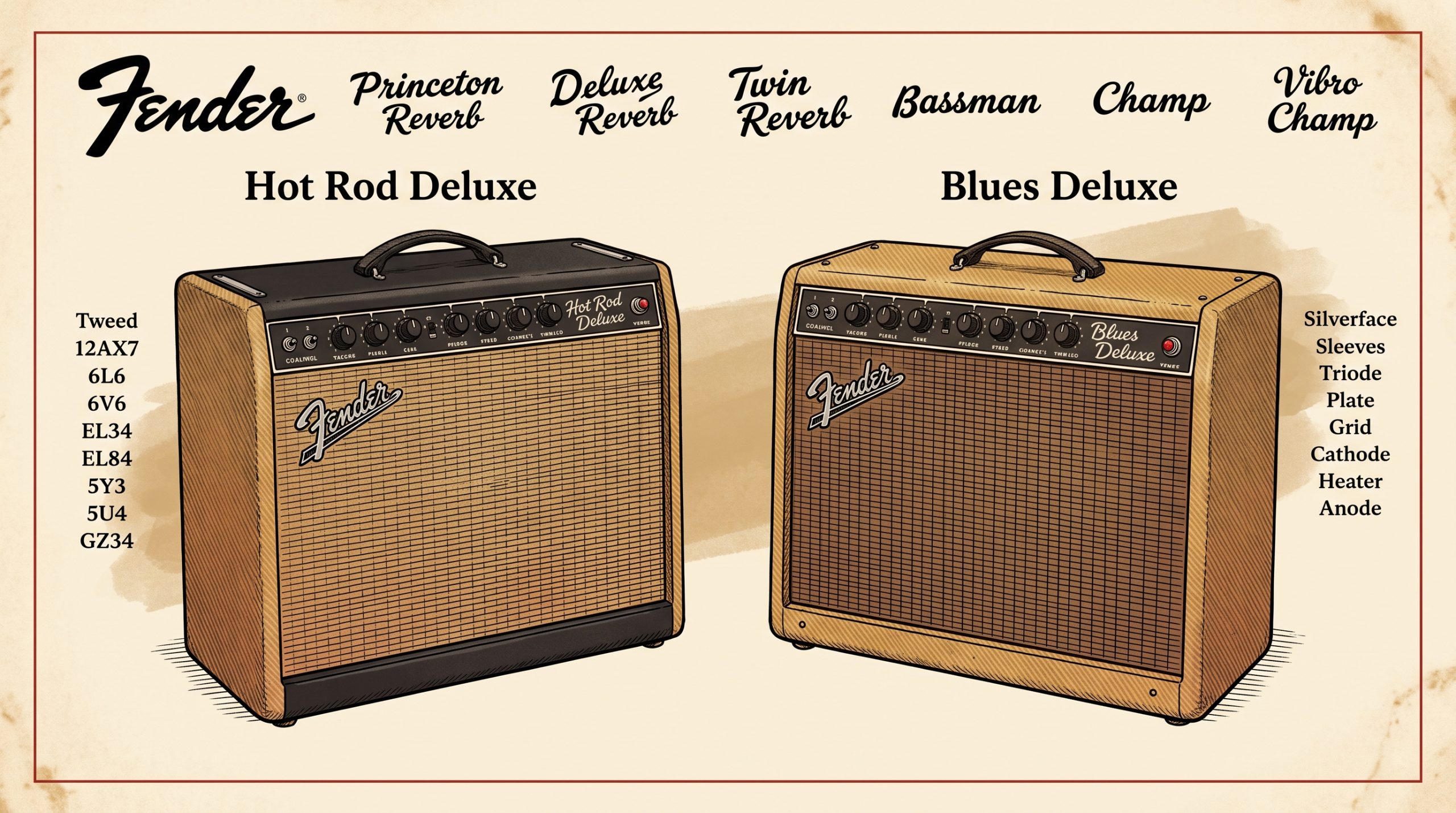
Fender launched the Blues Deluxe first, in 1993, out of its Corona, California facility — the same plant that built the Hot Rod Deluxe when it followed three years later, in 1996. The context matters: Fender was responding to mid-market pressure from Marshall and Mesa/Boogie, both of whom were selling feature-rich mid-gain combos to working players who couldn’t afford boutique gear and didn’t want a dated silverface. These amps were Fender’s answer, and they landed well enough that both are still in production three decades later.
It’s worth understanding what era these fall into for readers coming from a vintage perspective. Neither the Blues Deluxe nor the Hot Rod Deluxe is tweed, brownface, blackface, or silverface. They’re post-CBS, post-Rivera designs with PCB construction, solid-state rectifiers, and channel-switching circuitry that the original AB763 platform never had. Don’t approach them expecting a Princeton Reverb. They’re a different tool entirely.
Production history differs between the two. The Blues Deluxe was built in the USA from 1993 to 1997, discontinued, then reintroduced in 2005 as the Mexico-built Blues Deluxe Reissue, which has stayed in production since. The Hot Rod Deluxe stayed in continuous production from its 1996 introduction, with manufacturing moving from Corona, California to Fender’s Ensenada, Mexico facility around 2002. USA-made originals of both models generally carried heavier transformers and tighter build tolerances than the Mexico-built runs that followed. That matters for used buyers, and the back panel serial prefix helps identify origin. The Fender tube amp serial number guide covers how to read those prefix codes across production eras.
Why “Twin Brothers”?
Same chassis dimensions, same speaker baffle, same output transformer mounting, same power section topology. From the back panel, you’d need to read the badge to tell them apart. The divergence happens at the preamp stage, specifically in the tone stack and the gain-staging path. One resistor value and one extra tube stage account for most of what players hear as the “difference” between these two amps. Not a huge gap on paper. Audible in practice.
Specs Deep-Dive: What’s Actually Different?
Power Section (Where They’re Identical)
Both amps run a pair of 6L6GC output tubes in class AB push-pull configuration with a solid-state diode rectifier. No tube rectifier sag on either model. Plate voltage runs approximately 450–470V DC at the output transformer primary, consistent with Fender’s published PR246 schematic and the corresponding Blues Deluxe circuit documentation. The fixed bias is factory-set; it drifts over time and warrants checking whenever you replace output tubes. Both models share this maintenance requirement equally.
The solid-state rectifier gives these amps a stiffer, more immediate feel than a GZ34-equipped blackface. There’s no sag when you dig in. Players coming from a vintage Deluxe Reverb sometimes find that stiffness surprising. It’s not a flaw, just a different response characteristic.
The Critical Circuit Difference: The Mid-Slope Resistor
This is where the tonal divergence actually lives. The Hot Rod Deluxe uses a 130kΩ mid-slope resistor in the tone stack. The Blues Deluxe uses a 100kΩ resistor in the same position. That 30kΩ difference shifts how the tone stack interacts with mid-frequency content.
The higher 130k value on the Hot Rod Deluxe reduces low-end presence slightly and lifts perceived upper-mids, producing a brighter, more “scooped” character at equivalent knob settings. The 100k value in the Blues Deluxe retains more low-mid warmth, which is why many players describe it as “fuller” or “rounder” on the clean channel without touching the EQ. Not just a subjective impression. The frequency curve actually differs between the two circuits at that stage.
In practical terms: you can partially compensate on either amp by adjusting the mid and bass controls, but you can’t fully replicate one voicing with the other’s tone stack. The circuit sets a baseline that the EQ trims around, not the other way around.
Channel Configuration
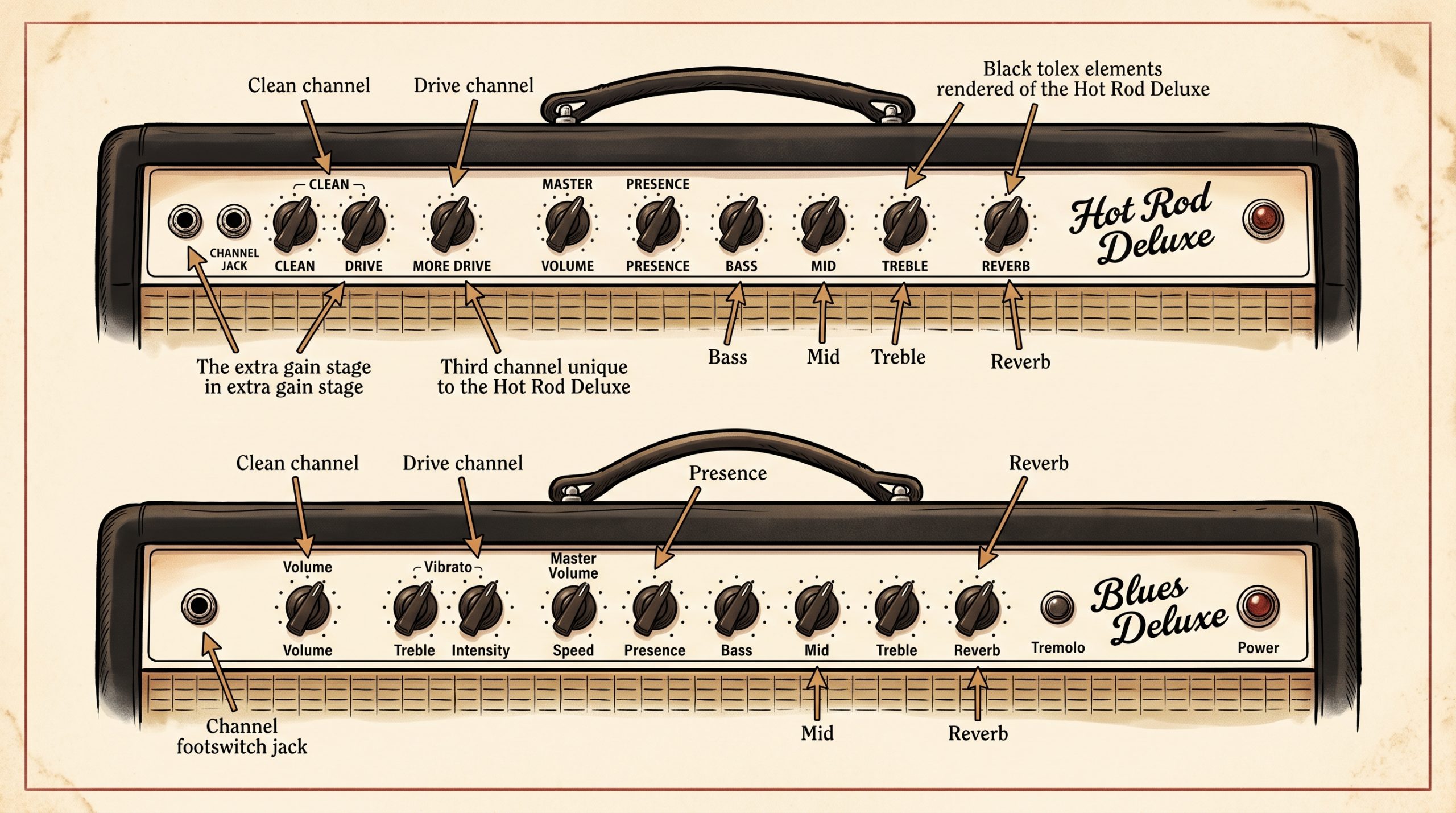
The Hot Rod Deluxe has three switchable channels: Clean, Drive, and More Drive. The Blues Deluxe has two: Normal and Drive. That sounds like a minor spec difference but it reflects a genuine architectural gap.
The “More Drive” channel on the Hot Rod Deluxe is not just the Drive channel with the knob cranked higher. It’s an additional gain stage in the preamp signal path. More gain stages mean more compression, tighter dynamics, and a denser saturation character. Some players love it. Others find it congested compared to a good overdrive pedal hitting the clean channel. The Blues Deluxe’s simpler two-channel path has fewer gain stages overall, which translates to a more open, less compressed Drive sound that many players describe as more touch-sensitive.
Effects Loop
Both amps include a series effects loop (Preamp Out / Power Amp In), so this isn’t a differentiator between them the way some comparisons assume. For players using time-based effects, particularly delay or chorus, running those after the preamp stage via either amp’s loop produces cleaner, more defined results than stacking them in front of the amp. The loop circuitry is functionally similar across both models, buffered with the same op-amp-based design used throughout the Hot Rod Series.
Speaker Complement (Original Production)
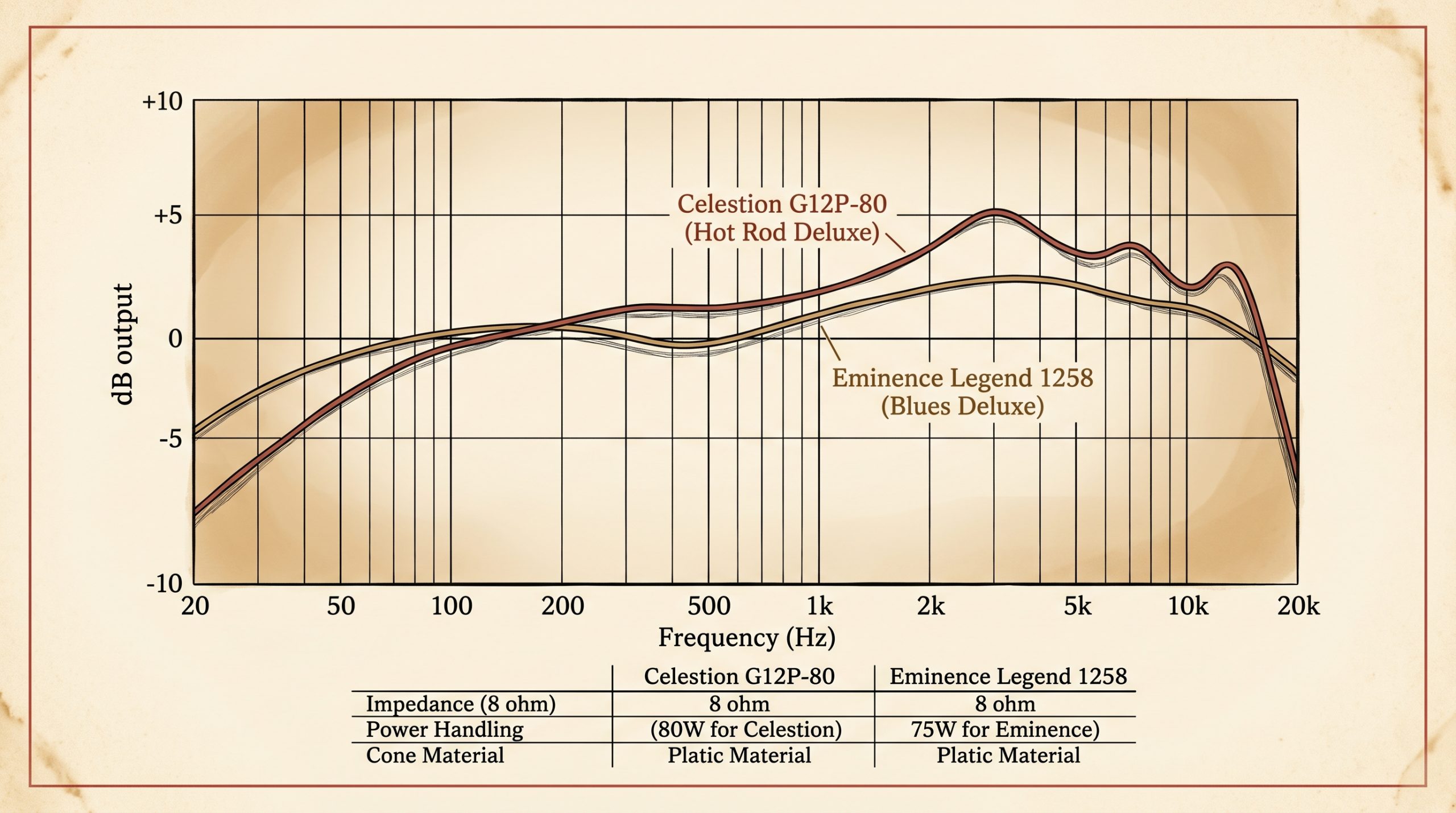
Original Hot Rod Deluxe units (Generation I/II, 1996–2012) shipped with an Eminence Special Design 12-inch (50W, 8 ohm). Original Blues Deluxe units (1993 USA production) shipped with a Fender-branded Special Design 12-inch made by a different manufacturer; the 2005-onward Mexico-built Reissue switched to an Eminence Special Design 12-inch, the same family of speaker later used across the Hot Rod Series. Both speakers land on the warmer, looser side of the Fender lineup, which is part of why neither amp sounds as scooped or hi-fi as the tone-stack differences alone would suggest.
To verify which speaker is in a used unit, check the rear of the speaker basket for the EIA code stamp in the format XXX-YYWW (manufacturer code, year, week). For a full decoding walkthrough, the article on Fender amp speaker date codes covers Oxford, Jensen, Eminence, and Celestion stamps with worked examples. The speaker is one of the highest-impact upgrade paths on both amps, and identifying the original before any swaps helps establish a baseline for comparison.
Tone Comparison: How Do They Actually Sound?
Clean Channel
The Blues Deluxe’s clean channel has a rounder low end and compresses slightly earlier than the Hot Rod Deluxe at equivalent volume settings. It’s a warmer, more “brown” quality that pairs naturally with single-coil pickups. The low-mid warmth from the 100k mid-slope resistor shows up immediately here, giving chords a density that doesn’t require tweaking the bass knob upward. Fingerpickers and chord melody players tend to land on the Blues Deluxe for exactly this reason.
The Hot Rod Deluxe’s clean channel is snappier. More attack transient, slightly brighter top end, and it stays cleaner a bit longer at higher volume settings before the preamp starts to break up. That stiffness comes from the 130k mid-slope value and the solid-state rectifier working together. Both amps begin to break up with single-coil pickups around volume 6–7. Humbuckers push that earlier, around 4–5. Bedroom-friendly volume these are not, once you start chasing natural overdrive.
Drive Channel
The Blues Deluxe drive channel is smoother and more compressed than the Hot Rod Deluxe equivalent. It’s appropriate for blues and classic rock up to early Marshall territory. There’s a softness to the onset that keeps single notes musical rather than edgy.
The Hot Rod Deluxe drive channel is more aggressive by comparison. Similar gain on tap, but the brighter mid voicing gives it a harder edge. Plug in a Les Paul and it barks when pushed. The “More Drive” channel extends that into higher-gain territory, though opinions split sharply here. Players coming from boutique amps often find it one stage too many. Players who want onboard gain versatility without a pedal board appreciate having it there.
Which Sounds Better?
That YouTube comparison circulating in the SERP results (the one where commenters consistently preferred the Blues Deluxe in “almost any clip”) captures something real: the Blues Deluxe sounds more cohesive out of the box to many ears. The warmer voicing, Eminence speaker, and simpler gain path combine into a more focused character. But “better” depends entirely on what you’re doing with it.
For fingerstyle blues, country, roots, or a transparent pedal platform, the Blues Deluxe is the stronger choice. It doesn’t get in the way. For players who need onboard gain flexibility or who play in classic rock contexts where a brighter presence helps cut a mix, the Hot Rod Deluxe earns its price premium. Neither is objectively superior. Genre and workflow determine the answer.
Build Quality, Reliability, and Known Issues
Production Era Quality Differences
USA-made originals — the Blues Deluxe through 1997, the Hot Rod Deluxe through approximately 2002 — carried heavier output transformers and tighter PCB assembly than the Mexico-production models that followed each line. The transformer quality difference is audible under load at stage volume. Heavier iron handles the current demands of two 6L6s more gracefully, with less compression and more headroom dynamic. Mexican-production units aren’t bad amps, but the cost-reduction shows in chassis feel and component selection on some runs.
To identify production origin on a used unit: check the back panel badge and serial number prefix. Earlier US-made units will also show higher overall chassis weight. The general-purpose Fender tube amp dating reference applies to Hot Rod series serial formats for year identification.
Known Reliability Issues
Both amps are PCB-based, not point-to-point. That means solder joint integrity matters more than it would on a hand-wired build. The Blues Deluxe has a well-documented history of cracked solder joints at the PCB-mounted input and output jacks. Because the jacks are soldered directly to the board rather than hardwired, repeated cable plugging stresses those joints mechanically over time. A cracked joint here produces intermittent signal loss or crackling that changes when you wiggle the cable — easily misdiagnosed as a bad tube. The fix is resoldering the jack pads, not a full re-cap.
The Hot Rod Deluxe shares the same PCB jack vulnerability, plus a failure mode of its own: the power resistors feeding the effects loop and reverb op-amps can run hot enough over time that their solder joints fail, taking out reverb and the loop until a tech reflows them. Filter capacitor aging is also a more common culprit than output transformer failure for hum or volume loss on units over 15 years old — check caps first. Preamp tube socket oxidation is another common nuisance on both models, causing intermittent clean-to-drive switching noise. Reverb tank connection corrosion and speaker jack wear round out the typical service items on both amps.
Repairability
Serviceable. Not simple. PCB layout means a tech needs to trace signal paths carefully rather than eyeballing a turret board. That said, Fender publishes schematics for both circuits through their official Fender support and documentation portal, and the schematics are also archived at Schematicheaven.net for offline reference. A competent tech can work on either amp without manufacturer support. Output tubes should be replaced every one to two years under regular gigging conditions, with a bias check after every swap.
Reissue Models: What Changed?
Blues Deluxe Reissue
The Blues Deluxe Reissue retained the core circuit topology of the original but moved production to Fender’s Ensenada, Mexico facility starting in 2005, and standardized on an Eminence Special Design 12-inch speaker — the same family used across the Hot Rod Series — in place of the original USA unit’s Fender-branded Special Design speaker. The cosmetic presentation also evolved, with updated grille cloth and badge treatment. The circuit voicing stayed consistent with the original, which means the warm mid-slope character that defines the Blues Deluxe experience carries through to current production.
Hot Rod Deluxe IV (Current Production)
The Hot Rod Deluxe IV is meaningfully different from the original PR246. Generation III (2012) and the current Generation IV moved from the original Eminence Special Design speaker to a Celestion A-Type 12-inch (50W, 8 ohm), which tightens the low end and adds more midrange articulation compared to the earlier Eminence.
Is the IV better than an early USA original? For the Drive and More Drive channels, yes. The early PR246 units had some harshness in the upper-mid gain range that the revised preamp addresses. The clean channel on USA originals still has a slight edge in transformer headroom dynamics, but the gap has narrowed. Used early originals in good condition are still strong value buys if the output transformer checks out and the PCB solder joints have been inspected.
Who Should Buy Which Amp?
Buy the Blues Deluxe If…
- Your main genres are blues, country, roots, or Americana
- You rely on pedals for drive and want the amp to stay transparent and warm underneath
- You prefer a fuller, rounder clean tone without extensive EQ adjustment
- Channel-switching simplicity matters more than gain-stage flexibility
- You want the tweed cosmetic over black tolex
Buy the Hot Rod Deluxe If…
- You want onboard drive without building a dedicated drive pedal chain
- You want a third gain stage for onboard high-gain sounds beyond the standard Drive channel
- Your music sits in classic rock, alt-country, or country-rock territory where a brighter mid response helps you cut through
- You gig regularly and need footswitch channel access mid-set
- A three-channel option justifies the $50 price premium for your workflow
Neither? Consider These Instead
If the 40-watt single-12 format is too loud for your situation, the Fender Blues Junior runs 15 watts with a similar warm-voiced character and costs considerably less on the used market. For players who want genuine vintage Fender cleans with blackface circuit provenance, a used Deluxe Reverb is the more historically grounded option, though it trades onboard gain for that character (both the Deluxe Reverb and the amps compared here include an effects loop). The Princeton Reverb is worth considering for lower-volume applications where 40 watts is simply too much power for the room.
Which One Should You Buy?
Same platform, different priorities. The Blues Deluxe is a warmer, simpler amp that rewards players who let pedals and picking technique do the heavy lifting. It needs less adjustment to sound good out of the box, particularly if your reference point is traditional clean tones. The Hot Rod Deluxe is the right choice when you need onboard gain flexibility, a third channel for higher-gain sounds, or a slightly brighter voice that cuts through a dense stage mix. If possible, play both before committing. The resistor difference and speaker pairing create a tonality gap that’s more apparent in person than any spec sheet can convey. Used examples of either in good condition, particularly USA-made originals with verified output transformers, represent solid value in the 40-watt combo category. Check the PCB jack solder joints on any used Blues Deluxe or Hot Rod Deluxe, and pull the chassis on a used Hot Rod Deluxe to inspect the effects loop and reverb power resistors before buying.
Frequently asked questions
What is the main difference between the Hot Rod Deluxe and Blues Deluxe?
The Hot Rod Deluxe adds a third "More Drive" channel and uses a 130kΩ mid-slope resistor in its tone stack instead of the Blues Deluxe's 100kΩ. That resistor difference makes the Hot Rod Deluxe brighter and more mid-scooped, while the Blues Deluxe retains more low-mid warmth. Both amps include a series effects loop and run the same 40-watt, 6L6-based power section.
Is the Blues Deluxe or Hot Rod Deluxe better for pedals?
For front-of-amp pedals, the Blues Deluxe is generally the preferred platform. Its warmer mid voicing and simpler gain path respond more transparently to overdrive pedals without adding its own coloration on top. Both amps offer a series effects loop for time-based effects, so that isn't a deciding factor between them — for a straightforward pedal chain, most players find the Blues Deluxe less combative.
Are the Hot Rod Deluxe and Blues Deluxe the same circuit?
Nearly identical in the power section. Both use the same 6L6GC output stage, same solid-state rectifier, and similar transformer specs. They diverge at the preamp and tone stack: the 130kΩ vs. 100kΩ mid-slope resistor changes the frequency character, and the Hot Rod Deluxe adds a third gain stage (the More Drive channel) that the Blues Deluxe doesn't have. Same chassis, different preamp priorities.
Which Fender amp is better for blues: the Blues Deluxe or Hot Rod Deluxe?
For traditional electric blues, the Blues Deluxe's warmer voicing and simpler gain structure make it the more natural fit. It compresses more naturally at lower gain settings and responds well to picking dynamics. The Hot Rod Deluxe works for blues too, especially if you want the More Drive channel for occasional higher-gain passages, but its brighter character requires more EQ management to get the warm, round clean tones that suit traditional blues best.
What does the Hot Rod Deluxe IV change compared to the original?
The Hot Rod Deluxe IV (current production) features revised preamp circuitry for smoother gain transitions, an improved spring reverb tank, and a Celestion A-Type 12-inch speaker in place of the Eminence Special Design used on Generation I and II units. Early USA-made originals may still edge the IV in clean headroom dynamics due to heavier transformer construction, but the IV addresses most of the original's known drive-channel roughness.