Contents
- 01What Are EL84 and EL34 Power Tubes?
- 02EL84 vs EL34, Side-by-Side Specs
- 03Tonal Character, How Do They Actually Sound?
- 04Amplifier Examples, Which Famous Amps Use Each Tube?
- 05Operating Class Explained, Why Class-A vs Class-AB Actually Matters
- 06Can You Swap EL84 for EL34? (And Vice Versa?)
- 07EL84 vs EL34 vs 6L6, The Three-Way Comparison
- 08EL84 vs EL34 in HiFi Applications
- 09Current Production vs. NOS Tube Recommendations
- 10Frequently Asked Questions
- 11Which Tube Is Right for You?
Most players assume the EL84 and EL34 are just different wattage versions of the same British sound. They’re not. The wattage difference is real, but it’s the operating class, the harmonic character, and the headroom behavior that actually separate them. A 15-watt EL84 amp and a 50-watt EL34 amp don’t just differ in volume. They differ in how they compress, how they distort, and how they respond to your pick.
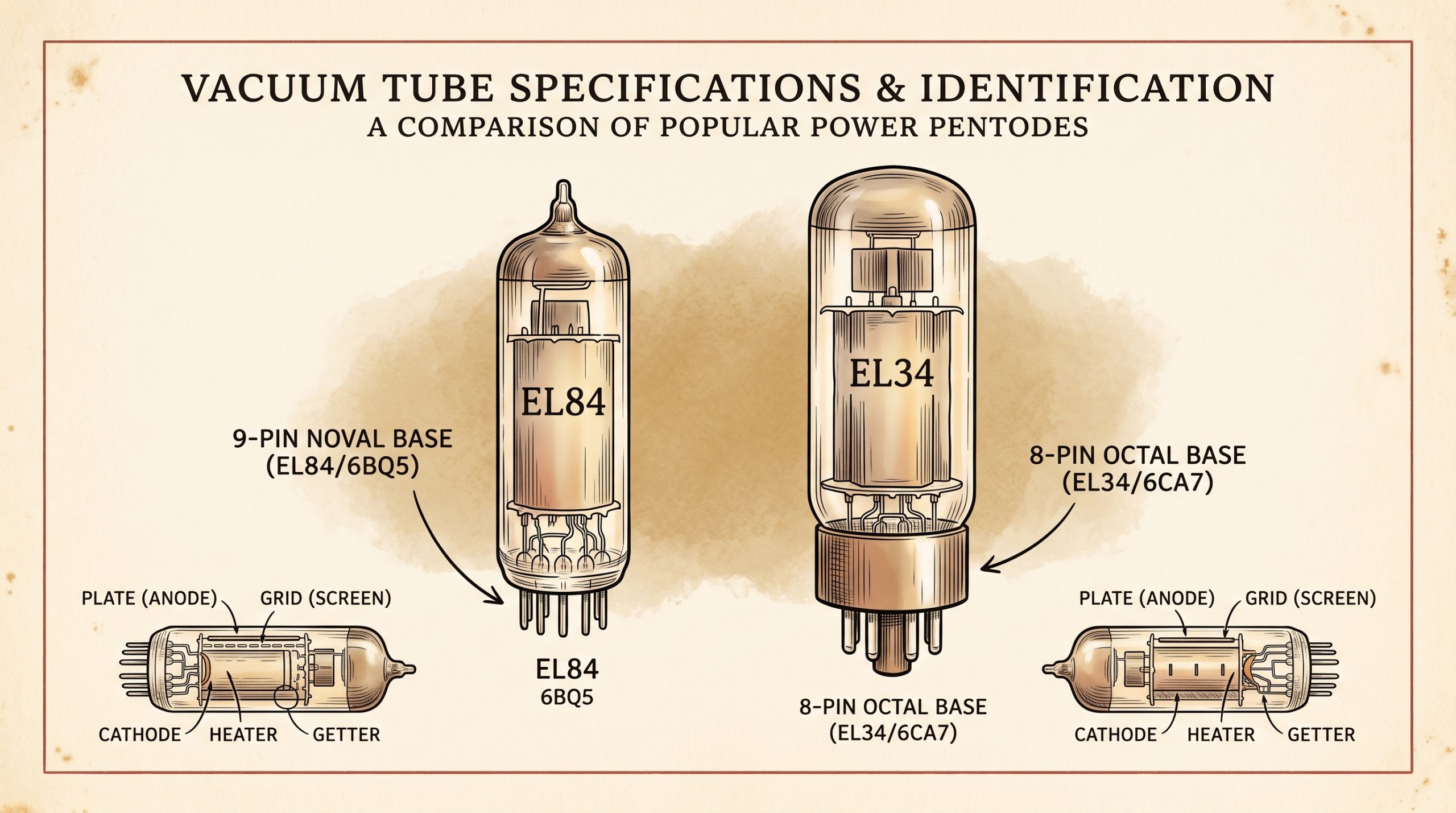
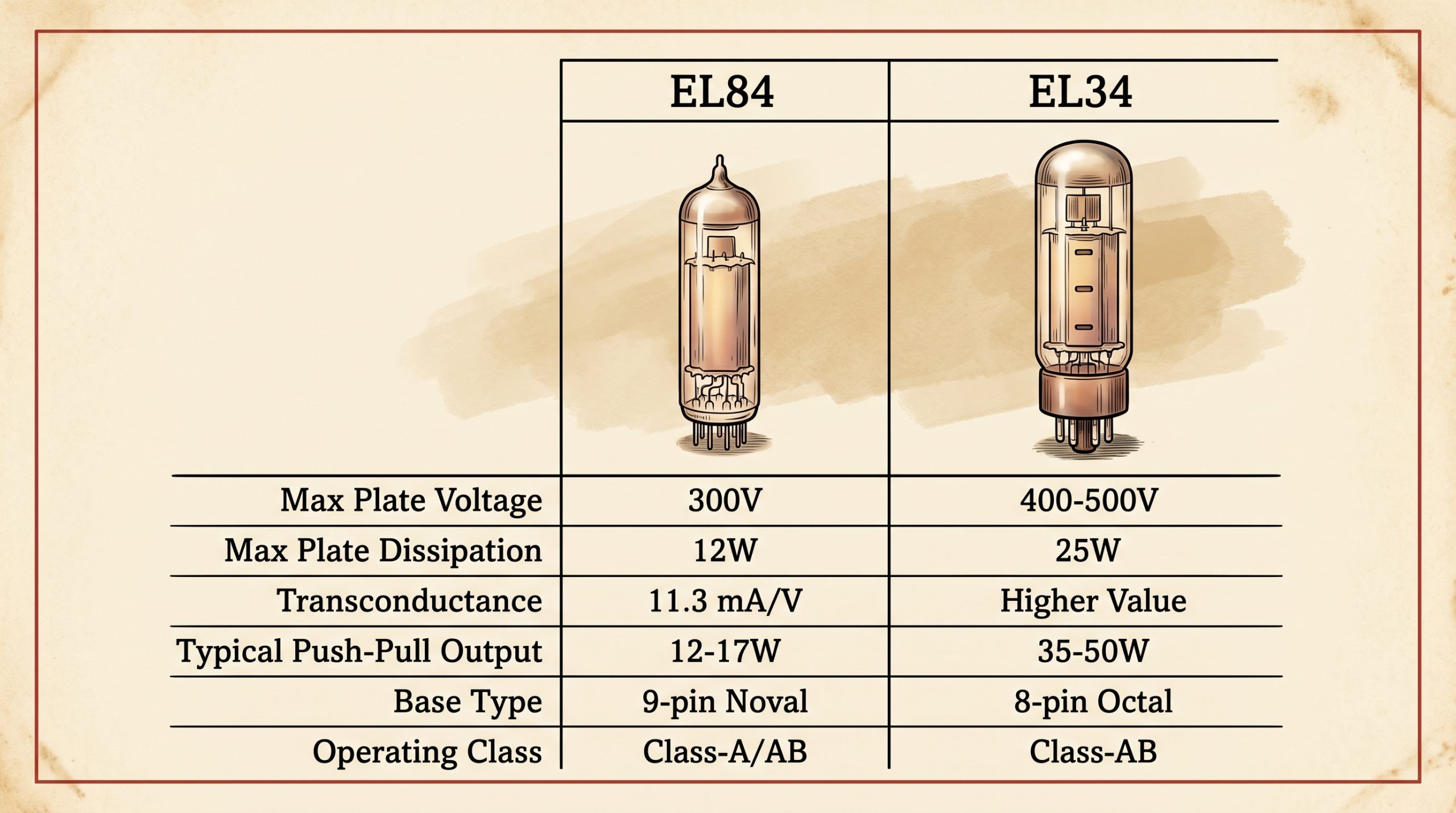
- EL84: 9-pin Noval base, 12W max plate dissipation, Class-A/AB, typical push-pull output 12-17W per pair
- EL34: 8-pin Octal base, 25W max plate dissipation, Class-AB, typical push-pull output 35-50W per pair or 50-100W per quad
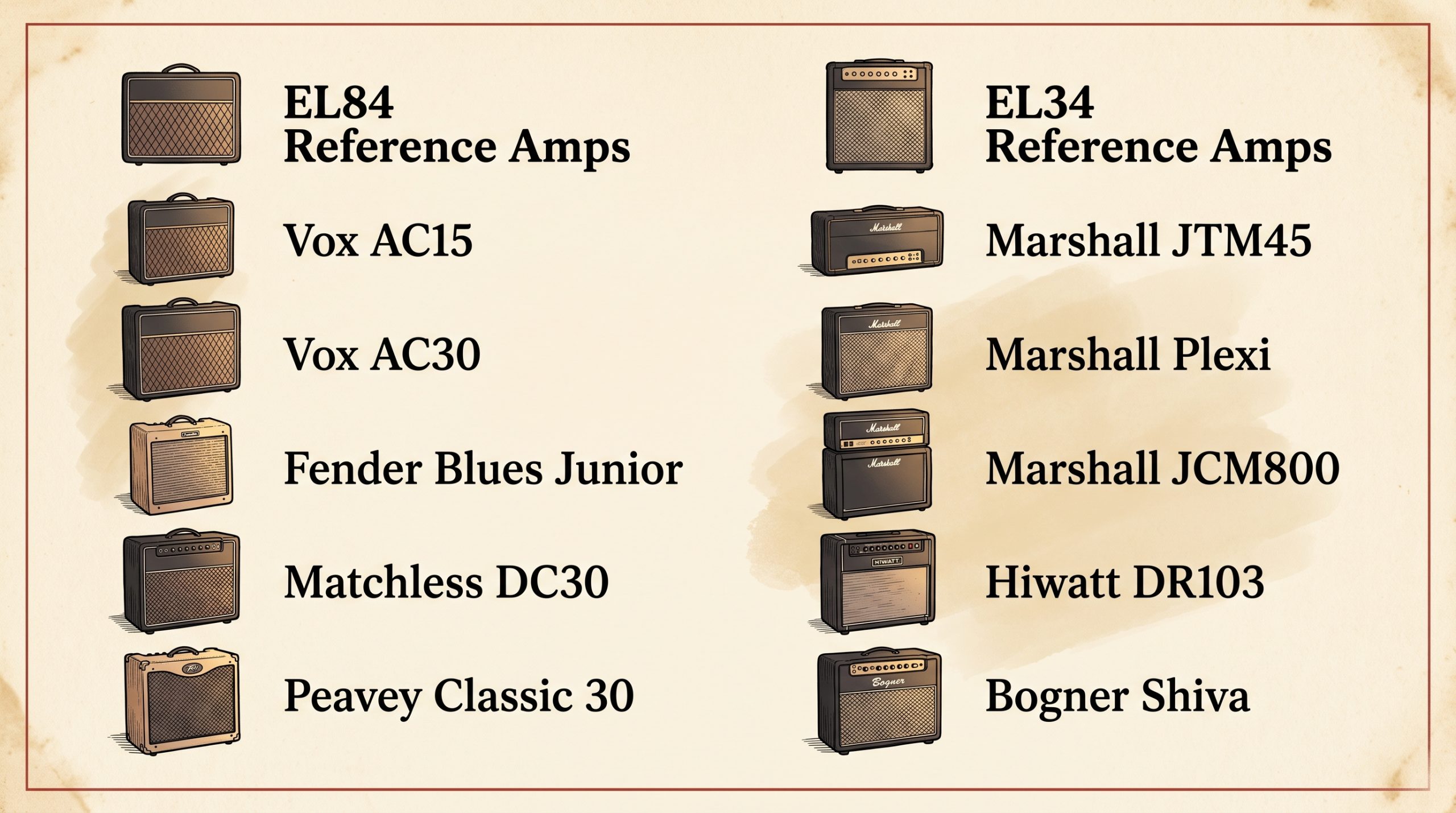
- EL84 reference amps: Vox AC15/AC30, Fender Blues Junior, Matchless DC30, Peavey Classic 30
- EL34 reference amps: Marshall Super Lead/JCM800, Hiwatt DR103, Bogner Shiva
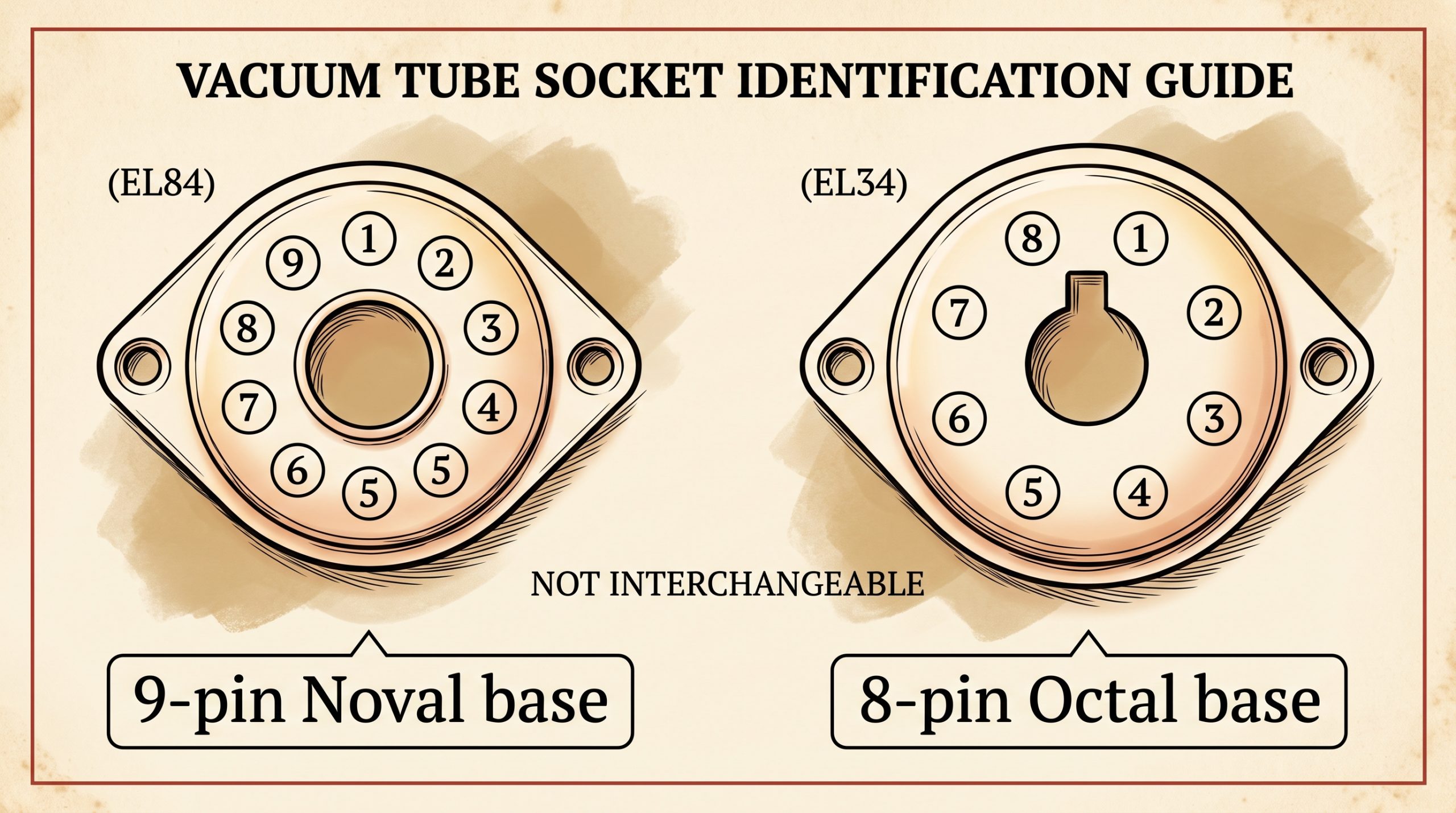
- EL84 and EL34 are NOT interchangeable, different socket types, different operating voltages, physically incompatible
- NOS Mullard EL84: $40-80/tube. NOS Mullard EL34: $80-150+/tube. Budget accordingly.
- EL84 equivalents: 6BQ5, 7189/7189A, 6P14P. EL34 equivalents: KT77, 6CA7 (close but not identical)
What Are EL84 and EL34 Power Tubes?
Both tubes trace their origins to Mullard’s Blackburn, UK plant in the early 1950s, both carry the “British” label, and both ended up defining distinct schools of amplifier design. That’s roughly where the similarities end.
EL84, The Small-Frame British Pentode
Mullard developed the EL84 around 1953. Philips (Eindhoven), Telefunken, and Soviet manufacturer Sovtek all produced their own variants. The tube sits on a 9-pin Noval base, the same miniature socket format used for preamp tubes like the 12AX7, which makes it physically compact enough to fit into small combo amp chassis without modification.
Datasheet specs from the original Mullard EL84 documentation show a maximum plate voltage of 300V, a maximum screen voltage of 300V, and a max plate dissipation of 12W per tube. In a push-pull pair, typical output sits between 12 and 17 watts. Transconductance (gm) runs approximately 11.3 mA/V with an amplification factor of around 19-22. Quiescent current in most cathode-biased circuits runs 35-48mA per tube at 300V plate voltage.
The EL84 operates predominantly in Class-A (single-ended) or Class-A/AB (push-pull). That continuous conduction is central to everything people love about it. More on the operating class implications below.
The full deep-dive into EL84 specs, substitutes, and biasing is covered in the EL84 Tubes guide, including a breakdown of NOS variants by country of manufacture.
EL34, The Large-Frame British Pentode
Mullard introduced the EL34 in 1955. GEC produced the closely related KT77 variant. Siemens, Tesla, and modern manufacturers including JJ Electronic, Electro-Harmonix, and Tung-Sol all produce current-production versions. The tube sits on an 8-pin Octal base, the same socket format as the 6L6 and 6V6, giving it a larger physical footprint and a heavier glass envelope.
The EL34 operates at substantially higher voltages. Typical operating plate voltage runs 400-500V, with an absolute maximum of 800V. Max plate dissipation is 25W per tube, so a push-pull quad runs at 100W max dissipation. Typical push-pull pair output: 35-50W. Quad: 50-100W depending on circuit. Transconductance comes in at approximately 11 mA/V, with an amplification factor of around 11, lower than the EL84. Fixed-bias circuits typically set quiescent plate current at 30-45mA per tube, with bias voltage ranging from -20V to -42V depending on the specific amp design.
The EL34 runs almost exclusively in Class-AB push-pull in guitar amplifier applications. That crossover behavior is a key part of its tonal identity.
For the complete EL34 specification breakdown and substitution guide, the EL34 Tubes guide covers original Mullard construction details alongside current-production comparisons.
EL84 vs EL34, Side-by-Side Specs
Numbers before opinions. Here’s what the datasheets and original Mullard documentation actually say:
| Specification | EL84 | EL34 |
|---|---|---|
| Base Type | 9-pin Noval | 8-pin Octal |
| Max Plate Dissipation | 12W | 25W |
| Typical Push-Pull Output | 12-17W (pair) | 35-50W (pair) / 50-100W (quad) |
| Max Plate Voltage | 300V | 800V absolute / ~450-500V typical |
| Transconductance (gm) | ~11.3 mA/V | ~11 mA/V |
| Amplification Factor (µ) | ~19-22 | ~11 |
| Operating Class (typical) | Class-A / Class-A/AB | Class-AB |
| Typical Quiescent Current | 35-48mA @ 300V | 30-45mA @ 450V |
| Direct Equivalents | 6BQ5, 7189, 6P14P | KT77, 6CA7* |
| First Manufactured | ~1953 (Mullard) | 1955 (Mullard) |
*The 6CA7 is an American beam tetrode variant with similar pinout but different internal construction. KT77 is a closer electrical equivalent. Neither is identical to the EL34 in all operating conditions.
Tonal Character, How Do They Actually Sound?
Guitar World’s amp expert coverage notes that the EL84 is smaller and less powerful than the EL34 but produces significantly more distortion at a given volume, resulting in a distinctly different sound character. That’s the practical reality most players run into: the EL84 breaks up earlier, and the breakup sounds different in kind, not just degree.
EL84 Tone Profile
The EL84’s frequency character centers on the upper midrange, roughly 1-4kHz, with pronounced chime and top-end detail that sits forward in a mix. Low-end mass is limited. This isn’t a complaint, it’s a design characteristic. That lean low end lets the chime breathe without getting muddy.
Breakup behavior is where the EL84 really earns its reputation. With only 12W of headroom per tube at 300V, the EL84 compresses and saturates early. Class-A operation means continuous conduction through the full 360 degrees of the audio cycle, which produces predominantly even-order harmonics. Even-order harmonics are musical. They sound like the note, only richer. That’s the harmonic structure behind the “sweet, glassy breakup” description that gets attached to Vox-style amps constantly.
Push an EL84 amp hard at high volumes and it can become shrill. Ice-pick treble is a real hazard with poor speaker matching. At the volumes where EL84 amps shine, below full-output cranking, touch sensitivity is very high. Roll your guitar volume back and the amp cleans up dramatically. Dig in with your pick and it compresses and sings. That’s Class-A dynamics at work.
Genres where EL84 tone fits naturally: British Invasion rhythm work, indie and jangle pop, Americana, lighter blues, and classic rock clean tones. Not a go-to for high-gain metal. Not great at staying clean at loud stage volumes either.
EL34 Tone Profile
The EL34 operates at higher voltages with more headroom, more output power, and a Class-AB crossover point that introduces odd-order harmonics (3rd, 5th) into the distortion character. Odd-order harmonics are more aggressive than even-order. They give the EL34 its bark. That’s the raunchy, crunchy articulation that makes a cranked Marshall Plexi feel physically confrontational in a way a Vox AC30 simply doesn’t.
Frequency character sits in the thick upper-mids, roughly 500Hz to 2kHz. Warmth without muddiness. Lower-end definition is tighter and more controlled than the EL84 but less scooped than a 6L6. Clean tones from an EL34 amp are punchy and thick rather than glassy or chimey. They don’t sparkle the way an EL84 does, but they have authority.
Overdriven EL34 tone is bold and sustaining. Articulate under heavy gain. Hard-strummed chords don’t collapse into a compressed mush the way they can with an EL84 pushed too hard. This makes the EL34 genuinely useful for a wider dynamic range on stage, from clean to fully saturated crunch, with the player controlling the transition via pick attack and volume.
Touch sensitivity is high but slightly less immediate than the EL84. The EL34 benefits from a boost or overdrive pedal to push it into saturation on a fixed-bias circuit. Pedal platform behavior is excellent. Ideal genres: classic rock, blues lead work, hard rock, Southern rock, heavy metal with appropriate gain staging.
Head-to-Head Tonal Summary
| Tonal Quality | EL84 | EL34 |
|---|---|---|
| High-End Sparkle | Very High | Moderate |
| Midrange Warmth | Moderate | Very High |
| Low-End Tightness | Lean / Airy | Defined / Punchy |
| Clean Headroom | Low (breaks up early) | High (stays clean longer) |
| Early Breakup Character | Sweet, even-order harmonics | Aggressive, odd-order harmonics |
| Touch Sensitivity | Very High | High |
| Pedal Platform Friendliness | Moderate | Very High |
Amplifier Examples, Which Famous Amps Use Each Tube?
Tube character doesn’t exist in isolation. It’s the interaction between the tube, the output transformer, the circuit topology, and the speaker that produces a finished amp sound. That said, certain amps have become the canonical reference points for each tube.
Iconic EL84 Amplifiers
- Vox AC15: 2x EL84, Class-A, cathode-biased, approximately 15W. The single-speaker EL84 standard.
- Vox AC30: 4x EL84, Class-A, cathode-biased, approximately 30W. Four EL84s don’t produce 4x the power of one due to Class-A efficiency limits, but the AC30’s headroom and chime remain the defining EL84 reference in rock.
- Matchless DC30: 4x EL84, Class-A, approximately 30W. Built on the AC30 circuit heritage but with higher construction quality and different voicing.
- Fender Blues Junior: 2x EL84, approximately 15W, fixed bias. One of the most widely sold current-production EL84 amps. The Fender Blues Junior guide covers its Class-A vs. Class-AB debate in detail, including why the amp’s marketing has historically been misleading about its operating class.
- Peavey Classic 30: 4x EL84, approximately 30W. Reaches full-quad output by running four EL84s rather than the usual pair, not from unusually high plate voltage.
- Orange Rocker 15: 2x EL84, 7-15W switchable. Orange’s smaller EL84-loaded combos aim at bedroom-friendly volume with usable breakup.
A note on Orange specifically, since it comes up constantly: Orange builds both EL84 and EL34 amplifiers. The Rocker 15 (EL84) and the Rockerverb 50 (EL34) overlap in some retailers’ search results. Four EL84s in the AC30 configuration produce roughly the same wattage as two EL34s in a Class-AB circuit, but the tonal signatures diverge substantially. The Rockerverb’s thicker mids and harder crunch character don’t sound like four EL84s. Same wattage figure, different tube behavior entirely.
Iconic EL34 Amplifiers
- Marshall JTM45: Originally 2x 6L6/5881 (1963-64), switched to KT66 by 1964, Class-AB, approximately 30-45W. American-tube-voiced despite the “British” reputation — Marshall didn’t move JTM-series circuits to EL34 power tubes until the 1966+ Super Lead/JTM50 below.
- Marshall 1959 Super Lead (Plexi): 4x EL34, approximately 100W, Class-AB. The four-EL34 circuit that defined British rock for decades.
- Marshall JCM800 2203: 4x EL34, approximately 100W. Single-channel preamp gain, EL34 power section.
- Marshall JCM800 2204: 2x EL34, approximately 50W. Same circuit philosophy, half the output. Both remain in heavy use for rock and blues work.
- Hiwatt DR103: 4x EL34, approximately 100W. Class-AB but biased with more care than many Marshall derivatives, producing a cleaner and more controlled EL34 sound.
- Bogner Shiva (EL34 version): 2x EL34, approximately 80W. Described on various forum threads as “raunchy and crunchy yet still articulate” with exceptional smooth lead character, an accurate characterization of EL34 at appropriate operating points.
- Orange Rockerverb 50: 2x EL34, approximately 50W. Orange’s flagship EL34 stage amp.
Operating Class Explained, Why Class-A vs Class-AB Actually Matters
This is where most comparisons stop making sense, because the terms get thrown around without explaining what they actually change about the sound. Not an abstract academic point. Class of operation directly determines harmonic content.
What Is Class-A Operation?
In Class-A, the output tube conducts for the full 360 degrees of the audio signal cycle. The tube never switches off. That means no crossover region, no crossover distortion, and an efficiency rate that’s roughly 25-30% (most of the power becomes heat). Runs hot. Literally.
For the EL84, continuous conduction produces predominantly even-order harmonics when the tube saturates. Even-order harmonics (2nd, 4th) are octaves and near-octaves of the fundamental frequency. Musically, they reinforce the note rather than clashing with it. This is the mechanical reason EL84 breakup sounds “sweet” and “musical” at low volumes. The harmonics add richness without harshness.
Power output trade-off: a push-pull pair of Class-A EL84s produces 12-17W, not the 24W you’d calculate by doubling one tube’s 6W single-ended output. Class-A efficiency limits cap the output below the theoretical maximum.
What Is Class-AB Operation?
In Class-AB, each output tube conducts slightly more than 180 degrees of the cycle. There’s a small intentional crossover region where neither tube is fully conducting. Efficiency improves to roughly 50-65%, which is why Class-AB EL34 amps can put out 50-100W from a practical transformer and power supply without generating dangerous amounts of heat.
The crossover region introduces odd-order harmonics (3rd, 5th) into the distortion character. Third-harmonic distortion sits a twelfth above the fundamental, which doesn’t reinforce the note the same way a second-harmonic does. At controlled levels, odd-order harmonics produce that aggressive “bark” the EL34 is known for. At higher distortion levels, they contribute to the harder, more complex crunch of a cranked Marshall. Spanky attack and aggressive note definition are partly Class-AB artifacts.
Cathode Bias vs. Fixed Bias, Impact on Each Tube Type
EL84 circuits frequently use cathode bias (self-biasing), where a resistor in the cathode circuit automatically sets the operating point. No adjustment required. Typical cathode resistor values run 130-180 ohms. This runs the tube harder than fixed bias, contributing to the compressed, warm character of many EL84 amps. It’s also why most EL84 amp owners don’t worry about biasing after a tube swap.
EL34 circuits almost universally use fixed bias, which means the grid is held at a fixed negative voltage (-20V to -42V depending on the design) via an adjustable bias supply. This requires periodic adjustment when tubes are swapped. Set it too hot (too much current) and you’re burning through tubes. Set it too cold and tone goes stiff and thin. Proper quiescent plate current: 30-45mA per tube at operating voltage, or whatever the specific amp manufacturer specifies in their service documentation.
Some cathode-biased EL84 circuits (the Vox AC30, for example) run their EL84s in conditions that accelerate tube wear compared to a fixed-bias design. The tubes sound great, but you’ll replace them more often.
Can You Swap EL84 for EL34? (And Vice Versa?)
No. Not directly. Not safely. Not without a significant amp redesign.
Why It’s Not Possible
The physical socket types are incompatible. EL84 requires a 9-pin Noval socket. EL34 requires an 8-pin Octal socket. An EL34 literally won’t fit into an EL84 socket. If you found some adapter that forced it, you’d then be feeding 300V maximum plate voltage tubes into a circuit running 450V or higher. Instant failure. Possibly worse depending on the circuit.
Beyond voltage, output transformer impedance ratios differ between EL84 and EL34 circuits. A transformer wound for an EL84 push-pull pair at 8kΩ plate-to-plate impedance won’t load an EL34 correctly. The mismatch degrades power transfer, distortion behavior, and can stress the transformer over time.
Converting an EL84 amp to run EL34s is a non-trivial modification. New output transformer, new power transformer with higher secondary voltage, new sockets, complete rebias. Not a tube swap. A partial amp rebuild.
What Tubes ARE Interchangeable With EL84?
- 6BQ5: The North American designation for the same tube. Identical pinout, identical electrical specs. Made by GE, Sylvania, and RCA. Direct drop-in substitute in any EL84 circuit.
- 7189 / 7189A: Higher-rated variant with a maximum plate voltage of 360V. Direct substitute in most EL84 circuits. Preferred for reliability in designs that push close to the 300V limit. The 7189A adds a slightly tighter construction spec.
- 6P14P: Soviet military equivalent of the EL84. Long-plate variant. Popular in audiophile and HiFi circles for perceived midrange smoothness. Compatible pinout, drop-in in most circuits.
What Tubes ARE Interchangeable With EL34?
- KT77: Closest drop-in equivalent. Beam tetrode variant from GEC. Slightly tighter bass response and different saturation character compared to the standard EL34, but electrically compatible in the same socket.
- 6CA7: American beam tetrode equivalent. Same pinout, compatible socket. Different internal structure produces a slightly different tonal character, generally described as less “British” and more forward in a different frequency range.
- KT88 / 6550: Not direct swaps. Different operating characteristics, different bias requirements, different sound. Some amps can run KT88s with circuit modifications, but this isn’t a substitution, it’s a conversion.
Some Mesa/Boogie amplifiers accept both EL34 and 6L6 via a bias-switching mechanism, which is a deliberate factory design choice, not evidence that the tubes are generally interchangeable. That’s an amp-specific feature, not a tube compatibility rule.
EL84 vs EL34 vs 6L6, The Three-Way Comparison
The 6L6 shows up in this conversation constantly because so many players are choosing between a British-flavored amp (EL84 or EL34) and an American-voiced Fender-style amp (6L6). Understanding all three clarifies where each tube actually sits.
Where the 6L6 Fits In
The 6L6 is an American-origin tube, developed by RCA and GE with the first commercial versions appearing around 1936. Octal base, like the EL34. Max plate dissipation of 30W per tube. Push-pull pair output: 40-60W. Quad: 80-120W. It’s the standard power tube in Fender’s entire classic lineup, from the Bassman to the Twin Reverb.
The 6L6’s tonal signature is a scooped midrange, extended tight bass, and a smooth clean top-end. There’s headroom before saturation. Country players and clean-tone players have relied on 6L6 circuits for decades precisely because the mids don’t push forward the way EL34 mids do. The detailed breakdown of 6L6 specs, applications, and substitutes is covered in the 6L6 Tubes guide, including the major NOS variants and how Fender’s circuit revisions interact with tube choice. For a deeper dive specifically on the American-vs-British tonal divide, see the 6L6 vs EL34 comparison.
Three-Way Tonal Comparison
| Characteristic | EL84 | EL34 | 6L6 |
|---|---|---|---|
| Origin | British (Mullard) | British (Mullard) | American (RCA/GE) |
| Low-End | Lean, airy | Defined, punchy | Extended, tight |
| Midrange | Forward, bright, chimey | Thick, barky | Scooped, recessed |
| High-End | Glassy, chiming | Smooth, controlled | Clean, glassy |
| Typical Output (pair) | 12-17W | 35-50W | 40-60W |
| Operating Class | Class-A / AB | Class-AB | Class-AB |
| Primary Amp Examples | Vox AC30, Matchless DC30 | Marshall Plexi, JCM800, Bogner | Fender Bassman, Twin Reverb |
| Best For | Cleans, light breakup, jangle | Crunch, hard rock, blues lead | Country, clean headroom, blues |
EL84 vs EL34 in HiFi Applications
Guitar players don’t own this conversation. Both tubes have deep roots in audiophile amplifier design, and the sonic differences carry over to HiFi listening contexts in predictable ways.
The EL84 appears in single-ended Class-A HiFi amps running 5-6W from a single tube. Designs based on the Leak Stereo 20 and various Quad II clones rely on EL84’s even-order harmonic richness for midrange transparency. At HiFi listening levels, well below clipping, the EL84 produces delicate detail retrieval in the upper mids and treble that suits chamber music, acoustic recordings, and vocal reproduction. Output transformer plate impedance for single-ended EL84 HiFi builds: approximately 5kΩ. Push-pull: approximately 8kΩ.
The EL34 dominates in HiFi push-pull designs. The Dynaco ST-70 is the canonical example, a push-pull ultralinear EL34 circuit that put high-quality amplification in hobbyist budgets from the 1960s onward. The Eico HF-81 used a similar approach. The EL34’s wider power output and lower-end authority suits orchestral reproduction, where dynamic peaks require headroom the EL84 simply can’t deliver. Output transformer plate impedance for push-pull EL34 HiFi builds: approximately 3.4kΩ. High-quality HiFi output transformers from Lundahl or Sowter improve on the plate-impedance matching precision compared to most guitar amp iron.
The practical HiFi differentiator: EL84 for intimate recordings at lower volumes, EL34 for dynamic slam and low-end authority in full-range listening.
Current Production vs. NOS Tube Recommendations
Top EL84 Options
| Tube | Type | Character | Price Range (each) |
|---|---|---|---|
| Mullard EL84 (Blackburn, pre-1970) | NOS | Reference standard, rich harmonics | $40-80 |
| Telefunken EL84 | NOS | Tighter, more clinical, excellent HiFi | $50-90 |
| JJ EL84 | Current Production | Slightly darker, reliable, good value | $12-18 |
| Electro-Harmonix EL84 | Current Production | Bright, close to Mullard character | $14-20 |
Top EL34 Options
| Tube | Type | Character | Price Range (each) |
|---|---|---|---|
| Mullard EL34 (Blackburn, 1960s) | NOS | Reference EL34 tone, very expensive | $80-150+ |
| Siemens EL34 | NOS | Tighter, extended highs | $70-120 |
| JJ EL34 | Current Production | Slightly darker, durable, industry standard | $18-25 |
| Tung-Sol EL34B | Current Production | Excellent Marshall-voicing, balanced | $18-25 |
| Electro-Harmonix EL34 | Current Production | Balanced, versatile, wide availability | $16-22 |
A practical note on NOS: counterfeit and relabeled NOS tubes are widespread on eBay and unverified marketplace sellers. Genuine pre-1970 Mullard EL84s carry the Blackburn plant code in the tube’s etched date code. For EL34s, original Mullard 1960s production has specific construction details (getter shape, mica spacer configuration) that experienced tube collectors use to verify authenticity. If the price seems too low for a claimed NOS Mullard, it’s almost certainly relabeled current-production stock. Tube retailer sites like TubeDepot and The Tube Store do basic testing and provide some provenance verification that open marketplaces don’t.
Which Tube Is Right for You?
Choose EL84 If…
- You play at lower volumes and want musical, responsive breakup without cranking an amp to uncomfortable stage levels
- Your style centers on chimey clean tones, light crunch, or vintage British sounds in the Vox tradition
- Touch sensitivity and dynamic response to pick attack matter more to you than clean headroom
- You’re building or buying a home-practice or studio amp in the 5-20W range where bedroom-friendly volume is a priority
Choose EL34 If…
- You need more headroom for clean tones at actual gigging volumes, where an EL84 amp would already be saturating
- Your style is hard rock, crunch blues, or classic British rock in the Marshall tradition
- You want a pedal platform that stays cleaner under drive pedals and only breaks up when you push it deliberately
- You’re running a higher-wattage amp in the 50-100W range where low-end authority and defined mids are essential
If you’re sitting somewhere between both descriptions, the EL34 wins on flexibility. It cleans up more gracefully at stage volumes, it takes pedals better, and the tonal range from clean to crunch covers more ground. The EL84 wins on feel at lower volumes and on that particular chimey breakup character that nothing else quite replicates. Both are worth knowing firsthand. A weekend with a Blues Junior and a weekend with a JCM800 will tell you more than any spec table can. The datasheets define the operating parameters. The music defines which one is actually useful to you.
Frequently asked questions
Can you replace EL84 with EL34?
No. EL84 and EL34 use incompatible socket types (9-pin Noval vs. 8-pin Octal) and operate at very different plate voltages. EL84 maximum plate voltage is 300V; EL34 circuits typically run 450V or higher at the plate. Physically, the tubes won't fit each other's sockets without an adapter, and forcing the voltage mismatch would destroy the tubes instantly. Converting an EL84 amp to run EL34s requires a new output transformer, new power supply, new sockets, and complete circuit rework.
What tubes are interchangeable with EL84?
The EL84's direct drop-in equivalents are the 6BQ5 (the North American designation for the same tube, made by GE, Sylvania, and RCA), the 7189 and 7189A (higher plate-voltage rating, preferred in circuits that push toward 300V), and the Soviet 6P14P (compatible pinout, slightly different construction, popular in HiFi applications). All three share the 9-pin Noval base and are electrically compatible in virtually all EL84 circuits.
Which is better, 6L6 or EL34?
Neither is objectively better. They serve different tonal goals. The 6L6, developed by RCA in 1936, produces scooped mids and extended tight bass. It's the core voice of classic American amplification, Fender's Bassman, Twin Reverb, Deluxe Reverb. The EL34, developed by Mullard in 1955, delivers thick upper mids and a harder, more aggressive crunch. Classic Marshall territory. Which one is right depends entirely on the music you're playing and the amp you're running.
What is the American equivalent of the EL84?
The 6BQ5 is the direct American equivalent of the EL84. GE, Sylvania, and RCA all produced 6BQ5 tubes. The designation differs because American and European tube-naming conventions diverged, but the electrical specs and pinout are identical to the EL84. Some audiophiles prefer NOS American 6BQ5s over European EL84s for specific construction details, but for guitar amp use, there's no practical sonic difference worth paying a premium for.
Do EL84 and EL34 amps require different biasing procedures?
Yes, typically. EL84 amps are frequently cathode-biased (self-biasing via a cathode resistor, usually 130-180 ohms), which means no periodic user adjustment is needed after a tube swap. EL34 amps are almost always fixed-biased and require adjustment when tubes are replaced. The standard procedure involves setting quiescent plate current to 30-45mA per tube, though specific amp manufacturers publish their own target specs in service documentation. Bias drift in a fixed-bias EL34 circuit can shorten tube life significantly and degrades tone before the tubes visibly fail.