Contents
- 01The Nine-Pin Dual-Triode Family
- 0212AX7 Specs and Characteristics
- 0312AT7 Specs and Characteristics
- 0412AT7 vs 12AX7, Head-to-Head Spec Comparison
- 05Where These Tubes Are Used in Fender Amplifiers
- 06When You Should Swap 12AX7 for 12AT7 (Intentional Tube Rolling)
- 0712AX7 vs 12AT7 vs 12AU7: The Full Family Compared
- 08Bias and Voltage Considerations When Swapping
- 09Best 12AT7 Tubes: NOS vs Current Production
- 10Frequently Asked Questions
- 11Choosing the Right Tube for Your Situation
That mu difference gets quoted everywhere. The plate resistance difference almost never does, and it’s the number that actually explains why you can’t just swap these two tubes freely across every socket in your amp. The 12AX7 is a high-gain voltage amplifier. The 12AT7 is a current driver. Same nine-pin socket, fundamentally different electrical behavior, and specific jobs in the circuit that they cannot trade without consequences.
- 12AX7 amplification factor (mu): 100, the standard high-gain preamp tube
- 12AT7 amplification factor (mu): 60, lower gain, higher current drive
- 12AX7 plate resistance (rp): 62,500Ω, high output impedance
- 12AT7 plate resistance (rp): 10,900Ω, low output impedance, critical for reverb driver position
- European equivalents: 12AX7 = ECC83 / 12AT7 = ECC81
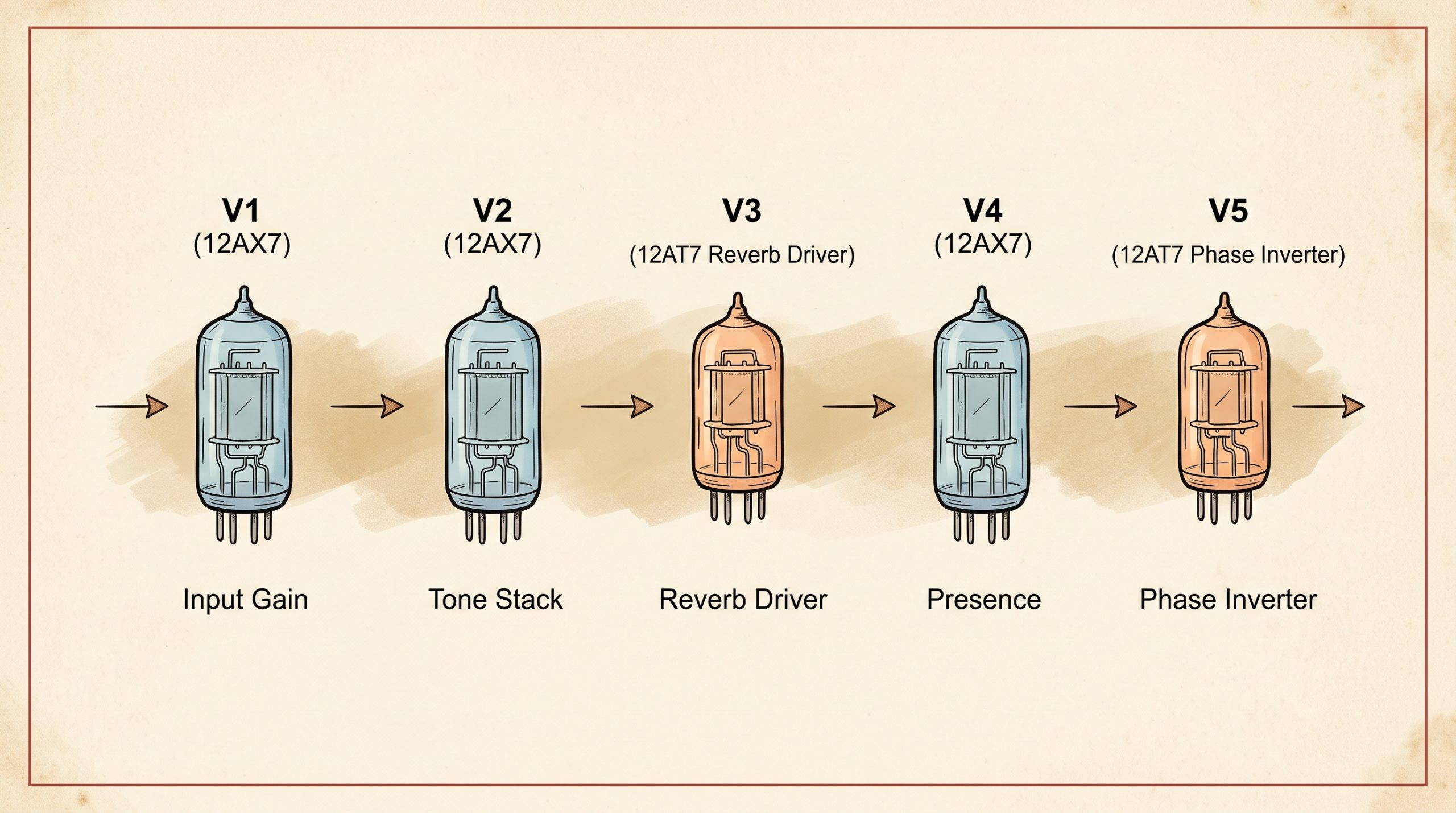
- Factory use in Fender AB763: 12AX7 in V1/V2/V4/V5 (V5 is the vibrato oscillator), 12AT7 in V3 (reverb driver) and V6 (phase inverter)
- Substituting 12AX7 for 12AT7 in the reverb driver position causes impedance mismatch, results in weak, thin reverb
- NOS Mullard ECC81 and Telefunken ECC81 command $30–$150+ per tube depending on condition and test results
- Both tubes share the same heater spec: 12.6V @ 0.15A (or 6.3V @ 0.3A), no heater wiring changes required
The Nine-Pin Dual-Triode Family
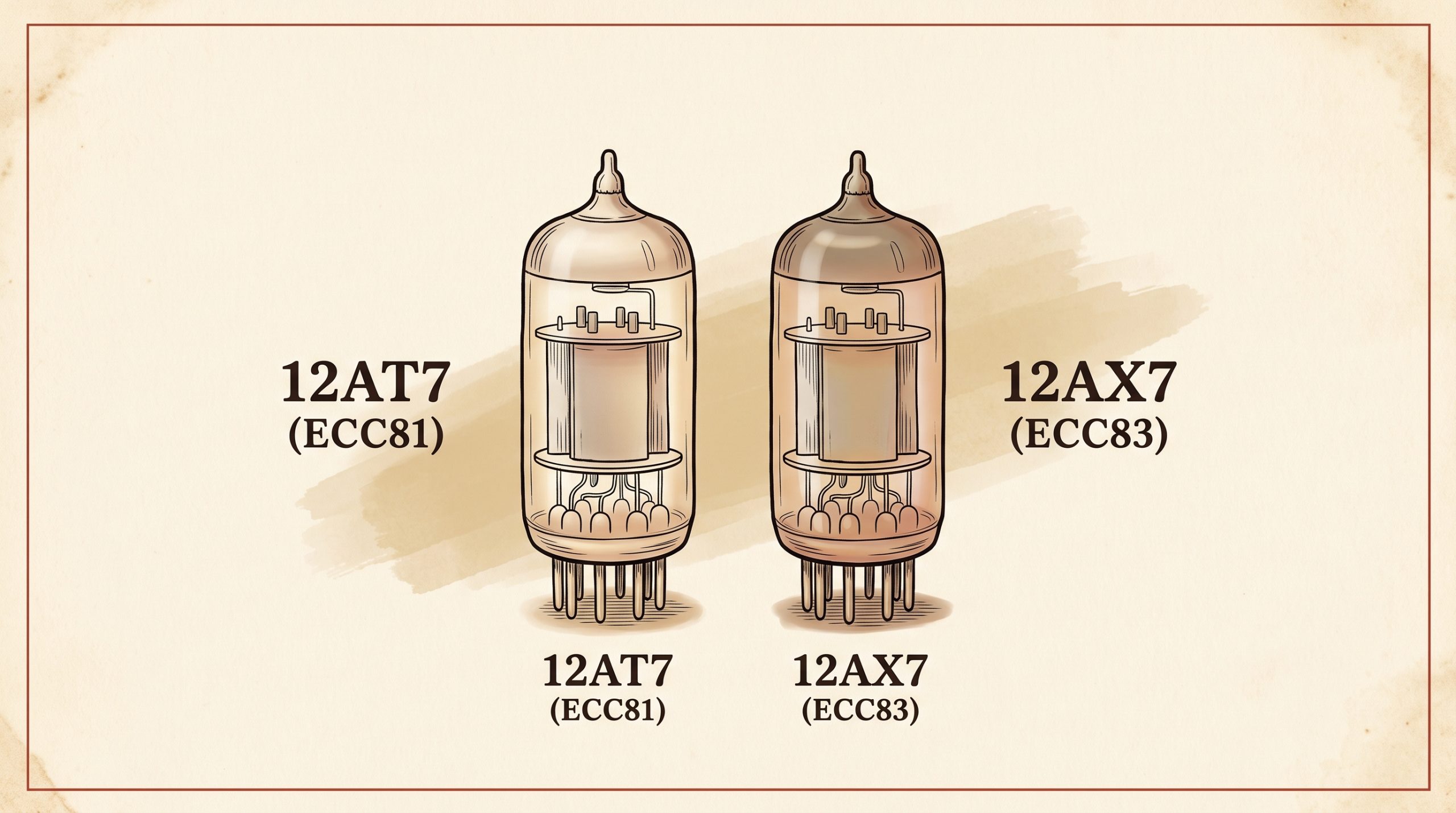
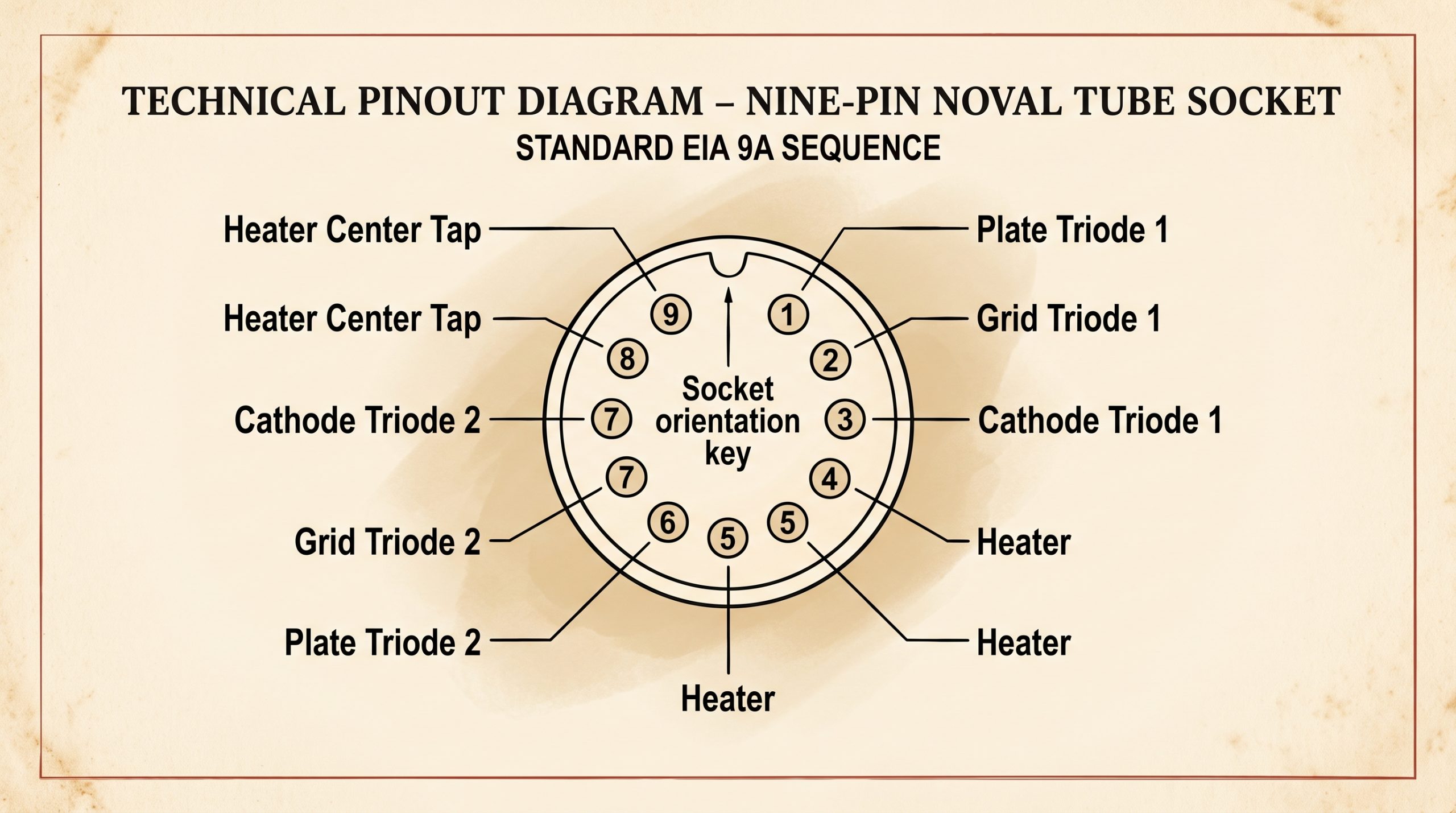
The 12AX7, 12AT7, and 12AU7 all share the same EIA 9A noval pinout, nine pins, two identical triode sections per bottle. That physical compatibility is what makes tube rolling possible and what makes uninformed swaps dangerous. Same socket, very different electrical behavior. Their European equivalents are the ECC83 (12AX7), ECC81 (12AT7), and ECC82 (12AU7) respectively, and you’ll see NOS tubes labeled either way depending on whether they came from American or European factories.
The interchangeability caveat matters most in guitar amp contexts: just because a tube fits doesn’t mean the circuit was designed for it. Cathode resistors, load lines, and downstream impedances are all calculated around a specific tube type. Swapping carelessly, especially in designated reverb driver or phase inverter positions, changes the operating point and can degrade performance measurably.
12AX7 Specs and Characteristics
Key Electrical Specifications
The 12AX7’s defining number is its amplification factor of 100, the highest of any tube in the 12-series family. But mu alone doesn’t explain the full picture. The plate resistance (rp) of approximately 62,500 ohms gives the 12AX7 a high output impedance, which means it’s sensitive to the load it sees downstream. The transconductance (gm) is 1,600 µmhos, and typical plate current per triode section runs around 1.2mA at standard operating voltages. Heater spec is 12.6V at 0.15A, or 6.3V at 0.3A. For the full GE/RCA datasheet figures, the TubeDepot 12AX7A reference page covers verified electrical parameters across manufacturers.
That high rp has a tonal consequence: into a low-impedance load, the 12AX7 can sound compressed and constrained. In correctly designed gain stages, where the load is well-matched, it delivers the sensitive, harmonically rich breakup that made it standard equipment in virtually every tube guitar amp built since the 1950s.
What the 12AX7 Sounds Like in a Guitar Amp
In the V1 input position, the 12AX7’s mu of 100 means the amp responds readily to picking dynamics and starts compressing and breaking up earlier than a lower-gain tube would. That spongy compression and spanky attack at the onset of overdrive is largely a 12AX7 characteristic. Push it harder and it barks when pushed, which is exactly what most players want in a driven Fender blackface.
The 12AX7 belongs in gain recovery stages (V2 in most Fender circuits) and as the tone stack driver where its high voltage gain keeps signal levels consistent through the passive tone network. It does not belong in positions that require current delivery to a reactive load. That’s the 12AT7’s job.
Common 12AX7 Variants Worth Knowing
The 5751 is a military-specification tube with a mu of 70, a popular drop-in for V1 when you want to tame a bright or overly sensitive amp without going all the way to 12AT7 territory. The 7025 is a low-noise version of the 12AX7 with identical mu, often specified in recording equipment. The ECC83 designation covers Mullard and Telefunken variants that are highly sought in audio circles for noise floor and harmonic character. The 12AX7A is an updated version with tighter production tolerances. For a full breakdown of current and NOS options, the 12AX7 buyer’s guide covers brand-by-brand comparisons in detail.
12AT7 Specs and Characteristics
Key Electrical Specifications
Here’s where the real story starts. The 12AT7 has a mu of 60, lower than the 12AX7, but that’s not the number you should be focused on. The plate resistance (rp) of approximately 10,900 ohms is the critical differentiator. Compare that to the 12AX7’s 62,500 ohms and you start to understand why these tubes aren’t interchangeable in positions that require driving a load. The 12AT7’s transconductance (gm) is 5,500 µmhos, more than three times the 12AX7’s 1,600 µmhos. Typical plate current per triode section runs around 10mA, versus the 12AX7’s 1.2mA. Heater spec is identical: 12.6V at 0.15A. The 12AT7 datasheet via Frank Pocnet’s tube archive documents the full operating parameters.
Low rp equals low output impedance equals the ability to drive downstream circuits without signal loss. That’s not a subtle difference. It’s the reason the 12AT7 ends up in reverb driver and phase inverter positions by design, not by accident.
What the 12AT7 Sounds Like
In gain stages where a 12AX7 would normally live, the 12AT7 sounds cleaner, more linear, and more open. Less saturation, more headroom. According to Reverb.com’s preamp tube swapping guide, some players find the 12AT7 produces a slightly cool, less harmonically dense character in V1 compared to the 12AX7, which tracks with the lower mu and higher current drive profile. It’s not worse. It’s just built for a different task.
In its correct positions, reverb driver, phase inverter, cathode follower, the 12AT7 doesn’t sound like anything specific. It sounds like the circuit working properly. Warm clean tones with full reverb decay and a phase inverter that drives both output tubes evenly. That’s the goal.
12AT7 Tube Equivalents and Variants
The closest direct equivalents are the ECC81 (European designation, covering Mullard, Telefunken, Valvo, and Amperex variants), the 6201 (premium low-noise military version, same specs as 12AT7), the B739 (British military designation for ECC81), and the 5965 (lower gain variant with mu approximately 47, used in military and broadcast equipment). All share the nine-pin noval pinout and work as drop-in replacements in most circuits, though operating points will shift slightly depending on the variant.
The Mullard 12AT7 (ECC81) was manufactured at Blackburn, UK from the 1950s into the 1980s, but its internal construction changed partway through that run: earlier production (predating the short-plate transition that swept the industry in the early 1960s) used long-plate construction, prized for warm midrange and a low noise floor; later Blackburn production shifted to short-plate construction. Don’t assume long-plate on a tube just because it’s labeled “Mullard Blackburn” — check the date code first. Look for Bx factory codes on the tube label.
The Telefunken 12AT7 (ECC81), made in Ulm, Germany, carries the familiar diamond embossment on the tube base. Tight bass response, extended high-frequency response, and an extremely low noise floor make it the reference standard for noise-critical applications. Phase inverter and studio equipment first choice. Market prices run $60–$150 per tube for tested NOS examples.
The Tung-Sol 12AT7 in vintage American NOS form offers well-balanced triode sections and reliable performance. Current production Tung-Sol 12AT7s (manufactured by New Sensor Corp. in Saratov, Russia) carry consistent specs and are the most practical choice for gigging amps that need a reliable reverb driver without NOS prices.
12AT7 vs 12AX7, Head-to-Head Spec Comparison
The table below uses standard datasheet values. Real-world production tubes vary slightly by manufacturer, but these figures represent nominal operating conditions at approximately 250V plate voltage.
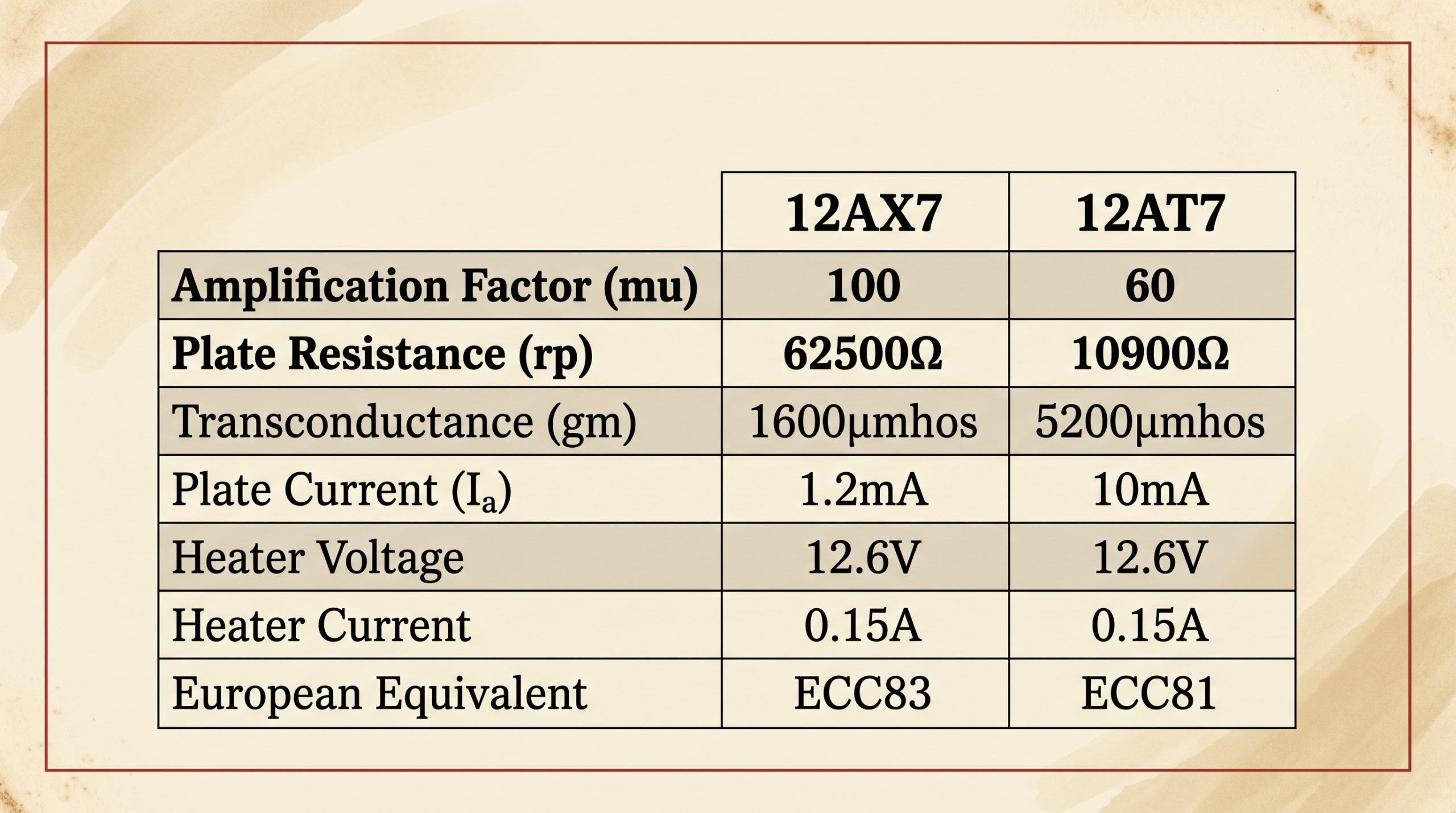
| Specification | 12AX7 (ECC83) | 12AT7 (ECC81) |
|---|---|---|
| Amplification Factor (mu) | 100 | 60 |
| Plate Resistance (rp) | 62,500Ω | 10,900Ω |
| Transconductance (gm) | 1,600 µmhos | 5,500 µmhos |
| Typical Plate Current | ~1.2mA per triode | ~10mA per triode |
| Heater Current | 0.15A @ 12.6V | 0.15A @ 12.6V |
| Output Impedance | High | Low |
| Headroom | Lower | Higher |
| Primary Use (Guitar Amp) | V1, V2 gain stages | Reverb driver, PI, cathode follower |
| European Equivalent | ECC83 | ECC81 |
| Military Equivalents | 5751 (mu 70), 7025 | 6201, 5965 (mu 47) |
Where These Tubes Are Used in Fender Amplifiers
This is where the specs stop being abstract. Most online discussions quote mu and stop there. The circuit-specific application is what tells you which tube goes where, and why getting it wrong produces audible, measurable problems.
The Blackface Era (1963–1967): AB763 and Variants
The AB763 circuit, shared across the Deluxe Reverb, Super Reverb, Twin Reverb, and Princeton Reverb in various configurations, establishes the template that nearly every Fender with reverb follows. Tube positions break down as follows:
- V1: 12AX7, input gain stage, designed specifically for mu 100. Dropping a 12AT7 here reduces gain significantly and cleans up overdrive onset. Intentional? Useful. Accidental? You’ll wonder why the amp sounds lifeless.
- V2: 12AX7, second gain stage and tone stack recovery.
- V3: 12AT7, reverb driver position. Factory spec, and not arbitrary. The 12AT7’s high current output (~10mA) properly drives the reverb tank’s input transformer. This is non-negotiable. More on the physics below.
- V4: 12AX7, reverb recovery and mixing stage.
- V5: 12AX7, vibrato/tremolo oscillator. A dedicated tube, distinct from the V4 reverb recovery stage, generating the bias-modulation signal that drives the amp’s tremolo circuit.
- V6: 12AT7, phase inverter (long-tail-pair). The 12AT7’s low rp and high gm provide balanced drive to both output tube grids. Substituting a 12AX7 here adds gain in the PI stage and can cause imbalance between the two halves of the push-pull output stage.
The Fender Deluxe Reverb guide documents the AB763 circuit in full, including transformer codes and production date identification for those cross-referencing their specific amp’s vintage. For broader era identification across models, the Fender tube amp serial number and dating reference covers chassis stamps and transformer codes that confirm which circuit revision you’re actually working with.
The Princeton Reverb (AA1164): A Closer Look
The AA1164 blackface Princeton Reverb (production 1964–1967, continuing into the silverface era) runs a compact tube complement: V1 12AX7, V2 12AX7, V3 12AT7 (reverb driver), V4 12AX7 (phase inverter, cathodyne configuration). Unlike the AB763 family’s long-tail-pair 12AT7 phase inverter, the Princeton Reverb splits a single 12AX7 triode section to drive both output tube grids directly. Both the ’68 Princeton Reverb Reissue and the current ’65 Princeton Reverb Reissue maintain this tube complement by design.
The Reddit thread that ranks second in SERP for this topic involves exactly this amp, a player with NOS 12AX7 stock wondering why swapping into V3 degraded the reverb. The answer is impedance mismatch, and it’s measurable.
Why Swapping 12AT7 for 12AX7 in the Reverb Driver Destroys Your Reverb
The reverb tank (Accutronics, MOD, and similar units) presents a reactive, low-impedance load to the driving tube. The input transformer on the tank has a reflected impedance that the 12AT7’s rp of 10,900Ω is reasonably matched to drive. Plug in a 12AX7 with its rp of 62,500Ω and the impedance mismatch is severe, the voltage transfer to the tank degrades, low-frequency response collapses, and the reverb send level drops dramatically.
The cathode resistor math makes this concrete. A typical Fender reverb driver cathode resistor is 820Ω. With a 12AT7 drawing ~10mA, the cathode voltage sits around 8.2V, within designed operating range. With a 12AX7 drawing ~1.2mA in that same position, cathode voltage drops to roughly 1.0V. That’s not a subtle operating point shift. The tube is running at a completely different bias condition, and the reverb tank is starved of drive current. Thin, washy reverb with poor low-frequency response is the predictable result. Not great.
The Silverface Era (1967–1981): What Changed
Silverface amps through approximately 1969 used identical tube complements to their blackface predecessors. Post-1969 circuit changes, master volume implementations, pull-boost features in the AA270 and related boards, affected gain staging in V1 and V2, but the V3 reverb driver position retained the 12AT7 spec throughout the entire silverface run. The AA270 board in particular has cathode resistor values in the reverb driver position that are optimized for the 12AT7’s 10mA plate current. Substituting a 12AX7 here produces a measurable operating point shift beyond just the reverb output level.
When You Should Swap 12AX7 for 12AT7 (Intentional Tube Rolling)
Taming a Bright or Gainy Amp in V1
Dropping a 12AT7 into V1 reduces amplification factor from 100 to 60, a 40% reduction in gain. The amp cleans up noticeably, requires a stronger input signal to break up, and the onset of overdrive shifts significantly later. For players building a pedal platform from a Fender that was always a little too eager, this is a legitimate modification. The 5751 (mu 70) is the middle-ground option, subtler taming that retains more of the amp’s original character. The 12AT7 in V1 is the more dramatic move.
Improving Phase Inverter Balance
Some amp builders intentionally specify a 12AT7 in the phase inverter position even when the original schematic calls for a 12AX7 (less common in Fender designs, but relevant in AB763 clones and boutique builds). The higher gm of the 12AT7 can produce better balance between the two output tube grids, which matters in push-pull circuits where imbalance increases even-order harmonic distortion. Worth experimenting with in a known-good build where you’re chasing that last increment of output stage cleanliness.
Tube Rolling Outcomes by Position
| Amp Position | Factory Spec | Swap To | Expected Result | Recommended? |
|---|---|---|---|---|
| V1 (Input Stage) | 12AX7 | 12AT7 | Significantly cleaner, more headroom, less input sensitivity | Yes, for pedal platform builds |
| V1 (Input Stage) | 12AX7 | 5751 | Slightly cleaner, retains more character, better microphonics rejection | Yes, subtle taming |
| V3 (Reverb Driver) | 12AT7 | 12AX7 | Weak, thin reverb; severe impedance mismatch with tank transformer | No |
| V6 (Phase Inverter) | 12AT7 | 12AX7 | Increased PI gain, potential output stage imbalance | Caution, circuit dependent |
| V6 (Phase Inverter) | 12AX7 | 12AT7 | Better balance between output tube grids, more headroom in PI | Yes, in some circuits |
12AX7 vs 12AT7 vs 12AU7: The Full Family Compared
Adding the 12AU7 to the Equation
The 12AU7 (ECC82) completes the picture with a mu of approximately 17, the lowest of the three. Its plate resistance (rp) is approximately 7,700Ω, and transconductance (gm) is 2,200 µmhos. Heater spec is identical to the other two: 12.6V at 0.15A. The 12AU7’s current drive capability is the highest of the three, which is why it appears in headphone amp output stages, certain reverb recovery circuits, phase inverters in some vintage designs, and throughout organ amplifier signal chains.
In guitar amp applications, the 12AU7’s mu of 17 is generally too low for V1, the gain loss is dramatic enough that most amps won’t produce useful overdrive at all. It’s not a tube rolling option for gain stages. Its role is current delivery, and it does that well.
Three-Way Comparison Table
| Spec | 12AX7 (ECC83) | 12AT7 (ECC81) | 12AU7 (ECC82) |
|---|---|---|---|
| Mu (Amplification Factor) | 100 | 60 | 17 |
| Plate Resistance (rp) | 62,500Ω | 10,900Ω | 7,700Ω |
| Transconductance (gm) | 1,600 µmhos | 5,500 µmhos | 2,200 µmhos |
| Typical Plate Current | ~1.2mA | ~10mA | ~10.5mA |
| Current Drive Capability | Low | High | Highest |
| Typical Guitar Amp Use | V1, V2 gain stages | Reverb driver, PI | Reverb driver, PI (some amps), headphone output |
| European Equivalent | ECC83 | ECC81 | ECC82 |
Bias and Voltage Considerations When Swapping
Do You Need to Re-Bias After a Preamp Swap?
Preamp tubes are self-biasing via cathode resistors in most guitar amp designs, no manual bias adjustment required the way you’d bias output tubes after a 6L6 swap. That said, “self-biasing” doesn’t mean “indifferent to which tube you install.” The cathode resistor is sized for a specific plate current. A 12AT7 drawing 10mA and a 12AX7 drawing 1.2mA see completely different voltage drops across that resistor, which shifts the operating point of the stage.
In V1 and V2 positions, this shift is usually tolerable within the range of the existing cathode resistor. The amp runs at a different operating point but not a damaging one. In the V3 reverb driver position, the shift is extreme enough to cause functional degradation, not just a tone change, but a complete change in how much drive signal reaches the reverb tank.
Checking the Cathode Voltage
A multimeter check of cathode voltage at the reverb driver socket confirms whether the tube is operating within the designed range. With the factory 12AT7 and an 820Ω cathode resistor at 10mA, expect approximately 8.2V at the cathode pin. A 12AX7 in that same socket at 1.2mA produces roughly 1.0V. That voltage difference represents the entire operating point shift in a single measurable number. Always check heater supply current budget if you’re swapping multiple tubes at once, cumulative heater current draw must stay within the power transformer’s rated capacity.
Best 12AT7 Tubes: NOS vs Current Production
NOS Recommendations
The Mullard ECC81 (12AT7) from the Blackburn factory, production dates spanning the 1950s through approximately 1980, remains the most sought NOS option for reverb driver positions. Long-plate construction, warm midrange response, and a reliable low noise floor. Tube label Bx factory codes (B9A, BVA, etc.) identify Blackburn origin. Current market pricing runs $30–$80 per tube for NOS tested singles. Pairs command more. Worth it for a high-use reverb amp where the reverb tail character matters.
The Telefunken ECC81, identifiable by the diamond embossment on the tube base, is the reference standard for low-noise applications. Tight stiff bass response, extended high-frequency response, noise floor substantially below most alternatives. Best used in the phase inverter position or studio equipment where noise is the primary concern. Pricing reflects the reputation: $60–$150 per tube is current market reality for verified Ulm production.
The GE 12AT7WA / 6201 (USA, 1950s–1970s) is the more affordable NOS route. Military-spec (WA suffix denotes ruggedized construction), well-balanced triode sections out of the box, and generally available in the $20–$50 range. A practical choice for a reverb driver position where budget is a consideration and tonal character matters less than reliability.
Current Production Recommendations
The Tung-Sol 12AT7 (New Sensor Corp., Saratov, Russia) is the most consistent current-production option. Reliable channel balance, spec-compliant output, and well-suited to reverb driver duty in touring amps. The brand name is licensed by New Sensor, it’s not the same as a 1960s American Tung-Sol, but the tube performs reliably and is priced appropriately.
The Electro-Harmonix 12AT7 is the budget-tier option, also New Sensor manufacture. Slightly higher noise floor than the Tung-Sol house brand. Fine for a practice amp phase inverter. Probably not the right choice if you’re chasing a lush reverb tail in a Princeton Reverb that you actually care about.
The JJ ECC81 from Bratislava, Slovak Republic, offers good mechanical build quality, useful for touring amps that take physical abuse. Some sample variation in measured mu relative to spec has been noted by amp technicians, though operating range stays within usable limits. Reliable for the application. Not exceptional.
Choosing the Right Tube for Your Situation
The decision framework is straightforward once the circuit position is identified. Use the 12AX7 in V1 and V2 gain stages where maximum amplification and early breakup are the goal. Use the 12AT7 wherever the circuit requires current delivery: reverb driver, phase inverter, cathode follower. The 5751 (mu 70) is the right choice when you want a subtler version of the 12AX7’s character with better microphonics rejection. The 12AU7 belongs in headphone driver stages, certain reverb recovery circuits, and phase inverter positions in the specific designs that call for it. If you’re unsure which circuit revision your amp actually uses, particularly relevant for silverface amps where tube complement can vary by production year, cross-referencing the chassis code against the Fender amp dating cheatsheet will confirm the factory tube layout before you order anything.
Frequently asked questions
What is the difference between 12AX7 and 12AT7 tubes?
The 12AX7 has an amplification factor (mu) of 100 and a plate resistance of 62,500Ω, making it the correct choice for high-gain preamp input and gain recovery stages. The 12AT7 has a mu of 60 and a plate resistance of only 10,900Ω, with a transconductance (gm) of 5,500 µmhos versus the 12AX7's 1,600 µmhos. That lower plate resistance gives the 12AT7 far superior current drive capability, which is why it's specified in reverb driver and phase inverter positions in Fender amplifiers. The tubes share the same nine-pin noval socket and heater specs, but are not interchangeable in all positions without circuit consequences.
Can I use a 12AU7 instead of a 12AX7?
You can physically install a 12AU7 in any socket designed for a 12AX7, the pinout is identical. However, the 12AU7's mu of approximately 17 compared to the 12AX7's 100 will dramatically reduce gain in a V1 input stage, likely making the amp too clean and dynamically flat for most guitar applications. Bias factors come into play as well, the cathode resistor in a gain stage designed for a 12AX7 is not sized for the 12AU7's operating point, and the mismatch can cause the tube to run outside its optimal range. The 12AU7 is better suited to reverb driver, phase inverter, or cathode follower positions in specific designs that call for it.
Are 12AX7 and 12AY7 interchangeable?
The 12AY7 has a mu of approximately 44 and the same nine-pin noval pinout, making it physically compatible with any 12AX7 socket. It was the original tube in many early Fender tweed amplifiers, including the 5E3 Tweed Deluxe, where it produced the cleaner, more dynamically responsive character of that era before the 12AX7 became universal. Substituting a 12AY7 for a 12AX7 in V1 reduces gain substantially and cleans up the tone, a useful and documented modification for tweed-style amps where that lower-gain character is the target sound.
What is the 12AT7 tube equivalent?
The closest direct equivalents are the ECC81 (European designation, covering Mullard, Telefunken, Valvo, and Amperex variants), the 6201 (premium low-noise military-spec version with identical operating parameters), the B739 (British military designation for ECC81), and the 5965 (a lower gain variant with mu approximately 47, used in military and broadcast applications). All share the nine-pin noval pinout and can be used as drop-in replacements for the 12AT7 in most circuits. Operating points will shift slightly with the 5965 due to its lower mu, which matters more in tightly specified circuits like reverb drivers than in phase inverter positions.
Is the 12AT7 the right choice for the reverb driver position in my Fender amp?
Yes, in virtually all Fender amplifiers with onboard spring reverb, including the Princeton Reverb (AA1164), Deluxe Reverb (AB763), Super Reverb, and Twin Reverb, the reverb driver position (typically V3) is specifically designed for the 12AT7. The tube's low plate resistance of 10,900Ω and high current output (~10mA per triode) are what properly drive the reverb tank's input transformer. Substituting a 12AX7 in this position, a common mistake when players have NOS 12AX7 stock on hand and run out of 12AT7s, produces weak, thin reverb with collapsed low-frequency response due to the impedance mismatch between the 12AX7's 62,500Ω rp and the tank transformer's reflected impedance.