Contents
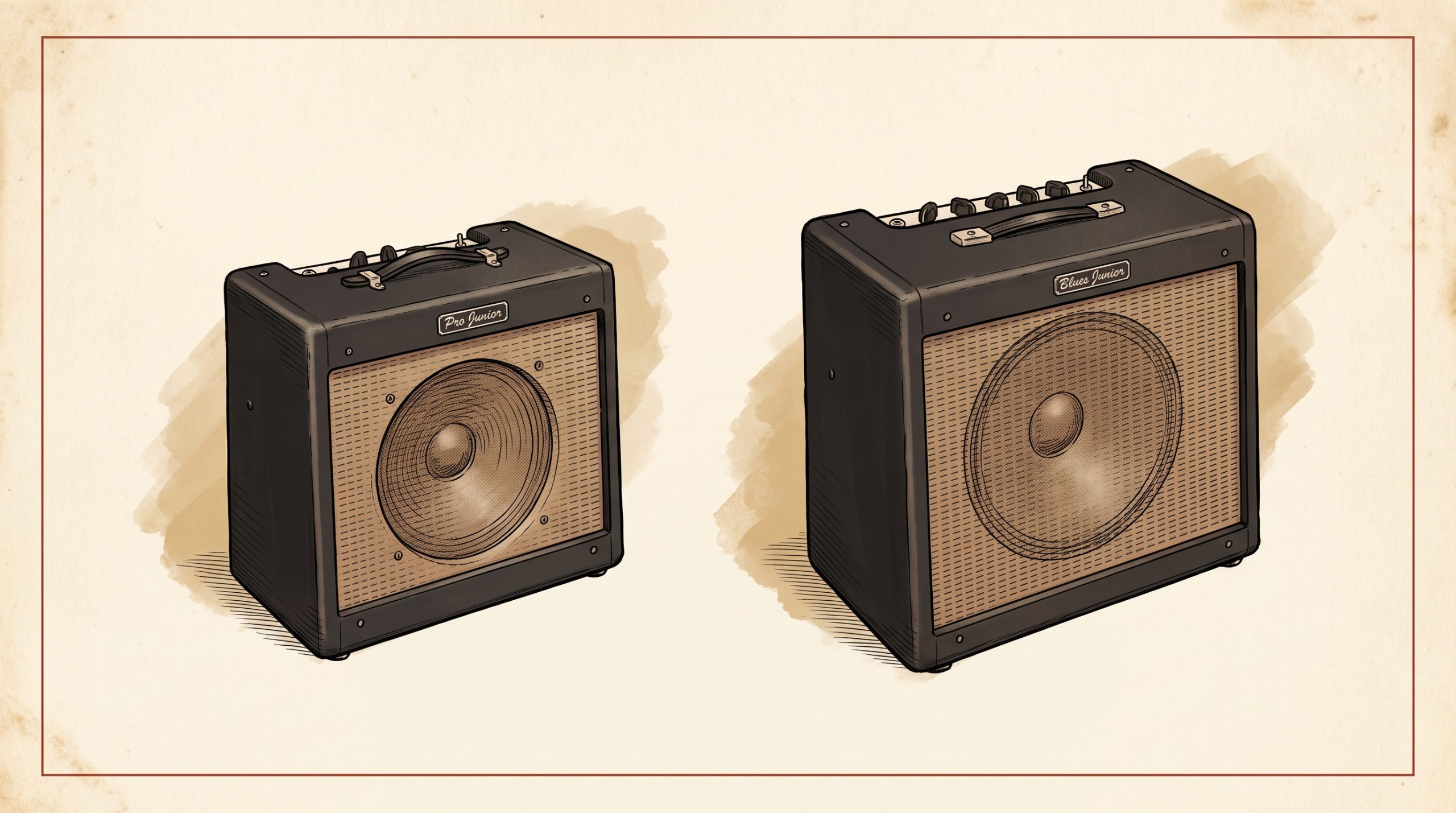
You’re standing in a guitar shop with a budget around $600 and two amps on the floor in front of you. One is small, black, almost alarmingly simple. The other is bigger, heavier, and has a lot more knobs. Both say Fender. Both run on EL84 tubes. Beyond that, they’re a different animal entirely.
The Pro Junior and Blues Junior have coexisted in Fender’s lineup since the 1990s, and the confusion between them is understandable. Same basic circuit DNA, same power tube type, same 15-watt rating, similar price bracket. But the speaker difference and feature set make them suited to genuinely different players. Here’s the full breakdown.
Quick Verdict
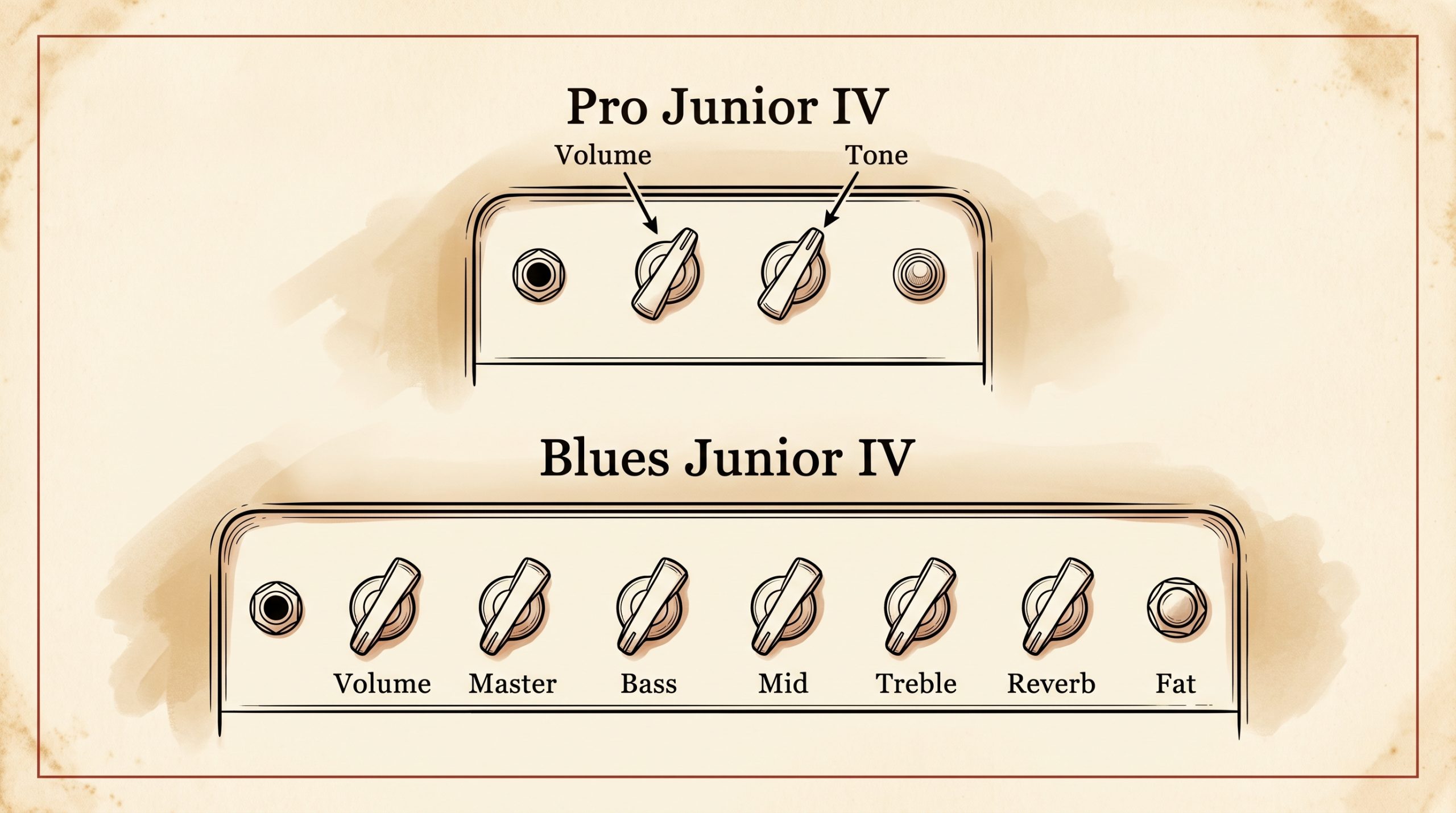
If you want maximum simplicity, a pedal-driven rig, or studio-friendly breakup at lower decibels, the Pro Junior is your amp. Two knobs, a 10-inch speaker, and you’re done. It sounds open and organic when pushed, but it demands to be played loud to get there, and it won’t give you flexibility if you need clean tones at stage volume.
The Blues Junior covers more ground. Three-band EQ, spring reverb, a master volume, and the Fat switch make it a realistic one-amp solution for gigging. According to Guitar World’s comparison coverage at guitarworld.com, the Blues Junior is the stronger all-rounder thanks to that EQ flexibility and the onboard reverb. That assessment is fair for most players. For the full breakdown, read on.
Amp Backgrounds
Fender Blues Junior: Production History
Fender introduced the Blues Junior in 1995, placing it firmly in the FMIC era, not in the pre-CBS or CBS transition periods that define vintage Fender collecting. The circuit draws loose inspiration from blackface voicing but isn’t a reissue or a clone of any existing Fender design. It’s an original FMIC creation.
Four distinct versions exist. The original Blues Junior ran from 1995 to 2001, followed by the Mk II (2001 to 2006) with minor PCB revisions. The Mk III (2006 to 2018) became the most widely modded and documented version in the aftermarket community, with Jensen P12Q speaker options in some production runs and extensive third-party mod support. The current Blues Junior IV has been in production since 2018 with an updated Celestion A-Type speaker and revised reverb tank. Production has been based in Ensenada, Mexico for the majority of the amp’s run. The full Blues Junior model guide covers the circuit revision history across all four versions in detail.
Fender Pro Junior: Production History
The Pro Junior actually preceded the Blues Junior, introduced in 1993, two years before the Blues Junior arrived. It became the deliberately stripped companion once the Blues Junior joined the lineup in 1995, but it hit the market first. Same power tube family, smaller cabinet, smaller speaker, fewer controls. The Mk I ran from 1993 to 2004, the Mk II (2004 to 2012) introduced a tweed covering option, and the Mk III (2012 to 2018) saw some limited runs including a version with a Jensen P10R speaker. The Pro Junior IV has been the current spec since 2018. All versions have been built in Mexico.
Specs Comparison
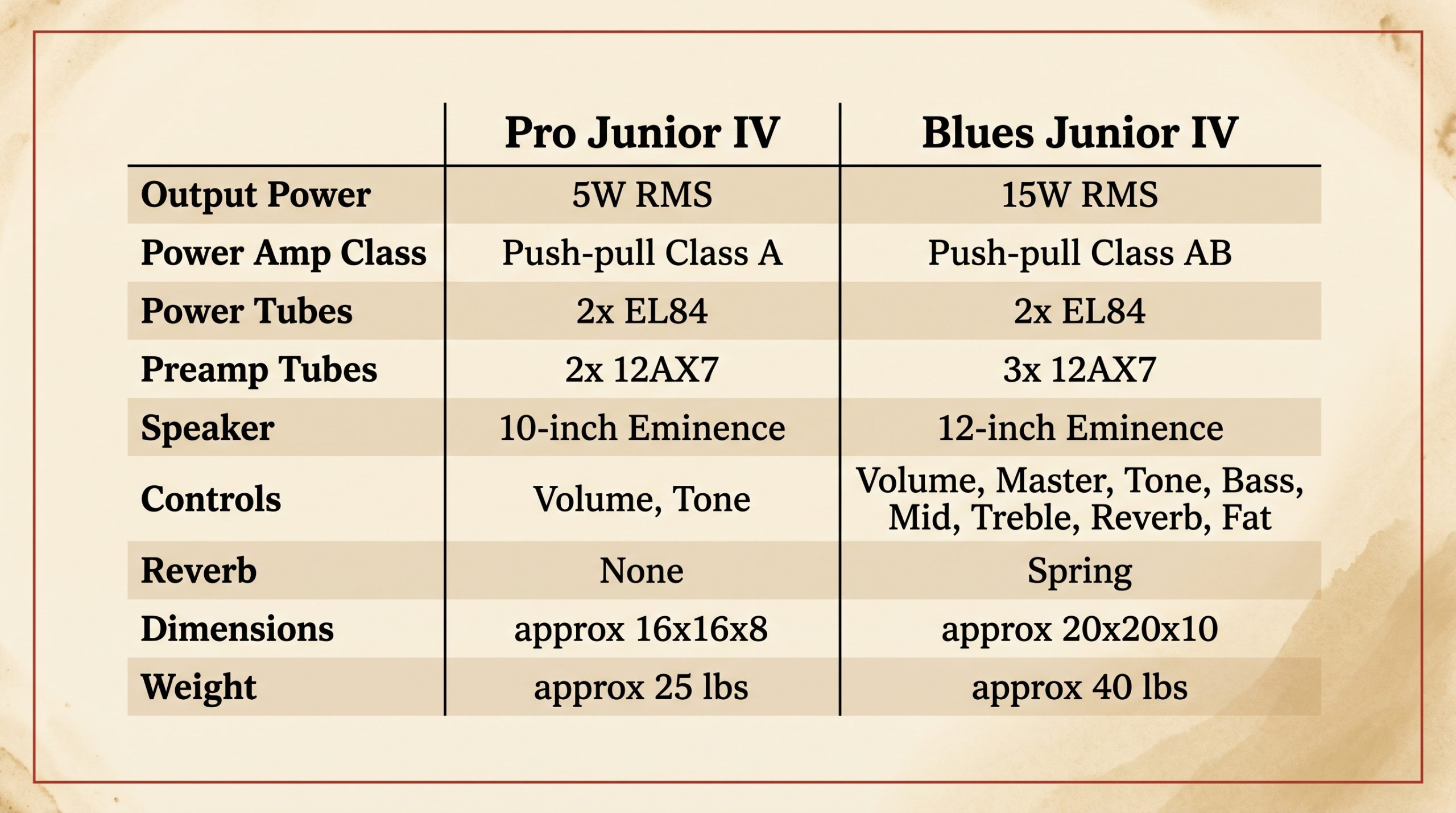
| Specification | Fender Pro Junior IV | Fender Blues Junior IV |
|---|---|---|
| Output Power | 15W RMS | 15W RMS |
| Power Amp Class | Push-pull (marketed as Class A) | Push-pull Class AB |
| Power Tubes | 2x EL84 | 2x EL84 |
| Preamp Tubes | 2x 12AX7 | 3x 12AX7 |
| Rectifier | Solid-state | Solid-state |
| Speaker | 10″ Jensen P10R (8 ohm) | 12″ Celestion A-Type (8 ohm) |
| Controls | Volume, Tone | Volume, Bass, Mid, Treble, Master, Reverb, Fat switch |
| Spring Reverb | No | Yes (Accutronics tank) |
| Effects Loop | No | No |
| Cabinet (approx) | 14.5″ x 15.25″ x 8.75″ | 18″ x 16″ x 9.5″ |
| Weight | ~23 lbs | ~31.5 lbs |
| Street Price (2026) | ~$540 USD | ~$790 USD |
| Made In | Mexico | Mexico |
The “Class A” Asterisk
Fender markets both amps with Class A language, and that deserves a straight answer. Neither amp is strictly Class A in the technical sense. Both run push-pull EL84 pairs, which places them in Class AB operation by definition. Single-ended Class A topology uses one output tube with no phase inverter. These amps use two.
What Fender is describing, loosely, is the operating bias point. The Pro Junior’s output stage runs its EL84s at a warmer idle current than a more conservatively biased AB design, which means it behaves more like a Class A circuit in terms of compression feel and harmonic response. It’s not a flaw in either amp. It’s just imprecise marketing language that’s worth understanding before you buy. The EL84 tube guide covers Class A versus AB operating behavior in the context of EL84 circuits specifically, which is directly applicable to both amps here.
Sound Character
Fender Pro Junior: Tone Profile
The Pro Junior starts breaking up around volume 3 to 4 on the dial. That’s not a complaint, it’s the whole point. The breakup character is warm and compressed with EL84 sag that adds harmonic complexity. The single Tone knob is a blunt instrument. You get a broad treble cut, and not much else. Players who rely on guitar volume and tone controls to shape their sound will get more from this amp than players expecting the amp itself to do the tonal heavy lifting.
The 10-inch speaker tightens the low end compared to a 12-inch cabinet, makes the midrange more forward, and gives the transient attack a faster decay. It barks when pushed. P-90s and lower-output humbuckers work particularly well here. Bright single-coils can get harsh at the top end without rolling back the guitar’s tone control first.
Volume at breakup is worth noting. Fifteen watts through a 10-inch driver breaks up sooner than the same power through the Blues Junior’s bigger cabinet and cleaner gain structure would suggest, but in practice a cranked Pro Junior is still plenty audible in a full band mix. It’s not a bedroom amp without attenuation.
Fender Blues Junior: Tone Profile
The Blues Junior holds its clean tone significantly longer than the Pro Junior. At bedroom practice volumes, it stays clean enough to be genuinely useful. The three-band EQ changes the amp’s practical character completely. The mid control in particular helps cut through a mix or sit back in a recording. That flexibility is what the Pro Junior simply doesn’t offer.
The Fat switch adds a low-frequency boost centered around 100 to 200Hz alongside some upper-mid presence, producing a thicker, more compressed feel that approximates blackface low-end bloom. It’s a useful one-button tone change that works especially well with single-coil guitars that sound thin through the standard voicing.
The Accutronics spring reverb is medium-decay, slightly splashy. It’s not as lush as the reverb in a Deluxe Reverb or Super Reverb, but it’s functional and genuinely useful for live work. The 12-inch speaker delivers fuller low-end extension and a more even frequency distribution across the range, with the classic Fender spanky attack on the top end. Works with everything pickup-wise. Strats and Teles particularly complement it.
Direct Tone Comparison
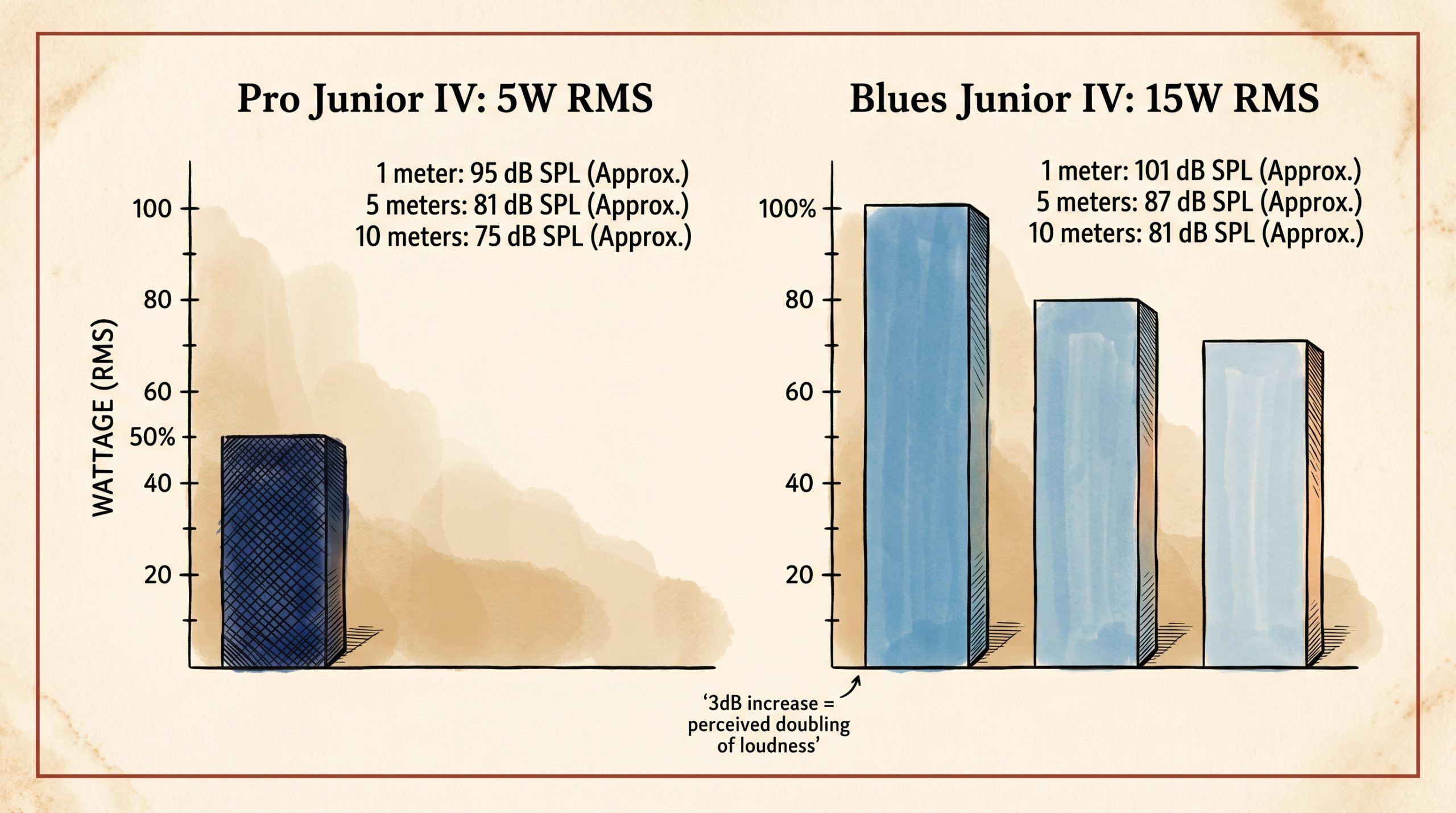
With both amps set at volume 5 on the dial, the Blues Junior is cleaner and louder. The Pro Junior is already breaking up, often noticeably so. At the edge of breakup, the Pro Junior has more compression and sag. The Blues Junior retains more clarity and note definition.
The loudness gap isn’t a raw power difference. Both amps run the same 15-watt EL84 output stage, so there’s no wattage-driven dB gap to quantify here. What actually separates them in a room is speaker efficiency and cabinet volume: the Blues Junior’s larger 12-inch Celestion in a bigger enclosure moves more air than the Pro Junior’s 10-inch driver in a smaller box, and the Blues Junior’s master volume and extra gain stage extend its usable clean headroom well past where the Pro Junior starts to compress. The Blues Junior is louder and cleaner-feeling at a given volume-knob setting by a perceptible and practical margin, but that comes from speaker and gain-staging differences, not from a power rating difference.
Pedal Platform Performance
Pro Junior as a Pedal Platform
Low headroom means pedals interact with an amp that’s already partly driven. That’s useful or limiting depending on your intent. Overdrive pedals work best as stacking tools here. A low-gain tube screamer into an already-breaking-up Pro Junior produces a complex, layered distortion that a higher-headroom amp can’t replicate. Fuzz is excellent. The compressed, low-headroom response smooths fuzz into the amp in a way that sounds and feels natural.
Delay and reverb work well placed before the input, though the absence of an effects loop means reverb trails will compress along with the amp’s natural breakup. Compressor pedals are largely redundant here. The amp compresses on its own. Using one adds sustain if you want it, but it won’t clean the amp up.
Blues Junior as a Pedal Platform
The Blues Junior’s cleaner foundation makes pedal character more predictable and more preserved. Overdrive pedals behave the way they’re supposed to, without the amp’s own saturation coloring the result. That’s standard pedal platform behavior, and it’s useful. Fuzz works but reads differently here. The cleaner amp exposes fuzz character more directly, with less smoothing from the power stage. Suits some fuzz types better than others.
The onboard reverb means you likely won’t need a reverb pedal in your chain. Running external reverb into the Blues Junior’s spring reverb can produce interesting ambient stacking, but it requires careful level management. The Fat switch interaction with drive pedals is activating it changes the input response of the amp, which alters how a drive pedal in front of it behaves. Worth experimenting with both positions.
Recording and Studio Use
Recording the Pro Junior
The Pro Junior is genuinely manageable in a home studio. The smaller 10-inch speaker and simpler two-knob gain structure mean it breaks up at lower physical SPL than the Blues Junior’s 12-inch cabinet does at the same 15-watt rating, which means you can achieve driven tones at decibels that won’t get you evicted. An SM57 positioned at the cap edge, one to two inches back, slightly off-axis is the standard starting point and works well here. Running it at 2 to 3 on the dial with a baffle in an apartment environment is realistic for driven tones.
There’s no DI out. A load box (Two Notes Captor, Suhr Reactive Load, or equivalent) allows silent recording without a mic. The compact cabinet dimensions make the Pro Junior practical for an isolation box setup if you want complete SPL control.
Recording the Blues Junior
The Blues Junior’s larger 12-inch speaker and cleaner gain structure require more volume management in a home studio context if you want to reach the amp’s natural breakup, even though it shares the same 15-watt rating as the Pro Junior. The Blues Junior’s cleaner headroom is an asset when you want a clean amp tone with pedals doing the distortion work, without amp breakup coloring the signal. The spring reverb saves you a reverb unit in the signal chain for basic tracking.
The larger cabinet produces more low-end room resonance than the Pro Junior. That’s not necessarily a problem, but it often means cutting below 80 to 100Hz in the mix. Same mic-or-load-box requirement applies. No DI out on either amp means you’re committed to one of those two approaches.
Gigging Suitability
Small Venue and Open Mic
The Pro Junior can hold its own in a quiet venue with PA support. No PA support and a loud drummer is a different story. It gets there volume-wise, but the limited EQ makes front-of-house management harder for a sound engineer trying to shape the signal. The Blues Junior is the more practical small venue amp between the two, primarily because the master volume allows clean tone management at lower stage volumes.
Mid-Size Venue
Blues Junior territory. The Pro Junior becomes workable with PA support, but the single Tone knob limits your ability to adjust for different rooms. The Blues Junior’s three-band EQ is a real asset here. An engineer can mic it, ask you to adjust mid or treble, and you can actually comply. Not possible with the Pro Junior.
Rehearsal and Practice
Forum consensus, documented across threads at tdpri.com and similar communities, describes the Pro Junior as “very loud and raw” in home practice contexts. That’s accurate. Neither amp is a true bedroom amp without some form of attenuation. The Blues Junior’s master volume gives it a more usable quiet range. It’s still a tube amp that wants to be played at volume, but at least the master control lets you separate preamp gain from output level. Not great for neighbors without an attenuator in the chain.
Versions and Upgrades
Blues Junior Version Differences
The Mk I (1995 to 2001) established the core circuit and included the Fat switch from early production. The Mk II (2001 to 2006) made minor PCB revisions without significantly altering the tonal character. The Mk III (2006 to 2018) is the most documented version in the modification community. The Billm Audio modification documentation, specifically the bias mod and mid-scoop mod, targets the Mk III PCB layout almost exclusively. Jensen P12Q speaker options appeared in some Mk III runs. If you’re buying used specifically for modding, a Mk III is the sensible target. The Mk IV (2018 to present) updated to a Celestion A-Type speaker and revised the reverb tank. Current production. If you’re buying new, this is what you’re getting.
When tracking down a used Blues Junior and trying to confirm its production year from the chassis, the Fender tube amp serial number and dating reference covers FMIC-era serial formats alongside the vintage stuff, which is useful for pinning down which version you’re actually looking at.
Pro Junior Version Differences
The Mk I (1993 to 2004) ran in black tolex. The Mk II (2004 to 2012) introduced the tweed covering option, a cosmetic change without circuit alteration. The Mk III (2012 to 2018) saw limited runs with a Jensen P10R speaker, which the aftermarket community generally regards as an improvement over the earlier stock Eminence. The Mk IV (2018 to present) is current production and carries the Jensen P10R forward as the standard factory speaker. No version carries dramatically different circuit topology. The core preamp and power stage remained consistent across all four versions.
Common Aftermarket Upgrades
Speaker swaps are the highest-impact upgrade on both amps. For the Pro Junior, an Eminence Red Fang is the most commonly recommended path away from the stock Jensen P10R that current Mk IV units ship with (earlier Mk I-III units with the older stock Eminence speaker are often swapped to a Jensen P10R instead, matching current-production spec). For the Blues Junior, a Jensen P12Q or Celestion Blue (expensive, but noted by the community) opens up the top end and tightens the low-end response considerably compared to the stock Celestion A-Type. Tube rolling in the preamp is a lower-cost starting point. Rolling a 12AT7 into V1 of the Blues Junior drops the preamp gain and gives cleaner headroom, which pairs well with drive pedals. The 12AX7 buyer’s guide covers the full NOS versus current-production options applicable to both amps, including the gain-staging implications of going to a lower-mu tube in V1.
Price and Value
Current street pricing sits around $540 for the Pro Junior IV and $790 for the Blues Junior IV. The used market changes the math. A Blues Junior III in good condition typically runs $350 to $450, while a Pro Junior III runs $250 to $350. Both represent strong value for all-tube combos at those price points. The Blues Junior III used often makes more sense than a new Mk IV if your budget allows for a speaker swap after purchase.
For context at this price point, the Vox AC4 and Blackstar HT-5 occupy similar territory. Neither matches the Blues Junior’s onboard feature set at comparable prices, and neither offers the Pro Junior’s sheer simplicity at the low end of the range. Both Fenders hold their used value reasonably well.
Who Should Buy Each Amp
Buy the Pro Junior If…
- Maximum simplicity is the goal and you’re running pedals for tone shaping
- Slide, blues, or classic rock where amp breakup is the primary sound
- You need something lightweight and genuinely portable
- Budget is the primary constraint and you want the cheapest all-tube Fender
- Home studio recording with a preference for driven tones at low SPL
- Fuzz pedals are a core part of your rig
Buy the Blues Junior If…
- Onboard reverb and EQ flexibility matter for your playing situation
- You’re in a band and need headroom to stay clean at stage volume
- One amp needs to cover clean, edge-of-breakup, and reverb tones
- You’re gigging without consistent PA support
- Home practice is a primary use case and master volume control is important
- Single-coil guitars (Strat, Tele) are your main instruments
Which Amp Fits Your Situation
The honest answer is that these two amps aren’t really competing for the same player. The Pro Junior rewards commitment to a simple, pedal-forward rig where amp breakup is a feature rather than a problem. The Blues Junior rewards versatility. It does more things, covers more venues, and gives sound engineers and home recorders more to work with. If you’re building a rig around pedals and want the amp to stay out of the way until you push it, the Pro Junior makes a strong case at its price point. If you need the amp itself to handle reverb, clean headroom variation, and EQ shaping, the Blues Junior is the practical choice. For deeper research on the EL84’s compression characteristics and how they affect both amps’ breakup behavior, the EL84 tubes guide is worth reading alongside this comparison.
Frequently asked questions
Is the Fender Pro Junior loud enough to gig with?
At 15 watts through a 10-inch speaker, the Pro Junior can hold its own in small-to-medium venues with PA support. Without a PA, it struggles in a full-band context with a loud drummer. Expect it to break up, often desirably, around volume 4 to 5 on the dial. For mic'd PA use, the volume is sufficient. For an unmic'd stage, it depends heavily on the room and the drummer.
What is the main difference between the Pro Junior and Blues Junior?
Both share the same 15W output stage and power tube type, so wattage isn't the differentiator it might appear to be. The real differences are speaker size (10-inch vs 12-inch), preamp tube count (2x vs 3x 12AX7), and onboard features. The Blues Junior adds a three-band EQ, spring reverb, master volume, and a Fat switch. The Pro Junior gives you Volume and Tone only. That feature gap makes them suited to quite different playing situations.
Is the Fender Blues Junior a Class A amplifier?
Fender markets it as Class A, but it runs a push-pull EL84 pair in Class AB operation. The Pro Junior is similarly marketed but runs its output stage at a warmer bias point that approaches Class A behavior in terms of feel and compression. Neither amp uses single-ended Class A topology in the strict technical sense. The marketing language is imprecise but widely accepted as shorthand for the amp's character rather than its circuit classification.
Which is better for home practice?
The Blues Junior is the more practical home practice option. Its master volume control lets you separate preamp gain from output volume, which gives you a wider usable range at lower SPL. The Pro Junior gets loud and breaks up quickly, making quiet practice difficult without an attenuator. That said, neither amp is ideal for apartment-level volumes without some form of power attenuation in the chain.
Which version should you buy used?
The Blues Junior III (2006 to 2018) is the community consensus for used buying. It has the most aftermarket modification support, the widest availability, and strong documentation. The Billm Audio mod documentation specifically targets the Mk III PCB. For the Pro Junior, the Mk III is the same sensible target, with the Jensen P10R-equipped limited runs being the most desirable examples. Both are commonly available in the $300 to $450 range in good condition.