Contents
- 01What Makes an Amp a "Tweed" Fender?
- 02The Three Sub-Eras of Tweed Fender Amps
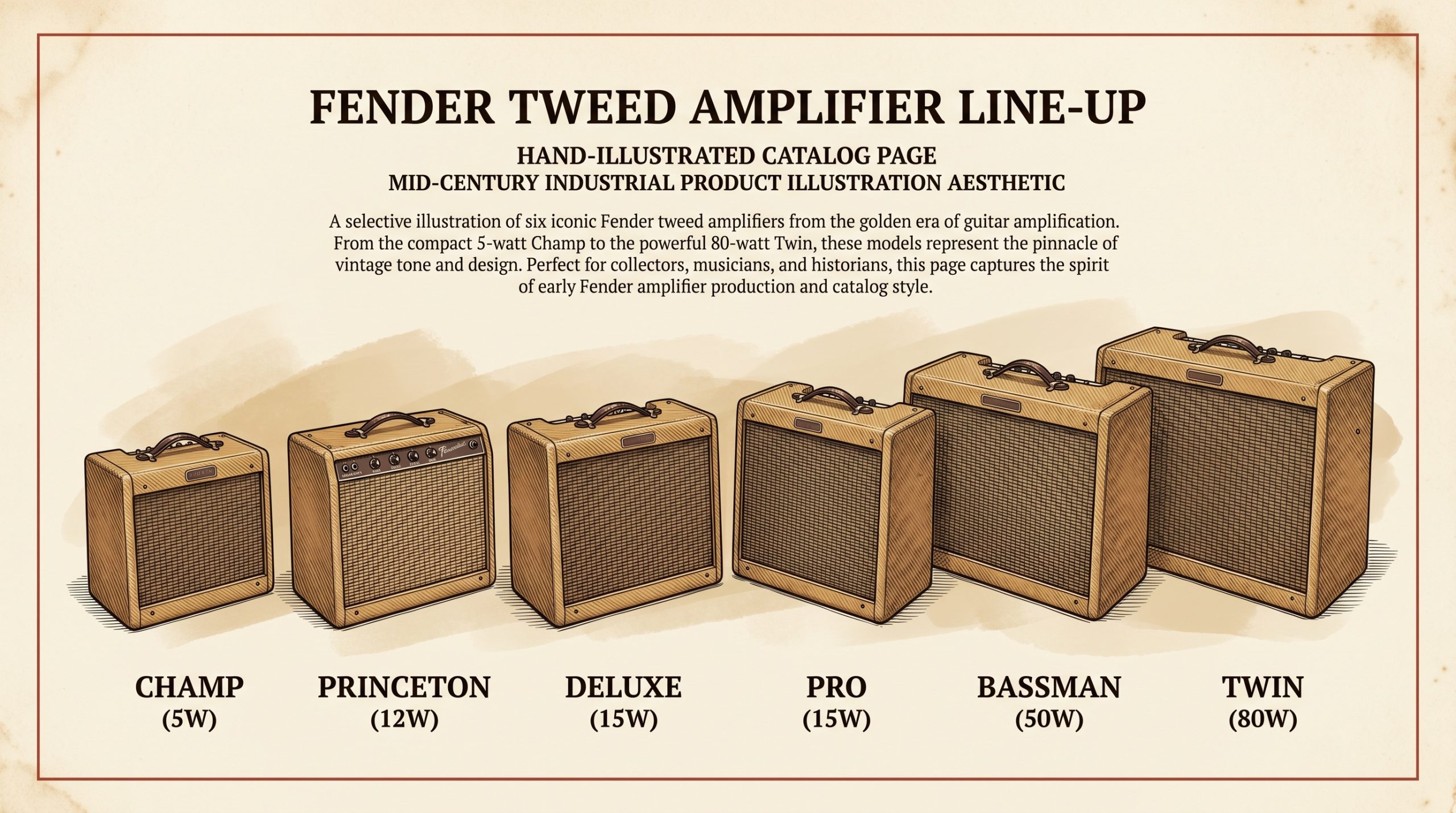
- 03Every Tweed Fender Amp Model: Specs, Circuit Numbers, and Production History
- 04How to Date a Tweed Fender Amp: EIA Codes and Date Code Guide
- 05Authenticating a Tweed Fender Amp: Spotting Fakes and Over-Restored Examples
- 06Tweed Fender Amp Values: Current Market Guide
- 07Tone Characteristics and Why Tweed Fenders Sound Different
- 08Frequently Asked Questions About Tweed Fender Amps
- 09What to Look For When Buying
Most people assume tweed Fender amps are simply “old brown amps with a vintage vibe.” They’re wrong, and that assumption costs collectors real money. The tweed era spans twelve years, three distinct cabinet sub-eras, and dozens of circuit revisions, each with different collector values, tonal characteristics, and authenticity markers. A 1953 TV Front 5B3 Deluxe and a 1958 Narrow Panel 5E3 are both “tweed Fenders,” but they’re separated by a complete circuit redesign, a cabinet transformation, and roughly $2,000 in current market value.
This guide covers identification first, tone second, and value third. Whether you’re buying, selling, restoring, or just trying to figure out what you have, the sections below walk through every model, every circuit number, the EIA date code system, and the authentication checks that separate a genuinely original example from a re-covered, re-speakered, or otherwise misrepresented amp. The fender tweed amp market rewards the informed buyer. It punishes the one who skips this research.
As Reverb’s documentation on the era notes, 1950s fender tweed amps are regarded by players and builders alike as the foundation of the modern guitar amplifier, establishing a template that influenced amp design for the following seven decades.
- Production years: 1948–1960 (some models transitioned into 1961–1964 with overlapping cosmetics)
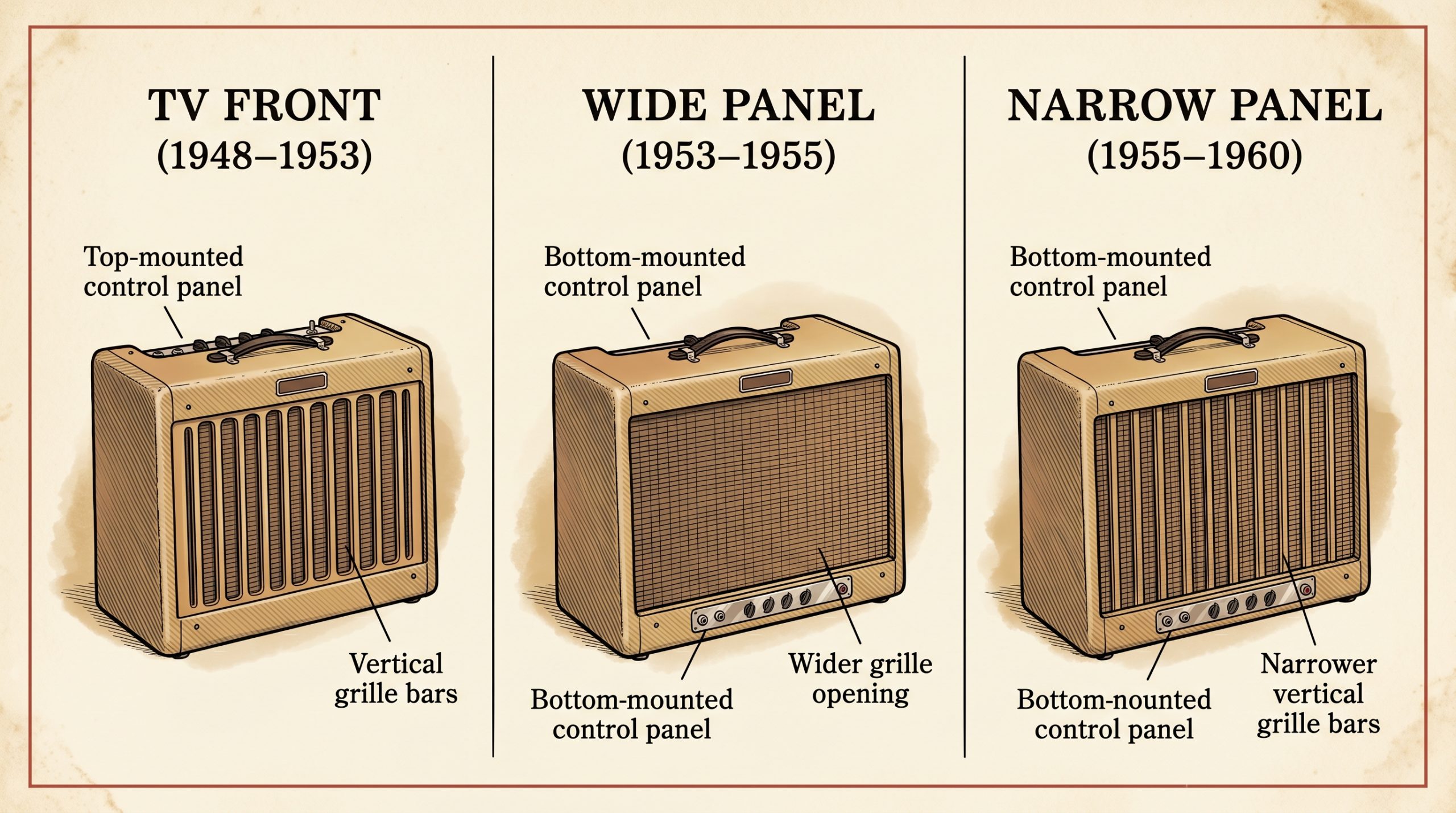
- Three sub-eras: TV Front (1948–1953), Wide Panel (1953–1955), Narrow Panel (1955–1960)
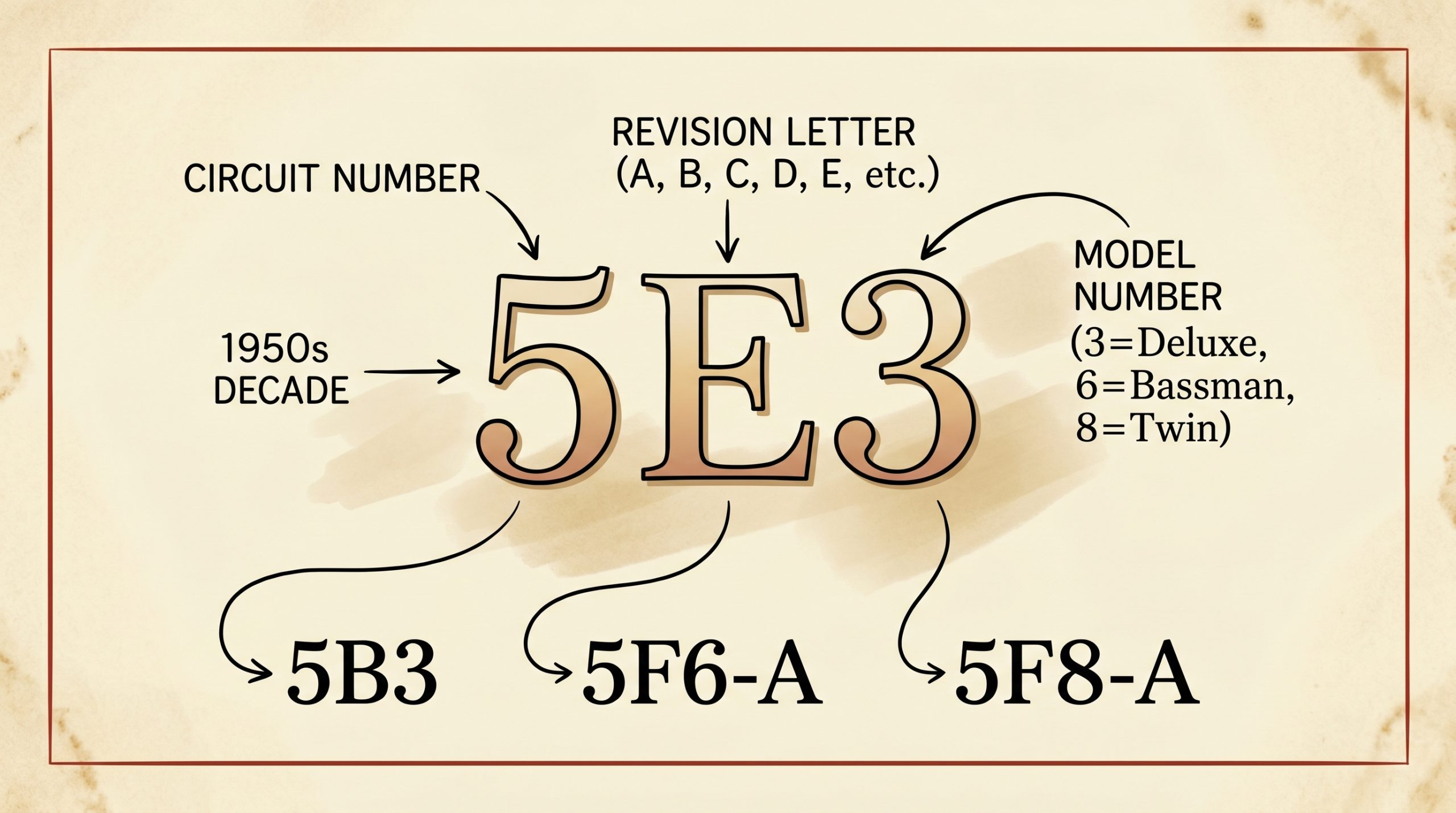
- Circuit numbering format: first digit = decade (5 = 1950s), letter = revision, second number = model
- Models covered: Champ, Princeton, Deluxe, Pro, Bassman, Twin, Super, and others
- Power range: 5W (Champ) to 85W (5F8-A Twin)
- All-original examples command 30–50% premium over re-covered or re-speakered examples
- Market values span $800 (player-grade Champ) to $22,000+ (all-original Twin)
- Reproduction tweed fabric available commercially since the 1990s, re-covered amps are common and often undisclosed
- Tube charts can be swapped between chassis, always cross-reference with EIA component codes
- The 5F6-A Bassman directly inspired the Marshall JTM45, counterfeits and misrepresented examples circulate at auction
What Makes an Amp a “Tweed” Fender?
The name comes from the covering material itself. Not wool tweed as in a jacket, but a lacquered cotton twill fabric, purchased by Fender from a luggage supply company in Chicago throughout the production era. The fabric arrived in rolls, was cut and applied to the cabinet, and then lacquered to a semi-stiff finish. That combination of material, adhesive, and lacquer produces the characteristic slightly rough, faintly yellowed surface that collectors know on sight. Original lacquer has a distinctive slightly musty smell when the cabinet is opened after decades in storage. Reproduction fabric doesn’t replicate that.
The Covering Material and Its Source
Fender sourced the same roll stock throughout the tweed era, but color and texture shifted slightly across years. Early TV Front examples tend toward a lighter, more ivory tone. Narrow Panel examples from 1957 to 1960 show a warmer amber-gold cast from years of lacquer oxidation. On an original cabinet, the grain runs vertically on the front and back panels and horizontally on the top and bottom. That directional consistency is a quick first check. Replacement and reproduction tweed often breaks that pattern, particularly at the corners where the fabric was cut and wrapped.
Staple oxidation is the other tell. Original Fender factory staples were plain steel, and after 60-plus years they have oxidized to a dull grey-brown. Replacement staples look comparatively bright, either shiny silver or brass-toned. Not conclusive alone, but alongside everything else.
Cabinet Construction and Hardware Cues
The cabinet itself changed three times across the tweed era. TV Front amps (1948–1953) had rounded top corners, a television-set silhouette, and the control panel mounted on the top of the cabinet. Wide Panel amps (1953–1955) maintained a similar shape but widened the decorative bezel around the grille cloth opening. Narrow Panel amps (1955–1960) are the ones most people picture when they think of a tweed Fender: the bezel shrunk significantly, the grille cloth takes up most of the front face, and on most models the control panel moved to the bottom front.
Handle type correlates with year. Earlier amps used a leather-wrapped wooden handle with visible end fittings. Later Narrow Panel examples shifted to a wider leather strap handle. Neither is universal across all models in a given year, but a mismatched handle relative to the stated year should prompt a closer look at the overall cabinet authenticity.
The Three Sub-Eras of Tweed Fender Amps
Breaking the tweed era into three sub-eras is the fastest visual identification framework available, and it’s the context that matters most when assessing value. A circuit number tells you the exact design. The sub-era tells you roughly when it was made before you open a single cabinet panel.
TV Front Era (1948–1953)
The TV Front cabinet takes its name directly from the styling language of early television sets: a rounded top, a slightly boxy profile, and the impression of a framed screen on the front. Control panels were top-mounted. The models produced in this era included the Dual Professional, Super, Pro, Deluxe, Princeton, early Bassman, and the Champion 600 and 800.
Circuit numbering started here with the 5A and 5B series. The “5” prefix indicates the 1950s decade. Point-to-point wiring was standard, and early examples used cloth-covered wire throughout the chassis. Knob style was the “chicken head” pointer type, a visual marker that definitively places an amp in this sub-era if present. TV Front amps are genuinely rare relative to later production, and while collector demand is high, the 5B-series circuits are considered less tonally refined than the 5E and 5F series that followed.
Wide Panel Era (1953–1955)
Short transition window. Not dramatic. The Wide Panel amps kept some TV Front cabinet proportions but introduced a noticeably wider decorative frame around the grille cloth. The 5C and 5D circuit series were introduced during this period, representing meaningful improvements in gain staging and output design over the 5A and 5B predecessors. Grille cloth was in transition as well, with oxblood and tan weave varieties appearing depending on model and production date. Wide Panel amps are less commonly discussed than the Narrow Panel classics that followed, but the 5D3 Deluxe and 5D6 Bassman from this era have their own following among players who prefer a slightly earlier circuit character.
Narrow Panel Era (1955–1960)
This is what most collectors mean when they say “tweed Fender amp.” The bezel shrank, the grille cloth expanded, the control panel dropped to the bottom front on most models, and the 5E and 5F circuit series arrived. Those circuits, particularly the 5E3 Deluxe, 5F1 Champ, 5F2-A Princeton, 5F6-A Bassman, and 5F8-A Twin, are the ones with the strongest collector demand and the highest market values. The final production year of 1960 overlaps with the beginning of the brownface transition, so late 1960 chassis stamps can appear on amps with either cosmetic treatment depending on model and inventory.
| Sub-Era | Years | Circuit Series | Cabinet Style | Collector Demand |
|---|---|---|---|---|
| TV Front | 1948–1953 | 5A, 5B | Rounded top, top-mounted panel | Moderate–High |
| Wide Panel | 1953–1955 | 5C, 5D | Wider bezel, transitional | Moderate |
| Narrow Panel | 1955–1960 | 5E, 5F | Narrow bezel, bottom-mounted panel | Very High |
Every Tweed Fender Amp Model: Specs, Circuit Numbers, and Production History
The circuit designation system used across the tweed era followed a consistent format: the first digit indicates the decade (5 for 1950s), the letter indicates the revision within that circuit family, and the second number identifies the model. As documented in the Fender circuit designation records compiled at Schematicheaven.net, these designations applied through the Tweed, Blonde, and Brown eras before the blackface redesigns of 1963 introduced new codes. What follows is a model-by-model breakdown covering the most significant tweed Fender amps in production.
Fender Tweed Champ (1948–1960)
The fender tweed champ is the most accessible entry point to the tweed collecting world, and the most recorded small amp in studio history. Circuit numbers progressed from 5C1 through 5D1 and 5E1 to the definitive 5F1. Power output sits at 4 to 5 watts RMS from a single 6V6GT running single-ended Class A. That topology, one power tube, no push-pull, produces the characteristic immediate harmonic compression that made the fender champ tweed a studio standard. The preamp uses a 12AX7, the rectifier is a 5Y3, and the original speaker was an 8″ Jensen P8T in 5C1 and 5D1 versions, transitioning to an 8″ Oxford or Jensen in the 5F1. The 5C1 is TV Front era; the 5F1 is Narrow Panel.
Controls on the 5F1 are as minimal as it gets: a single volume knob. No tone control. No reverb. Just guitar, volume, and whatever the 6V6 is doing at the moment. At bedroom-friendly volume it stays clean. Pushed above about 6 on the dial, it barks when pushed with a single-coil in a way that has ended up on more recordings than most players realize. The full model history of the Fender Champ is covered in depth in the Fender Champ model guide.
Fender Tweed Princeton (1948–1960)
The fender tweed princeton ran through more circuit revisions than almost any other model in the line. Starting at the 5B2, it passed through 5C2, 5D2, 5E2, and 5F2 before arriving at the 5F2-A, the most significant revision. That final circuit added a tone control, a meaningful improvement for players who found the earlier Princeton too one-dimensional for rehearsal and session use. Power output climbed across the revisions from roughly 4.5 watts (5B2) to approximately 4 to 5 watts in the 5F2-A, which uses a single 6V6GT tube in a single-ended configuration. Speaker changed from an 8″ Jensen P8T to a 10″ Jensen P10R in later versions.
The 5F2-A Princeton produces a warm, slightly spongy compression that sits between the single-ended Champ character and the push-pull Deluxe. It doesn’t have the 5E3’s interactive channel quirks, which makes it simpler to dial in. For anyone who wants a tweed Fender that behaves more predictably than the Deluxe, the 5F2-A is worth serious consideration.
Fender Tweed Deluxe (1948–1960)
The 5E3 Tweed Deluxe is the most cloned amp circuit in history. That designation isn’t hyperbole. From Ceriatone to Victoria to dozens of boutique builders, the 5E3 schematic has been reproduced more times than any other single Fender design. Circuit numbers ran from 5A3 through 5B3, 5C3, 5D3, 5E3, and 5F3. The 5E3 is the most sought-after revision.
Power output is approximately 12 to 15 watts from two 6V6GT tubes in Class AB push-pull, cathode biased. The preamp uses two 12AY7 tubes (V1 and V2) rather than the higher-gain 12AX7, giving the front end a softer, more dynamic response. A 12AX7 handles phase inverter duties. The rectifier is a 5Y3, which introduces rectifier sag under attack, that slight compression and “bloom” that tweed fans describe. Original speaker was a 12″ Jensen P12R or P12Q.
The cathodyne phase inverter in the 5E3 is the detail that makes this circuit feel different from everything that came after. It produces a slight asymmetry in the push-pull drive that contributes to the amp’s character at volume. The two channels are not independent in the way later Fender channels are: plugging into both simultaneously creates a cross-talk effect that players have used intentionally for decades. The loose low end, the interactive controls, the spongy compression at volume. Nothing else sounds quite like it.
Fender Tweed Pro (1948–1960)
The fender tweed pro is less discussed than the Deluxe or Bassman, but it’s a significant amp. Circuit numbers progressed from 5A5 through 5B5, 5C5, 5D5, 5E5, and 5E5-A. The 5E5-A is the most notable revision, rated at approximately 25 watts from two 6L6GC tubes. The 6L6GC represents a meaningful step up from the 6V6GT in the smaller models, both in headroom and in the character of the breakup when it arrives. Original speaker was a 15″ Jensen P15N.
Historically, the 5E5-A was one of the first Fender amps to employ a long-tailed pair phase inverter, an advance over the cathodyne design in the 5E3 Deluxe. That change produces a more balanced push-pull drive and generally tighter bass response. The Pro stays cleaner longer than the Deluxe and requires more volume to saturate, which makes it better suited to players who need clean headroom at stage-loud levels but still want the character of tweed-era circuitry. Rarer than the Deluxe. Less commonly available at auction.
Fender Tweed Bassman (1952–1960)
The 5F6-A Bassman is the most historically significant tweed Fender amp ever made. In 1962, Marshall’s service engineer Ken Bran reverse-engineered a borrowed Fender Bassman 5F6-A, documented the circuit schematic, and used it as the foundation for the original Marshall JTM45. That lineage makes the 5F6-A simultaneously the most important Fender amp and the most important British amp ever made, because the British amp didn’t exist yet.
Circuit numbers ran from 5B6 through 5D6, 5E6, and the definitive 5F6-A. Power output is approximately 50 watts from four 6L6GC tubes in a quad power section. The original speaker configuration in the 5F6-A was four 10″ Jensen P10R speakers in a horizontal open-back cabinet, a significant departure from the single 15″ speaker in earlier Bassman versions. The 5F6-A’s four-input two-channel front end, long-tailed pair phase inverter, and negative feedback loop created a circuit template that defined amplifier design for the following twenty years. The Fender Bassman complete guide covers the full circuit history in depth, including the transition from single-15 to four-10 configurations and the Marshall connection.
All-original 5F6-A examples in original condition are increasingly difficult to source. Significant value. Real scarcity.
Fender Tweed Twin (1952–1960)
The fender tweed twin is the apex of the tweed production run in terms of power and current collector value. Circuit numbers progressed from 5B8 through 5C8, 5D8, 5E8, 5F8, and the final 5F8-A. The 5F8-A runs four 6L6GC tubes and produces approximately 85 watts, among the highest output of any tweed-era amp. Original speakers were two 12″ Jensen P12N drivers in the 5F8-A. The output transformer on the Twin features a multi-impedance configuration, one of the identification features that distinguishes original transformers from field replacements.
The fender tweed twin’s combination of rarity, wattage, and historical position at the top of the original Fender lineup produces the highest dollar values in the tweed category. All-original 5F8-A examples regularly trade above $15,000. The 5E8 is less common than the 5F8-A and commands its own premium among circuit purists. Weighs a ton by tweed standards, which limited stage use and kept many examples in lighter rotation.
| Model | Final Circuit | Watts | Power Tubes | Speaker Config | Sub-Era | Rarity |
|---|---|---|---|---|---|---|
| Champ | 5F1 | 5W | 1x 6V6GT | 1×8″ | Narrow Panel | Common |
| Princeton | 5F2-A | 4–5W | 1x 6V6GT | 1×10″ | Narrow Panel | Common |
| Deluxe | 5E3 | 15W | 2x 6V6GT | 1×12″ | Narrow Panel | Common–Moderate |
| Pro | 5E5-A | 25W | 2x 6L6GC | 1×15″ | Narrow Panel | Scarce |
| Bassman | 5F6-A | 50W | 4x 6L6GC | 4×10″ | Narrow Panel | Scarce |
| Twin | 5F8-A | 85W | 4x 6L6GC | 2×12″ | Narrow Panel | Rare |
How to Date a Tweed Fender Amp: EIA Codes and Date Code Guide
Dating a tweed Fender amp accurately requires three independent data points: the tube chart date code, the EIA codes on the speaker and transformers, and the date codes on the potentiometers. All three should align within a 6 to 12 month window on a genuinely original, unmodified example. Any single source can be wrong: tube charts get replaced, speakers get swapped, transformers get substituted. The convergence of all three is what gives a reliable date. For a complete reference covering date codes across all Fender eras, the Fender tube amp serial number and dating guide covers the full methodology including transformer EIA codes, chassis stamps, and tube chart letter sequences.
Understanding the EIA Code System
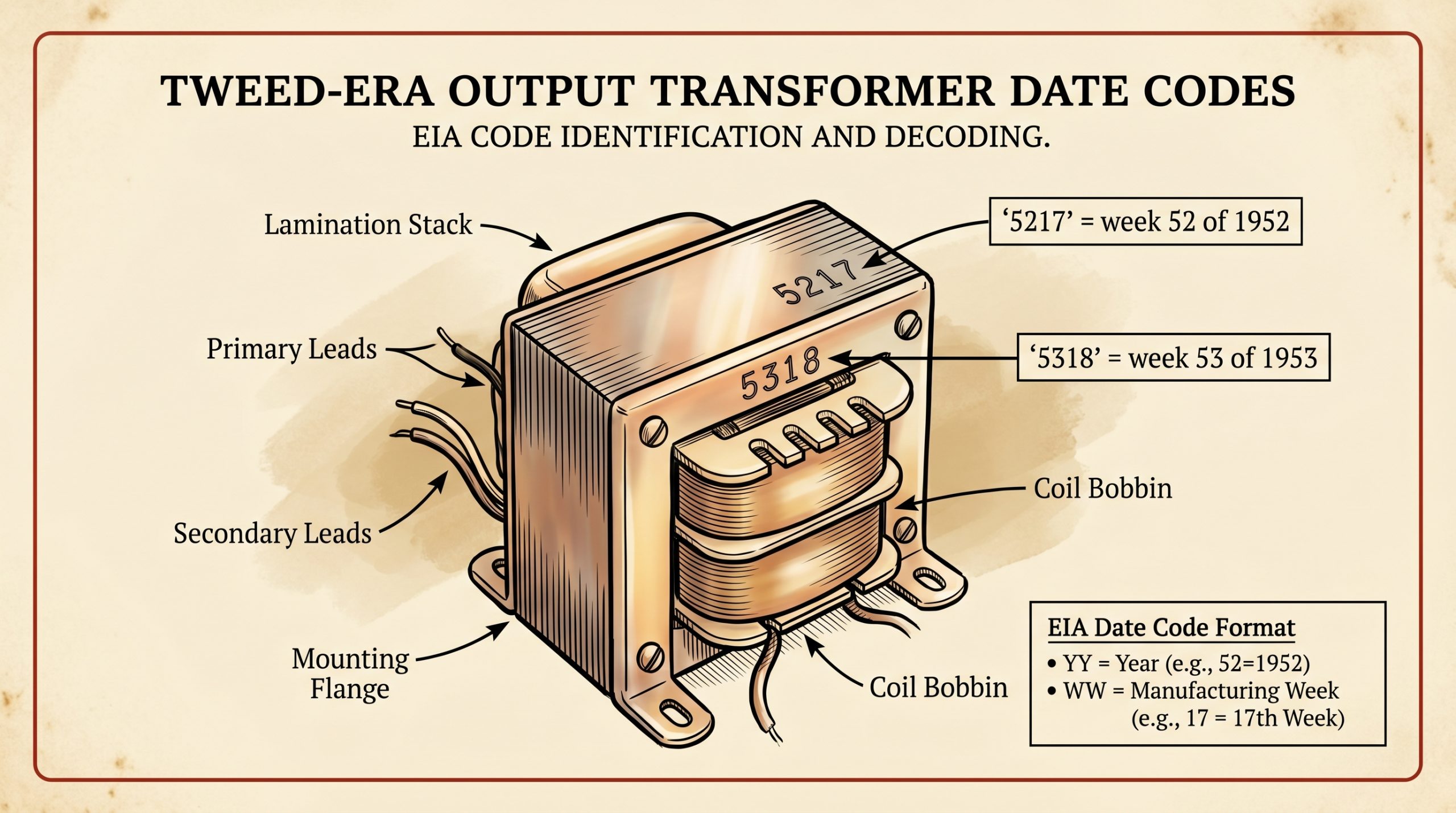
The Electronics Industries Alliance code system stamped components from participating manufacturers with a standardized identification format: manufacturer code, year (one or two digits), and week number. The format on a speaker might read 220 7 35, which decodes as Jensen (manufacturer code 220), 1957, week 35. On a transformer it follows the same structure.
Key manufacturer codes relevant to tweed-era Fender amps:
| EIA Code | Manufacturer | Component Type |
|---|---|---|
| 137 | CTS (Chicago Telephone Supply) | Potentiometers |
| 220 | Jensen | Speakers |
| 285 | Rola | Speakers |
| 304 | Stackpole | Potentiometers |
| 328 | Utah | Speakers |
| 465 | Oxford | Speakers |
| 606 | Schumacher / Triad | Transformers (context-dependent) |
The EIA code is physically stamped on the speaker’s magnet frame (back face) and on the bell housing or end bell of the transformer. On potentiometers, it appears on the metal casing, typically requiring a flashlight and removal from the chassis to read clearly. Note that code 606 appears for both Schumacher and Triad. Context, meaning the component type, whether transformer specifications match original Fender use, and cross-referencing with other date codes, determines which manufacturer produced that specific part.
Tube Chart Date Codes
Fender began inserting tube charts inside the cabinet from approximately 1951 onward. These paper charts list the tube complement for the amp and carry a two-letter date code stamped by the factory. The first letter indicates the year, the second indicates the month. The year code sequence: A=1951, B=1952, C=1953, D=1954, E=1955, F=1956, G=1957, H=1958, I=1959, J=1960, K=1961, and so on through the alphabet. The month code runs A=January through L=December.
A tube chart stamped GA decodes as January 1957: G=1957 (year), A=January (month). A chart stamped QA would decode outside the tweed era entirely, placing it in 1967, which is a forgery flag on any amp being represented as original 1950s tweed production. Use this as a quick sanity check before any other authentication work.
The tube chart is located inside the cabinet, typically stapled inside the back panel or within the chassis cavity. It’s accessible without any disassembly on open-back models. Tube charts can be replaced between chassis, which is why they’re a starting point, not a final answer. Greg Gagliano’s research series in 20th Century Guitar Magazine (1997–2000), archived at the Wayback Machine, provides extensive documentation on Fender tube chart date code sequences and the production context behind each letter range.
Chassis Stamps and Serial Number Dating
Serial numbers on tweed Fender amps were not strictly sequential by model. Early examples from pre-1954 production may carry no serial number or a very low three-digit number stamped on the rear of the chassis. Later production became more consistent, but serial ranges still overlapped across models produced simultaneously. Serial number alone is the weakest of the three dating methods.
The chassis stamp is the manufacturer’s internal production date, typically stamped directly into the metal of the chassis, visible from the rear. On confirmed original examples, cross-referencing chassis stamp with tube chart letter code and EIA component dates should produce a coherent picture within a reasonable window. A chassis stamp that’s 18 months later than the speaker EIA code, with a tube chart that aligns with neither, is a red flag for replaced components or mismatched chassis and cabinet.
Authenticating a Tweed Fender Amp: Spotting Fakes and Over-Restored Examples
The collector market for tweed Fender amps has attracted serious money since the late 1980s, and where serious money goes, misrepresentation follows. Re-covered amps, replaced transformers, swapped speakers, and refinished chassis are common. Not always disclosed. What follows are the checks that reveal the difference between an all-original example and one that’s been dressed up for the market.
Original vs. Replacement Tweed Covering
Authentic original tweed runs vertically on the front and back panels and horizontally on the top and bottom. Check the corner wraps: on original factory covering, the corner seams follow consistent technique with staples at measured intervals. The staples are dull grey-brown from oxidation. Replacement staples are comparatively bright.
Under UV light, reproduction tweed fabric from the major suppliers (available commercially since the early 1990s) fluoresces differently than period-correct cotton twill with decades of lacquer aging. Not universally reliable as a test, but useful when combined with staple condition and seam inspection. A re-covered amp in otherwise original condition typically sells for 30 to 50 percent less than a genuinely original-covering example. Sellers don’t always volunteer this information.
Chassis Originality Checks
All original potentiometers should carry manufacturer date codes within approximately six months of the tube chart date. An amp with a tube chart dated G-A (January 1957) that has pots coded to late 1961 has been repotted at some point. That’s not automatically disqualifying for a player-grade amp, but it affects collector value and authenticity claims.
Replaced filter caps are expected and acceptable. Electrolytic capacitors degrade over 60-plus years, and virtually every tweed Fender in circulation has had at least a cap job at some point. The question is whether the replacements are correct vintage-style axial cans or modern radial film caps, which are visually obvious inside the chassis. The output transformer is critical. A replaced OT reduces value significantly, particularly if it’s not the correct impedance specification for that circuit. Speaker EIA code should align with tube chart date within approximately 12 months on an unmodified example. Re-coned speakers show glue residue at the cone edge; originals are paper-to-frame without visible adhesive buildup.
Common Modifications That Reduce Collector Value
The modifications below appear frequently on amps listed as “original” or “stock” at prices that reflect that claim. They reduce collector value. Period.
- Complete pot replacement with modern components
- Added effects loop or master volume control
- Rewired grounds or conversion to three-prong grounded cord without disclosure
- Chassis repainting or polishing
- Cap jobs using modern film capacitors instead of correct period-style replacements
- Voltage switching modifications for international use
Player-grade versus collector-grade pricing reflects this directly. A 5E3 Deluxe with a re-cap using correct-style components, original pots, original speaker, and original covering can still command near-collector pricing. The same amp with added master volume, replaced pots, re-covered cabinet, and a swapped transformer is a player’s amp at a player’s price. Both have value. They’re just not the same thing.
Tweed Fender Amp Values: Current Market Guide
Values in the vintage tweed Fender amp market have climbed consistently since the mid-1980s and showed particular strength from 2020 onward. The following ranges reflect U.S. private sales and auction results through 2024 to 2025. These are not retail asking prices, which run higher. All-original condition means original covering, original speaker with matching EIA date, original transformers, and no circuit modifications beyond re-capping with correct-style components.
What Drives Value in the Tweed Market
Originality percentage is the single largest value driver. A fully original 5E3 Deluxe is worth meaningfully more than an otherwise identical amp that’s been re-covered and re-speakered, even if the circuit is untouched. Circuit desirability follows: 5E and 5F series circuits command 20 to 40 percent premiums over equivalent 5B and 5C versions of the same model. Narrow Panel cabinet examples command a further premium over TV Front and Wide Panel equivalents at the same circuit number. The 5E3 and 5F6-A occupy the top of collector demand within their respective wattage categories.
Current Market Value Ranges by Model
| Model | Circuit | Player-Grade Low | Player-Grade Mid | All-Original High |
|---|---|---|---|---|
| Champ | 5F1 | $800 | $1,200 | $2,000+ |
| Princeton | 5F2-A | $1,200 | $1,800 | $3,200+ |
| Deluxe | 5E3 | $2,500 | $3,800 | $6,500+ |
| Pro | 5E5-A | $3,000 | $4,500 | $8,000+ |
| Bassman | 5F6-A | $5,000 | $7,500 | $14,000+ |
| Twin | 5F8-A | $6,000 | $10,000 | $20,000+ |
TV Front and Wide Panel versions of these models typically sit 15 to 30 percent below the equivalent Narrow Panel values at comparable originality levels, reflecting lower collector demand for the earlier circuits despite their genuine rarity.
Where Tweed Fenders Sell and How to Research Prices
Reverb.com’s completed sales filter is the most accessible real-time resource. Filter by “sold” and search the specific model and circuit number. The Vintage Guitar Price Guide (annual print publication) provides a calibrated reference that accounts for condition grades. The Gear Page classifieds run private sales that often come in below dealer retail. Specialty vintage amp dealers including Dave’s Guitar Shop, Norman’s Rare Guitars, and Gruhn Guitars consignment carry authenticated examples with appropriate premiums for provenance. Auction houses including Heritage Auctions periodically handle high-value examples where bidding history provides transparent market data.
Tone Characteristics and Why Tweed Fenders Sound Different
The tonal character of tweed Fender amps isn’t random. It follows directly from specific design choices that Fender made in the 1950s, some of which were later abandoned in the blackface era in pursuit of cleaner headroom and more “hi-fi” response. Understanding the physics explains why these amps behave the way they do.
The Physics Behind Tweed Amp Breakup
Most tweed models use cathode-biased power stages rather than the fixed-bias arrangement common in later Fender designs. Cathode bias produces a softer, more dynamic compression response: the amp breathes with the signal rather than staying rigidly at a fixed operating point. When you dig in hard, it compresses slightly. When you back off, it opens up. That dynamic sag is part of what players describe as the tweed “bloom.”
The 5Y3 rectifier tube contributes further. Tube rectifiers introduce voltage sag under attack, a momentary drop in plate voltage that softens transients and adds a spongy quality to the attack that solid-state rectifiers don’t replicate. The 5Y3 has a relatively high internal impedance, so heavy picking attacks produce noticeable sag. The output transformer in these amps also saturates at relatively modest plate voltages, adding harmonic content at volumes that later amps would still consider clean. The result: warm clean tones at low volume, natural compression at medium volume, and harmonic saturation well before the circuit is truly pushed to its limits. The 6V6GT and 6L6GC tubes used across these models are covered in depth in the 6V6 tube guide and the 6L6 tube guide.
How Tweed Tone Differs Across Models
The Champ and Princeton in single-ended Class A configuration produce the most immediate harmonic saturation. Single power tube, no phase inverter in the traditional sense, very short signal path. The saturation arrives fast and stays consistent across the volume range. Spanky attack with a single-coil, rounder and more compressed with a humbucker.
The 5E3 Deluxe sits in a different category. Push-pull cathode bias with the cathodyne phase inverter creates a slightly asymmetric drive characteristic. The bass response is deliberately loose, the low end doesn’t tighten up the way it does in fixed-bias amps. The interactive channels are the other defining feature: connecting two guitars or running a cable between the inputs changes the gain staging in ways that players have exploited intentionally. It doesn’t behave like anything else in the Fender catalog, before or after.
The Bassman and Twin, with their larger output transformers and four-tube power sections, stay cleaner longer and produce a tighter bass response. The stiff bass response is a feature, not a limitation. These are working amps that could handle a band’s worth of volume in 1957. They break up differently when pushed, with a more controlled, less chaotic saturation than the smaller cathode-biased models.
Tweed vs. Later Fender Eras
The brownface transition (1960–1963) introduced more refined tone controls, higher headroom, and generally cleaner operation. Not better. Different. The blackface era (1963–1967) brought the mid-scoop that became the defining characteristic of the American clean tone, more headroom, and the fixed-bias power stages that changed how the amps respond dynamically. For a full comparison of era differences, the Fender amp dating cheatsheet provides a quick-reference breakdown of cosmetic and circuit markers across every production era from tweed through silverface.
What to Look For When Buying
If you’re entering the vintage tweed Fender amp market for the first time, start with the Champ or Princeton: they’re the most available, the most affordable, and the easiest to authenticate because there are fewer components to cross-check. The 5F1 Champ with original speaker and original covering at a reasonable player-grade price is a genuine piece of American amp history that also happens to be one of the best studio recording amps ever made. From that foundation, the path to a 5E3 Deluxe or eventually a 5F6-A Bassman becomes clearer once you’ve handled enough examples to recognize what original looks and smells like.
Before any purchase, request high-resolution photos of the tube chart date code, the EIA stamp on the speaker magnet, the output transformer bell housing, and the potentiometers. A seller who can’t or won’t provide those images on a $3,000-plus amp is not a seller worth pursuing. The authentication work is not complicated. It just takes the time to do it before money changes hands, not after.
Frequently asked questions
What is a Fender tweed amp?
A Fender tweed amp is any guitar amplifier produced by Fender between 1948 and 1960 covered in a lacquered cotton twill fabric commonly called tweed. The term covers more than a dozen models from the 5-watt single-ended Champ to the 85-watt Twin, all sharing point-to-point wired construction and the harmonic saturation character that defined American blues, rock, and country guitar tones. The circuit numbers (5A through 5F series) and three distinct cabinet sub-eras (TV Front, Wide Panel, Narrow Panel) provide the primary identification framework within the broader tweed category.
What years were Fender tweed amps made?
Fender produced tweed-covered amplifiers from 1948 (the first TV Front models) through late 1960, when the transition to brownface covering and new cabinet styling began. The transition wasn't a clean cutover: some models, including the Champ, continued with tweed cosmetics into 1961 and 1962 during the changeover period, while others switched earlier. Any amp claiming to be a "1961 tweed" warrants scrutiny unless the specific model is confirmed to have continued tweed production into that year.
Which tweed Fender amp is most valuable?
The 5F8-A Tweed Twin (1958–1960) commands the highest prices in the tweed category, with all-original examples regularly trading at $20,000 and above depending on condition and provenance. The 5F6-A Bassman follows closely, driven by its historical significance as the circuit that directly informed the Marshall JTM45. Among the smaller models, the 5E3 Tweed Deluxe generates the highest transaction volume and largest collector base. All three command meaningful premiums over earlier 5B and 5C circuit revisions of the same models.
How do I know if my tweed Fender amp is all original?
Cross-reference three independent date sources: the two-letter tube chart date code inside the cabinet, the EIA codes on the speaker and output transformer, and the date codes stamped on the potentiometers. All three should align within a 6 to 12 month window. Mismatched dates indicate replaced components, which reduces collector value but doesn't necessarily affect playability. Original tweed covering shows oxidized staples with a dull grey-brown tone, directional grain (vertical on front and back panels), and a patina that commercial reproduction fabric cannot replicate even with deliberate aging.
Are reissue tweed Fender amps worth buying?
Fender's '57 Custom series (including the '57 Custom Champ, Deluxe, and Twin) are faithful circuit reproductions built to the original specifications and are excellent playing instruments. They hold no collector value relative to original tweed examples, but they're significantly more affordable, readily serviceable, and safe from the authenticity concerns that come with purchasing vintage examples. Boutique builders including Victoria Amplifiers, Clark Amplification, and Swart Amplifier Co. also produce high-quality tweed-circuit-inspired designs with modern build quality and full warranties. For players who want the sound without the museum-piece anxiety, the reissue and boutique market is substantial and well-developed.