Contents
- 01Quick-Pass Checklist: Eliminate the Free Fixes in Under 3 Minutes
- 02The Effects Loop Trap: The No-Sound Culprit Nobody Mentions
- 03Tube Amp Specific: Diagnosing by What You See and Smell
- 04Solid-State and Modeling Fender Amps: Different Failure Modes
- 05Speaker and Output Transformer Failures
- 06Diagnostic Decision Tree: Which Path Is Your Amp On?
- 07Repair Cost Benchmarks: Should You DIY or Call a Tech?
- 08When to Stop and See a Tech, No Exceptions
- 09FAQ: Fender Amp No Sound
- 10What You Should Do
The pilot light is glowing. The tubes are warming up. The standby switch is flipped off. And there’s nothing, not a hiss, not a pop, not a single electron of audio reaching your ears. You’ve got a gig in 20 minutes, a studio session booked for the morning, or a brand-new amp out of the box that refuses to make a sound. Any of those scenarios is its own specific kind of awful.
The good news: most “no sound” failures follow a predictable pattern, and most are cheap or free to fix. This guide works through the full diagnostic ladder, from the 90-second free fixes through the $5–$20 quick repairs, on to the $50–$200 shop-level problems. It covers both tube and solid-state Fender amps, so whether you’re staring at a 1966 Deluxe Reverb or a Mustang LT25, you’re in the right place. The official Fender troubleshooting article gives you nine bullets. This gives you everything behind them.
Quick-Pass Checklist: Eliminate the Free Fixes in Under 3 Minutes
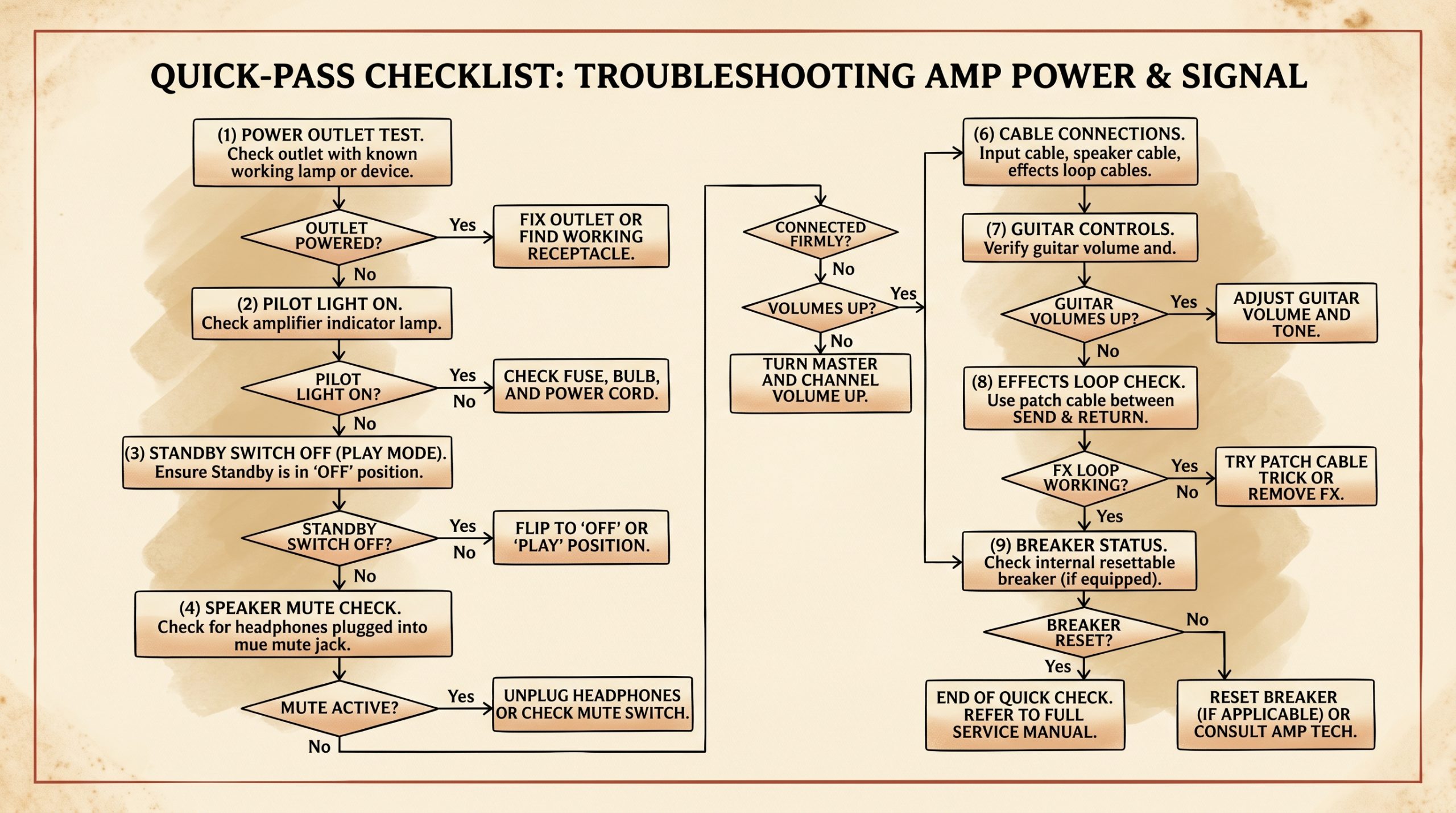
Run through these before assuming anything is broken. Fast. No embarrassing repair bills for a turned-down guitar volume knob.
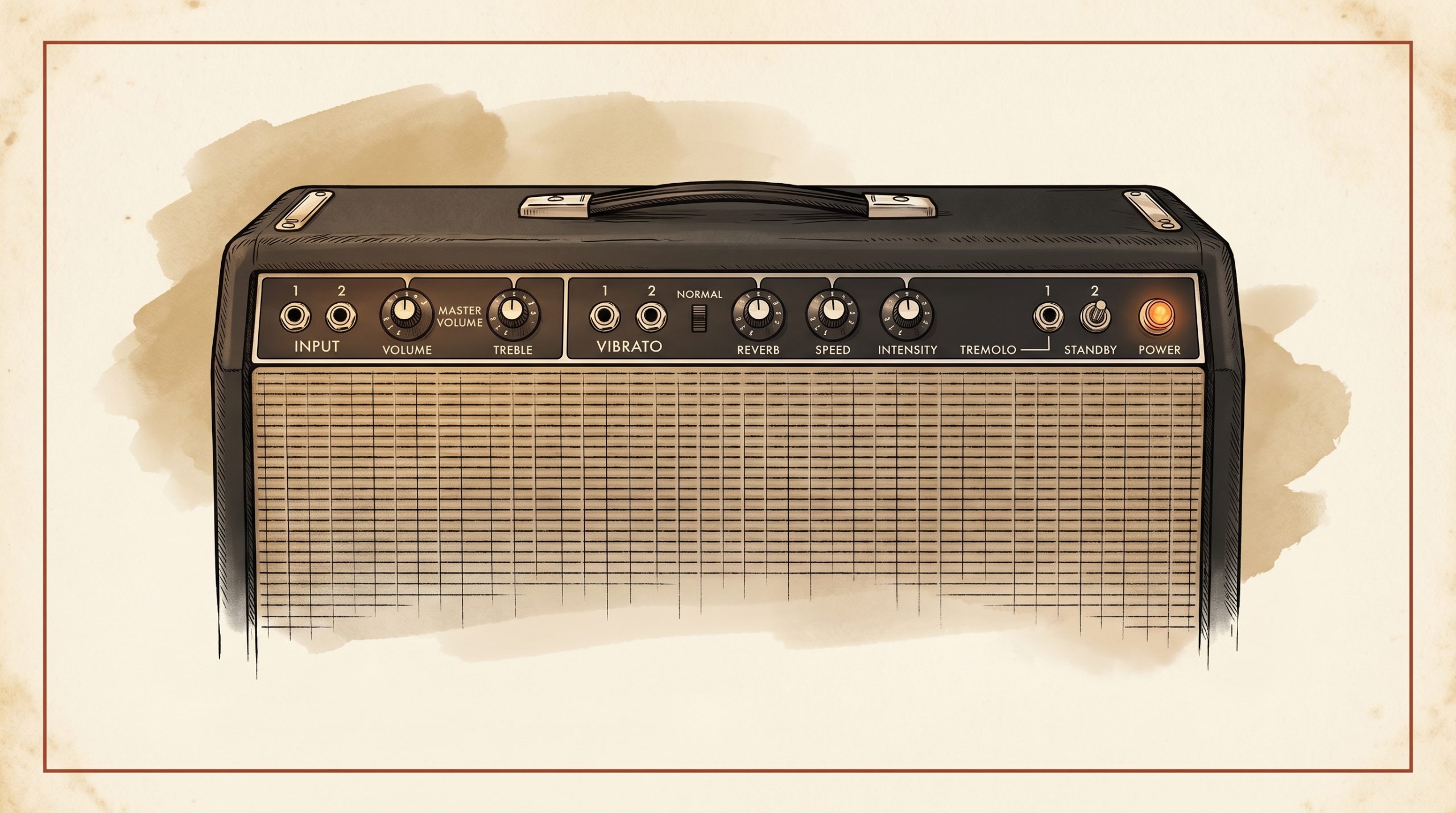
- Power source confirmed. Don’t just check whether the power strip is on. Test the outlet with a phone charger or a lamp. Older buildings with inadequate wiring can trip a breaker specifically under the startup current draw of a tube amp, which is substantial.
- Amp powered on correctly. The pilot light confirms the power transformer is energized. That’s it. On models like the Blues Junior and Hot Rod Deluxe, there’s a separate standby LED. Both need to be active.
- Standby switch disengaged. On a tube amp, wait 30 to 60 seconds after power-on before flipping standby. That’s not superstition, it allows cathode emission to stabilize before plate voltage hits the tubes. Skipping it doesn’t always cause immediate problems, but it shortens tube life over time.
- Speaker mute switch. This exists on the Hot Rod series and some Frontman models. Many players never notice it. Check the back panel.
- Master volume and channel volume. The Hot Rod DeVille and several other Fender models use dual-volume architecture: a channel volume and a master volume. Both need to be above zero. Zero on either one means silence.
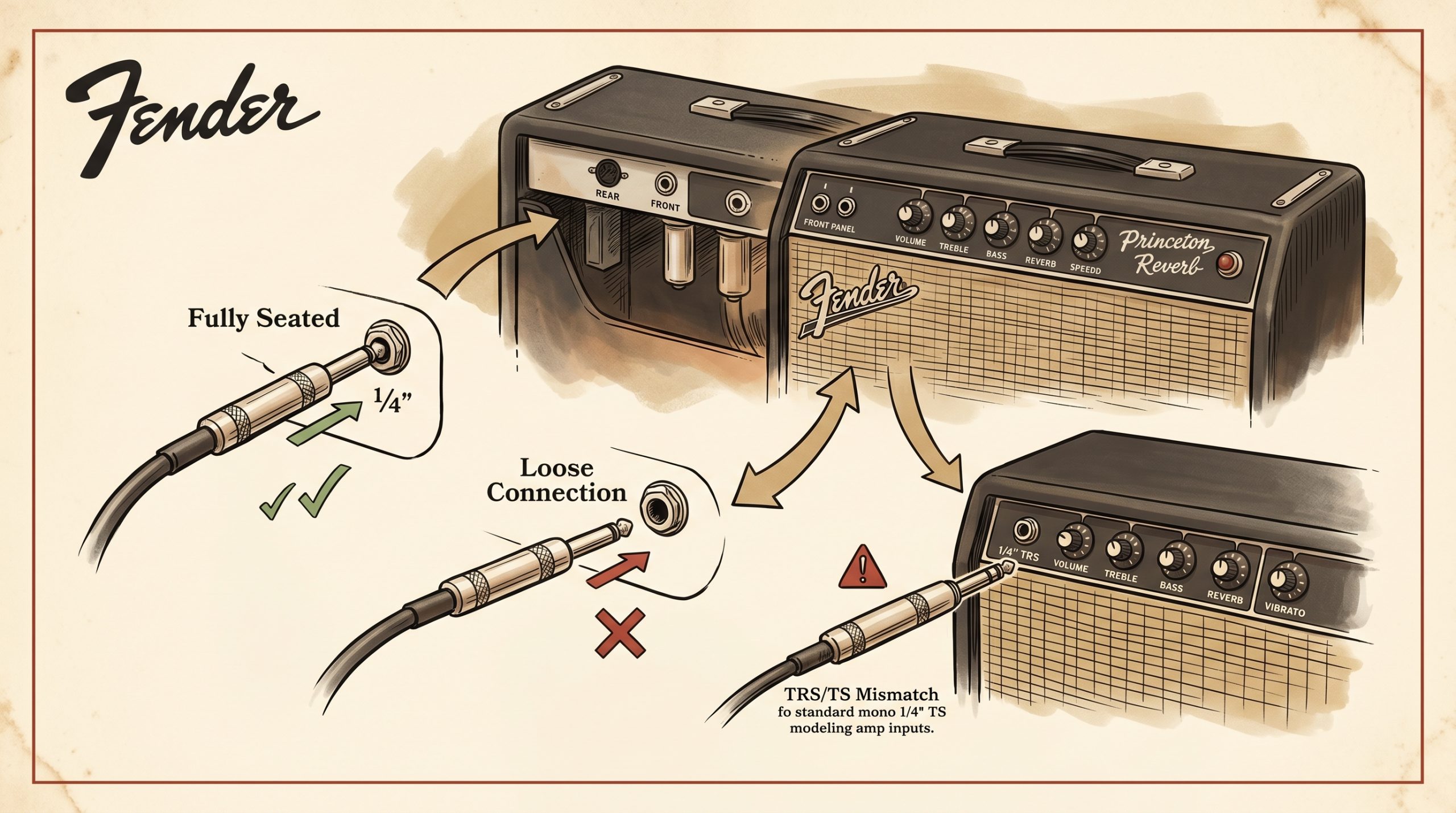
- Guitar cable seated at both ends. Check both the guitar jack and the amp input. Some of the newer modeling amps accept TRS jacks; a TS cable in a TRS-expected input can behave unexpectedly on certain models.
- Guitar volume and tone controls. Yes, it’s obvious. It’s also the most common “repair” call that techs get. Check it now so you don’t have to think about it again.
- Effects loop integrity. This is the most commonly missed free fix in the entire list, and it gets its own section below because it’s that important.
- Building circuit breaker. If the amp tripped the breaker once and you reset it, watch whether it trips again on power-up. A repeated trip is a safety signal, stop and investigate before continuing.
If all nine pass and you still have silence, you’re past the free-fix zone. Keep reading, the next sections narrow it to your specific amp type and failure mode.
The Effects Loop Trap: The No-Sound Culprit Nobody Mentions
This one isn’t in any of the top search results for “Fender amp no sound.” It should be. It’s a shockingly common cause of complete signal loss on amps that have an effects loop, and it costs about $10 to fix.
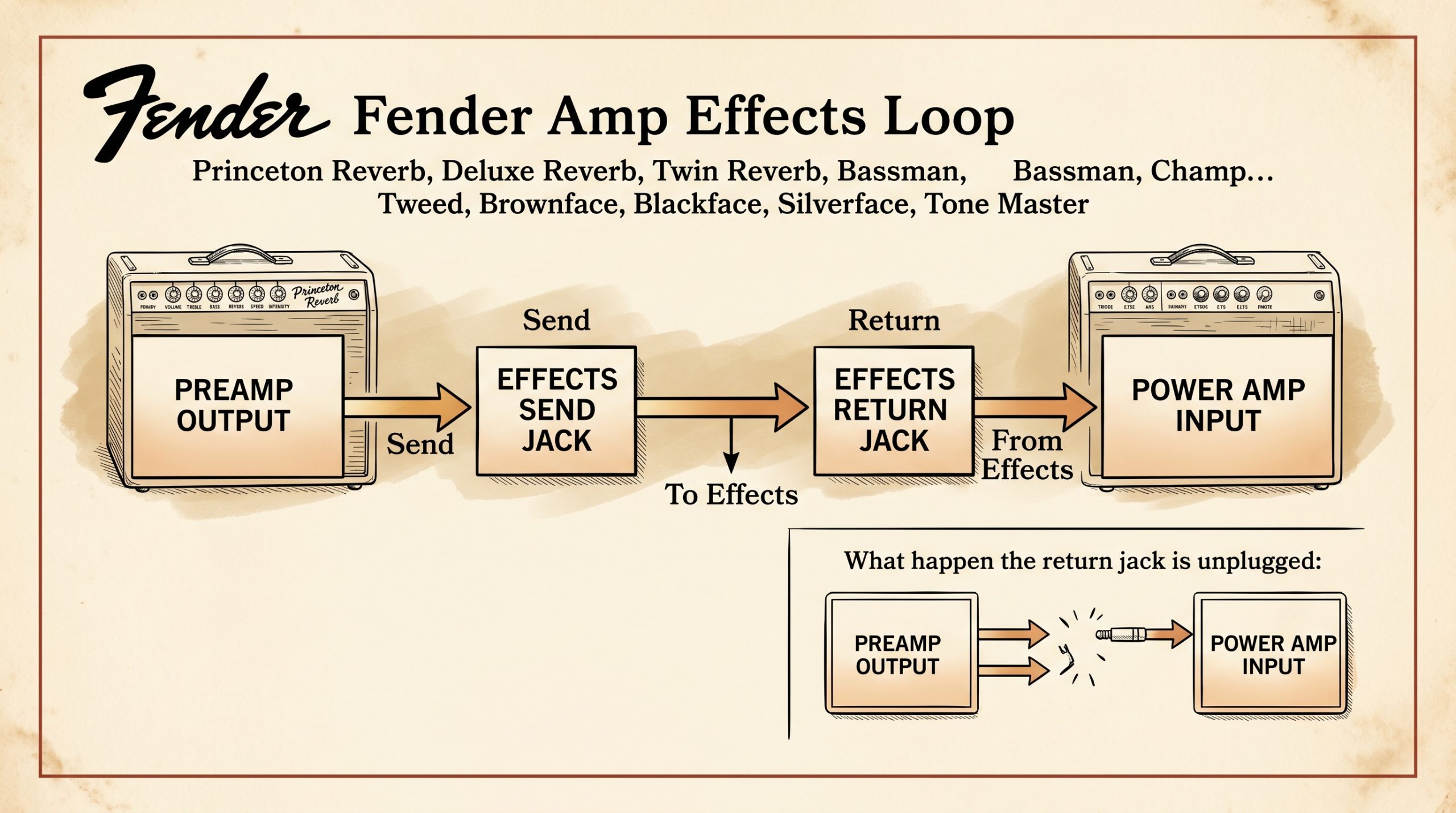
Fender amps with a series effects loop, including the Hot Rod Deluxe, Hot Rod DeVille, and Blues Deluxe, route the full audio signal through the Send and Return jacks on the back panel. That loop uses switching jacks: mechanical contacts that normally short the circuit closed when nothing is plugged in, maintaining signal continuity. When those contacts corrode or fail, the signal breaks completely. The amp sounds fine otherwise. Tubes glow. Pilot light on. Total silence from the speaker.
The test takes five seconds. Grab any instrument cable and plug it from the Send jack to the Return jack on the back panel. If sound comes back immediately, the effects loop switching jack is your culprit. The fix is DeoxIT D5 sprayed into the jack, worked in and out with a plug several times to clean the contacts. Ten dollars. Done.
If the contacts are physically damaged rather than just corroded, a tech can replace the jack for around $30 to $60 in labor. Still cheap.
| Amp Family | Effects Loop Type | Signal Break if Unplugged? |
|---|---|---|
| Hot Rod Deluxe / DeVille | Series | Yes, full signal loss |
| Blues Deluxe | Series | Yes |
| Vintage Blackface / Silverface (1963–1981) | None standard | N/A |
| ’65 Reissue series (Deluxe Reverb, Twin Reverb, Princeton Reverb) | None | N/A |
| Tone Master Deluxe / Twin | None | N/A |
| Frontman Series | None | N/A |
Tube Amp Specific: Diagnosing by What You See and Smell
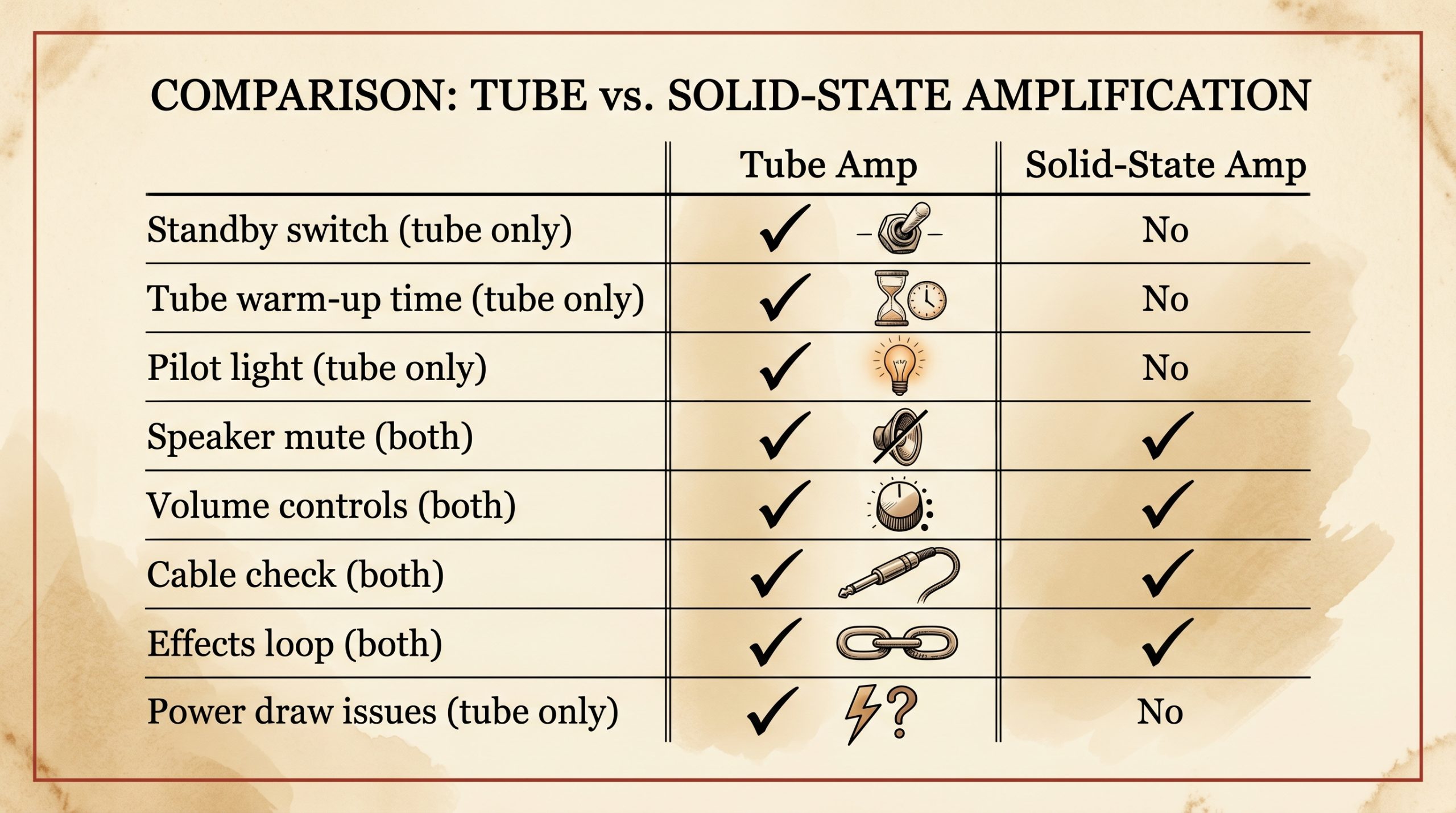
This section is for owners of blackface, silverface, tweed, and modern-production tube Fenders. If you have a solid-state or modeling amp, skip ahead.
No Sound + No Glow on Output Tubes
If the output tubes aren’t glowing at all, you’re almost certainly looking at a blown fuse. Check the fuse holder on the rear panel. Some Fender models carry two fuses: a mains fuse and a separate HT (high tension) fuse protecting the plate voltage supply. A blown HT fuse allows the filaments to glow normally, tubes look fine, but kills all audio output completely. Both fuses need to be intact.
Common mains fuse values by model at 117V (North America), per original Fender service documentation and schematic specs:
- Champ (tweed 5F1): 1A slow-blow
- Princeton Reverb (AA1164): 1A slow-blow
- Deluxe Reverb (AB763): 1A slow-blow (some 1966–67 production was stickered for 2A)
- Twin Reverb (AB763): 3A slow-blow
European 230V versions run roughly half these values. Always verify against the chassis tag on your specific amp, production variations exist. And critically: a blown fuse is a symptom, not the root cause. Replacing it without finding what caused it to blow is a fire risk. Not a metaphor. An actual fire risk. If a replacement fuse blows immediately on power-up, stop and see a tech, there is a short or component failure inside.
No Sound + Output Tubes Glowing Normally
Glowing output tubes with no sound points toward the preamp tube chain. The AB763 circuit family, covering the blackface Deluxe Reverb, Super Reverb, Vibroverb, and Twin Reverb produced from 1963 through 1967, and their silverface descendants through 1981, uses a standard preamp layout. Working from the input side toward the power tubes, the typical 9-tube AB763 Deluxe Reverb / Super Reverb chassis runs: V1 (12AX7/7025) normal channel preamp, V2 (12AX7/7025) vibrato channel preamp, V3 (12AT7) reverb driver, V4 (12AX7/7025) reverb recovery plus vibrato channel second gain stage, V5 (12AX7) tremolo oscillator, V6 (12AT7) phase inverter, V7 and V8 (6V6GT on Deluxe Reverb, 6L6GC on Twin) power tubes, and V9 rectifier (GZ34 on Deluxe Reverb, solid-state on Twin).
The phase inverter is the most frequently missed tube swap. When it fails, everything else looks normal: the output tubes glow, the power supply is fine, and tapping a preamp tube with a pencil while the amp is running produces hum through the speaker. But there’s no actual signal output. Always verify your specific amp’s tube layout against the chassis tube chart printed inside the cabinet, since numbering varies between layouts. When swapping any preamp tube, use a known-good replacement of the same type as the one you’re removing: 12AX7 in 12AX7 positions, 12AT7 in 12AT7 positions. Putting a 12AX7 in a 12AT7 socket (or vice versa) will not damage the amp, but the circuit will not work correctly. You can find verified schematic references for the AB763 preamp layout at schematicheaven.net and detailed per-tube function explanations at fenderguru.com.
Intermittent Sound or Sound Only When Tubes Are Tapped
Sound that cuts in and out when you tap the chassis or the tube envelope is almost always a cold solder joint or corroded tube socket. On an amp with 50-plus years of original solder, cold joints are practically expected. Corroded socket contacts are equally common, the fix is DeoxIT into the socket, worked in and out by seating and removing the tube repeatedly. Oxidized tube pins respond to a gentle cleaning with a pencil eraser followed by a dry cloth wipe.
If the joint needs to be reflowed, a temperature-controlled iron at 700°F (370°C) and fresh 60/40 rosin-core solder is the correct tool. Don’t use a cheap hardware-store iron on vintage amp sockets.
Safety notice: Voltages inside a tube amp chassis regularly exceed 450V DC and remain dangerous for 30 minutes or more after power-off. Filter capacitors hold charge even with the power cord disconnected. If you haven’t been trained in high-voltage electronics, stop at tube swapping, which is safe with the amp powered down, and bring the amp to a qualified technician for anything requiring chassis access.
Solid-State and Modeling Fender Amps: Different Failure Modes
No tubes means no tube failures. The diagnostic tree branches differently here, and some of the fixes are specific to the firmware-driven architecture of the Mustang and Tone Master series.
Fender Mustang LT25 / Mustang GTX / Tone Master: No Sound Checklist
Start with the output routing. The Mustang LT25 can route its signal to the speaker, to the headphone jack, or to USB, and if the output is set to headphone or USB only, the speaker produces nothing. Check this setting before anything else.
If the headphone jack is dirty or the switching contact is stuck closed (mechanically, it reads as “headphones inserted” even when nothing is plugged in), the main speaker cuts out completely. Same DeoxIT fix as the effects loop jacks above. Work a plug in and out of the headphone jack several times after applying contact cleaner.
Firmware corruption is a real failure mode on the Mustang series. A USB firmware re-flash using the Fender Tone app is the correct procedure. Factory reset (button combination varies by model, consult the Mustang LT25 quick-start guide) should be attempted before the firmware re-flash.
Fender Frontman and Other Solid-State Combos
Internal speaker wire disconnection is common after transport, particularly on older Frontman models where the connector at the jack plate isn’t strain-relieved. Open the back panel and check whether the speaker wire is seated. Not complicated. Takes 60 seconds.
A blown output transistor is not a DIY fix. Cost benchmark at a shop: $40 to $80 including the part and labor. A failed op-amp in the preamp stage requires schematic-level component diagnosis, that’s a tech job as well.
Speaker and Output Transformer Failures
These are the expensive-tier failures. They’re real, they happen on vintage amps, and they’re worth knowing how to identify so you can make an informed decision before calling a tech.
How to Test Whether Your Speaker Is Blown
Disconnect the speaker from the amp completely. Touch the positive and negative terminals of a 9V battery briefly to the speaker’s input terminals. A working speaker produces an audible click and visible cone movement. Nothing at all means the voice coil is likely open.
Confirm with a multimeter set to DC resistance. A standard 8-ohm speaker reads 6.5 to 7.5 ohms when healthy. An open-circuit reading (OL on most meters) means the voice coil is broken. That speaker needs a recone or replacement.
Original speaker complements for common Fender models, per Teagle and Sprung’s Fender Amps: The First Fifty Years:
- Deluxe Reverb (AB763, 1963–1967): 1x 12″ Oxford, Utah, CTS, or Jensen C12N at 8 ohms
- Twin Reverb (AB763, 1963–1967): 2x 12″ Jensen C12N, Oxford 12T6, or JBL D120F at 8 ohms each, wired in parallel to a 4-ohm total load at the amplifier
Output Transformer Failure
The diagnostic signature: output tubes glow, and tapping a preamp tube with a pencil produces hum through the speaker (confirming the preamp and speaker are functional), but there’s no output under normal signal load. The output transformer (OT) is the coupling point between the tube output stage and the speaker. When it fails, signal simply doesn’t pass.
A replacement OT runs $60 to $200 depending on model and manufacturer. Add 2 to 3 hours of labor at shop rates. Total cost: $220 to $450. Not cheap. But a matched replacement from a reputable supplier like Mercury Magnetics or Heyboer restores the amp correctly.
One hard rule: never run a tube amp without a speaker load connected. An open output with no speaker attached can reflect damaging voltage spikes back through the OT and destroy it quickly. This is how a lot of OTs fail in the first place.
Diagnostic Decision Tree: Which Path Is Your Amp On?
If the visual above isn’t loading, here’s the same logic in text form:
Expand: Text-Based Diagnostic Decision Tree
- Amp powers on, no sound. Run the 9-point quick checklist first.
- Does the amp have an effects loop? Yes: plug a patch cable from Send to Return. Sound returns? Clean or replace the loop jack. No: continue.
- Are the output tubes glowing? No: check both fuses (mains and HT). Blown fuse: find the root cause before replacing. Yes: continue.
- Tube amp: swap preamp tubes one at a time, using a known-good replacement of the same tube type for each socket. Check the chassis tube chart for the exact layout of your amp. Sound returns? Bad preamp tube, replace it.
- Tap tubes and sockets with a pencil while the amp runs. Intermittent sound? Cold solder joint or corroded socket contact.
- Solid-state amp: check output routing (speaker vs. headphone/USB), headphone jack switching contact, factory reset, firmware re-flash.
- All of the above pass with no result: test the speaker with a 9V battery and multimeter. Open coil? Speaker is blown.
- Speaker tests good and preamp has signal (preamp tap produces hum): suspect output transformer. Stop and see a tech.
Repair Cost Benchmarks: Should You DIY or Call a Tech?
This is the question most troubleshooting guides skip entirely. Here are realistic 2026 cost estimates so you can make an actual decision.
| Problem | DIY Difficulty | Part Cost | Shop Labor Est. | Total (Shop) |
|---|---|---|---|---|
| Bad cable | None | $8–$25 | N/A (DIY) | $8–$25 |
| Effects loop jack (cleaning) | Easy | $10 (DeoxIT) | 0.5 hr / $30–$50 | $30–$60 |
| Blown fuse | Easy | $1–$3 | 0.5 hr / $30–$50 | $30–$55 |
| Failed preamp tube (12AX7) | Easy | $10–$25 | 0.5 hr | $40–$75 |
| Failed output tube pair (6L6GC) | Moderate, requires biasing | $30–$80/pair | 1–1.5 hr + bias check | $100–$180 |
| Corroded tube socket | Moderate | $5–$15 | 1 hr | $80–$120 |
| Blown speaker (recone) | Hard | $30–$60 | 1–2 hr | $100–$180 |
| Output transformer replacement | Do not DIY | $60–$200 | 2–3 hr | $220–$450 |
| Filter cap rebuild (full set) | Do not DIY | $30–$80 | 2–4 hr | $200–$500 |
When to Stop and See a Tech, No Exceptions
Some things are not judgment calls. Stop and find a qualified tech immediately if you observe any of the following:
- Visible burn marks or discoloration on the PCB or any component
- Smell of burned electronics or melted insulation
- Arc marks or blackening around tube sockets
- The amp sparks, pops loudly, or trips the circuit breaker on power-up
- Any diagnosis that requires removing the chassis beyond pulling tubes from their sockets
Find someone with vintage Fender experience specifically. Not a general electronics repair shop. A tech who works on tube amps regularly will know what a correctly biased AB763 looks like, what cap values are correct for a silverface Princeton, and what the filter capacitor bank should measure. That knowledge matters. The Wayback Machine archives of Greg Gagliano’s research in 20th Century Guitar Magazine (1997–2000) remain a reference standard for identifying what “correct” looks like on vintage Fender chassis, and a good tech should be familiar with that baseline.
What You Should Do
Work the checklist top to bottom, do not skip steps. The free fixes are free for a reason: roughly seven out of ten “no sound” calls are solved in the first three minutes by a turned-down volume knob, a half-flipped standby switch, or a corroded effects loop jack that needs ten dollars of DeoxIT. Only after those nine quick checks fail does it make sense to start opening tube sockets, testing speakers, or pricing transformers.
If you have a vintage tube amp and the diagnosis points past tube swapping, the right next step is a tech with documented Fender experience, not a general electronics shop. The voltages inside an AB763 chassis are lethal at the wrong contact point. There is no shame in delegating that. There is real risk in not.
Frequently asked questions
Why is my Fender amp not producing sound?
The most common causes are a standby switch that's still engaged, a broken signal path through the effects loop (on amps with a series loop), or a failed preamp tube. Run through the 9-point checklist at the top of this article first. If all nine pass, move to the effects loop test on amps that have one: plug a short cable from the Send jack to the Return jack on the back panel. If that restores sound, the switching contact inside the loop jack is your problem. If not, start swapping preamp tubes one at a time, using a known-good replacement of the same tube type for each socket, with the amp powered down between swaps.
Why do I have power to my amp but no audio output?
Power and audio are separate circuits inside a tube amp. The power circuit energizes the transformers, heats the tube filaments, and lights the pilot lamp. The audio signal path runs separately through the preamp tubes, output tubes, output transformer, and speaker. Any break in the signal path, a failed preamp tube, a broken effects loop jack, a blown output transformer, or a dead speaker, kills audio while leaving the power circuit fully functional. Glowing tubes and a lit pilot light only confirm the power side is working.
Could a blown fuse cause my Fender amp to power on but have no sound?
Yes, specifically the HT (high tension) fuse on models that carry one. The HT fuse protects the plate voltage supply to the output tubes. When it blows, the filament heater circuit still functions, so the tubes glow and the pilot light stays on. But without plate voltage, there's no amplification and no audio output. Check both the mains fuse and the HT fuse before assuming a deeper fault. And again: a blown fuse is a symptom. Find out why it blew before simply replacing it.
My Fender Mustang LT25 has power but no sound. What do I do?
Start by checking the output routing in the amp's menu, the LT25 can direct its signal to the internal speaker, the headphone output, or USB, and if it's set to headphone or USB mode, the speaker produces nothing. Next, check the headphone jack itself: a dirty switching contact inside the jack can make the amp think headphones are permanently inserted. Spray DeoxIT D5 into the headphone jack and work a plug in and out several times. If that doesn't resolve it, perform a factory reset using the button combination in the LT25 quick-start guide. Firmware re-flash via the Fender Tone app is the last step before warranty service.
Is it safe to swap preamp tubes myself to diagnose a no-sound problem?
Preamp tube swaps (12AX7, 12AT7) are safe as long as the amp is powered down and you allow five minutes for capacitors to discharge before handling the tubes. Always replace with the same tube type as the one you removed. Output tube swaps are a different matter, they require a bias check after the swap. Running new output tubes without verifying bias can damage the output transformer. If you don't have a multimeter and the knowledge to check plate voltage and calculate bias current, have a tech handle output tube swaps. Preamp tubes only, same type, with the amp off. That's the safe boundary for self-diagnosis.