
Fender Deluxe Reverb: The Definitive Model Guide
Last updated: May 2026
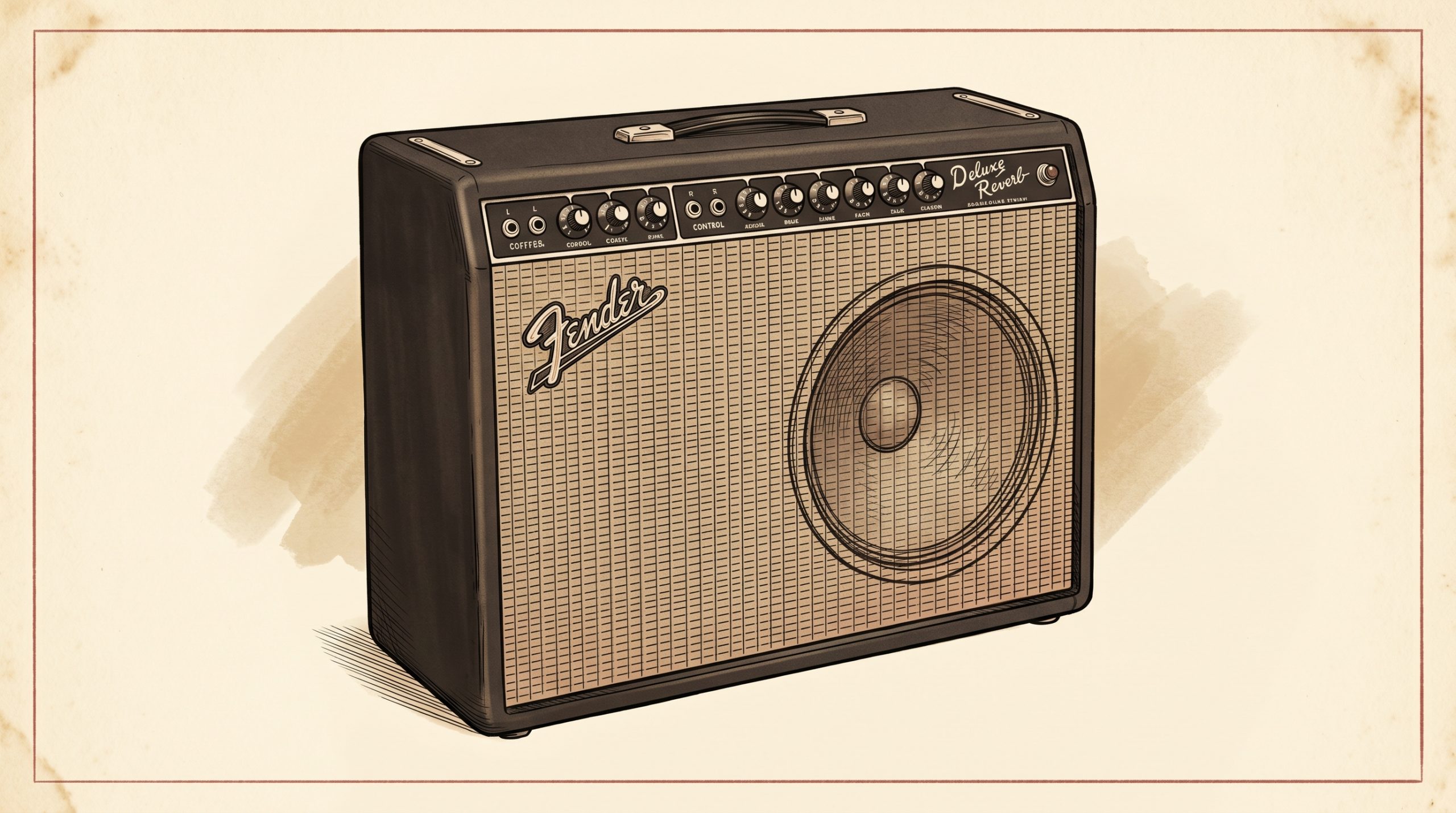
22 watts. One 12-inch speaker. Nine tubes. That’s the entire recipe, and it’s been one of the most recorded amplifier configurations in electric guitar history. The Fender Deluxe Reverb amp sits squarely between the Princeton Reverb (12W) and the Super Reverb (40W) in Fender’s lineup, and that middle position is exactly what makes it so useful. Enough clean headroom for most stages. Enough compression and breakup at volume 7 or 8 to satisfy players who want the power section working. Light enough to carry without a dolly. That combination doesn’t happen by accident.
This guide covers every production era from the 1961 brownface predecessor through the current hand-wired fender 64 custom deluxe reverb, with circuit numbers, tube specs, vintage buying prices, and a clear comparison of every modern variant. Whether you’re hunting a vintage fender deluxe reverb on the used market or deciding between the fender ’65 deluxe reverb reissue and the fender 68 custom deluxe reverb, the data you need is here.
- 🟢 Power output: 22W RMS into 8 ohms
- 🟢 Output tubes: 2× 6V6GT; Rectifier: 5AR4/GZ34
- 🟢 Preamp: 4× 12AX7, 2× 12AT7 (nine tubes total)
- 🟢 Channels: Normal + Vibrato, 4 inputs total
- 🟡 Weight: 40–42 lbs (vintage/reissue), 23 lbs (Tone Master)
- 🟡 Vintage blackface (AB763) used market: $2,800–$4,500+ all-original
- 🔴 No factory head configuration exists, any “Deluxe Reverb head” is a custom conversion
- 🔴 Factory bias on the ’65 Reissue runs cold (~28–32mA); rebias to ~35mA for vintage response
What Is the Fender Deluxe Reverb?
Core Identity and Why It Matters
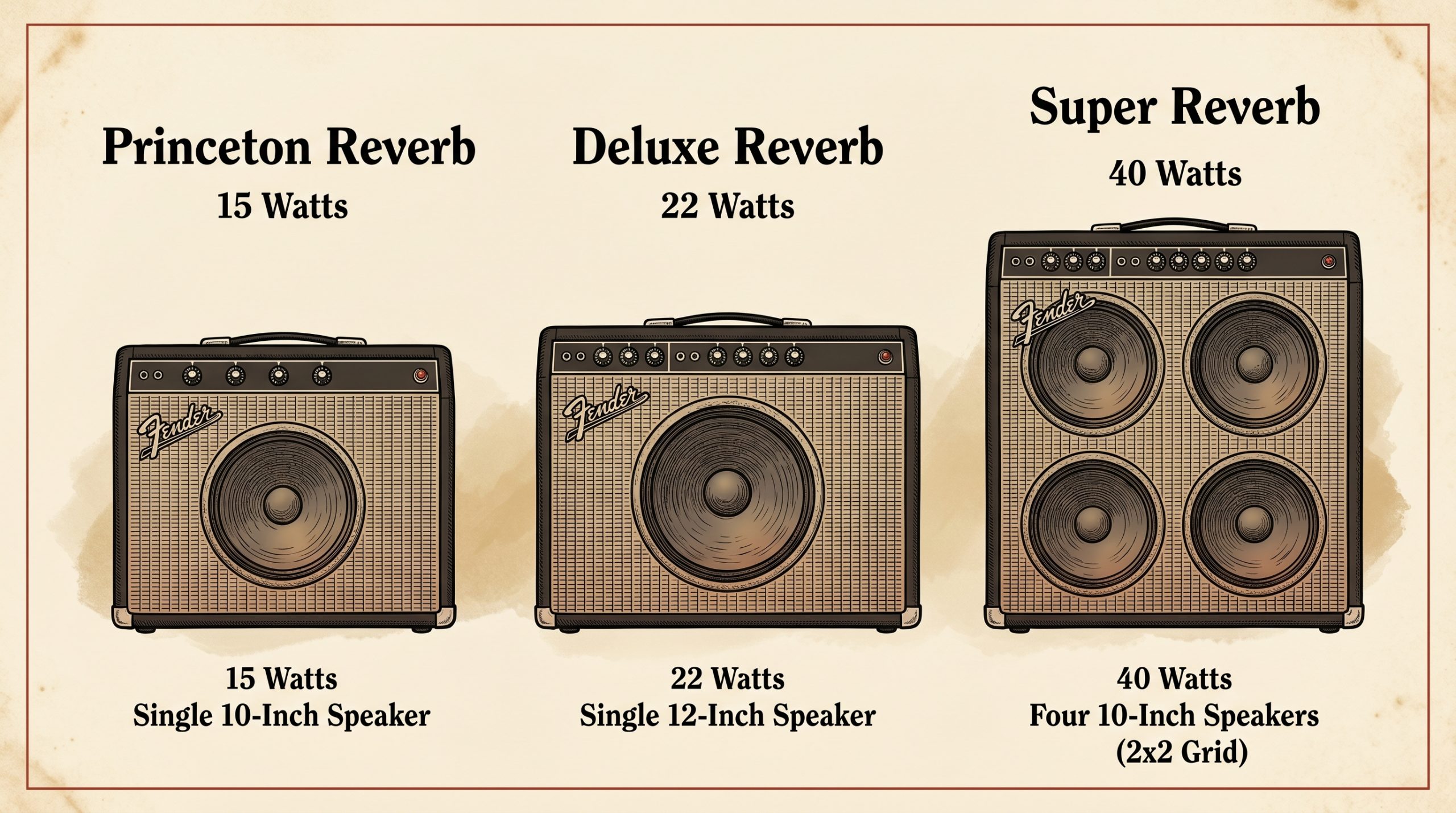
The Deluxe Reverb fills the gap in the Fender lineup that a lot of players spend years searching for. The Princeton Reverb gets you to 12 watts with a 10-inch speaker. The Super Reverb jumps to 40 watts across four 10-inch speakers. The Deluxe Reverb lands at 22 watts into a single 12-inch, and that combination hits a sweet spot that neither flanking model quite manages.
Two channels, both with independent volume and tone controls. The Normal channel handles clean rhythm work. The Vibrato channel adds reverb, tremolo speed, and tremolo intensity controls. Four inputs total, two per channel, allowing high and low sensitivity options. The reverb circuit is tube-driven, not a digital patch or a spring tank bolted onto a solid-state recovery circuit. The tube driving the tank is a 12AT7, and the signal path through the Accutronics 2-spring tank (model 4AB3C1B) and back into the circuit contributes substantially to the Deluxe Reverb’s character under a picked note. See the original article at Premier Guitar for the full technical breakdown.
Era Classification at a Glance
The production story runs through five distinct phases. The brownface Deluxe set the power topology in the early 1960s. The blackface era from 1963 to 1967 produced the units most players are chasing. The silverface era stretched from 1968 to 1982 with cosmetic and some circuit changes. A gap and dead-end detour followed with the fender deluxe reverb ii in 1982–1986. Then the reissue era began in 1993 and continues today across several variants. Understanding which era you’re looking at, and what changed between them, determines whether that used listing is priced correctly.
Complete Production History by Era
Pre-History: The Brownface Deluxe (1961–1963)
The direct ancestor of the Deluxe Reverb carries circuit codes 6G3 and 6G3-A. No reverb. No tremolo in the same form. Brown tolex, wheat grille cloth, oxblood detail on the earliest units. The original speaker complement was typically an Oxford or Jensen P12Q (alnico), and the cabinet dimensions establish the basic footprint that carried forward.
Why it matters for dating purposes: the 6G3/6G3-A establishes the two-6V6GT output section and the 5Y3 rectifier tube that gives the brownface its noticeably spongy compression. The Deluxe Reverb replaced the 5Y3 with a 5AR4/GZ34, stiffening the power supply considerably and changing the breakup character. Knowing this helps when a seller is calling a brownface “the same amp” as a blackface. It isn’t.
Blackface Era: The Definitive Vintage (1963–1967)
The 1965 Fender Deluxe Reverb is the amp most collectors reference when they say “Deluxe Reverb,” but the circuit actually debuted in 1963. Two circuit numbers cover this era: AA763 (1963) and AB763 (1963–1967). The AB763 is the more common and more sought-after version. Component value differences between AA763 and AB763 are minor but not insignificant: the AB763 added 1.5k grid stoppers to the 6V6 control grids and changed the phase inverter plate load from 100k/100k to 82k/100k to better balance the signal feed to the power tubes.
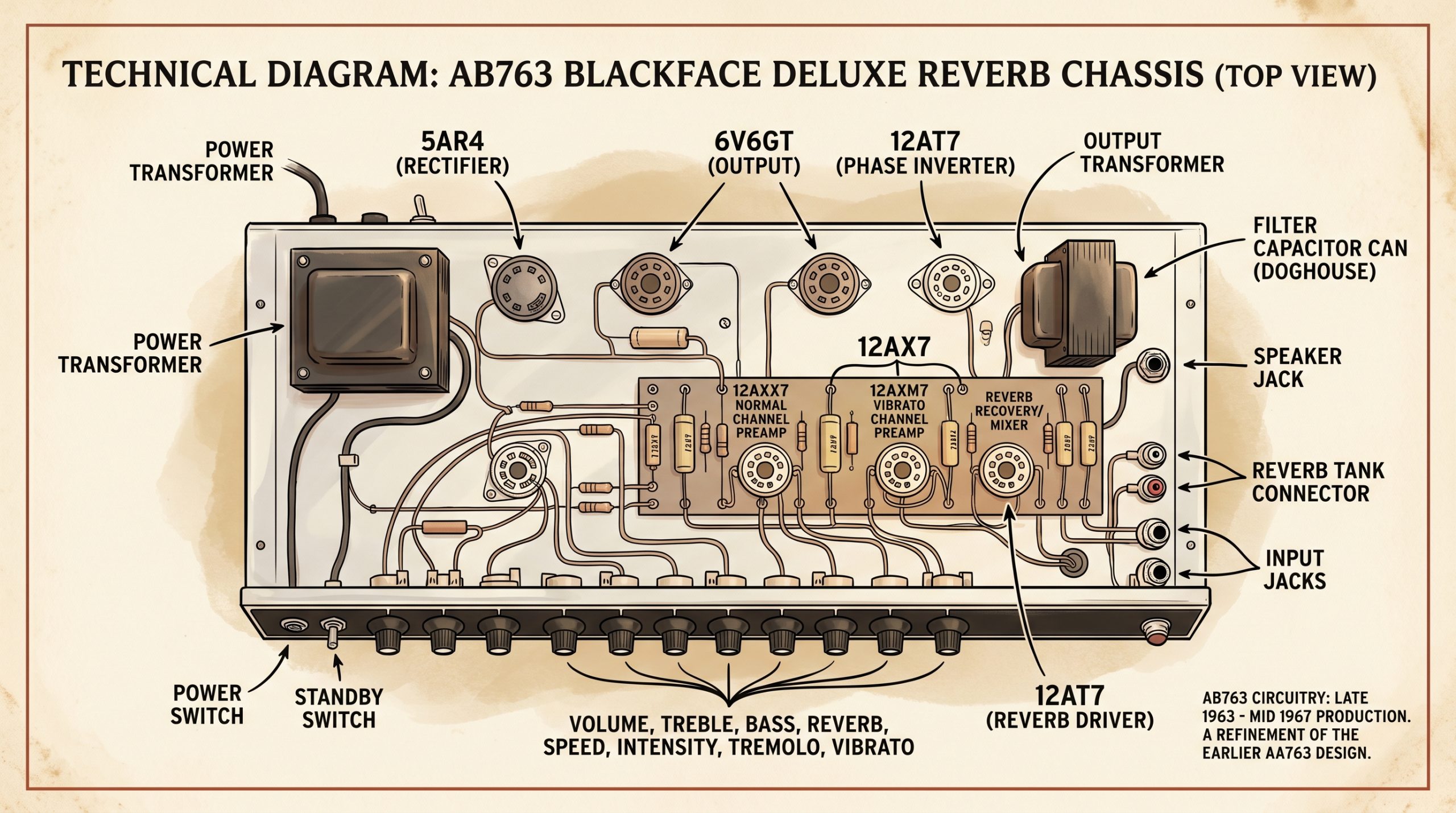
Power section runs two 6V6GT output tubes with a 5AR4/GZ34 rectifier. The 22-watt output is obtained by operating the 6V6 pair well in excess of their data-sheet maximum plate voltage (around 410V in service vs. the 350V data-sheet limit), which is part of why the amp has its characteristic feel under a hard pick attack and also why power tubes don’t always last as long here as in tweed-era circuits. Preamp carries four 12AX7 tubes (Normal preamp, Vibrato preamp, reverb recovery + vibrato 2nd gain stage, and tremolo oscillator) and two 12AT7 tubes handling reverb driver and phase inverter duties respectively. The original speaker in most blackface production was a Jensen C-12N (ceramic, 8 ohms), though the Oxford 12K5 was also factory-fitted in many units throughout the run and is well documented on original 1965–1967 examples. Speaker codes confirm the actual installed driver: EIA code 220-xxx indicates Jensen, with the following digits encoding the production date.
Transformers on original blackface units are typically Schumacher or Triad. EIA code 606-xxx on a transformer indicates Schumacher manufacture. Some 1966–1968 units carry Better Coil & Transformer Co. transformers, marked with EIA code 831; these are factory-original and not a defect. The output transformer condition has the largest single impact on the amp’s tone of any component, and a replaced OT on a vintage unit is a significant deduction against asking price.
Faceplate is brushed aluminum with black lettering. Cabinet is black tolex, silver grille. The tube chart date stamp uses a two-letter code: first letter encodes year, second encodes month. “OA” = January 1965. “OL” = December 1965. For a full breakdown of the two-letter system across all production years, the Fender tube amp serial number guide covers the complete dating methodology including transformer codes and speaker EIA stamps.
Silverface Era (1968–1982)
Three circuit numbers cover this run: AA768 (1968–1969), AA1069 (1969–1974), and AA270 (later runs). The first cosmetic change in 1968 is the brushed aluminum faceplate with blue/silver sparkle grille cloth and the “drip edge” trim strip around the grille, which lasted through 1969 only. Those drip-edge AA768 units are closest in circuit spec to the blackface AB763 and are increasingly valued by collectors who want vintage blackface response without blackface prices.
Post-1971 silverface units acquired a pull-boost function on the volume knob in some configurations, an altered bias point, and on some runs an Ultra-Linear output transformer winding. CBS cost-cutting introduced partial PCB construction replacing hand-wired turret boards in mid and late production. The speaker complement shifted away from Jensen in many units toward Oxford 12L6 or 12K5 (EIA code 465) and CTS units (EIA code 137). Of these, the 12L6 (~30W) is the speaker most commonly pulled from drip-edge and standard silverface Deluxe Reverb chassis on the used parts market.
Tonal character shifts from the blackface: the low end is slightly looser, the top end can edge toward ice-pick treble territory in late production, and the breakup character changes with the altered bias point. Not worse necessarily, but different. Some players actually prefer the pushed, looser feel of a mid-silverface unit for blues work.
The Gap Years and the Deluxe Reverb II (1982–1986)
Fender officially discontinued the Deluxe Reverb in 1982 as the Rivera-era redesigns took effect. What followed, the fender deluxe reverb ii, is an entirely different amplifier. Solid-state rectifier replacing the tube rectifier. Reduced 20-watt output. Different circuit topology. Eminence 12-inch speaker. Not a continuation of the AB763 lineage. Not bad, but not the same amp. Collectors and vintage players generally treat it as a separate model, which it is. The Deluxe Reverb name returned in 1993 with the proper reissue, and the II has faded from most conversations about the model’s history.
All Current Production Models: Full Specs Comparison
Fender currently offers four distinct production versions of the Deluxe Reverb, ranging from the standard fender 65 deluxe reverb reissue to the hand-wired Custom series. No factory fender deluxe reverb head configuration exists. The combo format is the only official production option. Custom and boutique conversions into open-back head enclosures exist in the used market, but these are owner modifications, not factory products.
Fender deluxe reverb dimensions for the standard combo: approximately 24.25” W × 17.5” H × 9.5” D. This applies across the ’65 Reissue, ’68 Custom, and the ’64 Custom hand-wired versions.
| Model | Year Introduced | Circuit Basis | Watts | Speaker | Reverb Type | Weight | MSRP (2024) |
|---|---|---|---|---|---|---|---|
| Fender ’65 Deluxe Reverb Reissue | 1993 | AB763 (PCB) | 22W | Jensen C-12K (ceramic, 100W) | 2-spring tube-driven | 42 lbs | $1,799.99 |
| Fender ’68 Custom Deluxe Reverb | 2013 | Modified AA768 | 22W | Celestion G12V-70 (12”) | 2-spring tube-driven | 43 lbs | $1,999.99 |
| Fender ’64 Custom Deluxe Reverb | 2017 | Hand-wired AB763 | 20W | Jensen C-12Q (ceramic, 35W) | 2-spring tube-driven | ~40 lbs | ~$2,799.99 |
| Fender Tone Master Deluxe Reverb | 2019 | Digital (AB763 modeled) | 22W equivalent | Jensen N-12K Neo (ceramic) | Digital | 23 lbs | $749.99 |
The fender deluxe reverb weight gap between the Tone Master and every tube version is substantial. 19 pounds is the difference between one-hand carry and a dedicated gig bag. For fly dates or players with back issues, that’s not a minor footnote.
Deep Dive: The ’65 Deluxe Reverb Reissue
Circuit Faithfulness to AB763
The fender ’65 deluxe reverb reissue is a PCB-based interpretation of the AB763 circuit, not a point-for-point reproduction. Where it matches: the long-tail pair (LTP) phase inverter topology that distinguishes the Deluxe Reverb from its smaller sibling the Princeton Reverb (which uses the simpler cathodyne PI), the bias target of approximately 35mA per tube at idle in a properly set-up unit, and the reverb recovery circuit architecture. The tube-driven reverb feel is authentic. The tremolo circuit tracks the original closely.
Where it diverges: the Jensen C-12K ceramic speaker (100W rating) in place of the original ceramic C-12N (50W) produces a tighter, slightly brighter response with less of the natural sag the original cone adds at higher excursion levels. The PCB construction replaces the hand-wired turret board of originals, which affects repairability more than tone. Tube sourcing from China rather than NOS American stock is audible to careful listeners but easy to address.
The clean tones on the reissue are exactly what the Fender platform promises: clear, detailed, and responsive to pick attack in a way that solid-state reverb-equipped amps don’t replicate. The amp barks when pushed past 6 on the Vibrato channel. That’s the power section working.
Tube Complement and Layout
The fender deluxe reverb tubes and fender deluxe reverb tube layout from the factory, following the canonical AB763 numbering used in the original Fender service literature:
- V1: 12AX7 (Normal channel preamp)
- V2: 12AX7 (Vibrato channel preamp)
- V3: 12AT7 (reverb driver)
- V4: 12AX7 (reverb recovery + vibrato 2nd gain stage)
- V5: 12AX7 (tremolo oscillator)
- V6: 12AT7 (phase inverter, long-tail pair)
- V7–V8: 6V6GT (output pair)
- V9: 5AR4/GZ34 (rectifier)
Nine tubes total. Note that the phase inverter is a 12AT7, not a 12AX7, and it sits at V6 in the canonical numbering, not V3. V3 is the reverb driver. This matters when reading older service manuals or troubleshooting: swapping a 12AX7 into V6 is a popular mod to reduce clean headroom, but it’s not a like-for-like replacement and should be done deliberately. Factory bias from Fender runs cold at approximately 28–32mA per output tube. A rebias to roughly 35mA opens up the low end, adds warmth to the clean tone, and brings the breakup character closer to a vintage blackface unit. Any qualified tech can do it in under 30 minutes.
Common upgrade paths: V1 benefits most from a high-gain, low-noise 12AX7 such as the Mullard reissue or a selected JJ ECC83S. V7/V8 upgrades to JJ 6V6S or NOS RCA 6V6GT add compression and harmonic complexity. Rolling a 5Y3GT into V9 in place of the 5AR4 introduces more rectifier sag and earlier, spongier breakup. Not period-correct for blackface spec, but useful for blues and roots applications. The JJ Electronic tube datasheet covers the ECC83S/12AX7 spec in detail.
Specs at a Glance
- Power output: 22W RMS
- Speaker: 12” Jensen C-12K, 8Ω, ceramic magnet
- Channels: 2 (Normal, Vibrato)
- Inputs: 4 (2 Normal, 2 Vibrato)
- Normal channel controls: Volume, Treble, Bass
- Vibrato channel controls: Volume, Treble, Bass, Reverb, Speed, Intensity
- Reverb: tube-driven Accutronics 4AB3C1B 2-spring tank, long decay
- Dimensions: 24.25” W × 17.5” H × 9.5” D
- Weight: 42 lbs
- Output impedance: 8Ω
The full fender deluxe reverb specs are confirmed on the Fender product page.
Deep Dive: The ’68 Custom Deluxe Reverb
What “Custom” Actually Means
The fender 68 custom deluxe reverb wears early silverface AA768 cosmetics but the circuit is a hybrid. The “Custom” Normal channel uses a Bassman-voiced preamp stage: more open, brighter, with a different breakup character than the standard blackface Normal channel. The Vibrato channel is voiced closer to AB763 spec. Two channels, two distinct tonal personalities on a single chassis. That’s the practical value of the Custom designation.
The output transformer on the ’68 Custom is modified for additional headroom compared to late silverface production, which pulls it closer to the blackface character in the power section. The factory speaker is the Celestion G12V-70, warmer in the mids with a more British character than the Jensen ceramic in the ’65 Reissue. It handles stage volume more confidently than the Jensen and doesn’t break up as early at the cone.
Who It’s For vs. the ’65
The ’65 Reissue is the cleaner platform. It takes pedals with less coloration from the amp itself, holds its clean tone further up the volume range, and stays truer to the blackface reference sound. The ’68 Custom has more built-in tonal complexity from the jump. The Normal channel’s Bassman voice adds a dimension that suits pushed blues and roots rock without needing drive pedals to get there.
The price gap is approximately $200 at current MSRP. If you’re running a board of overdrives and compressors into a clean platform, the ’65 Reissue is probably the better investment. If you want the amp itself to contribute more of its own character, the ’68 Custom earns that premium.
The ’64 Custom Deluxe Reverb: Hand-Wired Reference Standard
The fender 64 custom deluxe reverb is the closest production equivalent to an original blackface AB763 available new. Hand-wired on an eyelet board with Fender Vintage Blue tone capacitors. 20 watts of output, slightly lower than the ’65 Reissue’s 22W, with the same 6V6 power section but a different overall voltage and bias setup that contributes to a softer, more compressed character. The factory speaker is a Jensen C-12Q (ceramic, 35W, 8Ω), not an alnico unit; players seeking period-correct alnico response typically swap in a Jensen P-12N or P-12Q after purchase. The amp ships with reverb and tremolo active on both channels (a deliberate departure from the original AB763 design where those effects lived only on the Vibrato channel), and the channel names changed from Normal/Vibrato to Normal/Bright. Available through select Fender dealers rather than mass-market retail.
At approximately $2,799 against the ’65 Reissue’s $1,799, the premium is real but not as steep as some buyers expect. The difference is meaningful: the hand-wired build is more straightforward to service, the eyelet board construction is functionally identical to what Fender built in 1964, and reverb-on-both-channels is a usability upgrade some players value highly. The C-12Q speaker isn’t an alnico premium over the ’65 Reissue’s C-12K, but it is a different voicing (a 35W ceramic with more midrange grit). Weight is approximately 40 lbs in the solid pine cabinet, lighter than the ’65 Reissue. Not a bargain, but the right answer for the player who wants factory-spec hand-wired construction and doesn’t want to hunt for a clean original on the vintage market.
Vintage Deluxe Reverb Buying Guide
What to Look For in a Vintage Blackface Unit
The tube chart inside the back panel carries the two-letter date stamp. First letter = year of manufacture, second = month. “OA” = January 1965, “PC” = March 1967. A verified 1967 unit in original condition carries current market values above $3,500 based on documented sold listings. The Fender amp dating cheatsheet decodes the full two-letter system across all production years, including transformer and speaker EIA codes.
Check these before buying any vintage Deluxe Reverb:
- Speaker EIA code: 220-xxx confirms Jensen; 465-xxx confirms Oxford; date within the code should align with amp production date
- Output transformer EIA code: 606-xxx indicates Schumacher (most common); 831 indicates Better Coil & Transformer Co. (factory-original on some 1966–1968 units, not a defect); a non-period-correct replacement OT is the single biggest deduction
- Circuit number sticker: on the tube chart, confirms AB763 vs. AA763 vs. silverface circuit
- Cabinet: check tolex seams, especially corners. Re-covering is cosmetic but affects collector value
- Reverb tank: original Accutronics tanks (the modern equivalent is the 4AB3C1B) have a date stamp. A modern replacement tank is serviceable but not original
Red flags. Non-original output transformer. PCB modifications grafted onto a point-to-point chassis. A re-coned speaker with a mismatched date code. Any of these require pricing adjustments. Not dealbreakers for a player amp, but significant for a collector piece.
Realistic Price Ranges (Used Market, 2024)
Prices sourced from Reverb.com sold listings and the Vintage Guitar Magazine price guide, reflecting actual transaction data rather than ask prices:
- Blackface AB763, all original, verified: $2,800–$4,500+
- Blackface AB763, partial mods or re-coned speaker: $1,500–$2,500
- Early silverface AA768, drip-edge: $900–$1,800
- Mid/late silverface AA1069/AA270: $600–$1,100
- Used fender deluxe reverb ’65 Reissue: $900–$1,300
- Used ’68 Custom: $1,000–$1,400
The fender deluxe reverb used market moves quickly at the $900–$1,300 price point. A clean ’65 Reissue needing a re-cap sits comfortably in that range. A drip-edge silverface at $1,200 with original speaker and transformers is typically better value per dollar of vintage tone than a beat blackface at $1,800 with replaced components. Know what you’re buying.
Schematics and Circuit Architecture
Key Schematic Versions
The fender deluxe reverb schematic in its AB763 form is one of the most studied documents in amplifier DIY circles. Key architectural features: the long-tail pair (LTP) phase inverter, which provides actual signal gain in addition to phase splitting and contributes to the Deluxe Reverb’s relatively tight, punchy response compared to the Princeton Reverb’s simpler cathodyne PI; and the tube rectifier (5AR4), which maintains supply sag under transient load. These two elements interact directly with the feel of the amp under a hard pick attack.
The AB763 schematic differs from the earlier AA763 in two practically meaningful ways: 1.5k grid stopper resistors added to the 6V6 control grids to dampen oscillation, and the phase inverter plate load resistors changed from 100k/100k to 82k/100k to balance the signal feed to the power tubes. The ’65 Reissue schematic diverges from the vintage document at the PCB layout and several component value updates, but the signal path topology is preserved. Original Fender service literature for the AB763 is available through the Fender Support portal and archived at schematic reference sites that the vintage amp community has maintained since the late 1990s.
The LTP design choice is the key signal-path difference between the AB763-class amps (Deluxe Reverb, Vibrolux Reverb, Pro Reverb, Super Reverb, Twin Reverb) and the smaller cathodyne-PI amps in the same era (Princeton Reverb, Champ). For the full research lineage including the Greg Gagliano series in 20th Century Guitar Magazine, see our sources and credits page.
Era-by-Era Specifications Master Table
Every production variant from the brownface predecessor through current production in one reference table. Circuit numbers, output tubes, original speakers, and physical identifiers all confirmed against Teagle and Sprung’s “Fender Amps: The First Fifty Years” and original Fender service documentation.
| Era | Years | Circuit # | Output Tubes | Rectifier | Original Speaker | Faceplate | Tolex | Est. Weight |
|---|---|---|---|---|---|---|---|---|
| Brownface (pre-DR) | 1961–1963 | 6G3 / 6G3-A | 2× 6V6GT | 5Y3 | Jensen P12Q (alnico) | Tan/brown, brown knobs | Brown | ~38 lbs |
| Blackface | 1963–1967 | AA763 / AB763 | 2× 6V6GT | 5AR4 | Jensen C-12N (ceramic) or Oxford 12K5 | Brushed aluminum / black text | Black | ~40 lbs |
| Silverface (drip edge) | 1968–1969 | AA768 | 2× 6V6GT | 5AR4 | Oxford 12L6 or 12K5, or Jensen | Brushed aluminum / blue-silver sparkle | Black | ~40 lbs |
| Silverface (standard) | 1969–1982 | AA1069 / AA270 | 2× 6V6GT | 5AR4 | Oxford 12L6 or CTS | Brushed aluminum / blue-silver sparkle | Black | ~40 lbs |
| Deluxe Reverb II | 1982–1986 | PR286 | 2× 6V6 (modified circuit) | Solid-state | Eminence 12” | Silver/black | Black | ~42 lbs |
| ’65 Reissue | 1993–present | Based on AB763 (PCB) | 2× 6V6GT | 5AR4 | Jensen C-12K (ceramic) | Blackface-style | Black | 42 lbs |
| ’68 Custom | 2013–present | Modified AA768 | 2× 6V6GT | 5AR4 | Celestion G12V-70 | Silverface-style | Black | 43 lbs |
| ’64 Custom (hand-wired) | 2017–present | Hand-wired AB763 | 2× 6V6GT (20W output) | 5AR4 | Jensen C-12Q (ceramic) | Blackface-style | Black | ~40 lbs |
| Tone Master | 2019–present | Digital (AB763 modeled) | N/A | N/A | Jensen N-12K Neo (ceramic) | Blackface-style | Black | 23 lbs |
The Deluxe Reverb as a Recording Amp: By the Numbers
22 watts hits the recording engineer’s sweet spot for a reason. Achievable breakup on the Vibrato channel occurs around volume position 7–8, producing approximately 85–90 dB SPL at one meter. That’s loud enough to push a microphone properly, not so loud that it bleeds into every other channel in the room. The Princeton Reverb gets there earlier and quieter; the Super Reverb requires significantly more volume before the power section contributes anything meaningful.
Standard mic placement documented across studio practice: a Shure SM57 positioned 1–2 inches from the grille, 0–15 degrees off-axis from the dust cap edge. That position captures the upper-midrange definition the C-12K or C-12N delivers without exaggerating the natural treble roll-off above 6kHz. The frequency response of the Jensen ceramic speaker rolls off above that point naturally, contributing the “already recorded” quality that makes Deluxe Reverb tracks sit in a mix without heavy EQ.
Players needing the power section working but tracking at lower SPL commonly use a reactive load attenuator. The Weber MASS and Universal Attenuator are well-documented choices for this application, allowing the 6V6 pair and output transformer to operate at or near full load while the cabinet sees reduced power. The results vary by attenuator design and the amount of reduction applied, but 6–10 dB of attenuation preserves more of the power section character than the maximum reduction settings on most units.
Modding the Deluxe Reverb: What’s Worth It and What Isn’t
Speaker swaps produce the most audible change per dollar of any modification. Not a subtle difference. A completely different amp in some cases.
- Jensen P12Q alnico reissue (~$130): adds warmth, introduces natural cone breakup at high excursion, moves the character toward alnico-era Fender tone. The highest-impact single upgrade for a ’65 Reissue seeking additional warmth and vintage character.
- WGS G12C (~$75): warmer lower-mid response than the stock Jensen ceramic, budget-friendly, good choice for players who want more body without the alnico price.
- Celestion Blue (alnico, ~$250+): British character, smooth top end, fundamentally different flavor. Not period-correct for Fender, but works well in the open-back cabinet.
Rectifier tube rolling is low-cost and reversible. The stock 5AR4 provides a relatively stiff supply. A Mullard GZ34 reissue tightens the feel further. A 5Y3GT adds sag, earlier compression, and pushes the breakup threshold lower. The 5Y3 is brownface spec, not blackface, but for certain players the spongier response is exactly what they want.
If the reverb tank itself is failing or sounds thin, the correct replacement is an Accutronics 4AB3C1B (long, 2-spring, 8Ω input / 2,250Ω output, long decay). This is the same Type 4 architecture Fender originally specified. Do not substitute a 4EB3C1B; that’s a 600Ω input tank designed for the Hot Rod Deluxe / Deville family and will not interface correctly with the Deluxe Reverb’s 12AT7 reverb driver. Check Accutronics product guide for current tank specifications and compatibility data.
What to leave alone: a working original output transformer on a vintage unit. The transformer is a major contributor to the power section character, and aftermarket replacements rarely improve on a functional Schumacher or Triad unit. Adding one introduces risk and cost for uncertain gain.
The Deluxe Reverb vs. Its Closest Fender Competitors
The Princeton Reverb at 12 watts into a 10-inch speaker breaks up earlier and compresses more. The low end is thinner, the overall volume ceiling is lower, and it weighs significantly less (approximately 30–32 lbs for a vintage unit). The Princeton uses a simpler cathodyne phase inverter, which is one of the technical reasons it breaks up earlier and has a looser feel than the Deluxe Reverb’s long-tail pair. For bedroom-friendly volume and recording work where early power amp saturation is the goal, the Princeton is the stronger choice. The Deluxe Reverb’s extra 10 watts, larger speaker, and tighter phase inverter deliver noticeably more clean headroom and fuller low-end response at stage volumes.
The Twin Reverb at 85 watts is a different instrument for different applications. The Twin Reverb stays clean at volumes that would push a Deluxe into mild breakup, weighs approximately 65 lbs in silverface form, and requires a pedal in front for any grit. Players who never want the amp itself to compress or break up use the Twin. Players who want the amplifier to contribute some of its own character use the Deluxe.
The Tone Master Deluxe Reverb shares identical cosmetics and control layout with the ’65 Reissue. The 19-pound weight advantage is real and significant for gigging players. No tubes to bias, replace, or transport carefully. The digital circuit doesn’t reproduce the feel of the tube rectifier under a hard strum. That spongy compression from the 5AR4 is absent. For fly dates, backline situations, or players who simply don’t want tube maintenance, the Tone Master is a practical answer. For players who specifically want that rectifier interaction with their picking dynamics, it isn’t.
Frequently Asked Questions
What makes a Fender Deluxe Reverb special?
The combination of 22 watts, a single 12-inch speaker, tube-driven reverb, and two independent channels creates an amp that breaks up at achievable stage volumes without sacrificing clean headroom for lighter playing. The 5AR4 rectifier tube adds supply sag and compression that interact with pick dynamics in a way solid-state rectifiers don’t replicate. Two channels with completely independent voicing, four inputs, and a tremolo circuit that uses a dedicated 12AX7 oscillator rather than an op-amp give it more tonal flexibility than the power rating alone suggests.
What is the difference between the ’65 and ’68 Custom Deluxe Reverb?
The fender deluxe reverb 65 reissue is based on the AB763 blackface circuit with a Jensen C-12K ceramic speaker and functions primarily as a clean platform. The fender deluxe reverb 68 custom uses a modified AA768 silverface-based circuit with a Celestion G12V-70 speaker. The ’68 Custom’s Normal channel carries a Bassman-voiced preamp stage, producing a brighter, more open character distinct from the blackface Normal channel. Both run the same 6V6GT power section and 5AR4 rectifier.
How much does a vintage Fender Deluxe Reverb weigh?
An original blackface unit comes in at approximately 40 lbs. The ’65 Reissue runs slightly heavier at 42 lbs due to cabinet construction differences. The ’68 Custom is 43 lbs. The Tone Master Deluxe Reverb is 23 lbs, a full 19 lbs lighter than any tube version.
What tubes does the Fender Deluxe Reverb use?
The full fender deluxe reverb tubes complement for the AB763 circuit is: 4× 12AX7 (V1 Normal preamp, V2 Vibrato preamp, V4 reverb recovery + vibrato 2nd gain, V5 tremolo oscillator), 2× 12AT7 (V3 reverb driver, V6 phase inverter), 2× 6V6GT (V7/V8 output pair), and 1× 5AR4 (V9 rectifier). Nine tubes total. The 5AR4 can be substituted with a GZ34 (same tube, different name) or 5Y3GT to alter the feel of the power supply response.
Is the Fender Deluxe Reverb reissue a faithful reproduction of the original?
The fender deluxe reverb reissue preserves the AB763 circuit topology including the long-tail pair phase inverter and tube rectifier. Key differences from a vintage original: PCB construction versus hand-wired turret board, Jensen C-12K ceramic speaker versus the original Jensen C-12N or Oxford 12K5, and Chinese-sourced tubes versus NOS American stock. The ’64 Custom hand-wired version addresses the first point with eyelet board construction, but keeps a ceramic speaker (Jensen C-12Q) rather than the alnico spec some players associate with vintage Fenders. For period-correct alnico response, a post-purchase speaker swap to a Jensen P-12N or P-12Q is the typical route.
Which Deluxe Reverb Should You Choose
The model hierarchy maps cleanly to use cases. For the purist who wants hand-wired construction and an AB763 circuit without the vintage market risk, the ’64 Custom hand-wired is the answer, though it ships with a ceramic Jensen C-12Q rather than the alnico speaker some buyers expect at that price point. For the best combination of value and blackface tone in current production, the ’65 Reissue is the baseline to beat, particularly after a speaker swap to a Jensen alnico (P-12N or P-12Q) and a rebias to 35mA. The ’68 Custom earns its $200 premium over the ’65 Reissue for players who want the Bassman-voiced Normal channel and prefer the Celestion speaker character for pushed playing. For travel and fly dates, the Tone Master at 23 lbs is the practical choice if rectifier sag isn’t central to your sound. On the vintage market, an early silverface AA768 drip-edge unit in original condition often delivers the closest sound to a blackface at a significantly lower price point than a verified AB763, and that’s worth knowing before you spend $3,500 on a 1965 example. Whatever era you’re targeting, use the Fender tube amp serial number guide to verify production dates and circuit codes before any purchase decision.
