Contents
- 01Is Your Fender Amp Hum Normal, Or a Problem?
- 02The 3-Step Isolation Test (Do This Before Anything Else)
- 03Cause #1: Single-Coil Pickup Interference (Guitar Hum, Not Amp Hum)
- 04Cause #2: Ground Loop Hum
- 05Cause #3: Failing Filter Capacitors (120 Hz Ripple Hum)
- 06Cause #4: Bad Tubes (Microphonic or Failing Preamp and Power Tubes)
- 07Cause #5: Bad Solder Joints and Cold Grounds
- 08Cause #6: Power Transformer Mechanical Hum
- 09Cause #7: Environmental and Power Line Interference
- 10Fender Amp Hum by Era: What's Normal, What's Not
- 11Quick-Reference Diagnosis Table
- 12When to Call a Tech vs. DIY
- 13FAQ: Fender Amp Humming
- 14Where to Go from Here
You sit down for a practice session, flip the standby switch, and there it is, a steady drone underneath everything you play. Or maybe you noticed it slowly creep in over the past few months. Either way, chasing amp hum without a systematic approach wastes hours and sometimes money on fixes that don’t address the actual cause.
Fender amp humming breaks down into seven distinct causes, each with a specific diagnostic signature. The key is narrowing down which cause you’re dealing with before touching anything. This guide walks through each one with circuit-specific references, actual voltage figures, and actionable fixes, whether you’re looking at a blackface AB763 Deluxe Reverb or a brand-new Frontman combo.
Is Your Fender Amp Hum Normal, Or a Problem?
Not all hum is a problem. Acceptable idle hum in a vintage Fender tube amp generally measures under –70 dBV at the speaker terminal. Anything audible from more than 2–3 feet away at bedroom volume warrants investigation.
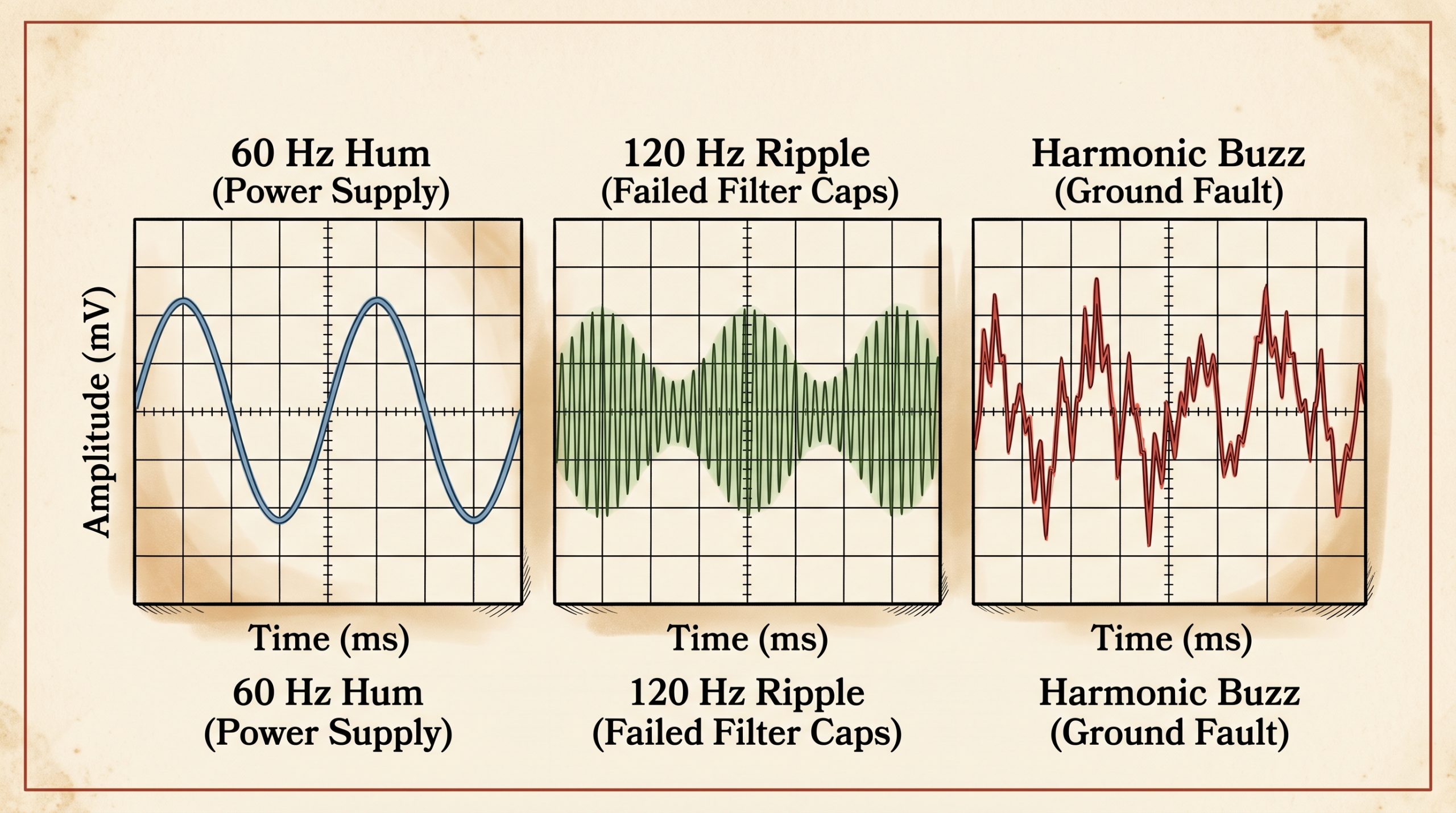
Three noise signatures point to three different problems. A smooth, single-tone 60 Hz hum usually comes from the power supply or transformer mechanical vibration. A higher-pitched 120 Hz hum, often with a “two-tone” or motorboating quality, points to filter capacitor failure and B+ ripple. A 60 Hz buzz with harmonic complexity, rougher and grittier than pure hum, indicates a grounding issue or single-coil pickup interference from the environment.
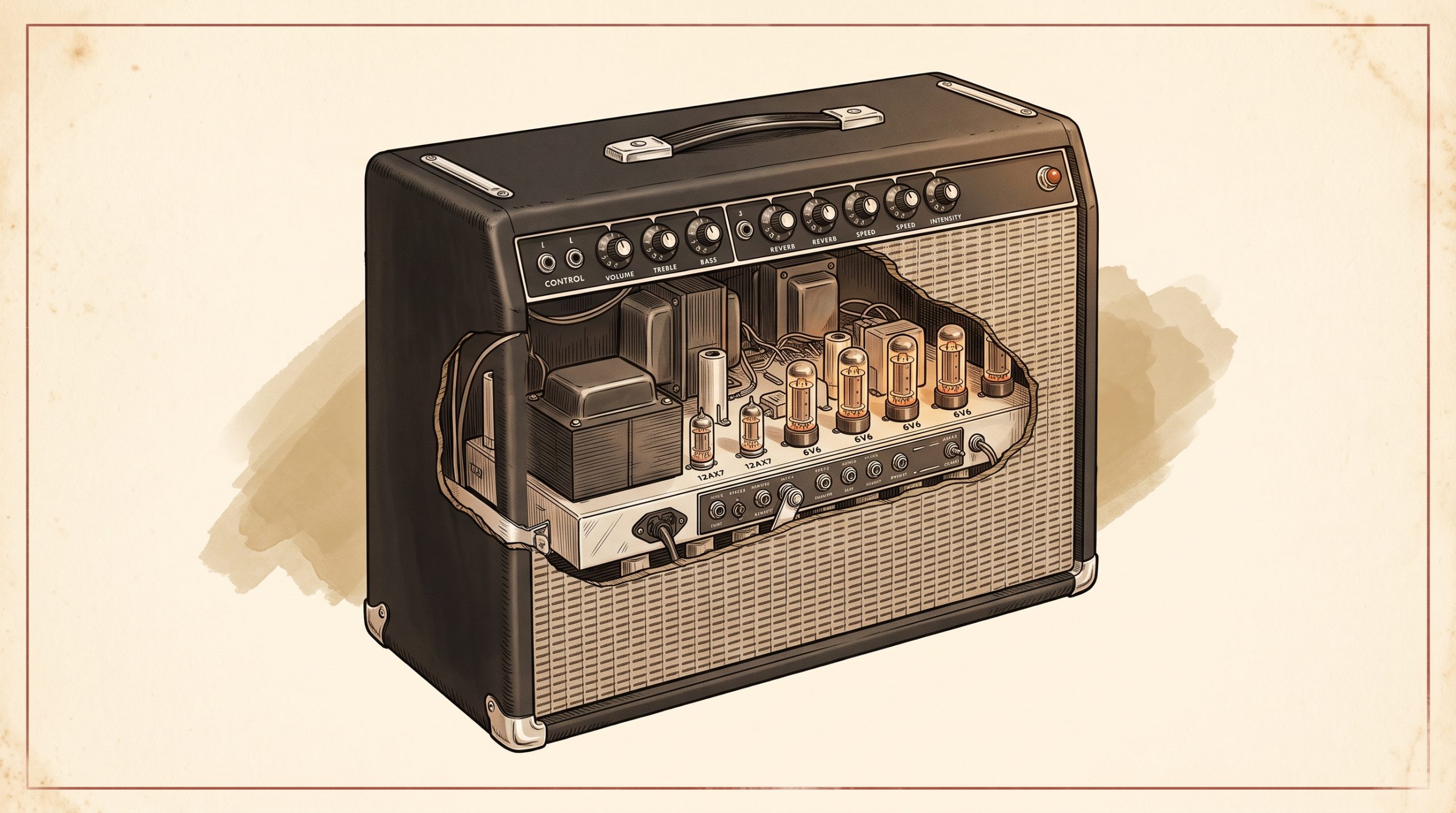
Single-ended Class A designs like the 5F1 Champ and early Princeton are inherently louder at idle than push-pull designs like the Deluxe Reverb or Twin Reverb. In push-pull output stages, the two power tubes work in opposition and cancel hum in the output transformer primary. Single-ended amps have no such cancellation, so a faint hum at idle is expected and normal. A blackface AB763 Twin Reverb sitting completely silent in a quiet room, by contrast, is exactly what a healthy push-pull design should do.
The 3-Step Isolation Test (Do This Before Anything Else)
Before swapping tubes, reflowing solder, or spending money on a recap, run this sequence. It takes five minutes and eliminates at least half the variables.
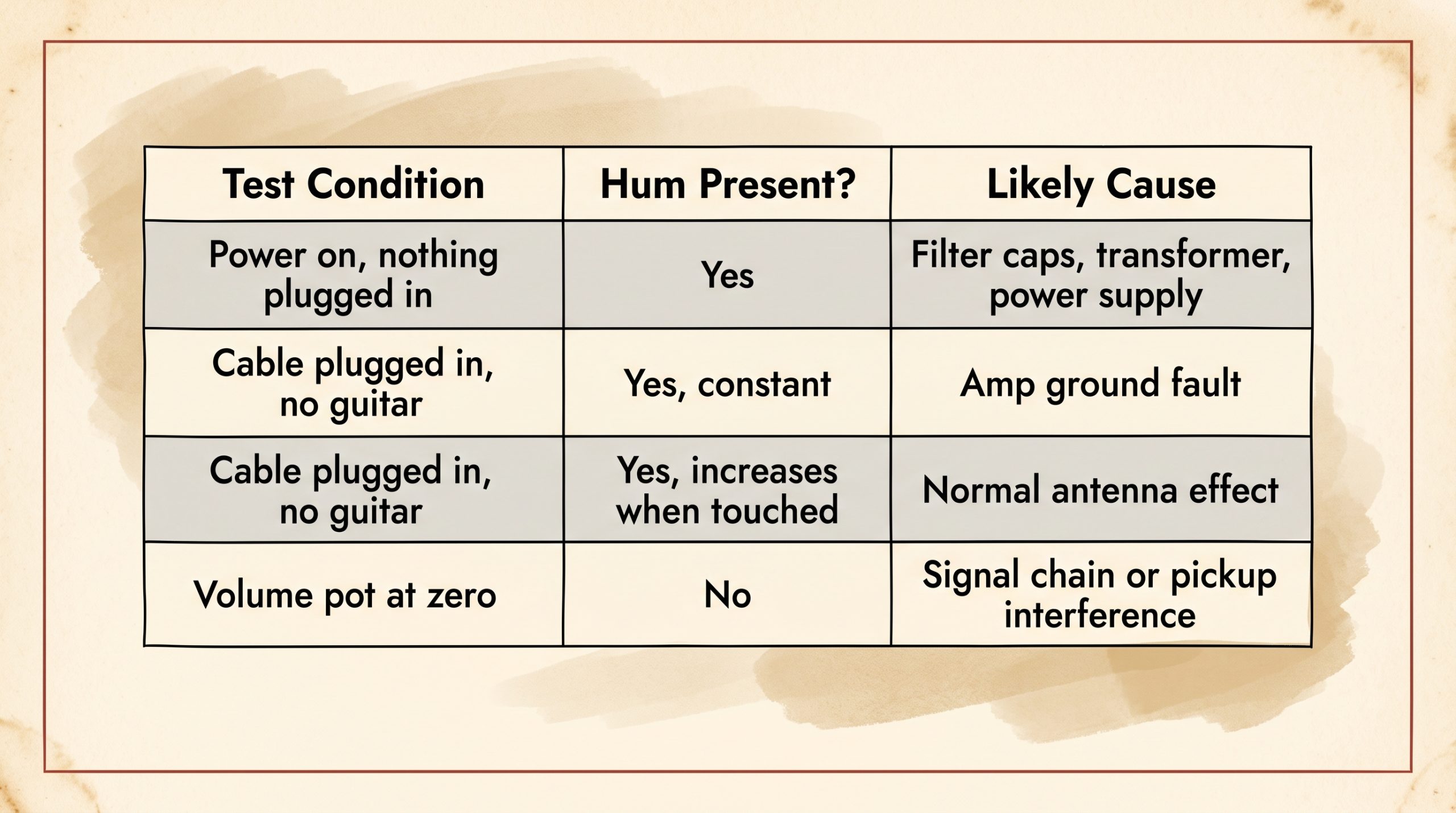
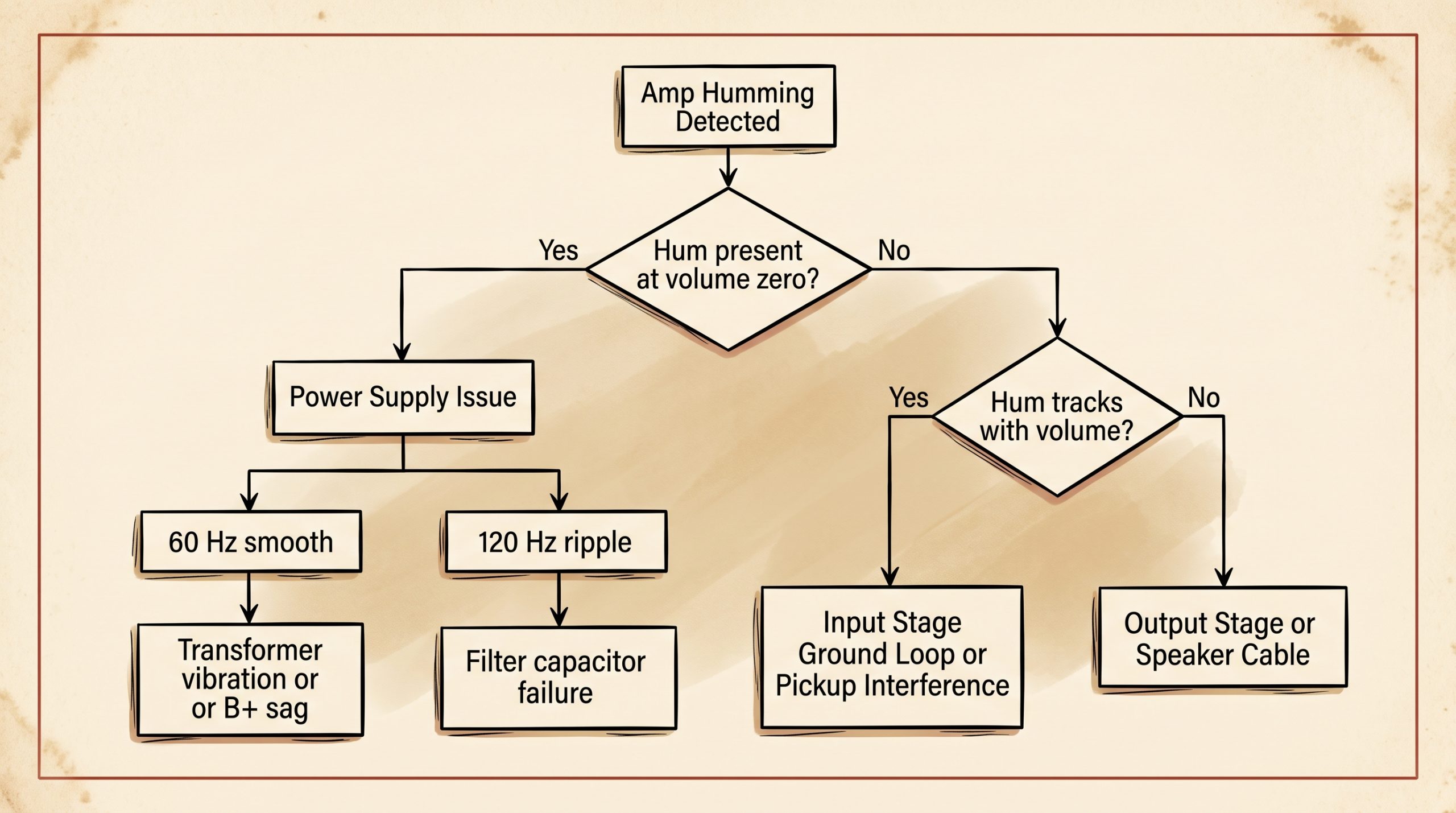
Step 1: Nothing plugged in test. Power the amp on with no guitar and no cable connected. If hum is present with the volume control at zero, the noise originates upstream of the volume pot, that’s a power supply or amp circuit problem. If hum is absent, the source is somewhere in your signal chain.
Step 2: Cable only test. Plug in a cable with no guitar attached. Touch the tip of the cable. Normal ground-reference behavior means hum increases when you touch the tip, your body acts as an antenna. If hum stays constant or worsens regardless, suspect an amp ground fault, not a signal chain issue.
Step 3: Volume pot sweep test. Slowly bring the volume up from zero. Hum that appears before noon on the dial and doesn’t change as you turn it further points to the power supply. Hum that tracks proportionally with the volume control points to the input stage, a ground loop, or pickup interference entering at the front of the amp.
| Test Condition | Hum Present? | Likely Cause |
|---|---|---|
| Power on, nothing plugged in | Yes | Filter caps, power transformer, output transformer |
| Cable plugged in, no guitar, hum increases on touch | Yes | Normal ground reference behavior |
| Guitar plugged in, hum increases and rotates with body | Yes | Single-coil 60 Hz pickup interference |
| Hum tracks volume pot | Yes | Input stage or ground loop |
| Hum constant regardless of volume position | Yes | Power supply B+ ripple |
Cause #1: Single-Coil Pickup Interference (Guitar Hum, Not Amp Hum)
This is the most common source of “Fender amp humming” complaints, and it has nothing to do with the amp. Single-coil pickups on a Stratocaster or Telecaster act as antennas, picking up 60 Hz electromagnetic fields radiated by building wiring, fluorescent lighting, computer monitors, and dimmer switches. The guitar brings it in through the input jack, the amp amplifies it faithfully.
The confirmation test is simple. Plug in your guitar and slowly rotate your body while standing still. If the hum changes pitch or intensity as you turn, pickup interference is confirmed. Not a mystery.
Common culprits in the room include fluorescent and LED lighting fixtures, computer monitors within six feet of the guitar, unshielded power cables running parallel to your guitar cable, and dimmer switches on the same circuit. Moving away from the interference source often cuts the problem in half immediately.
Fix options, in order of simplicity:
- Move away from the interference source and re-test
- Use a hum eliminator or passive DI box with ground lift (see Cause #2 for specifics on how these work)
- Shield the guitar’s pickup cavity with copper tape and connect the shielding to ground
- Switch to humbucking pickups, which cancel this interference by design
Cause #2: Ground Loop Hum
A ground loop forms when two pieces of equipment share an audio ground connection at different electrical potentials. Current flows along the ground path between them, inducing a 60 Hz loop that shows up as hum. The classic scenario: your amp is plugged into one outlet, your pedalboard power supply into a different outlet across the room, and your audio interface into a third. Each has its own ground reference. Connect them with audio cables and you’ve built a current loop.
Test for it by disconnecting all pedals and plugging the guitar directly into the amp. If the hum stops, the ground loop lives in your signal chain. Not in the amp.
Fix options:
- Plug all gear into a single power strip sharing one outlet
- Use a ground lift on effects pedals or a DI box with transformer isolation in the signal chain
- A passive ground loop isolator placed between pieces of gear breaks the loop without cutting the safety ground on any device
Reverb’s taming-the-60-cycle-hum guide notes that a ground loop isolator plugged between the amplifier and signal source resolves 60-cycle hum by providing transformer-isolated signal paths, eliminating the current loop without any safety risk.
Safety note, this matters: Never defeat the amp’s safety ground (the third prong on the power cord) to solve a hum problem. Fender’s own vintage 2-prong amps from the early 1960s included a capacitor (commonly called the “death cap”) intended to reduce hum by coupling the chassis to the AC line, a design that caused electrocutions. Fender issued service bulletins to address this. Lifting the ground on a modern amp recreates that hazard. Don’t do it.
Cause #3: Failing Filter Capacitors (120 Hz Ripple Hum)
Fender tube amps convert AC from the power transformer into DC using a rectifier, then smooth that DC with electrolytic filter capacitors in the power supply. As electrolytics age, typical useful lifespan is 20–35 years in lightly used amps, their capacitance drops and their equivalent series resistance (ESR) rises. The result: 120 Hz ripple from the rectified AC gets through to the audio circuit instead of being filtered out.
The signature is specific. This hum is higher in pitch than 60 Hz hum, often with a “two-tone” or motorboating quality. It doesn’t track the volume control, it’s present at volume zero and volume ten equally. And it’s there with nothing plugged in.
Fender-specific filter cap values for reference:
| Model / Circuit | Main Filter Cap | Screen Filter Cap |
|---|---|---|
| Blackface Twin Reverb (AB763) | 70µF @ 500V | 25µF @ 500V |
| Blackface Deluxe Reverb (AA763) | 25µF @ 500V x2 | 25µF @ 500V |
| Blackface Princeton Reverb (AA1164) | 25µF @ 500V x2 | 25µF @ 500V |
The fix is a power supply recap, the single most important routine maintenance item on any Fender tube amp over 30 years old. Parts run $40–$120 depending on the model. Shop labor typically adds $100–$200.
DIY is possible on eyelet-board designs if you have high-voltage experience and proper discharge procedures. But B+ rails in a Twin Reverb run at 460–480V DC. That’s lethal without respect for the work. If you haven’t discharged filter capacitors under high voltage before, this is the job to hand to a tech. The Fender amplifier service documentation for each model specifies the cap values and positions on the eyelet board.
Cause #4: Bad Tubes (Microphonic or Failing Preamp and Power Tubes)
A single failing 12AX7 in the preamp can inject hum into the signal path. V1, the first preamp position, closest to the input jack, has the most impact on noise floor because every subsequent gain stage amplifies whatever noise enters there. Swap V1 first with a known-good tube and retest.
In push-pull output stages, matched output tube pairs cancel hum in the output transformer primary. An unmatched or failing power tube creates an imbalance that defeats that cancellation, and 60 Hz hum appears. A properly matched pair of 6L6GCs within 5% plate current at operating voltage gives the output transformer something symmetrical to work with.
The tap test is quick. With the amp powered on and volume up slightly, tap each preamp tube gently with a pencil eraser. A microphonic tube rings, thuds, or squeals through the speaker. Replace it.
Tube complements by Fender era:
- Tweed (5E3 Deluxe, 5F1 Champ): 12AY7 or 12AX7 preamp, 6V6GT power
- Blackface and Silverface: 12AX7 preamp, 12AT7 phase inverter, 6L6GC or 6V6GT power
Replacing a microphonic preamp tube costs $15–$25. A matched output tube pair with bias service runs $40–$120 plus labor. The 12AX7 buyer’s guide on this site covers current production and NOS options with specific noise floor data for each brand.
Cause #5: Bad Solder Joints and Cold Grounds
Cold solder joints are a slow-motion problem. Decades of thermal cycling from power-up and power-down, combined with speaker vibration transmitted through the chassis, gradually crack solder joints. A cracked joint creates intermittent resistance in a ground path, the amp sees a floating or high-impedance ground at that point and hum appears.
Common failure locations on vintage Fender eyelet-board amps:
- The ground bus wire running along the eyelet board
- Tube socket cathode connections on preamp tube sockets (pins 3 and 8 on a 12AX7 socket)
- Output transformer secondary ground connection to the bus
- Input jack sleeve ground connections
The wiggle test confirms it. With the amp on at low volume, gently flex the eyelet board or press on components. If the hum changes, increases, decreases, or cuts out, a cold joint is nearby. On PCB-based Fender amps like the Frontman series, cracked PCB traces near stress points (jack mounting holes, transformer mounting) are the version of this problem. Same cause, different substrate.
The fix is reflowing all ground bus solder points with fresh 60/40 rosin-core solder, then cleaning with flux remover. Not glamorous work. Often highly effective.
Cause #6: Power Transformer Mechanical Hum
This one gets misdiagnosed constantly. There are two distinct phenomena to separate: electrical hum through the speaker, and mechanical buzz directly from the transformer body.
Power transformers hum at 60 Hz because of magnetostriction, the laminated steel core physically vibrates in the alternating magnetic field. This is normal, and under most circumstances you won’t hear it through the speaker. What you hear with your ear near the chassis is the transformer itself vibrating.
It becomes a problem when transformer laminations loosen with age (common on Fender’s vintage Schumacher and Triad transformers after 40+ years), when mounting bolts vibrate loose and transmit buzz to the chassis, or when DC offset on the AC mains line causes asymmetric magnetization of the core. DC offset comes from asymmetric loads on the building’s wiring, common in older buildings with lots of half-wave rectifier power supplies on the same circuit.
Test: place your hand flat on the transformer housing (safely, without touching anything else). Feel or hear buzz directly from the unit. That’s mechanical, not electrical.
Fixes in order: tighten all transformer mounting bolts, apply transformer varnish to the lamination stack, install a DC blocker on the AC line. Commercial DC blocker units run around $50. A DIY version uses a bridge rectifier and capacitor in the hot leg of the AC supply to block DC component while passing AC.
Cause #7: Environmental and Power Line Interference
Dirty power means AC line voltage with high total harmonic distortion (THD), caused by HVAC motors, dimmer switches, switching power supplies, and variable-speed equipment all on the same circuit. Your amp’s power transformer doesn’t fully reject harmonic content on the AC line, and some of it ends up in the audio signal.
The tell: hum that appears only at certain times of day, in certain rooms, or worsens when specific appliances switch on. Intermittent. Location-dependent. Not related to tubes, caps, or guitars.
Fix options:
- Dedicate a 20A circuit to your studio or rehearsal space, isolated from HVAC and lighting loads
- A power conditioner with RFI/EMI filtering (the Furman M-8Dx is a common choice at around $130) filters line noise before it reaches your amp
- For critical recording, a fully isolated power transformer provides the cleanest solution
- Fluorescent and certain LED fixtures generate RF that single-coil pickups pick up readily, switch lighting to incandescent or move the amp away from fixtures
Fender Amp Hum by Era: What’s Normal, What’s Not
Acceptable idle hum varies significantly across Fender’s production history. Knowing which era your amp comes from sets realistic expectations and helps you identify when something’s actually wrong versus when the design is working exactly as intended. For dating and circuit code identification across these eras, the Fender tube amp serial number and dating guide covers transformer codes, chassis stamps, and tube chart interpretation for every production period.
| Era | Common Circuits | Typical Idle Hum | Notes |
|---|---|---|---|
| Tweed (1948–1960) | 5F1, 5E3, 5F6-A | 5–10 mV at speaker (high) | Champ and Princeton are single-ended, with no push-pull hum cancellation; 5E3 Deluxe and 5F6-A Bassman are push-pull |
| Brownface (1959–1963) | 6G3, 6G2, 6G5 | 3–7 mV | Transitional; rectifier changes affect hum character |
| Blonde (1961–1963) | 6G7, 6G6 | 2–4 mV | Improved B+ filtering; cleaner than brownface equivalents |
| Blackface (1963–1967) | AA763, AB763, AA165 | Under 2 mV | Best hum rejection of vintage era; audible hum unusual |
| Silverface (1967–1981) | AA1069, AA270, AA864 | Under 2–3 mV early; higher late | Ultra-Linear output on later models; transitional-era caps now often at service life |
A blackface AB763 Deluxe Reverb that hums audibly from three feet away in a quiet room isn’t behaving normally for its circuit. The same audible idle hum on a 5E3 tweed Deluxe is completely within spec. Era context changes everything.
Quick-Reference Diagnosis Table
| Symptom | Tracks Volume? | Hum Frequency | Likely Cause | Fix |
|---|---|---|---|---|
| Hum with nothing plugged in | No | 120 Hz | Filter caps failing | Recap power supply |
| Hum disappears when guitar unplugged | Yes | 60 Hz | Single-coil pickup or environment | Hum eliminator, shield guitar, move away from source |
| Hum changes when you rotate body | Yes | 60 Hz | EMI from lighting or electronics | Move, shield, change lighting |
| Hum increases with all effects connected | No | 60 Hz | Ground loop in signal chain | Single power strip, ground loop isolator |
| Mechanical buzz from chassis, not speaker | N/A | 60 Hz | Transformer lamination vibration | Tighten bolts, DC blocker on AC line |
| Tapping preamp tube causes thud through speaker | Yes | Variable | Microphonic preamp tube | Replace tube (V1 first) |
| Intermittent hum, changes when flexing board | No | Variable | Cold solder joint in ground path | Reflow all ground bus connections |
When to Call a Tech vs. DIY
Some of this work is genuinely accessible to a careful hobbyist. Some of it is not.
Safe to DIY:
- Swapping preamp or power tubes
- Replacing input jacks on eyelet-board amps
- Reflowing cold solder joints on the eyelet board (with amp unplugged and caps discharged)
- Filter cap replacement on PCB-based solid-state amps with B+ under 50V
Send to a tech:
- Any power supply work on tube amps with B+ above 200V
- Output transformer replacement
- Fixed-bias adjustment after output tube swap (requires bias probe and meter under live voltage)
Safety first, every time: Fender tube amplifiers store lethal charge in filter capacitors, up to 500V DC in a Twin Reverb, even after the amp is powered off and unplugged. Capacitors must be discharged before any internal work. This isn’t optional caution. It’s the reason vintage amp techs are still alive.
| Cause | DIY or Tech? | Estimated Parts Cost | Estimated Shop Labor |
|---|---|---|---|
| Microphonic preamp tube | DIY | $15–$25 | N/A |
| Unmatched output tubes | DIY (tube swap) / Tech (bias) | $40–$120/pair | $40–$80 bias service |
| Cold solder joints | DIY (with discharge) | Under $10 (solder, flux) | $60–$100 |
| Filter cap recap | Tech recommended | $40–$120 | $100–$200 |
| Ground loop | DIY | $20–$50 (isolator) | N/A |
| DC blocker for transformer hum | DIY or Tech | $30–$60 | $50–$80 |
Where to Go from Here
Start with the 3-step isolation test, it takes five minutes and immediately divides the problem space in half. If the hum is present with nothing plugged in, you’re looking at the power supply or output stage. Get the amp to a tech if the B+ rail is above 200V. If hum only appears with guitar connected, single-coil interference and ground loops account for the vast majority of cases, both of which are fixable without touching the amp’s internals.
Era context matters for setting expectations. A silverface Princeton Reverb with capacitors from 1974 is more than 50 years old. Those filter caps are almost certainly past their service life. A fresh recap on a vintage amp this age often transforms its noise floor. For help identifying your amp’s circuit code, production year, and transformer date codes before discussing service with a tech, the Fender amp transformer date code decoder gives you the tools to read those EIA stamps accurately and show up to the conversation informed.
Frequently asked questions
Why does my Fender amp hum when nothing is plugged in?
Hum present with no input signal and with the volume control at zero points to the power supply. Aging filter capacitors allow 120 Hz B+ ripple through to the audio circuit, producing a higher-pitched hum that doesn't change with the volume control. A failing rectifier tube (common on amps using a GZ34 or 5Y3) can also contribute. Run the isolation test: if hum is equally loud at volume zero and volume ten, the problem is upstream of the volume pot and downstream of the power transformer. A recap is the likely fix.
Is some hum normal for a Fender tube amp?
Yes, especially on single-ended tweed-era designs such as the 5F1 Champ. A 5F1 Champ or 5E3 Deluxe with a faint idle hum inaudible beyond two to three feet at bedroom volume is operating within spec. Audible hum from across a room, or hum that has noticeably changed since the last time you used the amp, warrants diagnosis. Blackface AB763 push-pull designs should be very quiet at idle, any audible hum on a healthy Deluxe Reverb or Twin Reverb in a quiet room is worth investigating.
What is a guitar amp hum eliminator, and does it actually work?
A hum eliminator is a passive or active device that breaks ground loops using transformer-isolated signal paths. The Ebtech HE-2 is a common passive unit; the ISP Decimator addresses noise floor more broadly with active gating. Hum eliminators work specifically for ground loops between pieces of equipment. They don't fix internal amp noise from failing filter caps, bad tubes, or cold solder joints, those problems live inside the amp and need to be addressed at the source.
My brand-new Fender amp is buzzing, is it defective?
Run the 3-step isolation test before assuming defect. New solid-state Fender amps (Frontman series) should be nearly silent with nothing plugged in. Hum on a new amp with no input signal is a warranty issue, contact Fender support or the retailer. Hum that only appears with guitar plugged in is almost always single-coil pickup interference from the room environment, not a defect. The guitar is picking up 60 Hz from nearby electronics, and the amp is amplifying it faithfully.
Can a bad speaker cause hum?
Rarely, and the failure mode is different. A torn or damaged speaker cone can produce mechanical buzz that resembles electrical hum, but true 60 Hz or 120 Hz electrical hum isn't generated by the speaker, it enters the signal upstream. To isolate, never run a tube amp with the speaker disconnected and no load, because that can damage the output transformer. Swap in a known-good speaker of the correct impedance, or connect the amp to a load box, and retest. If the hum is unchanged, the speaker isn't the cause.