Contents
- 01A Brief History of the 12AX7 and ECC83
- 02Technical Specifications: The Full Datasheet Breakdown
- 03Are ECC83 and 12AX7 Truly Interchangeable?
- 04Where Real Differences Actually Come From: Construction and Manufacturer
- 05ECC83S: What Does That "S" Actually Mean?
- 0612AX7A vs. 12AX7: Another Naming Layer
- 07The Dual-Triode Family: ECC83 Among Its Relatives
- 08ECC83 and 12AX7 in Fender Amplifiers: Where It Lives and Why It Matters
- 09Current Production ECC83 and 12AX7 Recommendations
- 10Frequently Asked Questions: ECC83 vs 12AX7
- 11Where to Start
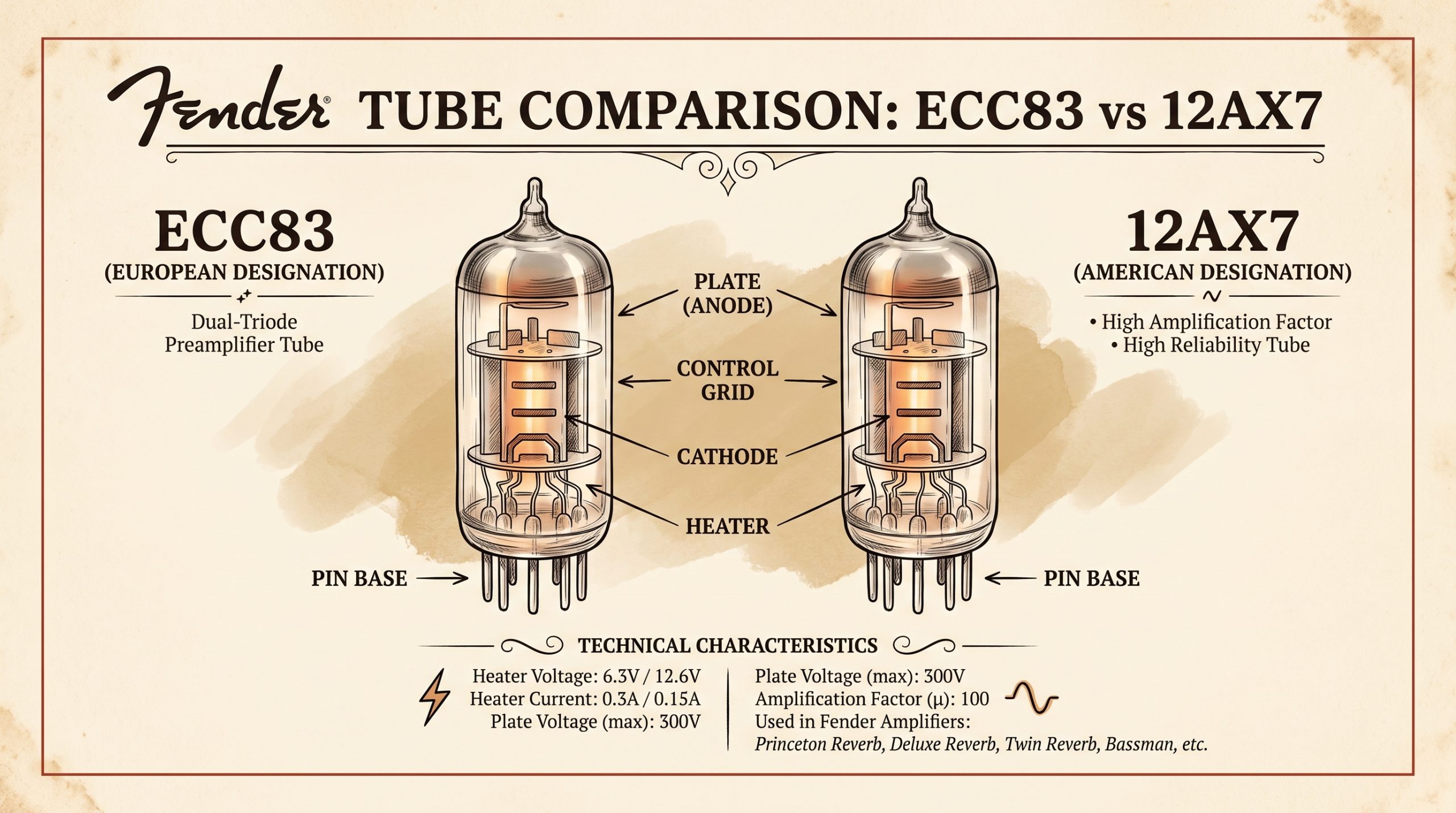
You can drop an ECC83 into any socket that calls for a 12AX7, and vice versa, without touching a single solder joint. The tube is the same. The pinout is the same. The specs are the same. What changes is the nameplate on the box, which reflects whether the tube was standardized under the American RETMA/EIA system or the European CECC/Mullard-Philips system. Where it gets interesting, and where real-world tonal differences actually exist, is in construction, manufacturer, and era. Not the name.
- Electrically identical: amplification factor (μ) = 100, transconductance (gm) = 1,600 µmhos, plate resistance (rp) = 62,500 Ω
- Same pinout: 9-pin Noval (B9A base), direct drop-in replacement in any guitar amp
- No re-biasing required when swapping ECC83 for 12AX7 or vice versa
- Works in every Fender amp from tweed through current production reissues
- Real tonal differences come from manufacturer, plate construction, and era, not the name
- ECC83S (JJ) is a short-plate construction variant, not a separate tube type
- 5751 is NOT a 12AX7 substitute. It has μ = 70, roughly 30% less gain. Deliberate modification, not a neutral swap.
- Counterfeit NOS tubes are common on eBay. Relabeled current-production stock sold as vintage Mullard or Telefunken.
A Brief History of the 12AX7 and ECC83
The tube didn’t start with a naming dispute. It started with two separate engineering communities solving the same problem.
The American Side: RCA and the 12AX7 (1947)
RCA engineers in Camden, New Jersey developed the 12AX7 around 1946, with the tube officially released for public sale on September 15, 1947. The goal was a compact, high-gain replacement for the bulkier 6SL7 octal dual-triode, using the smaller 9-pin Noval (B9A) envelope that was becoming standard for miniature tube designs. Two triode sections, both derived from the 6AV6, shared a single glass envelope.
The naming follows the RETMA/EIA American tube-numbering convention:
- 12 = 12.6V heater rating
- A = first designator letter in the beam/triode sequence
- X = relative transconductance classification
- 7 = 7-element count (9-pin Noval base per convention at the time)
Fender, Gibson, Ampeg, and nearly every American amp builder adopted the 12AX7 immediately. By the mid-1950s it was the default preamp tube in American audio equipment.
The European Side: Mullard, Telefunken, and the ECC83 (1953-1954)
The European designation came separately, standardized under the CECC (Cenelec) Mullard-Philips system. The naming convention is different but the tube underneath is the same:
- E = 6.3V heater voltage class
- CC = double (dual) triode
- 83 = type number within the family
Key European manufacturers included Mullard (Blackburn, UK), Telefunken (Ulm, West Germany), Amperex (Netherlands), Valvo (Germany), RFT (East Germany), and Tesla (Czechoslovakia). Vox spec’d ECC83 in the AC30. Marshall put it in the JTM45. Same tube, different continent, different label.
Multiple sources on tube preamp swapping, including documentation reviewed by Premier Guitar and Reverb contributors, note that the ECC83 is simply the British designation for the 12AX7, and in most situations the two types function as direct replacements with no functional distinction beyond the name printed on the glass.
Technical Specifications: The Full Datasheet Breakdown
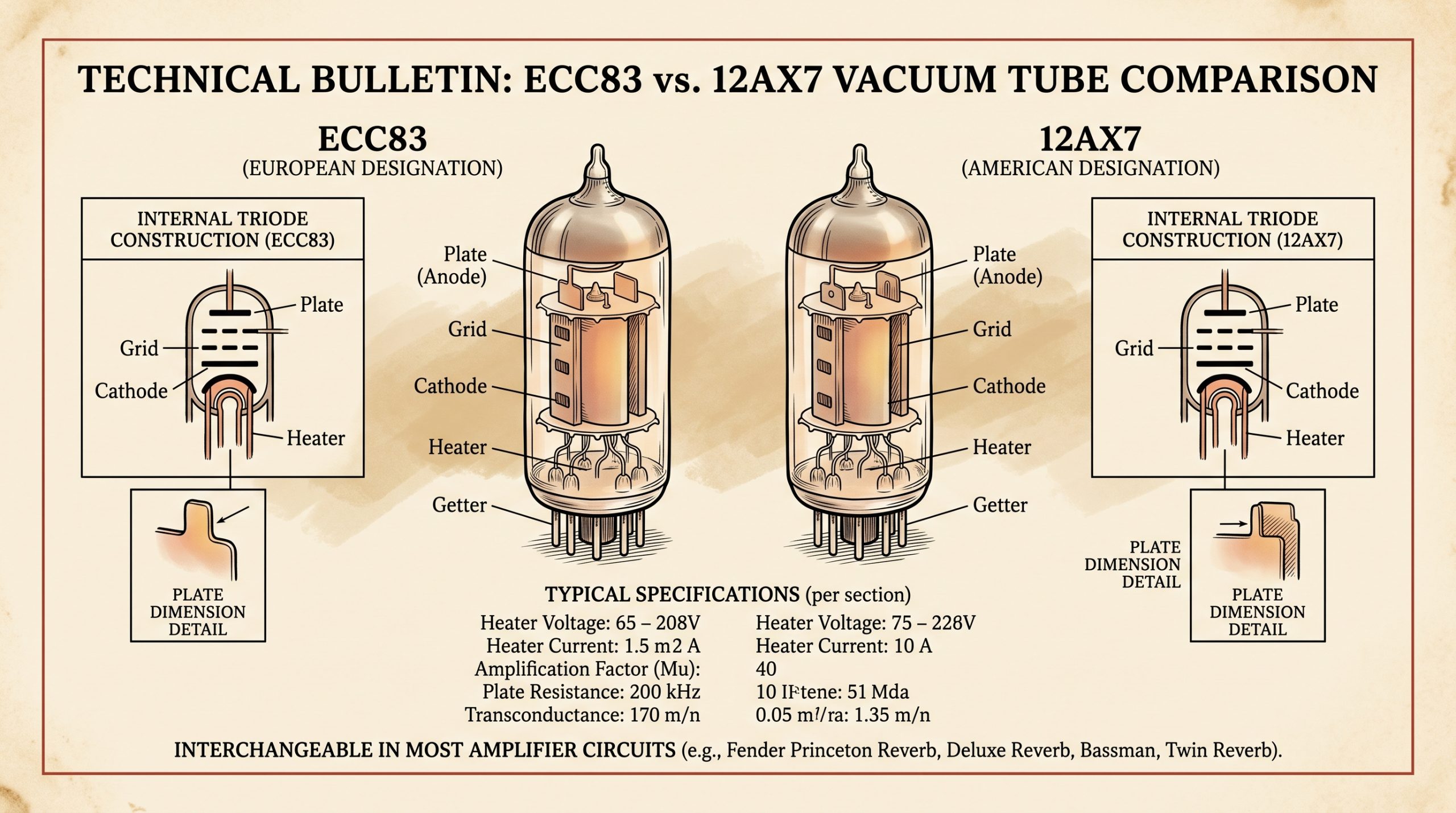
The RCA RC-30 tube manual and the Mullard ECC83 published datasheet show identical numbers across every relevant parameter. There’s no room for interpretation here.
Electrical Specifications
| Specification | 12AX7 (RCA Datasheet) | ECC83 (Mullard Datasheet) |
|---|---|---|
| Type | Dual high-gain triode | Dual high-gain triode |
| Amplification Factor (μ) | 100 | 100 |
| Transconductance (gm) | 1,600 µmhos | 1,600 µmhos |
| Plate Resistance (rp) | 62,500 Ω | 62,500 Ω |
| Heater Voltage | 12.6V or 6.3V CT | 6.3V or 12.6V CT |
| Heater Current at 6.3V | 300 mA | 300 mA |
| Heater Current at 12.6V | 150 mA | 150 mA |
| Max Plate Voltage | 300V | 300V |
| Max Plate Dissipation | 1.2W per triode | 1.2W per triode |
| Base | 9-pin Noval (B9A) | 9-pin Noval (B9A) |
| Envelope | T-6½ glass | B9A glass |
The Heater Voltage Question: Why It Matters for Fender Amps
The center-tapped heater is one thing players often misread as a potential incompatibility. It isn’t. Both names describe a center-tapped heater wired across pins 4, 5, and 9. Fender amps universally power preamp tube heaters at 6.3VAC, using pins 4 and 5, with pin 9 as the center tap or left unconnected depending on the circuit revision. At 6.3V the heater draws 300 mA per tube. At 12.6V (series wiring) it draws 150 mA. No amp modification is needed either way.
No re-biasing is required when swapping ECC83 for 12AX7. Preamp stages in all Fender amplifiers are cathode-biased via a fixed resistor, typically a 1.5kΩ cathode resistor in the V1 position. That resistor sets the operating point automatically. You don’t touch it. You pull the old tube, seat the new one, and you’re done.
For a broader reference on how circuit codes and production eras relate to tube complement choices, the Fender tube amp dating reference covers the EIA codes and chassis stamps that confirm original specifications across all production years.
Are ECC83 and 12AX7 Truly Interchangeable?
Yes. Completely. Same pinout (B9A Noval), same electrical specs, same physical envelope dimensions with only minor variation in plate structure between manufacturers. The tube works in every Fender amp that calls for a 12AX7, from the 5E3 tweed through every blackface and silverface circuit, through current production reissues. It works equally in Marshall, Vox, Mesa Boogie, and every other amp that uses this tube type.
The name on the box does not determine performance. The construction and manufacturer do. That distinction matters a lot when you’re choosing tubes, and not at all when you’re checking compatibility.
Where Real Differences Actually Come From: Construction and Manufacturer
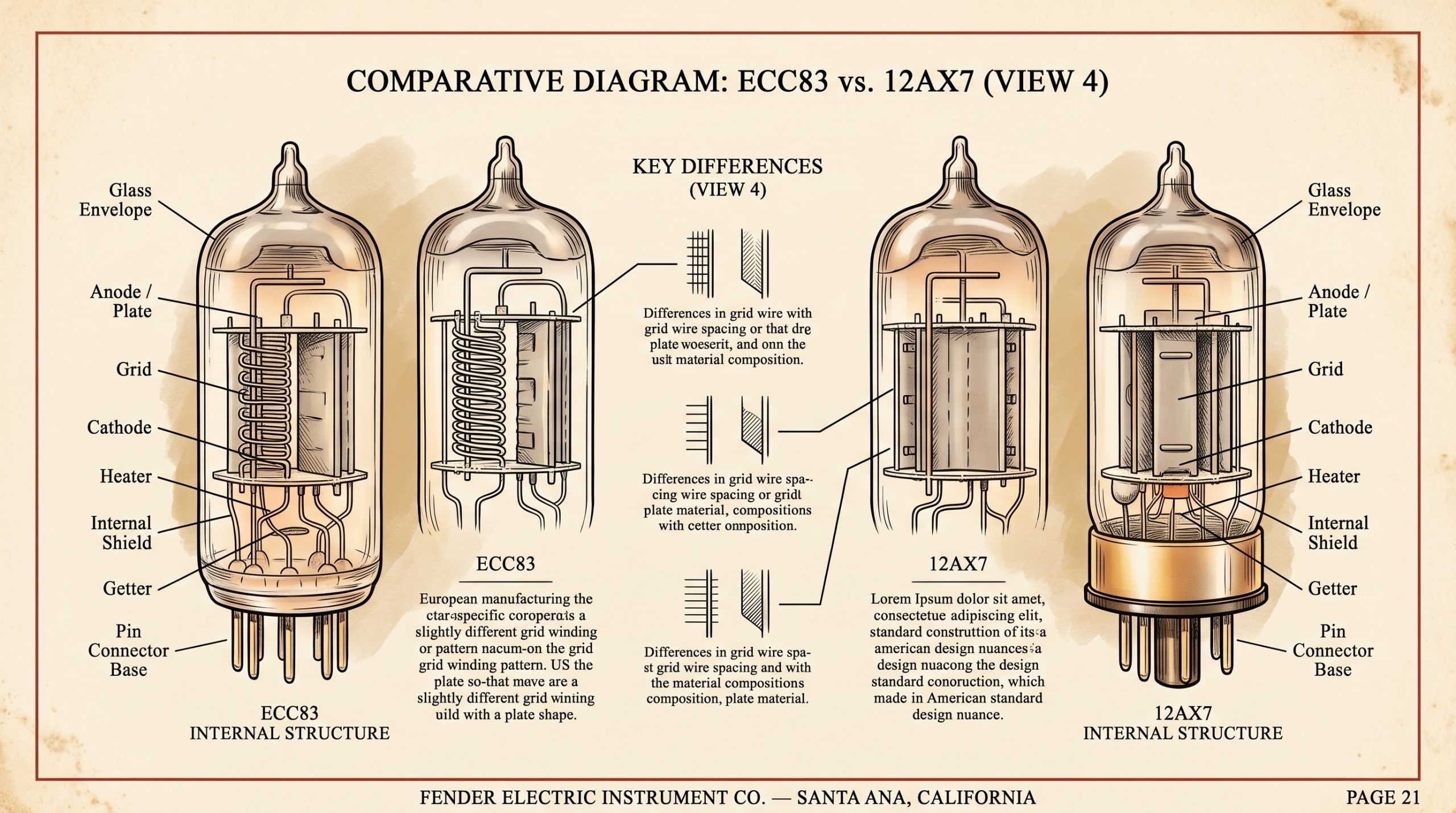
This is where the conversation gets useful. Two tubes can both be labeled ECC83 and sound noticeably different from each other. That’s not because the name changed. It’s because plate geometry, mica spacer design, getter construction, and factory sourcing all affect how a tube actually behaves in a circuit.
Long-Plate vs. Short-Plate Construction
Plate length is the most significant construction variable for guitar amp applications. Long-plate designs, including the Mullard Blackburn ECC83, Telefunken ECC83, and early RCA 12AX7, tend toward warmer low-end response, more bloom in the attack, and more musical breakup at lower plate voltages. They’re also slightly more microphonic, which matters more in high-gain first-stage positions than in later gain stages. Short-plate designs, like the current JJ ECC83S and Shuguang 12AX7, deliver tighter high-mids, lower microphonics, and more consistent behavior across production batches.
| Construction Type | Key Manufacturers | Tonal Character | Best Application |
|---|---|---|---|
| Long Plate | NOS Mullard, Telefunken, RCA Gray Plate | Warm, open, dynamic | V1 clean channel, reverb recovery stage |
| Short Plate | JJ ECC83S, Shuguang 12AX7B | Tight, focused, punchy | Phase inverter, high-gain stages |
| Spiral Filament | Telefunken ECC83 (diamond bottom) | Ultra-low noise, pristine | Studio preamps, critical V1 position |
Getter Shape and Quality Indicators
The getter is the silvery metallic deposit inside the glass envelope. It maintains vacuum integrity after the tube is sealed. Halo (circular) getters are typical of European manufacture. Top-mounted getters are more common in American production. Getter flash color tells you something important: silver means a good vacuum seal. White or oxidized getter flash means the tube’s vacuum has been compromised. Don’t buy it.
Mica spacers also matter. Double-mica construction (one spacer at top and bottom of the plate assembly) is more mechanically stable and significantly less microphonic than single-mica designs. If you’re putting a tube in V1 of a high-gain stage or a loud stage amp, double-mica construction is worth seeking out.
The Country of Manufacture Factor
Not a myth. Different factory origins genuinely produce different results:
- British (Mullard Blackburn, Brimar): warm, musical harmonic content, bloom on attack
- German (Telefunken Ulm): precision construction, lowest noise floor, spiral filament design
- American (RCA, GE, Sylvania): gray plate vs. black plate tonal character, excellent dynamics
- Czech (Tesla, JJ): modern long-plate options with consistent quality control
- Chinese (Shuguang, Psvane): affordable entry level through genuine premium tiers, quality varies significantly by model
- Russian (Sovtek, Electro-Harmonix, Tung-Sol reissue): standard production amp spec tubes, widely used and reliable
ECC83S: What Does That “S” Actually Mean?
The “S” is not an official CECC designation. It’s a JJ Electronic commercial identifier for their short-plate variant of the ECC83 line. Not a different tube type. Not a special selected grade. Specifically, it indicates shorter plate length compared to JJ’s standard (long-plate) ECC83.
In practice, the ECC83S offers slightly lower microphonics and a tighter, more present sound profile compared to JJ’s long-plate ECC83. Both are electrically identical to the 12AX7 and both drop into any 12AX7 socket without modification. The ECC83S tends to work better in high-gain first stages where microphonics are a concern. The long-plate JJ ECC83 leans warmer and more open. Choose based on where the tube is going in the circuit, not on the “S” designation itself.
12AX7A vs. 12AX7: Another Naming Layer
The “A” suffix indicates a revised military and commercial specification, introduced in the mid-1950s. Not a different tube. The 12AX7A tightened tolerances on heater warm-up time, interelectrode capacitances (input capacitance: 1.6 pF; output: 0.46 pF; grid-plate: 1.7 pF), and reduced hum and noise standards for sensitive audio applications.
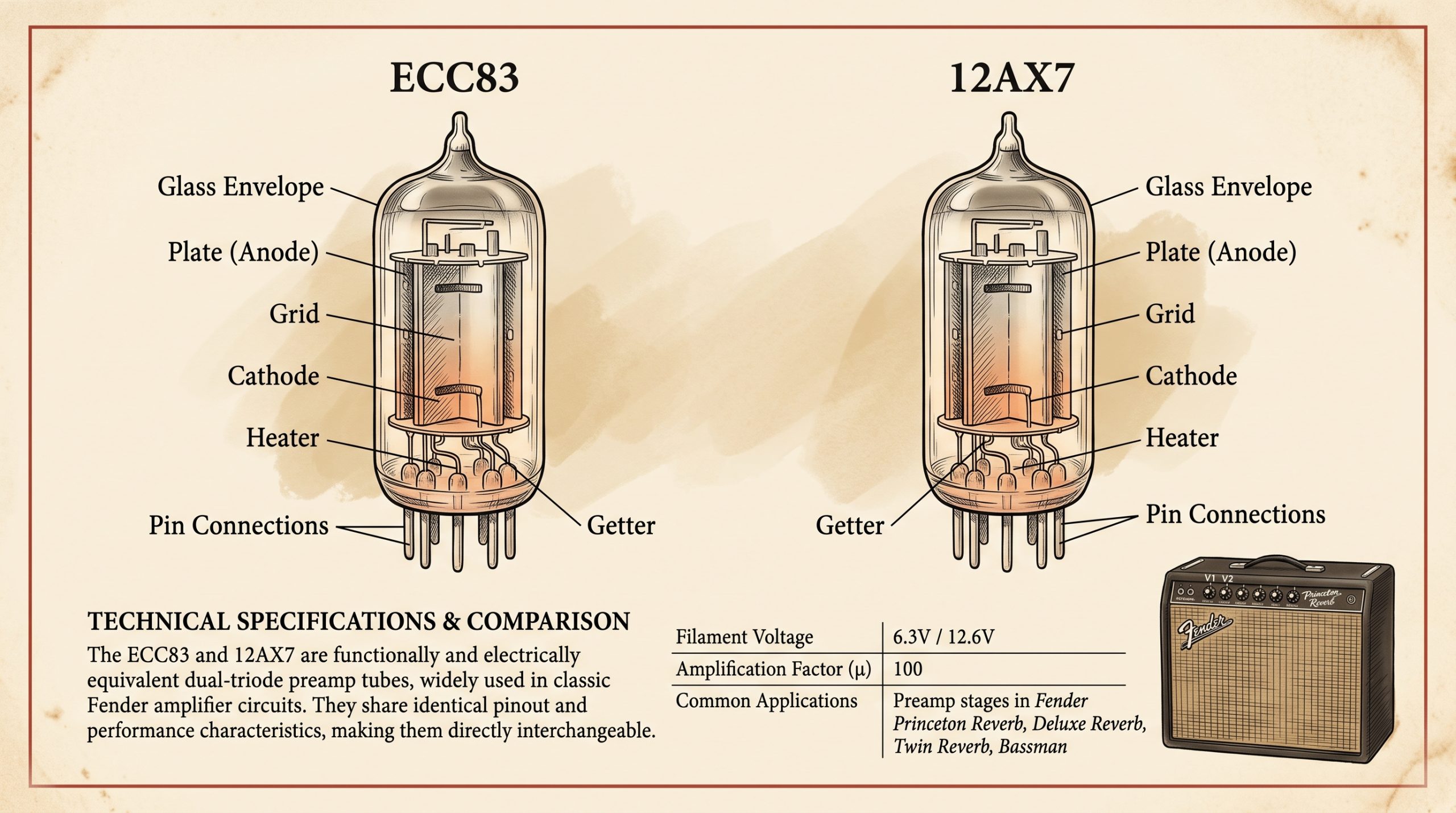
The 12AX7A is electrically interchangeable with the 12AX7. No socket modifications, no circuit changes. Most tubes sold today as plain “12AX7” already meet or exceed 12AX7A tolerances. The distinction is largely historical, though military-spec NOS examples like the Sylvania 12AX7A WA command meaningful collector premiums because of their documented build quality and noise floor.
Worth knowing. Not worth losing sleep over when tube rolling a guitar amp.
The Dual-Triode Family: ECC83 Among Its Relatives
The 12AX7/ECC83 sits at the high-gain end of a family of dual-triode types sharing the same Noval pinout. Knowing where it fits helps clarify why you can’t just swap any of these tubes without consequences.
| American Name | European Name | Gain Factor (μ) | gm (µmhos) | rp (Ω) | Common Use in Fender Amps |
|---|---|---|---|---|---|
| 12AX7 / 12AX7A | ECC83 | 100 | 1,600 | 62,500 | V1, V2 preamp, reverb recovery |
| 5751 | (none) | 70 | 1,600 | 58,000 | Drop-in lower-gain substitute for V1 |
| 12AT7 | ECC81 | 60 | 5,500 | 10,900 | Reverb driver, vibrato circuit |
| 12AU7 | ECC82 | 17-20 | 2,200 | 7,700 | Driver stages, not typically in preamp V1 |
| 12AY7 | (none) | 44 | 1,350 | 26,500 | Original V1 tube in tweed Fender circuits |
The 5751 as a 12AX7 Substitute: Is It Worth It?
The 5751 is a military-specification dual-triode with μ = 70, which puts it about 30% below the 12AX7’s gain factor of 100. Same Noval socket, physical drop-in. But it changes the amp’s behavior noticeably, reducing gain and pushing the breakup point higher. In V1 of a tweed Deluxe or another circuit that breaks up early, this can be a useful and intentional modification, giving you more clean headroom before the amp starts barking. In a low-gain circuit that’s already clean, the difference is less dramatic.
Don’t treat the 5751 as a neutral swap. It’s a deliberate tonal choice. If that’s what you’re after, it’s a solid one. If you just want a fresh 12AX7 without changing the amp’s character, get an actual 12AX7 or ECC83.
ECC83 and 12AX7 in Fender Amplifiers: Where It Lives and Why It Matters
The 12AX7 has been Fender’s default preamp tube since the late 1940s, and understanding its position in specific circuits helps you make smarter tube-rolling decisions. For detailed era-by-era production context on any of the amps below, the Fender Deluxe Reverb guide covers AB763 and AA763 circuit specifics in depth, including original tube complement specs.
Which Fender Amps Use the 12AX7 / ECC83?
| Era | Amp Example | Circuit Number | Years | Preamp Tube Positions | Original V1 Spec |
|---|---|---|---|---|---|
| Tweed | Tweed Deluxe | 5E3 | 1955-1960 | 2x 12AX7 | 12AY7 in V1 (lower gain), 12AX7 in V2 |
| Brownface | Brown Deluxe | 6G3 | 1961-1963 | 3x 12AX7 | 12AX7 |
| Blackface | Deluxe Reverb | AB763 (AA763 on earliest 1963-early 1964 units) | 1963-1967 | 4x 12AX7 | 12AX7 |
| Blackface | Twin Reverb | AB763 | 1963-1967 | 4x 12AX7 | 12AX7 |
| Silverface | Deluxe Reverb | AB763 | 1968-1971 | 4x 12AX7 | 12AX7 |
| Silverface | Super Reverb | AB763 / AB568 | 1967-1969 | 4x 12AX7 | 12AX7 |
The 5E3 tweed Deluxe is specifically. As documented in Teagle and Sprung’s Fender Amps: The First Fifty Years, the original V1 position in the 5E3 circuit called for a 12AY7, not a 12AX7. Installing a 12AX7 in that position increases gain and pushes the circuit toward earlier breakup. That’s a common and well-known modification, not an error, but it is a change from factory spec.
Position-by-Position Tube Rolling Guide for Fender Amps
Not all sockets are equal. Your tube rolling budget should reflect that.
- V1 (first preamp gain stage): The most tonally sensitive position in the entire amp. This tube sees the guitar signal first and shapes gain structure for everything downstream. Put your best tube here: long-plate NOS or the best current-production option you can afford.
- V2 (second gain or tone stage): Less critical. A solid current-production ECC83S or Tung-Sol 12AX7 works well here without breaking the bank.
- V3 (reverb recovery, if present): Low-noise tube preferred. Telefunken NOS is overkill for most players but delivers results. A quiet current-production option like the JJ ECC83S handles this position cleanly.
- Phase inverter position: Varies by circuit. Many Fender amps use a 12AX7 here (check the specific schematic), though some circuits specify 12AT7. Confirm before swapping.
Current Production ECC83 and 12AX7 Recommendations
NOS benchmarks are useful as reference points. Not everyone has the budget or patience for vintage glass. Current production has improved substantially over the past decade, and there are genuinely good options available new.
Current Production Options
| Tube | Construction | Best For | Price Range |
|---|---|---|---|
| JJ ECC83S | Short plate, Tesla heritage (Slovakia) | All-around, high-gain V1, low microphonics | $15-20 |
| Tung-Sol 12AX7 (reissue) | Long plate, Russia | Clean Fender tones, warm V1 character | $18-25 |
| Mullard 12AX7 (reissue) | Long plate, Russia | Vintage warmth approximation, home audio lean | $18-25 |
| Electro-Harmonix 12AX7EH | Short plate, Russia | Budget workhorse, consistent and quiet | $12-16 |
| Psvane 12AX7-T MKII | Long plate, China | Premium current production, studio-grade noise floor | $35-55 |
The Tung-Sol 12AX7 reissue is a strong choice for V1 in blackface Fender circuits if you want warm clean tones without hunting NOS stock. The JJ ECC83S is the practical choice for a stage amp where microphonics and consistency matter more than ultimate vintage warmth. The reissue Mullard leans more toward home audio character and works better in a studio context than a loud stage amp, as noted in testing documented at The Tube Store’s 12AX7 review database.
NOS Benchmarks: The Reference Tier
These aren’t necessarily what you should buy. They’re what everything else gets measured against.
- Mullard Blackburn ECC83 (1960s): warmest, most musical harmonic content, the benchmark for vintage clean tone in a Fender circuit
- Telefunken ECC83 diamond bottom (1950s-60s): lowest noise floor, most linear response, spiral filament construction, studio reference standard
- RCA 12AX7 Black Plate (1950s): American warmth, excellent dynamics, barks when pushed in a low-wattage tweed circuit
- Sylvania 12AX7 Long Black Plate (1950s): aggressive attack, high-headroom character, widely used in tweed contexts for spanky attack and stiff bass response
Counterfeit NOS is a real problem. Relabeled Chinese or Russian current-production tubes sold as vintage Mullard or Telefunken are common on eBay. If the price on a “NOS Telefunken ECC83” seems low, it probably isn’t what the seller claims. Buy NOS from established dealers with return policies, and cross-reference construction details against factory documentation before spending serious money.
The 12AX7 complete buyer and replacement guide covers NOS sourcing, testing, and how to evaluate construction quality in more detail.
Where to Start
If you’re standing in front of a vintage Fender and wondering whether to grab an ECC83 or a 12AX7 to replace the tired preamp tube in V1, the answer is that the designation is the last thing you should be looking at. Look at the manufacturer, the plate construction, and the era. A current-production Tung-Sol 12AX7 or JJ ECC83S gives you a solid, reliable starting point without the NOS price premium. From there, if you want to understand what the vintage glass actually does differently in circuit, the Mullard Blackburn ECC83 is the traditional benchmark worth hearing at least once in V1 of a clean blackface circuit. The difference between a great tube and a mediocre one in that position is audible. The difference between a tube labeled ECC83 and one labeled 12AX7 is not.
Frequently asked questions
Can you replace a 12AX7 with an ECC83?
Yes, without any modification. The ECC83 and 12AX7 share identical pinouts (B9A Noval, 9-pin), identical electrical specifications, and the same physical envelope dimensions. You can pull a 12AX7 from any guitar amplifier socket and seat an ECC83 in its place with no circuit changes, no re-biasing, and no adjustments. The cathode-biased preamp stages used in Fender amplifiers set their operating point automatically via fixed cathode resistors. Nothing to touch.
Is ECC83 better than 12AX7?
Neither designation is better than the other, because they describe the same tube. Perceived quality differences between specific tubes labeled ECC83 and those labeled 12AX7 come entirely from the manufacturer, the construction era, and the plate geometry, not from the naming system. A 1960s Mullard Blackburn ECC83 sounds different from a current-production Russian 12AX7 because they are built differently, in different factories, with different materials, in different decades. The name printed on the glass tells you nothing about quality on its own.
What does ECC83S mean, and is it different from ECC83?
The "S" in ECC83S is a JJ Electronic commercial designation indicating their short-plate construction variant. It is not an official CECC standard suffix and does not indicate a selected or specially tested grade. The ECC83S is electrically identical to the 12AX7 and ECC83 in every measurable specification. Compared to JJ's long-plate ECC83, the ECC83S offers lower microphonics and a slightly tighter, more present high-mid character. Both are direct drop-in replacements in any 12AX7 socket.
Is a 5751 the same as a 12AX7?
No. The 5751 is a physically compatible but electrically distinct tube. Its amplification factor is approximately 70, compared to the 12AX7's μ of 100, a difference of roughly 30% less gain. The 5751 uses the same 9-pin Noval socket and fits any 12AX7 position, but installing it changes the amp's gain structure and breakup character. In V1 of a circuit that breaks up early, the 5751 can provide useful additional clean headroom. That's a deliberate tonal modification. It is not a neutral like-for-like replacement.
Which position in a Fender amp matters most for tube rolling?
V1, the first preamp position, has the greatest impact on tone. This tube amplifies the guitar signal before anything else in the circuit gets a chance to shape it, and its noise floor, gain character, and microphonic behavior are carried through every subsequent stage. Spend your money here first. V2 and later positions are progressively less sensitive to tube choice, though V3 reverb recovery stages benefit from a low-noise selection. The phase inverter position should be confirmed against the specific circuit schematic before swapping, since some Fender circuits use 12AT7 there rather than 12AX7.