Contents
- 01A Tale of Two Eras: The History Behind Each Reissue
- 02Circuit Differences: Where the Two Amps Actually Diverge
- 03Full Specifications Comparison
- 04Controls, Channels, and Feature Differences
- 05Speaker and Cabinet Construction
- 06Reverb and Tremolo Quality
- 07Pedal Platform Shootout: Which Takes Pedals Better
- 08Studio Recording and Gigging Considerations
- 09Modding Both Reissues: Common Upgrades and Circuit Corrections
- 10Frequently Asked Questions
- 11Which Deluxe Reverb Should You Choose
This guide covers the circuit differences, full specs, tonal character, controls, pedal platform behavior, and recording considerations so you can make the right call the first time.
- Both amps: 22W, 2x 6V6GT, 5AR4 rectifier, open-back 1×12 pine cabinet, made in Mexico
- ’65 DRRI circuit: AB763 blackface, bright cap present, no mid control, higher clean headroom
- ’68 Custom circuit: modified silverface, bright cap removed (Custom ch.), mid control added
- ’68 Custom has two distinct channels: Vintage (blackface-voiced) and Custom (mid-forward)
- Neither amp has an effects loop, all pedals go in front
- Both weigh approximately 42 lbs. Not a lightweight grab-and-go option.
- The headroom difference is NOT a wattage difference, both are 22W. It’s purely circuit voicing.
- Current production speakers differ by model: ’65 DRRI ships with a Jensen C12K (not the period-correct Jensen C12N), ’68 Custom ships with a Celestion G12V-70
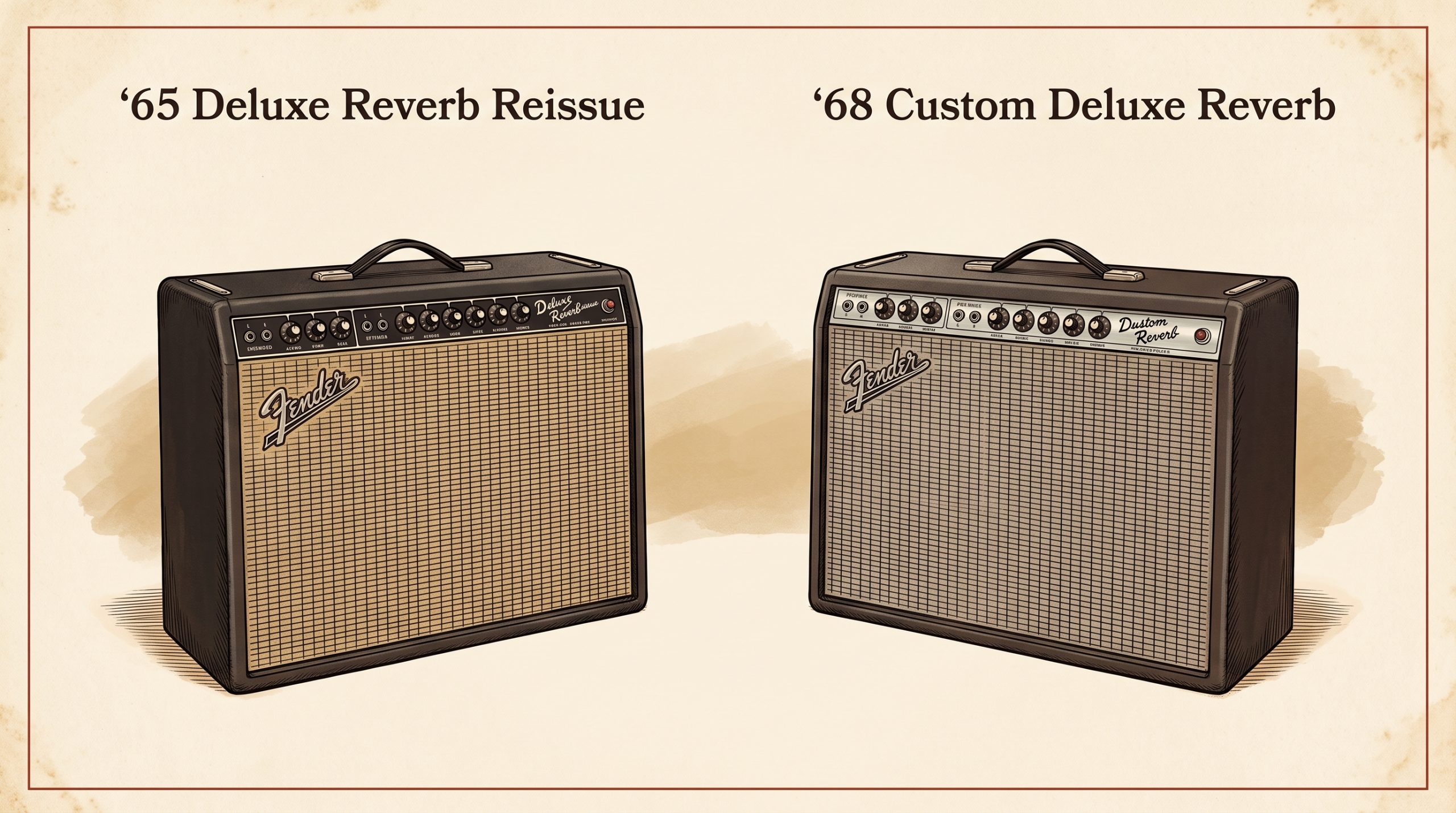
A Tale of Two Eras: The History Behind Each Reissue
The Original ’65 Blackface Deluxe Reverb (Circuit: AB763)
The Deluxe Reverb as players know it today entered production in 1963 and ran through 1967 under Fender’s blackface cosmetics. The circuit code is AB763. Fender’s internal circuit codes use a two-letter revision sequence (AA, AB, AC, and so on) followed by a three-digit month-and-year stamp, so 763 marks a circuit revision finalized in July 1963. The same code often applies across several different blackface-era models that shared a given circuit revision, not just the Deluxe Reverb. This dating convention is documented in Greg Gagliano’s research published in 20th Century Guitar Magazine from 1997 to 2000 (archived via the Wayback Machine).
Original AB763 Deluxe Reverbs shipped with Jensen C12N speakers in an 8-ohm configuration, with Oxford and Utah variants appearing later in the production run. The output transformer carries a Fender parts-catalog number in the 022-prefixed series used during the CBS era — a Fender internal part number, distinct from the EIA source-date codes stamped on transformers and speakers for dating purposes. For specifics on reading those transformer and chassis stamps on an original, the Fender tube amp dating reference covers EIA codes and date stamps across all production eras.
Fender relaunched the Deluxe Reverb as a reissue in 1993, making the ’65 DRRI one of the longest-running production reissues in the company’s catalog. Its staying power isn’t marketing momentum. It’s the fact that the AB763 circuit genuinely works, delivering the clean, scooped American tone that defined mid-’60s studio recordings.
The Original ’68 Modified Silverface Deluxe Reverb
CBS acquired Fender in January 1965. By 1968, engineering changes were showing up in the circuits. The transitional period of 1968 to 1969 produced modified circuitry that retained the basic AB763 architecture but introduced a mid-boost voicing on the main channel and removed the bright cap that gave blackface amps their sparkle at low volumes. Fender does not publish a single canonical circuit code for the modern reissue’s specific modified circuit — the closest documented lineage is the AB763-to-silverface transition, which included further running changes in that era (sometimes referenced as AB868 for the original-era changes), though no source confirms that designation applies verbatim to this reissue’s circuit.
Fender introduced the ’68 Custom Deluxe Reverb in 2013 as part of a broader ’68 Custom series. It isn’t a straight clone of any single vintage circuit revision. Fender added a dedicated Mid control to the Custom channel and retained a “Vintage” channel voiced to approximate the blackface character, giving the amp a dual-personality layout no original 1968 production unit actually had. That distinction matters when you’re comparing it to the ’65.
Circuit Differences: Where the Two Amps Actually Diverge
The AB763 Blackface Topology (’65 DRRI)
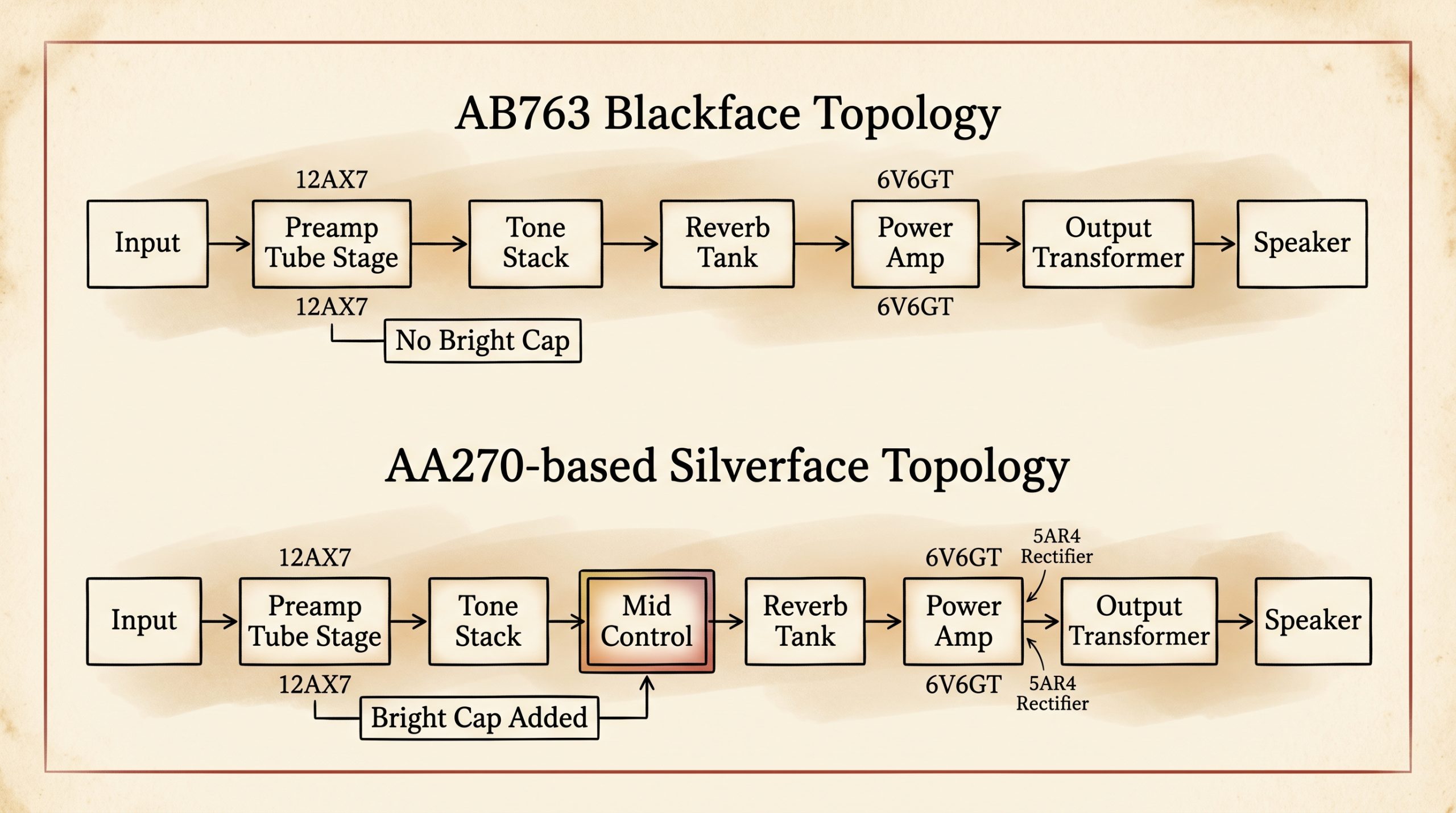
The preamp runs four 12AX7s, with one 12AT7 driving the reverb send and a second, dedicated 12AT7 running the phase inverter. The phase inverter is a long-tail pair configuration, shared with most Fender blackface and silverface designs of the era. The tone stack is the classic Fender “scoop” implementation derived from the James/Baxandall topology, with a mid cut centered around 400 to 500Hz. That scoop is what gives the amp its characteristic sparkle-and-thump character with recessed mids.
The bright cap is a 120pF capacitor across the volume pot on the Vibrato channel. At lower volume settings, it rolls the pot’s attenuation effect on high frequencies, keeping the top end present when you’d otherwise lose it turning down. At higher volumes, its effect diminishes. This is why the ’65 sounds notably cleaner and more hi-fi at bedroom volumes than the ’68 Custom’s Custom channel does at the same setting.
Output stage: two 6V6GT power tubes running fixed bias. Rectifier: 5AR4 (GZ34) tube rectifier, which contributes the characteristic sag and spongy compression under pick attack. The GZ34/5AR4 rectifier guide covers the specific behavior of that tube and why it matters for feel. Both reissues use PCB construction rather than point-to-point wiring, a common forum grievance but not a functional liability in production.
The Modified Silverface Topology (’68 Custom)
The big change is the removal of the bright cap from the Custom channel. Gone. Without it, the amp doesn’t add artificial top-end presence at low volumes. The result is a warmer, rounder top end that some players find more natural and others find dull, depending on their guitar and pickup type.
The added Mid control is the second major difference. On the Custom channel, the Mid knob provides approximately 0 to +6dB of boost centered around 500Hz. At noon, you’re already adding roughly 3dB compared to where the ’65 sits at equivalent settings. That midrange push is what gives the amp its earlier perceived breakup and fuller low-to-mid presence. It’s not that the amp has less clean headroom in terms of wattage. It’s that the voicing pushes the signal harder into the output stage at equivalent volume settings.
The ’68 Custom also has two distinct channels: the Vintage channel (Volume, Treble, Bass, blackface-voiced without the Mid control) and the Custom channel (Volume, Treble, Middle, Bass, Reverb, Speed, Intensity). This layout makes the ’68 more versatile on paper. You get a functional approximation of blackface voicing AND the mid-forward Custom channel in one box.
MusicRadar’s review of the ’68 Custom Deluxe Reverb notes that the Vintage channel carries slightly less brightness and headroom compared to the ’65 reissue’s Vibrato channel, confirming that even the “blackface-like” channel on the ’68 isn’t a perfect clone of the AB763 voicing.
Circuit Comparison
| Feature | ’65 DRRI (AB763) | ’68 Custom (modified silverface) |
|---|---|---|
| Circuit Number | AB763 | Modified silverface / Custom variant (no single documented factory code) |
| Bright Cap (main ch.) | Yes (Vibrato ch.) | No (Custom ch.) |
| Mid Control | No | Yes (Custom ch.) |
| Channel Names | Normal + Vibrato | Vintage + Custom |
| Power Tubes | 2x 6V6GT | 2x 6V6GT |
| Rectifier | 5AR4 (GZ34) | 5AR4 (GZ34) |
| PCB or Point-to-Point | PCB | PCB |
| Clean Headroom | Higher | Lower (Custom ch.) |
| Typical Breakup Point | Volume 7-8 | Volume 5-6 (Custom ch.) |
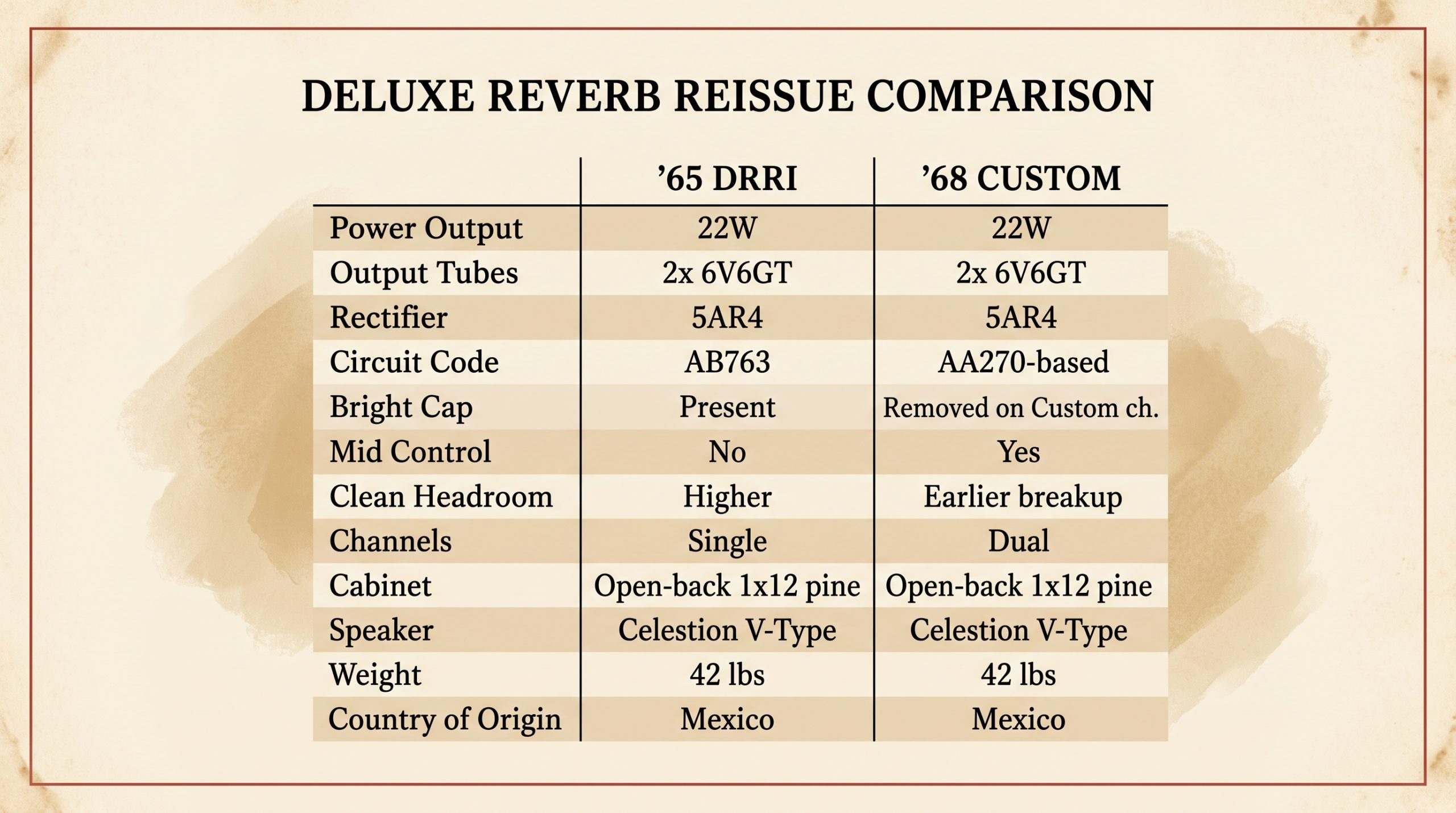
Full Specifications Comparison
| Spec | Fender ’65 DRRI | Fender ’68 Custom DR |
|---|---|---|
| Output Power | 22W | 22W |
| Speaker | 12″ Jensen C12K ceramic (current) | 12″ Celestion G12V-70 (current) |
| Speaker Impedance | 8 ohm | 8 ohm |
| Preamp Tubes | 4x 12AX7, 2x 12AT7 | 4x 12AX7, 2x 12AT7 |
| Power Tubes | 2x 6V6GT | 2x 6V6GT |
| Rectifier | 5AR4 (GZ34) | 5AR4 (GZ34) |
| Reverb | Spring, tube-driven | Spring, tube-driven |
| Tremolo | Vibrato channel | Custom channel |
| Effects Loop | No | No |
| Cabinet | Open-back 1×12, pine | Open-back 1×12, pine |
| Weight | ~42 lbs | ~42 lbs |
| Dimensions | 24.5″ x 17.5″ x 9.5″ | 24.5″ x 17.5″ x 9.5″ |
| Street Price (current) | ~$1,799 | ~$1,679 |
| Reissue Introduced | 1993 | 2013 |
| Country of Manufacture | Mexico | Mexico |
| Control Panel Cosmetics | Black panel (blackface) | Silver panel (silverface) |
Controls, Channels, and Feature Differences
’65 DRRI Channel Layout
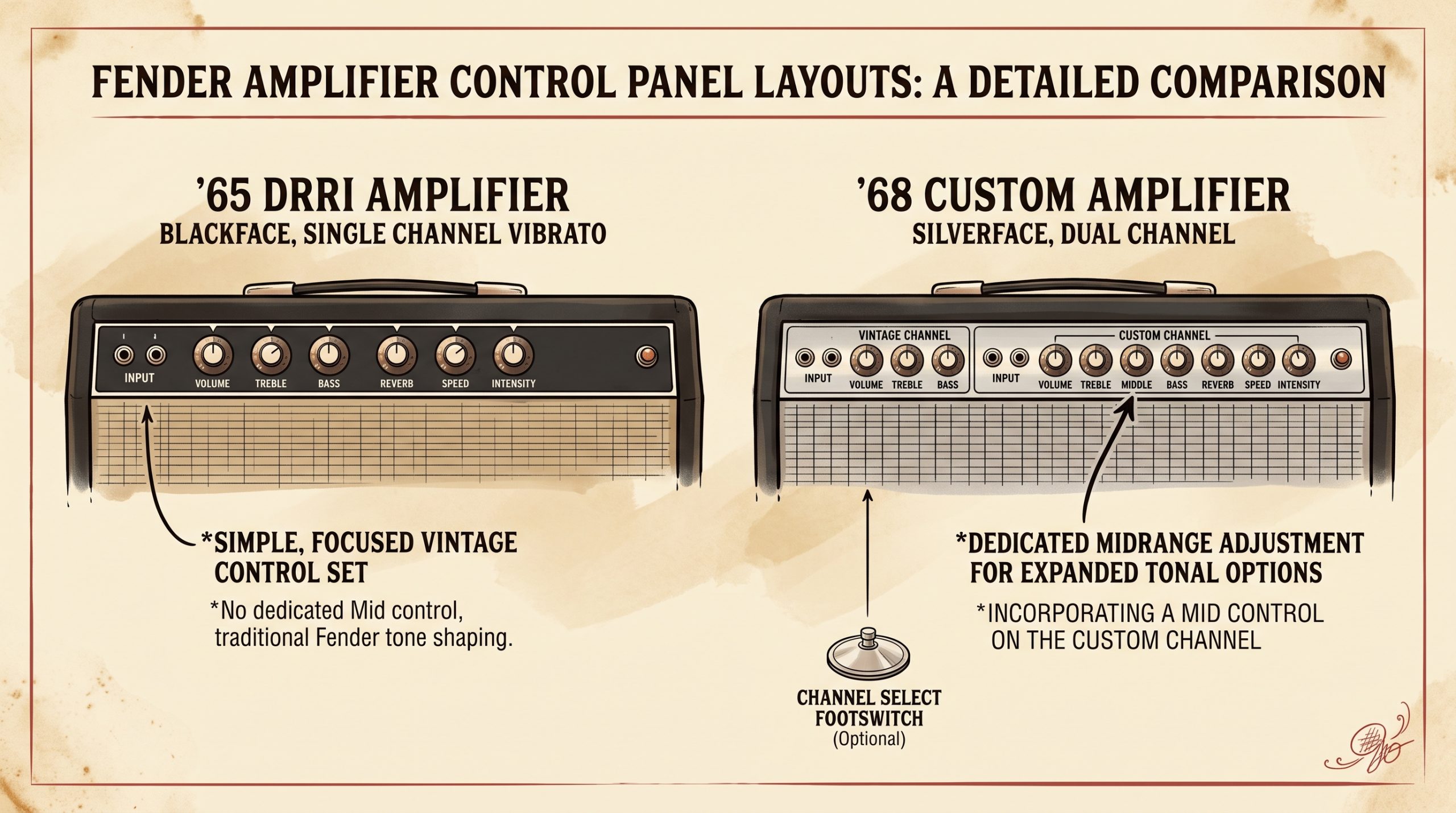
The Normal channel offers one control: Volume. No reverb, no tremolo, no tone controls. It’s there for a clean dry signal, useful for running two instruments simultaneously (the Normal and Vibrato channels can be jumpered for a blended tone, a classic trick from the original blackface era). The Vibrato channel runs Volume, Treble, Bass, Reverb, Speed, and Intensity. No Mid control anywhere on the amp. That’s either a feature (simplicity) or a limitation, depending on your pickups and playing style.
No master volume. No channel-switching footswitch. Simple.
’68 Custom Channel Layout
The Vintage channel gives you Volume, Treble, and Bass in a blackface-approximate voicing without the Mid control. The Custom channel runs Volume, Treble, Middle, Bass, Reverb, Speed, and Intensity. Tremolo lives on the Custom channel only, mirroring the ’65’s arrangement where tremolo lives on the Vibrato channel.
The Middle control is the headline feature. Range is approximately 0 to +6dB at the center frequency, continuously variable. At zero, the Custom channel still sounds different from the ’65 because the bright cap is still absent. The Mid control stacks on top of that baseline tonal shift.
Which Layout Suits Which Player
Set-and-forget players who want a clean platform will be happier with the ’65’s straightforward two-channel layout. Players who need to adjust midrange response on the fly, run humbuckers, or want both a blackface-style channel and a mid-voiced channel available in one amp will find the ’68 Custom’s layout genuinely useful. It’s a more versatile amp on paper. Whether that versatility matters to you depends entirely on how you actually use the amp.
Speaker and Cabinet Construction
Current Speaker Complement
The two current-production reissues actually ship with different factory speakers. The ’65 DRRI carries a 12-inch, 8-ohm Jensen C12K ceramic speaker — a modern ceramic Jensen, not the vintage-correct alnico Jensen C12N the AB763 circuit was originally voiced around. Early ’65 DRRI units from 1993 through the early 2000s shipped with Eminence-made “Special Design” speakers before the line settled on the Jensen C12K. The ’68 Custom carries a 12-inch, 8-ohm Celestion G12V-70, a British-voiced driver that suits its mid-forward Custom-channel character. Neither factory speaker is a vintage-exact match: the period-correct replacement for the ’65 DRRI is still the Jensen C12N, available from Jensen directly at around $90 to $100. For the ’68 Custom, its stock Celestion G12V-70 already leans mid-forward, though a Warehouse Guitar Speakers ET65 or a Jensen P12Q are common alternatives if you want to push further into that character rather than brighten it up.
Cabinet and Cosmetics
Both cabinets are open-back, single 12-inch, pine construction. Identical dimensions at approximately 24.5 x 17.5 x 9.5 inches. Identical weight at approximately 42 lbs. Heavy for a 22-watt amp. That’s the open-back pine cabinet and the transformer weight combined. Not exactly a featherweight for a two-set bar gig.
The visual difference is the control panel: the ’65 uses the classic black panel with silver knobs (blackface cosmetics), while the ’68 uses a silver panel (silverface cosmetics). Both use black Tolex and silver grille cloth. At a distance, they look nearly identical. Up close, the panel color and the Middle knob give it away.
Reverb and Tremolo Quality
Spring Reverb
Both amps run an Accutronics two-spring long tank (4AB3C1B or equivalent specification), with tube-driven reverb recovery via the dedicated 12AT7. The reverb circuit topology is essentially identical between the two models. The difference in reverb character comes from the amp’s overall voicing: the ’65’s brighter baseline makes the reverb appear slightly more splashy and defined at equivalent Reverb settings. The ’68 Custom’s warmer top end softens the reverb tail slightly. Neither is better. They’re just calibrated to the amp’s overall voice.
Tremolo
Both amps use optical tremolo operating via bias modulation. Fender labels it “Vibrato” on the panel, which is technically incorrect. It’s amplitude modulation (tremolo). Speed and Intensity controls are present on both. The circuit topology is the same. No meaningful sonic difference in tremolo character between the two amps. If you’re buying one over the other based on tremolo quality, don’t. It won’t be a factor.
Pedal Platform Shootout: Which Takes Pedals Better
Overdrive and Distortion Pedals
The ’65 DRRI is widely regarded as the better pedal platform. The reason is practical: the scooped midrange creates a natural gap in the frequency spectrum that mid-forward drive pedals fill perfectly. A Tube Screamer, a Klon Centaur circuit, or a Blues Driver hits the amp and the combined output is full, harmonically rich, and balanced. The pedal’s mids meet the amp’s scoop and the result is greater than the sum of the parts.
The ’68 Custom’s mid-forward Custom channel can become congested with mid-boosting drives. Stack a Tube Screamer onto an already mid-heavy signal and you get a wall of upper-midrange that sounds great in isolation and muddy in a mix. The ’68 Custom responds better to transparent overdrives (OCD, Timmy, Fulltone Full-Drive) or to drives with a low-mid cut built in. Gain staging is also more constrained on the ’68 Custom because clean headroom arrives sooner, so there’s less room to work with before feedback becomes an issue at stage volume with humbuckers.
Modulation and Time-Based Effects
Neither amp has an effects loop. Everything goes in front. For most modulation and time effects, this isn’t a problem. Chorus, phaser, and flanger pedals work fine in front of both amps. The ’65’s cleaner signal path and brighter voicing produces slightly more articulate tremolo pedal response, since the amplitude swings are more distinct against the cleaner baseline. With the ’68 Custom’s warmer top end, tremolo pedal depth can sound slightly less defined at high Intensity settings.
If an effects loop is non-negotiable for your rig, both amps can be modified by a qualified technician to add one. It’s a common modification on these circuits. Not a cheap one, but common.
Verdict for Pedalboard Players
The ’65 DRRI is the stronger pedal platform. Cleaner headroom, scooped mids, brighter baseline. It’s a blank canvas. The ’68 Custom is more of a standalone tone amp that sounds best with light drive from a transparent overdrive or the amp itself. Not bad. Just different in intent.
Studio Recording and Gigging Considerations
Recording
At lower volumes, the ’68 Custom produces a more immediately usable driven tone for recording. The Custom channel breaks up at volume 5 to 6, which is genuinely manageable in a home studio or project recording context without an attenuator. Getting natural amp overdrive from the ’65 at low volume requires either a THD Hotplate-style attenuator, a volume-knob trick, or cranking past the point where your neighbors tolerate it.
Microphone placement differs between the two. The ’65’s extended high-frequency response typically requires less treble attenuation in post-processing, but it can also produce more proximity effect sensitivity with a close-placed dynamic mic. The ’68 Custom’s rounder top end records with a more mid-forward profile that often sits better in dense mixes with minimal EQ work.
Live Gigging
Both amps are 22 watts into an efficient 12-inch speaker, which puts them at approximately 100 to 101dB SPL at 1W/1m depending on the speaker loaded. That’s sufficient for small to medium club gigs without PA support, particularly with single-coil pickups. The ’65’s clean headroom gives it an advantage in loud rehearsal and stage contexts where you need clean volume before the amp starts compressing. The ’68 Custom with humbuckers at loud stage volume can be tricky: the earlier breakup on the Custom channel means you’re fighting unwanted drive and potential feedback before you’ve found comfortable stage volume. The Vintage channel is the safer option in that situation.
Modding Both Reissues: Common Upgrades and Circuit Corrections
Common ’65 DRRI Mods
Speaker swap is the most popular first move. A Jensen C12N brings the amp closer to its original voicing than the current Jensen C12K. A Warehouse Guitar Speakers ET65 adds warmth and slightly earlier speaker breakup for players who want more grind without a circuit modification.
Bias adjustment is worth doing on any new or recently retubed unit. Factory bias on the ’65 DRRI tends to run cold. Setting the 6V6GT output tubes to approximately 25 to 28mA per tube produces better tone, more even harmonic content, and slightly warmer breakup. Any tech with a multimeter and a bias probe can do this in 15 minutes.
Filter cap refresh: the electrolytic capacitors in the power supply degrade over time. On any reissue over 10 years old, a full re-cap is worth the cost. It’s not glamorous work, but a tired power supply produces soft bass response and mushy attack. Fresh caps restore stiff bass response and the spanky attack the circuit is supposed to deliver.
Common ’68 Custom Mods
Bright cap restoration is the single most discussed ’68 Custom modification. Adding a 120pF cap to the Custom channel’s volume pot effectively converts the Custom channel voicing to approximate the blackface character. It’s reversible, inexpensive, and widely documented. If you bought a ’68 Custom and keep wishing it sounded more like a ’65, this is your first call to a tech.
Speaker swaps follow the same logic as the ’65. The Mid-forward Custom channel pairs well with a speaker that doesn’t exaggerate the upper midrange. Celestion G12H-30 or WGS ET65 both work well without fighting the amp’s natural character.
Channel-switching footswitch: neither amp ships with a footswitch for channel selection, and the ’68 Custom’s two-channel layout makes this more immediately useful than on the single-voiced ’65. Adding a simple A/B footswitch for the Vintage and Custom channels is a low-cost modification that makes the amp meaningfully more practical on stage.
Which Deluxe Reverb Should You Choose
The ’65 DRRI is the cleaner, more headroom-rich blackface purist’s amp. The ’68 Custom is the mid-forward, earlier-breaking silverface player’s amp with a dual-channel layout that adds real flexibility. Both are well-made production amps at a fair price, and both can be improved with a speaker swap and a proper bias adjustment. If you play Stratocasters and Telecasters through pedals, or if you need clean volume in a loud band context, the ’65 DRRI is the practical choice. If you record at home, play humbuckers, or want natural amp breakup without cranking past apartment-hostile volumes, the ’68 Custom’s Custom channel gives you that without compromise. The ’68 Custom’s Vintage channel also means you’re not giving up the blackface character entirely. For players who can only own one Deluxe Reverb and play across multiple styles, that dual-channel layout is a genuine advantage — and current street pricing actually puts the ’68 Custom around $100 to $120 below the ’65 DRRI, not a premium.
Frequently asked questions
Which Fender Deluxe Reverb is best, the '65 or the '68 Custom?
Neither is objectively better. The '65 DRRI is the right choice for clean tones, pedalboard rigs, and single-coil players who need headroom before breakup. The '68 Custom is the right choice for natural amp breakup at manageable volumes, humbucker and P-90 players who want filled-out midrange, and players who want blackface-style and mid-voiced options from a single amp. If maximum versatility in one box is the priority, the '68 Custom's Vintage plus Custom channel layout wins on that count.
Is the Fender '65 Deluxe Reverb Reissue a good amp?
Yes, without qualification. The '65 DRRI has been in continuous production since 1993, which is a longer run than most production amps manage. It runs the authentic AB763 blackface circuit at a price well below what original 1963 to 1967 Deluxe Reverbs command on the vintage market. It's a standard in recording studios and on stages precisely because the circuit is that good. The speaker and some component choices in the reissue leave room for upgrades, but the core circuit is sound.
Does the Fender '65 Deluxe Reverb have an effects loop?
No. Neither the '65 DRRI nor the '68 Custom Deluxe Reverb has an effects loop. Every pedal goes in front of the preamp. For drive and modulation pedals this is typically not a limitation. For players who run stereo time-based effects or need reverb and delay after the preamp, an effects loop can be added by a qualified technician as a modification. It's a real consideration worth factoring into the purchase decision if your rig depends on loop placement.
What are the actual circuit numbers for these reissue amps?
The '65 Deluxe Reverb Reissue is based on the AB763 blackface circuit. The '68 Custom Deluxe Reverb is based on modified silverface-era circuitry with Fender's own "Custom" voicing modifications: the bright cap is removed from the Custom channel, a Mid control is added to that channel, and a separate Vintage channel is included to approximate blackface voicing. Fender does not publish a single specific circuit-revision code for this modified reissue circuit. The reissue is not a straight clone of any single vintage circuit revision. Fender's original amplifier support documentation and archived service bulletins confirm the AB763 as the basis for the '65 reissue.
Can you get the '68 Custom to sound like the '65, or vice versa?
Partially. The '68 Custom's Vintage channel approximates blackface voicing, though MusicRadar's review documents that it carries slightly less brightness and headroom than the '65's Vibrato channel. Adding a 120pF bright cap to the Custom channel moves the '68 further toward '65 territory. Going the other direction is harder: the '65 has no Mid control and can't replicate the Custom channel's mid-forward voicing without a circuit modification. For players who genuinely want both sounds, the '68 Custom is the more flexible starting point.