Contents
- 01What Is an EL34 Tube?
- 02EL34 Pinout: What Every Pin Does
- 03Manufacturer History: Who Made the EL34 and When
- 04The Sound of EL34 Power Tubes: What Makes Them Distinctly British
- 05Why Fender Chose the 6L6 Over the EL34
- 06EL34 Tube Equivalents and Substitutes
- 07EVH 5150 III and the EL34: An American Amp's British Heart
- 08Best EL34 Tubes: Current Production Reviews
- 09Blackstar Studio 10 EL34: Single-Tube Design and What It Reveals
- 10How to Bias EL34 Tubes
- 11Marshall EL34 100/100: The Power Amp Perspective
- 12FAQ: EL34 Tubes
- 13The Transatlantic Tone Split
- 14Sources
The EL34 sits at the center of the British amp sound. Its pronounced upper midrange, early compression, and aggressive harmonic character made it the default choice for Marshall from the mid-1960s onward, and it remains the dominant output tube in British-style designs today. Understanding it means understanding half of the transatlantic tonal divide that’s shaped electric guitar sound for 60 years.
What Is an EL34 Tube?
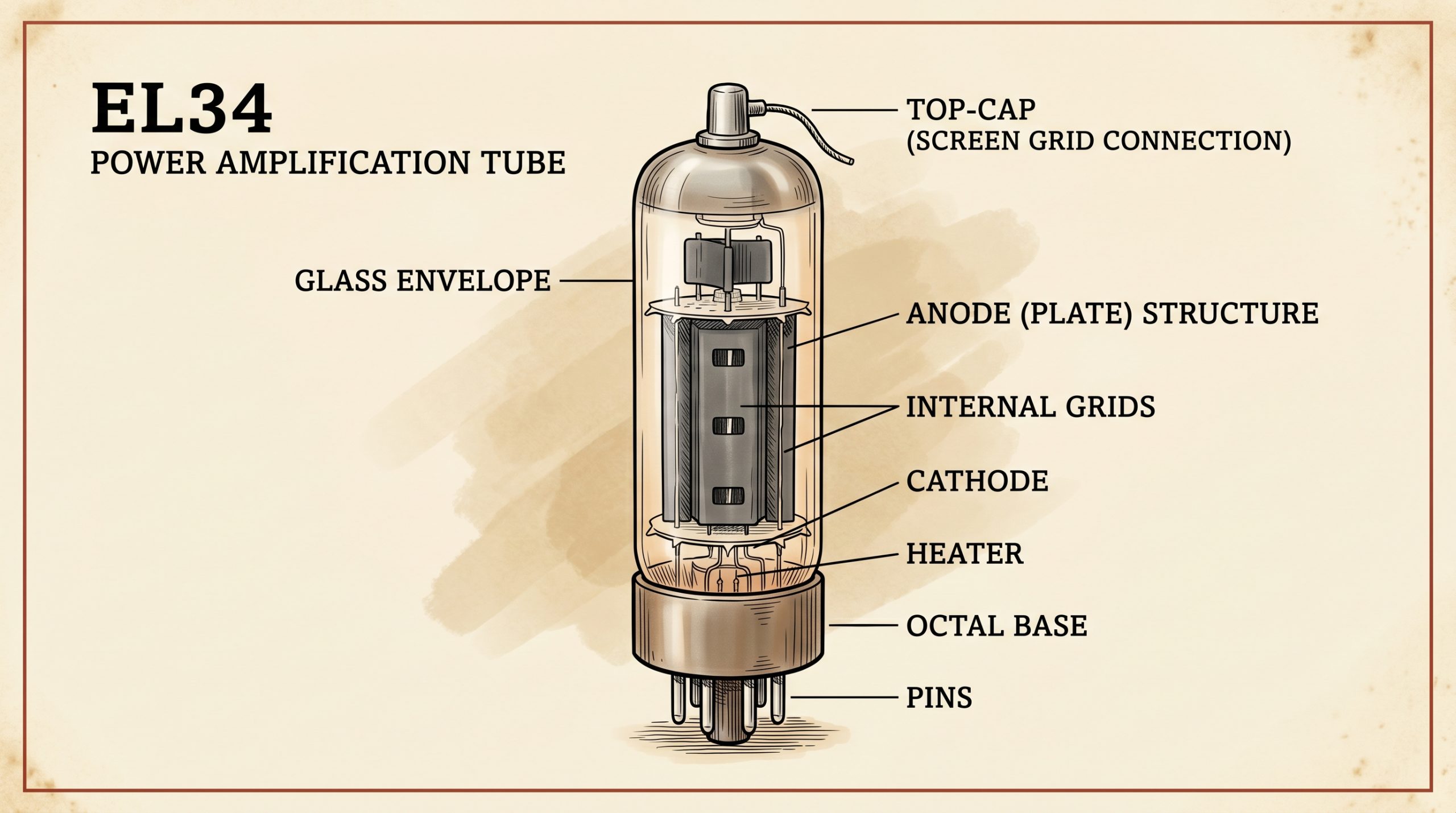
The EL34 is a true pentode, which distinguishes it from the beam tetrode designs (6L6, KT66, KT88) common in American amplification. “EL” in the Mullard/Philips European designation system stands for the power pentode class. The number 34 is a sequential type identifier, not a specification value. That pentode topology, specifically the presence of a suppressor grid (G3) between the screen and plate, shapes its harmonic character in a way that beam tetrodes simply don’t replicate.
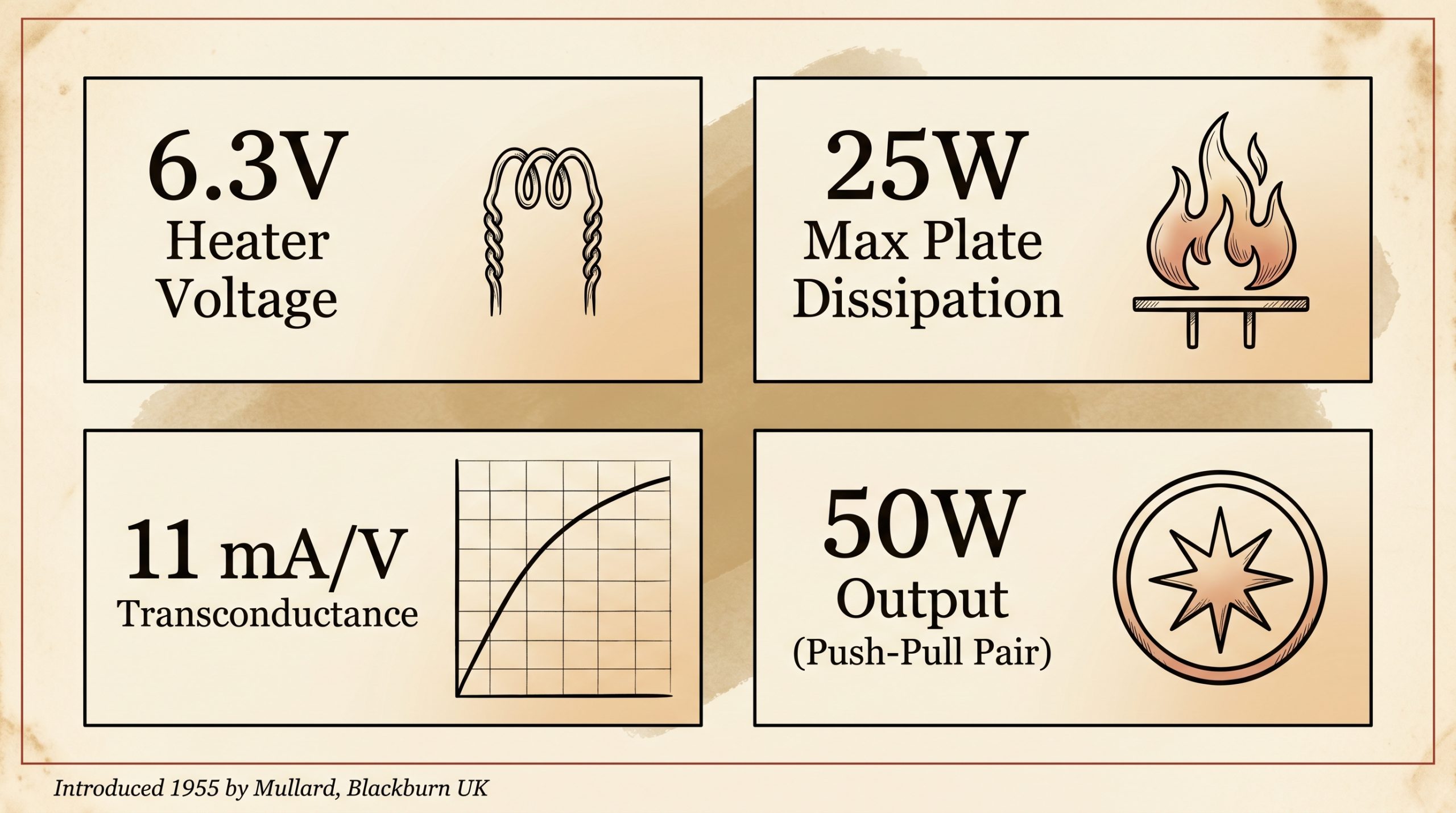
The full datasheet specs are below. Note the top-cap screen grid connection, which is physically absent on 6L6 and KT66 tubes. That single structural difference is one of the reasons the EL34 isn’t a drop-in substitute for American-market tubes without socket rewiring.
| Parameter | Value |
|---|---|
| Tube Type | Power Pentode |
| Introduced | 1955 (Mullard, Blackburn UK) |
| Heater Voltage | 6.3V |
| Heater Current | 1.5A |
| Max Plate Voltage | 800V |
| Max Plate Dissipation | 25W |
| Max Screen Voltage | 500V |
| Max Screen Dissipation | 8W |
| Transconductance (gm) | ~11 mA/V |
| Typical Plate Current (Class AB) | 70–80 mA/tube |
| Output (push-pull pair) | ~50W |
| Pin Configuration | Octal (8-pin) with top cap for G2 |
EL34 Pinout: What Every Pin Does
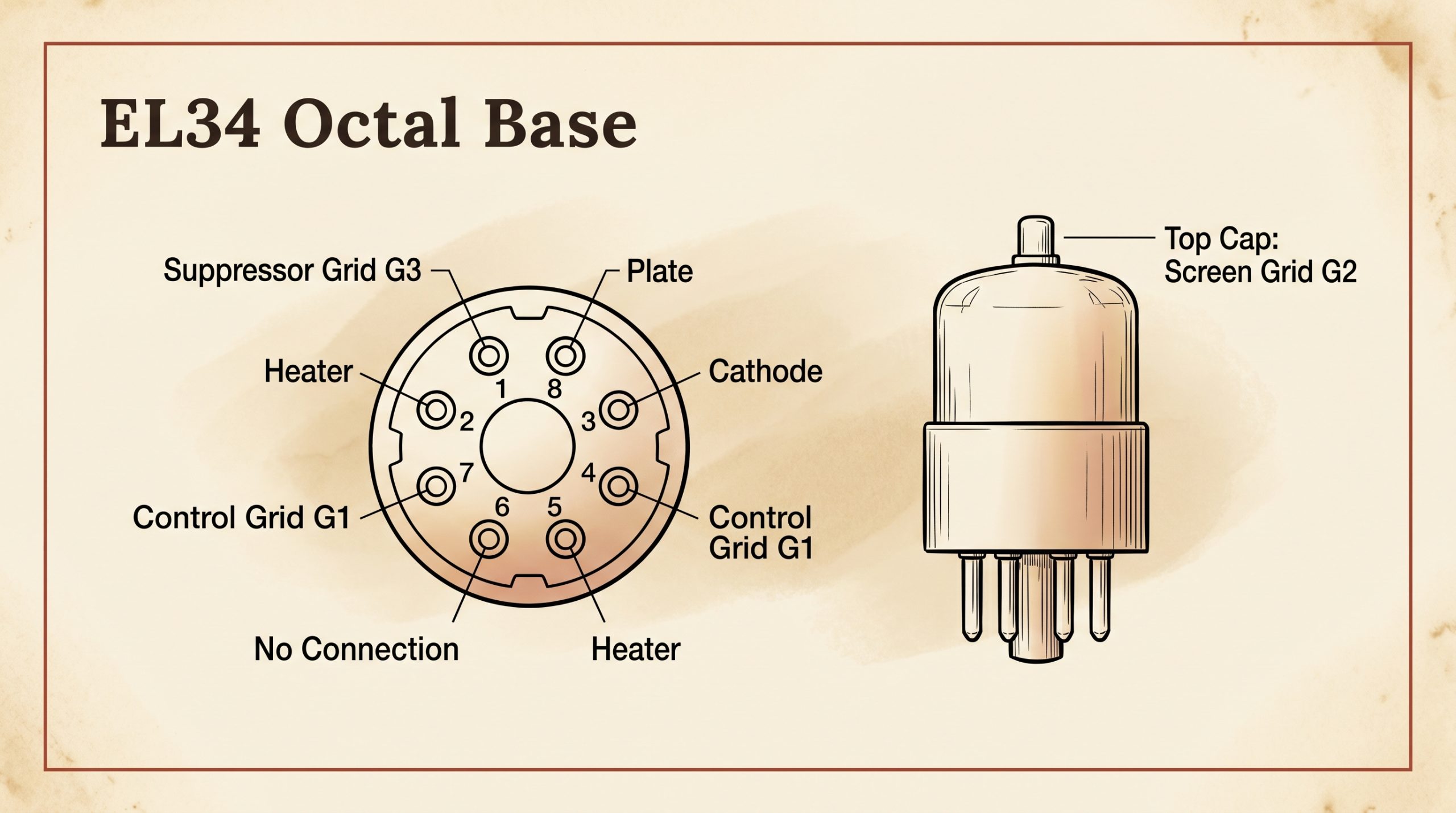
The EL34 uses an octal base with eight pins plus a top-cap connection. That top cap carries the screen grid (G2), which is the single most important identification detail when you’re looking at an unknown tube. No top cap, it’s not an EL34. The full pin assignment is below.
| Pin | Connection |
|---|---|
| 1 | Suppressor Grid (G3), connected to cathode or ground |
| 2 | Heater |
| 3 | Cathode |
| 4 | Control Grid (G1) |
| 5 | Heater |
| 6 | No connection (internal screen shield in some variants) |
| 7 | Control Grid (G1), tied to pin 4 internally |
| 8 | Plate (Anode) |
| Top Cap | Screen Grid (G2) |
Pin 1 is the critical one for compatibility. In a true pentode, pin 1 connects the suppressor grid (G3) to either the cathode (pin 3) or circuit ground. This is what makes the EL34 a pentode rather than a tetrode. In a 6L6, pin 1 has no connection at all. Fender’s octal sockets wired for 6L6 tubes simply leave pin 1 floating. Drop an EL34 in without tying pin 1 to ground first and you’ll get unpredictable behavior at best, screen damage at worst.
For biasing purposes, a safe fixed-bias target for most Marshall-style EL34 circuits is 70% of maximum plate dissipation. At a typical B+ of 480V, that works out to approximately 36.5 mA per tube (17.5W divided by 480V). Most EL34 amps run comfortably between 32 and 40 mA. Screen resistors of 1k ohm at 5W minimum are not optional in any fixed-bias EL34 design. They protect the screen grid from voltage spikes that the G3 suppressor grid, on its own, won’t stop.
The Fender tube amp serial number and dating guide covers socket wiring differences across Fender’s production eras, which is useful context if you’re trying to understand what would actually be required to adapt a specific Fender chassis for EL34 use.
Manufacturer History: Who Made the EL34 and When
Mullard’s Blackburn factory in Lancashire introduced the EL34 in 1955 as part of the Philips European Letter series. Mullard was a wholly owned subsidiary of Philips at the time, and the EL34 design was licensed outward through the Philips network to Siemens, Telefunken in Germany, and Tesla in Czechoslovakia (the company that eventually became JJ Electronic). That licensing arrangement explains why EL34 production spread rapidly across Europe while American manufacturers weren’t making the type at all in significant quantity.
The supply chain timeline matters:
- 1955: Mullard Blackburn introduces EL34 production
- Late 1950s to mid-1960s: Jim Marshall begins building amplifiers using Mullard EL34 tubes sourced through UK distribution channels
- 1960s: Siemens and Telefunken variants enter the market; Telefunken EL34s (with diamond-bottom construction) become collector items decades later
- 1970s–1980s: Blackburn Mullard production continues; Soviet-era production from Reflektor (Saratov, Russia) begins supplying the market under various labels
- 1990s: Sovtek and Electro-Harmonix branded tubes from Reflektor become common OEM replacements; JJ Electronic (Cadca, Slovakia) emerges from the former Tesla factory
- 2000s–present: New Sensor Corporation markets Tung-Sol, Mullard reissue, and Electro-Harmonix branded EL34s all from the Reflektor plant; JJ produces independently in Slovakia; Genalex Gold Lion reissue enters the premium tier
Vintage Mullard Blackburn EL34 production ran through several construction variants that collectors track closely. The “xf2” designation refers to smooth-plate construction with a specific getter halo, while “xf4” refers to ribbed-plate construction. The xf4 ribbed-plate Mullard is the more sought-after variant for guitar use, typically trading at $80 to $150 per tube on the NOS market depending on test results and labeling. The xf2 smooth-plate runs slightly lower but is still well above any current production option.
Mica spacer design, getter halo shape, and the presence of Blackburn factory date codes on the glass (readable with the Fender amp dating cheatsheet methodology applied to tube production codes) all feed into vintage tube authentication. A tube sold as “NOS Mullard EL34” without verifiable factory codes and halo construction details should be treated skeptically.
The Sound of EL34 Power Tubes: What Makes Them Distinctly British
The tonal core of the EL34 is its upper-midrange presence. The 1 kHz to 3 kHz region gets a pronounced lift compared to beam tetrode designs, which is exactly why a Marshall cuts through a band mix where a Fender Twin sits back and cleans up. The EL34 doesn’t wait to be loud before it sounds aggressive. It barks when pushed at moderate volumes.
The pentode topology explains part of this. A true pentode with a suppressor grid generates odd-order harmonics differently than a beam tetrode. The G3 connection in the EL34 affects how the tube clips, producing a harder, more asymmetrical saturation curve compared to the rounded, more even-order clipping typical of 6L6 beam tetrodes. That’s why EL34 distortion sounds “crunchier” at equivalent volumes, and why 6L6 distortion sounds “warmer.” Neither is objectively correct. They suit different music.
The screen grid (G2) behavior adds another dimension. EL34 screens are more sensitive to voltage spikes than 6L6 screens, which contributes to the tube’s dynamic compression character. When the signal demands more current than the screen can cleanly supply, the result is a spongy compression that many players describe as the “feel” of a British amp. It’s not sag in the rectifier sense. It’s a faster, more articulate event that happens at the output tube level.
Class AB push-pull pairs create crossover characteristics at the zero-crossing point of the waveform. EL34 pairs tend to have a slightly sharper crossover transition than 6L6 pairs, which adds a subtle odd-order harmonic component even at clean volumes. Inaudible in isolation. Audible when comparing side-by-side in a live mix with other instruments.
The full picture of the EL34 sound: aggressive midrange, natural compression at moderate power, earlier harmonic saturation onset, and a “cut” quality that the 6L6 tube guide documents as largely absent from American power tube designs.
Why Fender Chose the 6L6 Over the EL34
Three converging reasons, none of which are purely sonic.
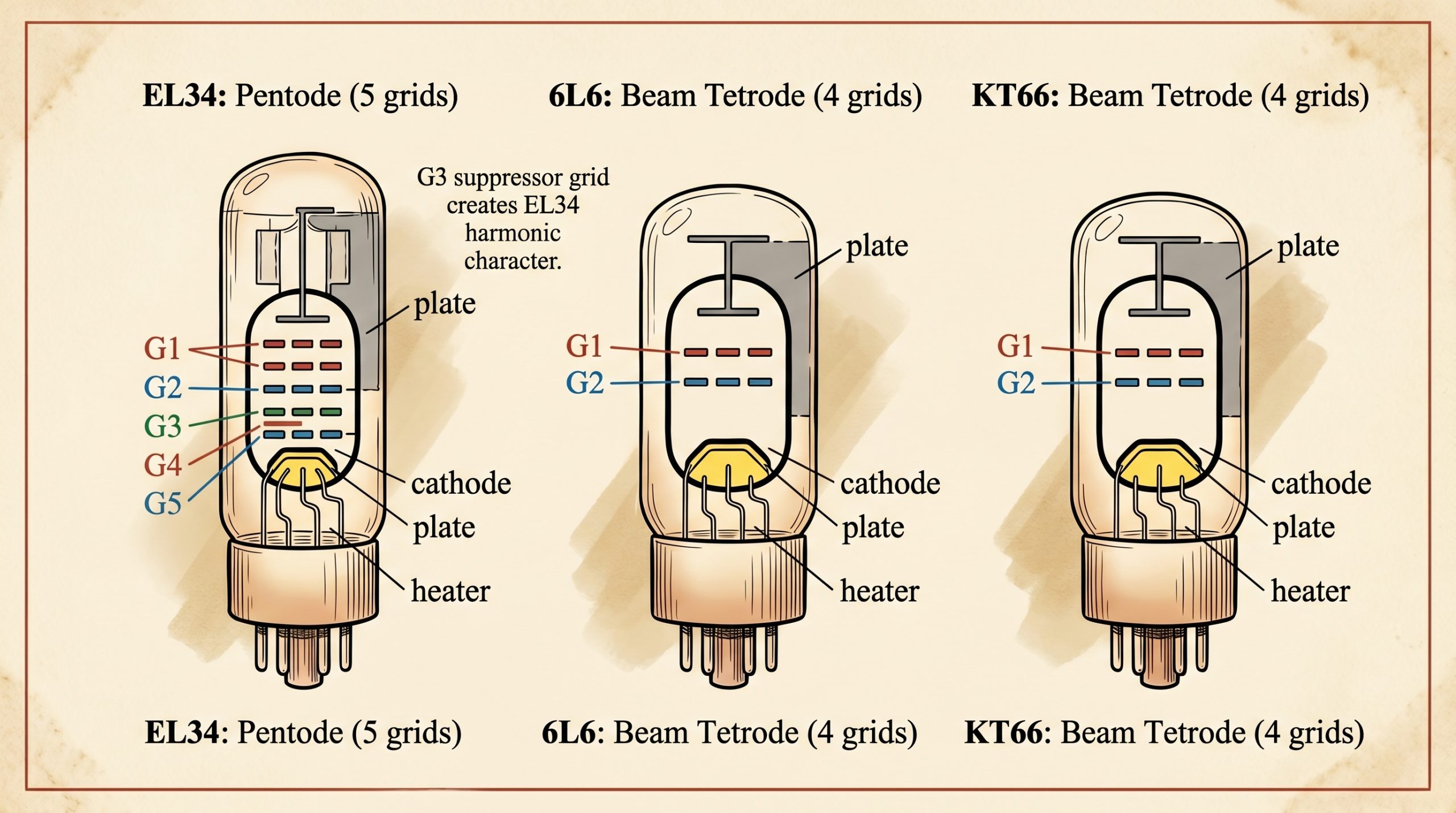
Supply chain first. In the 1950s and 1960s, American amplifier manufacturers sourced from American tube makers: GE, RCA, Sylvania, Raytheon, and Tung-Sol. All of them produced 6L6 variants. None of them produced EL34s in significant quantity. The EL34 was a European tube. Sylvania eventually introduced the 6CA7 as a domestic beam-tetrode equivalent, but that came later and was never Leo Fender’s tube.
Pin wiring architecture second. Fender’s octal socket wiring, standardized across the tweed, brown, blonde, and blackface eras, connected pin 1 to nothing for 6L6 operation. Using an EL34 in that socket without tying pin 1 to ground leaves the suppressor grid floating. It’s a simple one-wire modification, but Fender had no incentive to make it. Chassis stamps from the AB763 production run confirm that the standard Fender output socket layout didn’t provide for G3 grounding.
Tonal philosophy third. Leo Fender built around clean headroom, sparkle, and a scooped midrange character. The 6L6 beam tetrode, with its warmer low-mids and more even harmonic content, matched that design intent exactly. The AB763 Twin Reverb, for example, runs B+ at approximately 480V with a solid-state rectifier — the same rectification approach as most Marshall circuits. The spongy rectifier-tube sag associated with Fender clean tone comes from smaller models: the Deluxe Reverb runs a GZ34 tube rectifier, not the Twin. EL34 tube character and Marshall’s higher-voltage designs are the primary reasons EL34-equipped British amps feel tighter and more forward.
The Fender Twin Reverb guide covers the AB763 circuit in detail, including B+ voltage measurements and rectifier choice across the blackface and silverface production runs, which illustrates exactly how different the Fender power supply philosophy was from the Marshall approach.
The irony here is significant. Eddie Van Halen built his early recorded tone on a modified Marshall Plexi, an EL34-based amp. Then he spent years working toward his own signature amplifier. And when the EVH 5150 III was released with EL34 tubes, an American guitar icon had effectively returned to the British tube that defined his early sound.
EL34 Tube Equivalents and Substitutes
The EL34 has three widely accepted substitutes and two partial substitutes. “Direct drop-in” means the tube fits the socket, accepts the same bias settings within a reasonable window, and doesn’t require wiring modifications. Even among direct substitutes, rebiasing after swapping is always required.
| Tube | Type | Direct Drop-in? | Tonal Character vs. EL34 | Typical B+ Range | Notes |
|---|---|---|---|---|---|
| 6CA7 | Beam Tetrode (US) | Yes (most amps) | Warmer, less aggressive mids, more 6L6-like | 400–500V | Sylvania original; EH 6CA7 current production |
| KT77 | Beam Tetrode | Yes | Tighter bass, more headroom, slightly scooped mids | 400–500V | GEC original; Genalex Gold Lion current reissue |
| KT66 | Beam Tetrode | No (pin 1 difference, lower dissipation) | Warmer, rounder, vintage character | 350–450V | Original Marshall JTM45 tube before switch to EL34 |
| KT88 | Beam Tetrode | No (higher dissipation, bias change required) | More power, extended bass, hi-fi character | 500–600V | Common in hi-fi; not standard for guitar |
| 6L6GC | Beam Tetrode | No (pin wiring, bias change) | American character, less mids, more clean headroom | 400–500V | Requires amp modification and full rebias |
The KT66 note deserves expansion. Early Marshall JTM45 amplifiers used KT66 tubes, not EL34s. The JTM45 circuit was partly derived from the Fender 5F6-A Bassman schematic, and the KT66 was the available British beam tetrode at the time. Marshall switched to EL34s as the JTM45 evolved into the 1962 and 1959 Plexi designs. That historical shift, from KT66 warmth to EL34 aggression, tracks directly with the emergence of what became “the Marshall sound.”
6CA7 vs EL34: Stage volume makes these nearly indistinguishable to most audiences. In a recording context, the 6CA7’s softer transient attack and warmer midrange become audible. A good choice if you want EL34 compatibility with a slightly more relaxed character.
KT77 vs EL34: The KT77 keeps the EL34’s midrange presence but tightens the low end considerably. Metal players rolling through EL34 territory often prefer KT77s for the improved low-frequency definition under heavy palm muting. Not great for vintage Marshall warmth, but very good for modern high-gain clarity.
EVH 5150 III and the EL34: An American Amp’s British Heart
The EVH 5150 III was released through Fender’s EVH brand following Eddie Van Halen’s departure from Peavey, where the original 5150 used 6L6 tubes. The 5150 III complicated that lineage immediately.
The 100W version of the 5150 III shipped to the North American market with 6L6 tubes, which kept the American headroom character that defined the original 5150. But the 50W version used EL34s. That wasn’t an accident. At 50W with EL34 power tubes, the amp reaches its natural compression point at lower stage volumes, which aligns better with the studio and bedroom-friendly headroom target the 50W format implies. EL34s compress earlier than 6L6s at equivalent power levels, which means the 50W 5150 III “feels” pushed at volumes where the 100W 6L6 version would still feel clean and stiff.
The bias specification for the EVH 5150 III 50W EL34 centers around approximately 35 mA per tube at roughly 470V B+, which puts each tube at about 16.5W plate dissipation. That’s 66% of maximum. A conservative and safe operating point for extended tube life.
Players rolling tubes through the 5150 III EL34 platform frequently compare JJ EL34 (warmer, rounder high end, vintage character) against KT77 (tighter low end, more articulate under gain) as the two main camps. The amp’s gain structure responds differently to each, with the KT77 producing a slightly more defined note attack and the JJ producing more of that classic spongy compression on the crunch channel.
The broader narrative point: Eddie’s early recorded tone, particularly the first Van Halen album, came through a modified Marshall Plexi. EL34-based circuit. Forty-plus years later, his signature amplifier came in an EL34 variant. Different amp, same tube family.
Best EL34 Tubes: Current Production Reviews
The following assessments are based on documented construction specs, factory origin, independently reported reliability data, and tonal observations across Marshall JCM800 2203 (four EL34 tubes, ~50W) and Blackstar Studio 10 EL34 (single EL34, Class A) contexts. Pricing reflects current retail as of 2024 and will shift.
Tung-Sol EL34B
Current production from the Reflektor factory in Saratov, Russia, marketed by New Sensor Corporation. The build construction is strong across the line: ribbed plates, triple mica spacers, and a getter halo that indicates proper vacuum maintenance. The Tung-Sol EL34B’s tonal character leans balanced, with clear mids that retain EL34 aggression without the harshness some players associate with older Sovtek production. Top end is present without ice-pick treble. Reliability is among the best in current production, with a low reported failure rate across the tube retail market. The tubestore.com’s tube reviews identify the Tung-Sol EL34B as a top current-production choice, consistent with community consensus across multiple amp forums.
Price: approximately $25 to $30 per tube. Best application: all-around use in any EL34 amp where consistency and reliability are the priority.
JJ EL34
Manufactured by JJ Electronic in Cadca, Slovakia, in the former Tesla factory. JJ’s build philosophy has military-influenced roots: heavy construction, robust plates, consistent tolerances. The tonal character runs warm in the low-mids, with less high-end “spike” than Tung-Sol. Some players describe it as slightly dark. That’s not a flaw. In a bright-voiced amp like a JCM800 or Hiwatt, the JJ’s warmth is a feature.
Industry reliability reputation is excellent. JJ tubes are the most common OEM replacement set in new-production Marshall reissues and clones for a reason. Price: approximately $18 to $24 per tube. Best application: vintage Marshall tones, JCM800 restorations, any amp that benefits from a darker high end.
Mullard EL34 Reissue
The Mullard reissue is also a New Sensor/Reflektor product, not a Blackburn production tube. That matters for expectation-setting. The reissue attempts to replicate original Mullard construction characteristics, and build quality is generally good. Tonal character is warm and musical, with a sweet high end that gets closer to vintage character than either JJ or Tung-Sol in the upper frequencies. QC is slightly more variable than JJ or Tung-Sol, meaning matched sets may show wider spread on the bias meter before breaking in.
Vintage NOS Mullard EL34s from Blackburn production (xf2 or xf4 variants) are a categorically different product, trading at $80 to $150 per tube on the NOS market. The reissue is not a substitute for that. It’s a good tube in its own right at approximately $25 to $35 per tube.
Genalex Gold Lion EL34
Also a Reflektor-based product. The Gold Lion EL34 sits at the premium end of current production with heavy-duty plate construction and tight factory matching. The tonal character leans hi-fi: extended bass response, clear highs, less of the compressed midrange character that defines the classic EL34 sound. Guitar players wanting clean headroom with EL34 compatibility will like it. Players chasing pushed British crunch may find it too clean. Price: approximately $30 to $40 per tube. Audiophile Review’s tube comparison identified the Gold Lion KT77 (the Gold Lion’s direct relative) as a standout in extended listening tests, which is consistent with the brand’s hi-fi positioning.
Oldchen EL34
Chinese production from an emerging brand with a smaller track record. The community assessment is consistent: variable QC, competitive pricing at approximately $10 to $15 per tube, adequate for budget practice amps and test builds. Not recommended for a vintage Marshall where reliability is critical. Best for players who rebias frequently, don’t mind occasional rejects, and are building or experimenting on a budget.
Electro-Harmonix 6CA7
Technically a 6CA7 (beam tetrode), not a true EL34, but a direct drop-in substitute in virtually all EL34 sockets. The EH 6CA7 delivers the warmer, slightly softer character that separates 6CA7 from EL34 in a recording context, while handling the pin and voltage requirements of EL34-wired amps without modification. Particularly popular in Hiwatt-style circuits where the original EI 6CA7 was the preferred tube. Price: approximately $20 to $25 per tube.
| Brand | Origin | Tonal Character | Reliability | Price/Tube | Best Application |
|---|---|---|---|---|---|
| Tung-Sol EL34B | Russia (Reflektor) | Balanced, clear mids | Excellent | $25–30 | All-around guitar use |
| JJ EL34 | Slovakia (JJ Electronic) | Warm, vintage, slightly dark | Excellent | $18–24 | Vintage Marshall tones |
| Mullard Reissue EL34 | Russia (Reflektor) | Warm, musical, sweet highs | Good | $25–35 | Vintage character on a budget |
| Genalex Gold Lion EL34 | Russia (Reflektor) | Extended, hi-fi, clean | Very Good | $30–40 | Hi-fi / maximum clean headroom |
| Oldchen EL34 | China | Variable | Variable | $10–15 | Budget builds, test platforms |
| EH 6CA7 | Russia (Reflektor) | Warm, beam-tetrode character | Good | $20–25 | Hiwatt-style tones |
Blackstar Studio 10 EL34: Single-Tube Design and What It Reveals
The Blackstar Studio 10 EL34 is an unusually useful data point because it runs a single EL34 in Class A. Most EL34 amps use push-pull pairs or quads. Push-pull operation cancels even-order harmonics through transformer phase inversion, which shapes the distortion character significantly. A single EL34 in Class A doesn’t cancel anything. You hear the tube directly.
The operating point on the Studio 10 puts the plate voltage at approximately 310 to 330V with a plate current around 60 mA, keeping each tube well within its dissipation limit at roughly 19W. Class A single-ended operation generates predominantly even-order harmonics, producing a softer, rounder saturation than push-pull designs. That’s why the Studio 10 EL34 sounds warmer and more compressed than a JCM800 pushing the same tube type at twice the voltage.
For players interested in tube-rolling EL34s without the cost of buying matched quads, the Studio 10 EL34 is a practical test platform. Single-tube replacement costs are low enough to justify trying several brands, and the Class A operating point emphasizes the character differences between tubes more clearly than a push-pull design would. JJ vs. Tung-Sol character differences that are subtle in a JCM800 become more audible in the Studio 10 context.
Bedroom-friendly volume at 10W. Doesn’t require a stage to evaluate. Worth considering as a dedicated tube-rolling test rig if you’re optimizing a more expensive Marshall and want to audition tubes before committing to a matched quad.
How to Bias EL34 Tubes
Biasing establishes the DC operating point of the output tubes. Get it wrong and you’re either running the tubes too cold (thin, harsh tone, increased crossover distortion) or too hot (red-plating, shortened tube life, transformer stress). Not optional. Every time you swap EL34 brands or lots, rebias.
Fixed bias (the Marshall standard): The bias voltage is set externally via a trim pot or adjustment circuit. This is the most common EL34 configuration in Marshall and Marshall-style designs.
The math is straightforward. Maximum plate dissipation for EL34 is 25W. The target is 70% of that figure. 70% of 25W equals 17.5W per tube. To find the target plate current, divide that by the actual B+ voltage your amp runs.
A discussion on Rig-Talk regarding the Marshall EL34 100/100 confirms the methodology: “An EL34 can dissipate 25 watts, so 17.5 watts is 70%. To get it right, measure the B+ voltage at pin 3 of one of the EL34 tubes.” At 480V B+, target current is 17.5W divided by 480V, which equals 36.5 mA per tube. At 440V B+, target current is 17.5W divided by 440V, which equals 39.8 mA per tube.
Practical safe window for most Marshall-style EL34 circuits: 32 to 40 mA per tube. Don’t exceed 40 mA without verifying your specific amp’s transformer and B+ headroom first.
Cathode bias (self-bias): Some boutique EL34 amps and Class A designs use a cathode resistor to set operating current automatically. These designs are self-adjusting within limits and don’t require regular bias checks the way fixed-bias amps do. New tubes in a cathode-biased amp still benefit from confirmation that the cathode resistor value hasn’t drifted.
Tools needed: a bias probe (which adds a series resistor to each tube socket to allow current measurement), a digital multimeter, and patience. Some amps include a bias test point that makes this process easier. Work with the amp off and discharged before touching anything near the power supply. Tube amps contain lethal plate voltages that persist after power-down. Discharge the filter caps before any internal work.
Screen resistors of 1k ohm at 5W are the single most important protection component in EL34 circuits. Many vintage Marshall amps have under-specced or missing screen resistors. Adding them is cheap insurance.
Marshall EL34 100/100: The Power Amp Perspective
The Marshall EL34 100/100 is a stereo power amplifier, not a complete amp head. That distinction matters for players searching this unit. It has no preamp stage. No EQ. No gain control. Eight EL34 tubes total, four per channel, delivering 100W per channel in push-pull Class AB operation.
This unit was extensively used in 1980s and 1990s rack guitar systems, where the preamp functions were handled by separate units (Mesa Boogie Studio Preamp, ADA MP-1, various others). The EL34s in the 100/100 handle all of the tonal character, which means tube choice matters considerably more here than in an amp where a preamp section shapes most of the sound before the signal reaches the output stage.
Bias procedure follows the same formula as a JCM800 per tube. With 8 tubes across two channels, matching consistency matters more than in a 4-tube amp. Even bias spread across all eight tubes prevents channel imbalance. Replacing all eight with a single matched octet from the same production lot is the most reliable approach.
The 100/100 runs a solid-state rectifier, so B+ is stiffer and higher than a rectifier-tube design. Plate voltages typically run in the 490 to 510V range, which puts the per-tube target current at roughly 34 to 36 mA at 70% dissipation. JJ EL34 and Tung-Sol EL34B are both well-suited to this operating point.
The Transatlantic Tone Split
The EL34 isn’t a better output tube than the 6L6 and it isn’t a worse one. It’s a different tool that emerged from a different supply chain, a different circuit philosophy, and a different musical context. British amp builders in the late 1950s had Mullard EL34 tubes available and American amp builders had GE and RCA 6L6 types. Leo Fender built around clean headroom and sparkle. Jim Marshall built around cut and compression in a rehearsal room. The tubes they chose reflect those priorities precisely.
For players rooted in Fender-centric American tone, understanding the EL34 sharpens the picture of why your amp sounds the way it does. The 6L6’s even-order warmth, the rectifier-tube sag, the scooped midrange character: all of it makes more sense when you understand what the EL34 does differently at the circuit level. Current production quality for EL34 tubes is genuinely high. Both Tung-Sol EL34B and JJ EL34 are reliable, well-built tubes that perform well in any Marshall-style circuit, and the full 6L6 tube guide gives the American counterpart equal treatment for players who want both sides of the comparison.
Sources
- The Tube Store: EL34/6CA7/KT77 Tube Reviews, tube retailer review series used for current production tonal assessments
- JJ Electronic EL34 Product Specifications, factory specs and construction details for JJ production tubes
- New Sensor Corporation: Tung-Sol EL34B, construction and specification data for current Tung-Sol EL34B production
- Premier Guitar: Power Trip, A Guide to Power Tubes, cited for EL34 historical origin context
Frequently asked questions
What are EL34 tubes used for?
EL34 tubes are used primarily as output tubes in British-style guitar amplifiers, most notably Marshall, Hiwatt, Orange, Vox AC30 variants, Bogner, and EVH designs. They also appear in hi-fi stereo amplifiers. The most common configuration is a matched pair (producing approximately 50W in push-pull Class AB) or a matched quad (approximately 100W). The Blackstar Studio 10 EL34 is one of the few production amps to run a single EL34 in Class A at 10W.
Are EL34 and 6CA7 the same tube?
Electrically compatible in most amplifiers, but not internally identical. The EL34 is a true pentode with a suppressor grid (G3). The 6CA7, originally made by Sylvania, is a beam tetrode using beam-forming plates instead of a G3 grid. The 6CA7 is generally considered a direct drop-in substitute in EL34 sockets, but its internal construction produces a slightly warmer, less aggressive character, particularly noticeable in the upper midrange on recordings. At stage volume, many players don't hear a meaningful difference.
Can I use EL34 tubes in a Fender amp?
Generally no, without modification. Fender's standard octal socket wiring, used across the tweed, blackface, and silverface eras, leaves pin 1 unconnected because the 6L6 doesn't use that pin. The EL34's suppressor grid connects to pin 1, which must be tied to ground for the tube to operate correctly. Using an EL34 in an unmodified Fender socket leaves the G3 floating. Beyond the wiring fix, the Fender bias circuit is calibrated for 6L6 current draw, requiring a complete rebias after the pin modification. Not recommended for vintage Fender amps where original socket integrity matters.
How long do EL34 tubes last?
Typical lifespan runs 1,000 to 3,000 hours, depending on operating point, brand, and B+ voltage. Amps that run high B+ (over 500V) and high plate current shorten tube life measurably compared to conservatively biased amps at 460V or less. Signs of worn EL34 tubes include loss of gain, increased noise floor, microphonics (the tube ringing when tapped), red-plating (visible orange glow on the plate inside the glass), and erratic bias readings. Hard-driven Marshall circuits, particularly at high master volume with the bias set aggressively, will eat through tubes faster than a lightly used studio amp.
What is the best EL34 tube brand right now?
For reliability and balanced character, the Tung-Sol EL34B is the most consistent current production option, with low failure rates and a tonal profile that works well across most EL34 amp designs. For vintage Marshall warmth and a slightly darker high end, the JJ EL34 is the industry standard for good reason and the most affordable of the quality options. Vintage NOS Mullard EL34 (Blackburn xf4 ribbed-plate) is in a separate category for collectors and players prioritizing authentic vintage character over value. If subjective sonic differences between brands are your main concern, trying at least two brands in your specific amp before committing to a bulk purchase will tell you more than any general review.