Contents
- 01What Is the Fender Blues Deluxe? A Quick Orientation
- 02History and Production Timeline
- 03Circuit Architecture and Specs
- 04How Does It Sound? Tonal Character by Channel
- 05Fender Blues Deluxe vs. The Competition
- 06The Blues Deluxe Name and What It Doesn't Mean
- 07The Blues Deluxe Harmonica Connection
- 08The Epiphone Zephyr Blues Deluxe: What Is It?
- 09Common Issues, Modifications, and Upgrades
- 10Buying Guide: New, Used, and What to Look For
- 11Frequently Asked Questions
- 12Who Should Buy the Blues Deluxe
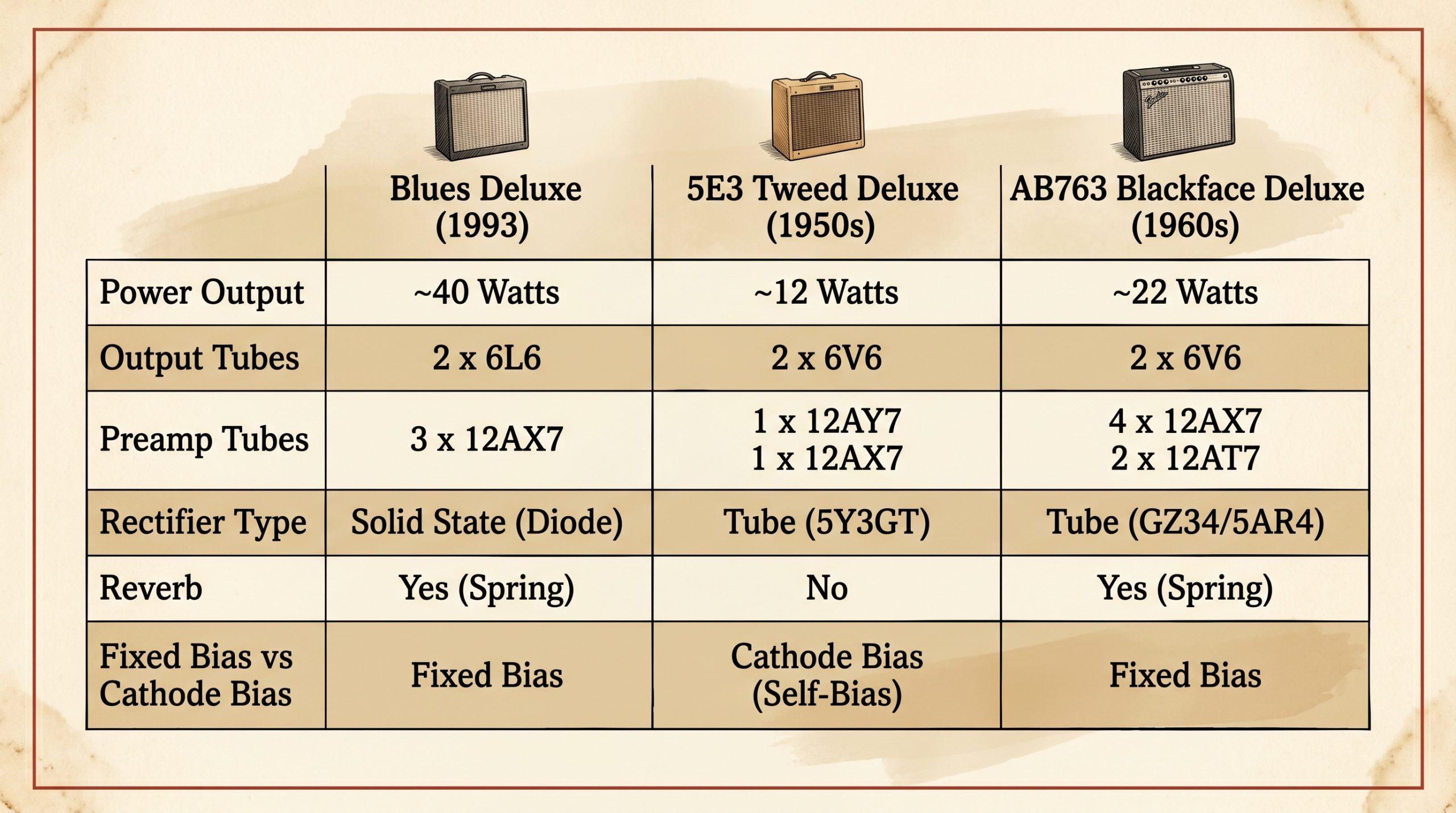
The Fender Blues Deluxe is a clean-sheet 1990s design with no direct circuit lineage to the 5E3 tweed Deluxe or the AB763 blackface Deluxe Reverb. It’s a 40-watt, PCB-built combo from Fender’s Hot Rod Series, first released in 1993; the Blues Junior followed in 1995 and the Hot Rod Deluxe in 1996. The tweed covering is cosmetic branding. The circuit is a modern, solid-state-rectified, fixed-bias design that has more in common with its Hot Rod siblings than with any vintage Fender schematic. That’s not a knock on it. It just means you need to know what you’re actually buying.
What Is the Fender Blues Deluxe? A Quick Orientation
The Blues Deluxe sits in Fender’s Hot Rod Series, a product family that launched in 1993 and has remained in continuous production (with one gap for the Blues Deluxe specifically) ever since. It is not a reissue of a vintage Fender Deluxe model. The vintage Fender Deluxe lineage runs from the Model 26 of the late 1940s through the 5E3 tweed circuit of the mid-1950s and the AA763/AB763 blackface era of the 1960s. None of those circuits have anything to do with the Blues Deluxe’s topology. If you’re looking for that 5E3 sag and early breakup, the Blues Deluxe won’t deliver it. What it does deliver is a capable, gigging-friendly platform with real spring reverb, more clean headroom than a Deluxe Reverb, and a Drive channel that works best at moderate settings.
Think of it as the Hot Rod Deluxe’s slightly quieter, warmer-looking sibling. Same power rating. Same basic Hot Rod DNA. Different cosmetic identity and a slightly different voicing. The Fender Hot Rod Deluxe gets more stage time in conversations, but the Blues Deluxe has its own valid reasons to exist.
History and Production Timeline
Origins of the Hot Rod Series (1993)
Fender launched the Blues Deluxe in 1993 out of its Corona, California operation. The Blues Junior followed in 1995 and the Hot Rod Deluxe in 1996, together making up what became known as Fender’s Hot Rod Series. The Blues Deluxe was positioned as the series flagship in terms of visual identity, leaning into the tweed aesthetic to appeal to players who wanted vintage looks without vintage prices or vintage limitations.
That original 1993 production run used a Fender Special Design 12″ speaker and was assembled in the USA. The circuit itself was designed specifically for the Hot Rod Series, not adapted from any Fender service bulletin or vintage schematic. It runs two 6L6GC output tubes in a fixed-bias configuration with a solid-state rectifier, three 12AX7 preamp tubes, and a long-tank spring reverb. Fender targeted gigging players who needed clean headroom in small-to-medium venues without hauling a Twin Reverb.
USA production ran from 1993 to 1997, after which the Blues Deluxe was discontinued and the Hot Rod Deluxe (introduced 1996) became the flagship of the Hot Rod Series. The Blues Deluxe was reintroduced as the Blues Deluxe Reissue in 2005, this time built in Ensenada, Mexico, and has remained in continuous production since. The easiest way to confirm which version you have is to check the back panel label. “Made in USA” examples from the 1993-1997 run typically show up on the used market in the $575-$800 range depending on condition, per current Reverb comps. The Mexico Reissue is not a circuit redesign of the original; the topology is essentially the same, but component sourcing and build tolerances differ between the two production eras. If you need help confirming a specific production year from the serial number, the Fender tube amp serial number and dating guide covers the Hot Rod Series era in detail.
The Reissue Era (2005 to Present)
The “Reissue” designation that now accompanies the Blues Deluxe is not a reissue of a vintage circuit. It is a continuation of the 1993 original, brought back in 2005 as a Mexico-built combo with minor spec refreshes. The main change between the original USA production run and the Mexico Reissue is the speaker: the original Fender Special Design was replaced by an Eminence Special Design 12″ (8 ohm), Fender-labeled. The tweed covering was retained and doubled down on as a marketing anchor. PCB revisions have occurred across production runs but the core topology has stayed consistent.
The phrase “reissue of a reissue” gets thrown around in forum discussions and it’s accurate in a limited sense. The current Blues Deluxe Reissue is a continuation of the 1993 original with cosmetic continuity, not a circuit-accurate recreation of any older Fender amp. Current street price for a new Reissue runs approximately $1,149 USD.
Circuit Architecture and Specs
Tube Complement
The Blues Deluxe uses three 12AX7 preamp tubes and two 6L6GC output tubes. V1 handles the Normal channel input stage. V2 drives the cascaded gain stages in the Drive channel. V3 functions as the phase inverter. The output section runs fixed bias, with an idle current target of approximately 35-38mA per tube. That figure can drift over time, which means retubing should be followed by a professional bias check. The bias trim pot is accessible inside the chassis but this is not a procedure for a first-time owner with a multimeter and optimism. Have a tech do it.
The rectifier is solid-state. Full stop. There is no GZ34. There is no 5Y3. The solid-state rectifier produces a tighter, faster attack compared to tube-rectified vintage Deluxes. That’s a meaningful tonal distinction. The 5E3 tweed Deluxe’s characteristic sag and compression come largely from its 5Y3 rectifier and cathode-biased output section. The Blues Deluxe doesn’t do that. It’s a stiffer, more controlled power supply by design.
The 12AX7 tube complement is worth paying attention to when retubing, since each position has a different functional role and responds differently to brand and grade substitutions.
Channel Architecture
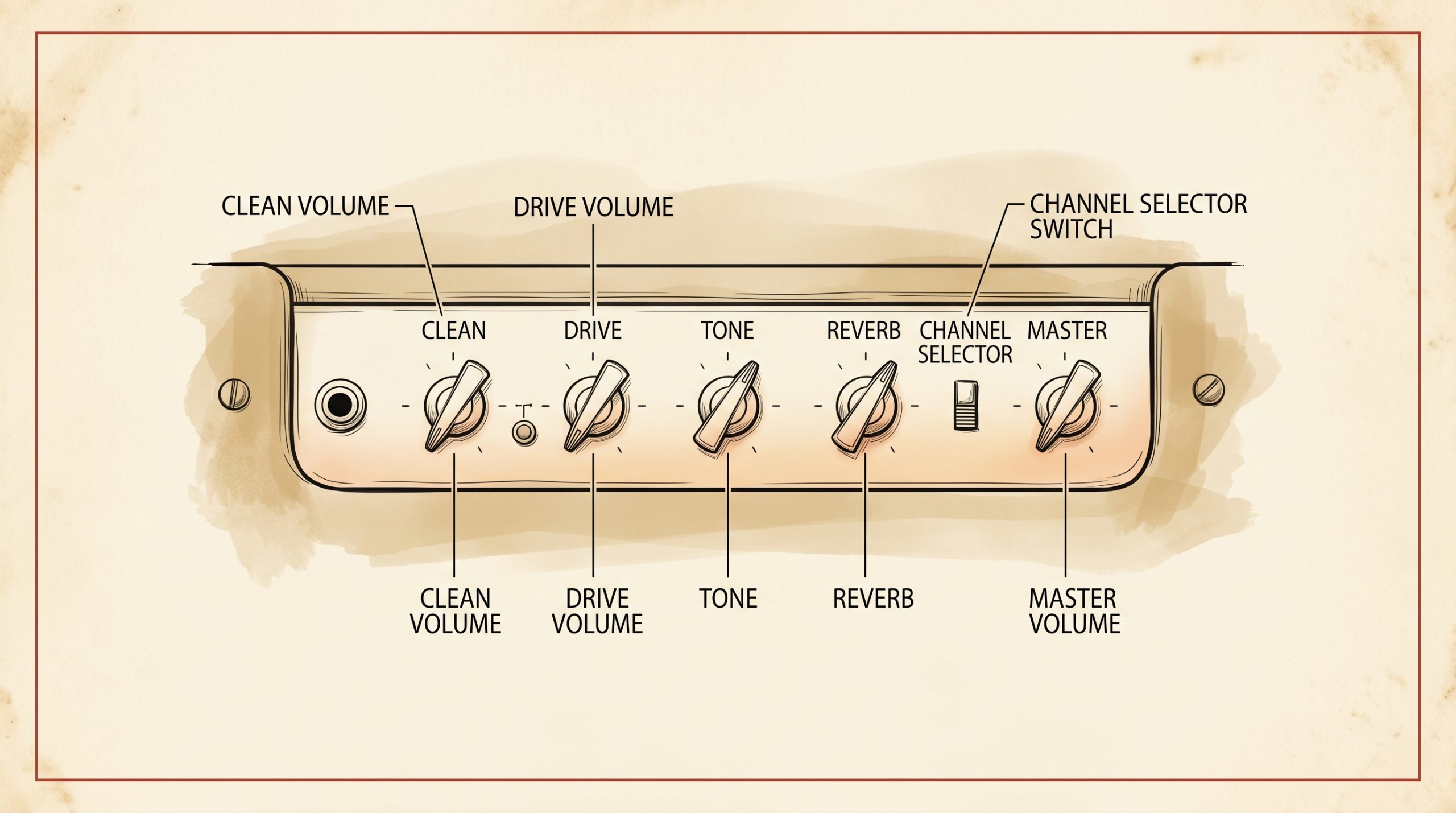
The Normal channel is a straightforward single-input design with a Volume control and a bright switch. It’s relatively clean at moderate volumes. The Drive channel adds a Gain control, a channel Volume, and a Master Volume, using cascaded gain stages to generate overdrive on demand.
One significant usability issue: the amp uses a shared tone stack. Bass, Middle, and Treble controls affect both channels simultaneously. You cannot EQ the Normal and Drive channels independently. For players who want a clean rhythm setting and a different EQ curve for leads, this is a genuine constraint. Not a dealbreaker for everyone, but worth knowing before you buy.
The effects loop is a series configuration. Time-based effects placed in the loop (delay, reverb) sit after the preamp gain stages, which is generally the preferred position for those effects. The spring reverb tank is a long-tank Accutronics-style configuration and applies to both channels.
Power Section and Transformer Specs
Output is rated at 40 watts RMS. The output transformer provides impedance taps at 4, 8, and 16 ohms. The stock speaker is wired to the 8-ohm tap. The power transformer is rated for standard mains voltage. The solid-state rectifier produces a firm, immediate response in the power section, which keeps the low end tight and the attack defined. Players expecting the spongy compression of a cathode-biased, tube-rectified amp will need to adjust expectations. Not worse. Different.
Speaker Complement and Cabinet
The current Reissue ships with an Eminence Special Design 12″ rated at 8 ohms. The original 1993 US-made units used a Fender-branded Special Design speaker from a different manufacturer. The cabinet is open-back, which contributes to the amp’s airy, spread-out low-midrange character. An open-back design disperses sound in a wider pattern than a closed-back cabinet, which affects how the amp sounds both on stage and in a room. Closed-back cabinets produce a tighter, more focused low end. The Blues Deluxe’s open-back configuration suits clean tones and reverb-forward playing well.
Common speaker upgrades include the Celestion Vintage 30 (adds definition and slightly scooped mids), Jensen C12N (classic Fender sparkle, vintage-voiced), Eminence Patriot Ragin Cajun (budget-friendly warmth), and Weber Michigan (closest to the character of the original Fender Special Design). Always match the 8-ohm impedance when swapping. Mismatched impedance can stress the output transformer over time.
| Spec | Blues Deluxe (1993 Original) | Blues Deluxe Reissue (Current) |
|---|---|---|
| Output Power | 40W RMS | 40W RMS |
| Output Tubes | 2x 6L6GC | 2x 6L6GC |
| Preamp Tubes | 3x 12AX7 | 3x 12AX7 |
| Rectifier | Solid-state | Solid-state |
| Speaker | Fender Special Design 12″ | Eminence Special Design 12″ |
| Channels | 2 (Normal, Drive) | 2 (Normal, Drive) |
| Effects Loop | Yes (Series) | Yes (Series) |
| Reverb | Spring | Spring |
| Weight | ~46 lbs | ~45 lbs |
| Country of Origin | USA | Mexico |
| Cabinet | Open-back | Open-back |
| Covering | Tweed | Tweed |
How Does It Sound? Tonal Character by Channel
Normal Channel: The Clean Headroom Story
The Normal channel is where this amp earns its keep. At 40 watts through a solid-state rectifier into an open-back cabinet, it stays cleaner longer than a 22-watt Deluxe Reverb. Breakup on the Normal channel typically sets in around volume 4-5 on the dial in a normal room environment, which means you can push the amp to a usable stage volume before things get crunchy. For players who want warm clean tones with a pedal board doing the dirt work, this channel is a genuinely capable platform.
The bright switch on the Normal channel adds upper-midrange presence. Useful with darker humbuckers. Can produce ice-pick treble through a bright single-coil Strat neck pickup if you’re not careful. The shared Bass/Middle/Treble stack gives you enough shaping flexibility to work with most guitar types.
Compare it directly to the Fender Deluxe Reverb AB763: the Blues Deluxe stays clean at higher volumes because of the power rating and rectifier type. The Fender Deluxe Reverb breaks up earlier and with more interactive, dynamic sag. Neither is objectively better. They’re tools for different volume requirements.
Drive Channel: Where Things Get Complicated
The Drive channel is the Blues Deluxe’s most debated feature. At moderate Gain settings (roughly 4-6 on the dial), it produces a useful blues crunch. Spanky attack with some harmonic saturation on the pick transient. Pushed past 7, the cascaded gain stages can sound fizzy or plasticky, a complaint that shows up consistently in player communities. This is not a high-gain channel and shouldn’t be treated as one.
The sweet spot most experienced players land on: Gain at 4-6, channel Volume at 5-6, Master at a moderate room level. That combination produces a workable pushed-blues tone that responds to picking dynamics. Back off on the guitar’s volume and it cleans up reasonably well.
The shared tone stack is the Drive channel’s biggest structural limitation. You can’t optimize the EQ independently for clean rhythm and lead tones without manually adjusting controls between settings. Players using the Blues Deluxe as a pedal platform often skip the Drive channel entirely, keeping the Normal channel as the foundation and using external overdrive pedals for dirt. That approach works well.
The Reverb
The long-tank spring reverb is a genuine high point. It’s warm, has appropriate decay, and doesn’t sound digital or clangy. It applies to both channels and sits in a position in the circuit that keeps it musical rather than overwhelming. Set around 3-4 on the Reverb control and it adds depth without washing the signal. Turn it up past 6 and you’re into surf territory. The reverb alone justifies the amp for players coming from dry, dry combos.
Fender Blues Deluxe vs. The Competition
Blues Deluxe vs. Blues Junior: What’s the Difference?
The Blues Junior uses 15 watts and a pair of EL84 output tubes. The Blues Deluxe runs 40 watts through 6L6GCs. That’s not a subtle difference. The Junior breaks up earlier, weighs significantly less at around 31 lbs, and doesn’t have an effects loop. The Deluxe stays cleaner longer, is loud enough to compete with a drummer without PA support, and the effects loop makes it more practical for players using rack or pedal-based time effects.
The Junior is a bedroom-to-small-venue amp. The Blues Deluxe is a gigging amp. If you’re mostly playing at home or in small coffee shop settings, the Junior’s 15 watts is more appropriate and you won’t need the extra headroom.
| Feature | Blues Deluxe Reissue | Blues Junior IV |
|---|---|---|
| Power | 40W | 15W |
| Speaker | 12″ Eminence Special Design | 12″ Celestion A-Type |
| Output Tubes | 2x 6L6GC | 2x EL84 |
| Channels | 2 (Normal + Drive) | 2 |
| Effects Loop | Yes | No |
| Weight | ~45 lbs | ~31 lbs |
| Street Price (New) | ~$1,149 | ~$790 |
| Best For | Gigging, medium venues | Practice, small venues |
Blues Deluxe vs. Hot Rod Deluxe: The Sibling Rivalry
Both amps run 40 watts through a pair of 6L6GCs. Both have PCB-based circuit designs from Fender’s Hot Rod Series, the Blues Deluxe introduced in 1993 and the Hot Rod Deluxe in 1996. The differences are real but not huge. The Hot Rod Deluxe has three channels (Clean, Drive, More Drive) compared to the Blues Deluxe’s two, and the Hot Rod’s Drive channel tends toward a more aggressive, higher-gain character. The Blues Deluxe is generally considered to have a slightly warmer, less strident overall voice. Whether that’s the circuit, the cabinet, or player expectation is hard to separate definitively.
The Hot Rod Deluxe comes in black tolex. The Blues Deluxe comes in tweed. If aesthetics matter to you in your venue context, that’s a legitimate consideration. Price-wise they’re close. Most players who want three channels and more gain versatility land on the Hot Rod. Players who want a cleaner visual statement and a slightly simpler channel setup lean toward the Blues Deluxe.
Blues Deluxe vs. Vintage Fender Deluxe Circuits (5E3 and AB763)
This comparison is worth making explicitly because the tweed covering on the Blues Deluxe consistently misleads buyers. The 5E3 tweed Deluxe produces 12-15 watts through a cathode-biased output section with a 5Y3 tube rectifier. It barks when pushed, sags on loud notes, and the Volume controls on both channels interact with each other in a way that’s either endearing or frustrating depending on your perspective. It’s a different instrument than the Blues Deluxe, not a louder version of it.
The AB763 blackface Deluxe Reverb runs 22 watts through a fixed-bias output stage with a tube rectifier, and includes both reverb and tremolo. It breaks up earlier than the Blues Deluxe and has a more dynamic, touch-sensitive response in the power section. At equal volume settings, the Deluxe Reverb feels more compressed and reactive. The Blues Deluxe feels stiffer and more powerful. Neither is a substitute for the other.
The Blues Deluxe Name and What It Doesn’t Mean
Joe Bonamassa’s “Blues Deluxe” Is an Album, Not an Amp Endorsement
Searches for “Joe Bonamassa Blues Deluxe” commonly land on amp pages, but the connection is to Bonamassa’s 2003 breakthrough album of the same name, not the Fender amplifier. The album’s title track is a cover of the Jeff Beck Group song “Blues Deluxe” from the 1968 Truth album. Bonamassa later released Blues Deluxe Vol. 2 in 2023 to mark the album’s 20th anniversary. None of this has anything to do with the Fender Blues Deluxe amp.
Bonamassa’s documented live rig consists of vintage Marshall heads (1987 Silver Jubilees, a 1986 JCM800, JCM2000 DSLs), Dumble amps, a Bogner Uberschall, Carol-Ann JB-100, Van Weelden Twinkleland, and vintage Fender high-power amps including Tweed Bassman and Twin Reverb units. Per Premier Guitar’s Rig Rundowns from 2009, 2018, 2021, and 2023, the Blues Deluxe is not part of his amp collection. The shared name is coincidental and the album/amp confusion has propagated through forum discussions and AI-generated content for years.
Other Artists Associated with the Amp
The Blues Deluxe has appeared in the rigs of blues, country, and Americana players drawn to its clean platform and spring reverb quality. Its tweed aesthetic has given it visibility in roots and rockabilly contexts as well, appealing to players whose musical touchstones include 1950s-era Fender tones. The amp’s character makes it most comfortable in blues, roots rock, country, and singer-songwriter settings where warm clean tones and a decent reverb cover most of the functional requirements. Documented artist associations with the Blues Deluxe specifically are limited compared to higher-profile Fender models like the Twin Reverb or Deluxe Reverb; most working players who use the amp do so quietly as a clean platform for pedal-driven tones rather than as a signature voice.
The Blues Deluxe Harmonica Connection
Fender also produces a product called the Blues Deluxe harmonica, which is an entirely separate item from the amplifier. It’s a diatonic harmonica in Fender’s harmonica product line, marketed under the same name purely by coincidence of branding. If you arrived at this article searching for information on the Fender Blues Deluxe harmonica, Fender’s accessories page covers the instrument directly. The harmonica and the amplifier share nothing beyond a name.
That said, the amp itself is a reasonable choice for amplified harmonica players. Its warm clean tones on the Normal channel handle a Shure Green Bullet or similar harp microphone well, and the spring reverb adds appropriate space. The Drive channel is generally too fizzy for harp use at most settings. Stick to the Normal channel if you’re running a harmonica through it.
The Epiphone Zephyr Blues Deluxe: What Is It?
Some searches for “Blues Deluxe” land on the Epiphone Zephyr Blues Deluxe, which is a semi-hollow electric guitar, not an amplifier. It’s part of Epiphone’s Inspired by Gibson collection, a full-hollowbody or thinline instrument aimed at the archtop and blues markets. The “Blues Deluxe” name in that product is Epiphone’s own branding decision and has no connection to Fender’s amp or harmonica product. If you came here looking for the guitar, you’re in the wrong section entirely.
Common Issues, Modifications, and Upgrades
Known Reliability Issues
The number one reported failure point on the Blues Deluxe is the PCB-mounted input and output jacks. Because the jacks are soldered directly to the circuit board rather than hardwired to it, mechanical stress from repeated cable plugging causes hairline fractures at the solder joints over time. The symptom is intermittent signal, crackling, or complete signal loss that changes when you wiggle the cable. The fix is resoldering or replacing the jack pads, which is a straightforward repair for a tech but not a great surprise on a gigging amp.
Intermittent reverb is another common complaint on older units. Before assuming the tank is dead, check the RCA cable connections to the tank itself. Loose or corroded connections account for a large percentage of reported reverb failures. The tank can also be damaged by rough shipping if the amp is bought used and transported without proper padding.
Channel-switching reliability issues have been documented on pre-Reissue units. The footswitch jack and associated relay circuitry can develop contact problems with age. Bias drift on the fixed-bias output section is also worth monitoring: the trim pot can shift over time, and annual checks after retubing are good practice.
Recommended Tube Upgrades
For output tubes, JJ 6L6GC or Tung-Sol 6L6GCM are the most commonly recommended upgrades. The JJ tends toward a warmer, slightly rounder low end. The Tung-Sol adds a bit more top-end definition and a tighter bottom. Both are solid, available options that won’t require major bias adjustment from the stock setting, though a check after swapping is still recommended.
For the V1 position (Normal channel input), a Mullard reissue 12AX7 is a popular choice for players prioritizing clean headroom and low noise. For V2 (the Drive channel gain stage), substituting a lower-gain tube such as a 12AT7 can tame some of the fizz at higher gain settings. This is a reversible, low-cost modification that meaningfully improves the Drive channel’s usability. Not a complete fix, but worth trying before dismissing the channel entirely.
Always have the bias confirmed after any output tube swap. The target is approximately 35-38mA idle current per tube, but individual tube samples vary enough that a fresh check is worth the cost of a shop visit.
Speaker Upgrades
The stock Eminence Special Design is functional but not exciting. Common upgrades and their general character:
- Celestion Vintage 30 (8 ohm): Adds midrange definition and a slightly scooped character. Popular with blues and roots players who want more note separation.
- Jensen C12N (8 ohm): Warm, sparkling, vintage-voiced. Pulls the amp in a more classic Fender direction. Good choice if you want the clean channel to feel more like a blackface-era Fender.
- Eminence Patriot Ragin Cajun (8 ohm): Budget-friendly warmth with more midrange body than the stock speaker. Good value upgrade.
- Weber Michigan (8 ohm): Generally considered the closest substitute to the original Fender Special Design character. Recommended for players who want to hear what the amp was voiced around.
Impedance matching is non-negotiable. Always use an 8-ohm replacement in the stock cabinet unless you’re also changing the output transformer tap wiring. A mismatched load puts unnecessary stress on the output transformer.
Buying Guide: New, Used, and What to Look For
Current Pricing (New and Used)
The current Blues Deluxe Reissue carries a street price of approximately $1,149 USD new. Used Mexico-production Reissue units typically sell in the $450-$650 range on Reverb depending on condition and cosmetics. Original US-made 1993-1997 units command a modest premium in the $575-$800 range, with limited-edition tolex variants occasionally pushing higher. Whether the US-made premium is justified sonically is debatable. The core circuit is consistent across production eras. The main argument for a US-made example is parts quality and build construction, which some players consider tighter on the Corona-era units.
What to Check When Buying Used
A few specific checks before committing to a used Blues Deluxe:
- PCB jack condition: Wiggle all input and output jacks firmly while a cable is plugged in and signal is running. Any crackling or signal drop indicates fractured solder joints at the PCB mount.
- Reverb tank: Physically inspect the tank if you can access it. A damaged or dented tank from shipping is an easy miss on a visual inspection but produces a characteristically wrecked reverb sound.
- Tube condition: Ask when tubes were last replaced. Output tubes in particular have a finite life and a rebias event should follow any swap.
- Speaker cone integrity: Press gently on the speaker cone in multiple spots around the circumference. Any crunching or scratching suggests the voice coil is rubbing.
- Output transformer: Ask if it has been replaced. Replacement is an expensive repair and a replaced transformer can indicate the amp was run with a mismatched speaker load at some point.
- Production origin: Check the back panel label for “Made in USA” or “Made in Mexico” to confirm the production era.
Is It Still Worth Buying?
As a clean platform with a genuine spring reverb, yes. The Normal channel is genuinely good for blues, country, Americana, and roots playing. The effects loop makes it a practical gigging amp for players with pedal boards. The Drive channel is the weakest element of the value proposition and most experienced Blues Deluxe owners effectively ignore it, using external overdrive pedals instead.
The weight is a real consideration. At approximately 44.5-46 lbs depending on the production run, this amp weighs a ton for a single-12 combo. The Blues Junior at 31 lbs is dramatically easier to transport. Aftermarket caster kits are widely available and genuinely help for venue-to-venue transport. Budget for that if you’re gigging regularly.
According to reviewers at MusicRadar, the Blues Deluxe Reissue delivers classic Fender tone with notably low noise characteristics, and players can extend clean headroom and widen the perceived soundstage by pushing the amp in larger room environments. That assessment aligns with the amp’s design intent: it’s built to fill a room cleanly, not to generate gain on its own terms.
Who Should Buy the Blues Deluxe
The Blues Deluxe is an underappreciated gigging amp that tends to get lost between the Blues Junior’s price appeal and the Hot Rod Deluxe’s channel versatility. Its strengths are real: a legitimately good clean channel with room-filling headroom, one of the better spring reverbs in this price range, a practical effects loop, and enough volume to hold its own in a live band context without a full PA mix. The Drive channel is a weak point, but that’s a known quantity easily worked around with a decent overdrive pedal.
Blues, roots rock, country, and Americana players who gig regularly and want a pedal platform with real spring reverb will get consistent value from it. Bedroom players don’t need 40 watts. High-gain players will find the Drive channel inadequate. Players who need independent EQ per channel will hit the shared tone stack limitation repeatedly. But for the player who knows what the amp is and uses it accordingly, the Blues Deluxe does its job without drama. At current used pricing for a Mexico Reissue, it’s a sensible buy if you go in with accurate expectations. Just bring a dolly.
Frequently asked questions
How loud is a Fender Blues Deluxe?
At 40 watts through a 12" speaker with a sensitivity rating around 98 dB/1W/1m, the Blues Deluxe produces approximately 100-103 dB SPL at one meter under typical conditions. That's adequate for rehearsal with a drummer and for club or small venue gigs without PA support on the guitar. It's significantly louder than a Blues Junior (15W) and will stay clean at stage volumes where a 22-watt Deluxe Reverb would already be breaking up. For bedroom use at low volume, it can feel like more amp than you need.
What is the difference between the Fender Blues Deluxe and Blues Junior?
The Blues Deluxe is a 40-watt amp using 6L6GC output tubes, with an effects loop, spring reverb, and two channels. It weighs approximately 45 lbs. The Blues Junior runs 15 watts through EL84 output tubes, has no effects loop, and weighs around 31 lbs. The Junior breaks up earlier and suits home and small venue use. The Blues Deluxe is the gigging amp of the two, with more clean headroom and the added flexibility of an effects loop. Price difference is roughly $360 at current street pricing (Blues Deluxe ~$1,149 versus Blues Junior IV ~$790).
What year did the Fender Blues Deluxe come out?
The Blues Deluxe was introduced in 1993 as part of Fender's Hot Rod Series; the Blues Junior followed in 1995 and the Hot Rod Deluxe in 1996. USA production ran from 1993 to 1997, after which the model was discontinued. The Blues Deluxe Reissue was reintroduced in 2005 as a Mexico-built combo and has remained in production since. The "Reissue" designation refers to this 2005 reintroduction of the 1993 design, not a reissue of any vintage circuit.
Is the Fender Blues Deluxe a good pedal platform?
Yes, particularly the Normal channel. Its clean headroom at 40 watts gives overdrive and distortion pedals plenty of uncolored signal to work with, and the response to volume pot adjustments on the guitar is good for cleaning up a driven pedal without switching channels. The series effects loop makes it practical for delay and reverb placement after the preamp. Most Blues Deluxe players using it as a pedal platform bypass the Drive channel entirely and run everything through the Normal channel with external gain stages.
How much does the Fender Blues Deluxe weigh?
Stock weight is approximately 44.5 to 46 lbs depending on the production run. The heaviest components are the output and power transformers. There is no official lightweight version of the Blues Deluxe. For comparison, the Blues Junior weighs around 31 lbs. Players concerned about transport weight who want similar tonal character should factor in the cost of an aftermarket caster kit, which is a practical solution for regular venue use without significantly reducing the amp's structural integrity.