
12AX7 Tubes: The Complete Buyer and Replacement Guide
A 12AX7 is a high-gain dual triode preamp tube with an amplification factor of 100, used in virtually every guitar amp, hi-fi preamp, and studio device built since the 1950s.
Last updated: May 2026
Amplification factor 100. That single number explains why the 12AX7 shows up in the preamp section of almost every tube amp ever built. Whether it’s a blackface Fender, a British stack, or a modern boutique combo, the odds are strong there’s at least one 12AX7 sitting in V1, doing the heavy lifting on input gain and tone shaping. It’s the most-replaced preamp tube in the world, which means the buyer’s market is crowded, confusing, and occasionally deceptive. See the source at Guitar World: Preamp tubes: everything you need to know.
This guide cuts through the noise. Literally.
- 🟢 Type: Dual triode, high-mu (μ=100)
- 🟢 Direct equivalents: ECC83, 7025, ECC803, CV4004, B759
- 🟢 Heater voltage: 12.6V (series) or 6.3V (parallel)
- 🟢 Plate voltage max: 300V
- 🟡 Near-equivalent (lower gain): 5751 (μ=70), 12AT7 (μ=60)
- 🟡 NOS pricing: $30-$200+ per tube depending on brand and testing
- 🔴 Watch out for: Counterfeit “NOS” tubes on eBay, relabeled Chinese production sold as vintage stock
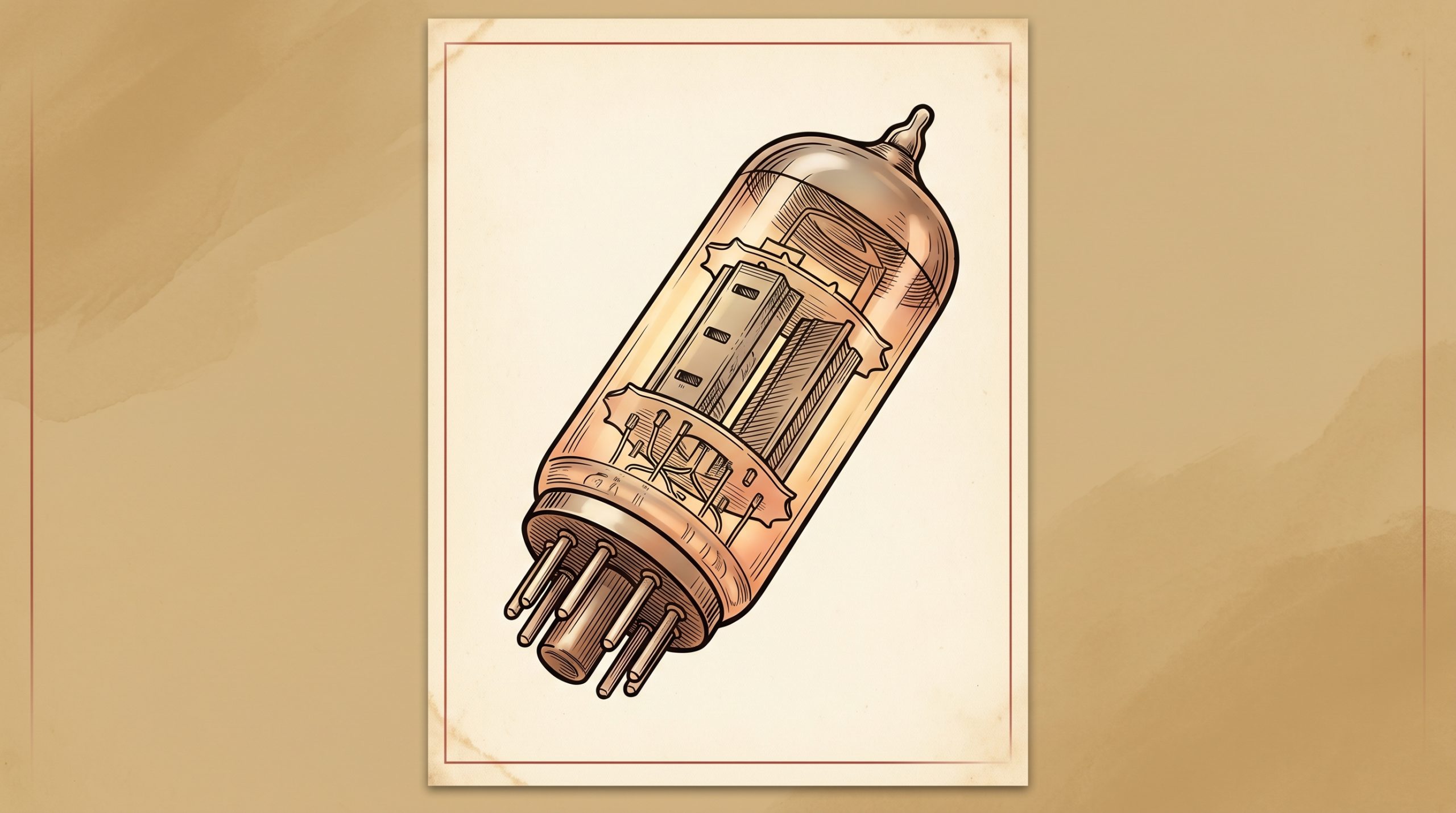
12AX7 vs ECC83 vs 7025: What’s the Actual Difference?
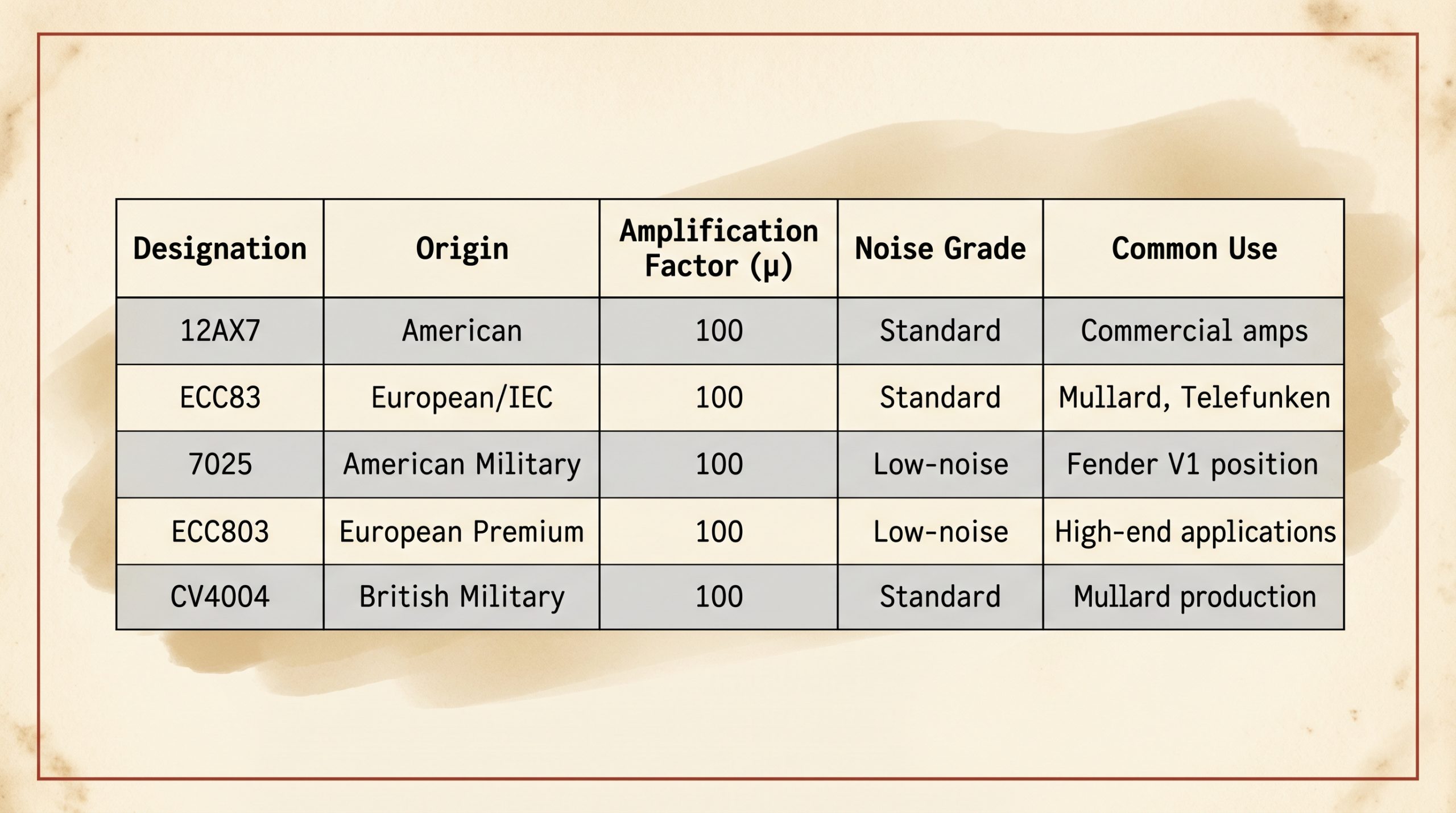
Electrically? Nothing. The 12AX7 (American designation), ECC83 (European/IEC designation), and 7025 (low-noise American spec) are pin-compatible, functionally identical tubes. They all use the 9-pin noval socket, share the same μ=100 amplification factor, and will drop straight into the same circuit without any modification.
The differences are mostly historical and grading-related:
- 12AX7: Standard American commercial designation. Used by RCA, GE, Sylvania, Tung-Sol, and most American manufacturers from the 1950s onward.
- ECC83: IEC designation used by European manufacturers: Mullard (UK), Telefunken (Germany), Siemens (Germany), Amperex (Netherlands). Same tube, different name.
- 7025: A low-noise version of the 12AX7. Per the RCA receiving tube manual, the 7025 uses a spiral-wound (coiled) filament to reduce hum and is specified for the same average noise as a 12AX7A plus a maximum allowable noise value. Fender specified 7025 tubes in several blackface-era amps for the V1 position, where noise matters most. Per the verified data at Amplified Parts, all 12AX7 tubes share μ=100, but real-world gain and noise vary tube to tube even within the same designation.
- 5751: Not equivalent — a lower-gain (μ=70), ruggedized industrial version of the 12AX7 with a 600G shock rating. Pin-compatible but reduces gain by roughly 30%. Often confused with the 7025.
- ECC803 / E83CC: A premium, long-plate version of the ECC83, built to tighter tolerances. Still pin-compatible. JJ Electronic currently produces an ECC803-S in this category.
- CV4004 / B759: British military/commercial equivalents, associated with Mullard production. Genalex Gold Lion markets its reissue 12AX7 under both “ECC83” and “B759” designations.
Bottom line: if your amp calls for a 12AX7, any of these will work. The 7025 designation in a vintage Fender service bulletin is telling you to use a low-noise tube in V1, not a different component. Understanding the era behind your amp’s original tube spec is part of proper dating research. The Fender tube amp serial number and dating guide covers the tube chart designations found in blackface and silverface-era amps, which is useful context when sourcing correct-spec replacements.
12AX7 Pinout and Technical Specs
The 12AX7 uses the 9-pin noval (B9A) socket. Both triode sections share the same glass envelope but operate independently.
| Pin | Function |
|---|---|
| 1 | Triode A, Anode (Plate) |
| 2 | Triode A, Grid |
| 3 | Triode A, Cathode |
| 4 | Heater |
| 5 | Heater |
| 6 | Triode B, Anode (Plate) |
| 7 | Triode B, Grid |
| 8 | Triode B, Cathode |
| 9 | Heater center tap |
For 12.6V operation (series), connect to pins 4 and 5 with pin 9 unused. For 6.3V operation (parallel), connect pins 4 and 5 together as one supply leg and use pin 9 as the other leg — each filament half then sees 6.3V.
Key absolute maximum ratings (from standard 12AX7 datasheet specs):
- Amplification factor (μ): 100
- Maximum plate voltage: 300V (GE spec; RCA datasheets cite 330V)
- Maximum plate dissipation: 1.2W per triode section
- Heater voltage: 12.6V across pins 4 and 5 (series) or 6.3V across pins 4+5 to pin 9 (parallel)
- Heater current: 150mA at 12.6V; 300mA at 6.3V
- Typical plate resistance: ~62.5kΩ
- Typical transconductance (gm): ~1,600 µmhos
Full datasheets are available through Frank’s Electron Tube Data Sheets, one of the most reliable archival sources for original manufacturer specifications.
Current Production 12AX7 Tubes: Comparison Chart
New-production (reissue) tubes are manufactured today primarily in Russia, Slovakia, and China. Quality varies significantly between brands, and even between batches from the same brand. The chart below summarizes the main options you’ll encounter.
| Brand / Model | Made In | Character | Best For | Approx. Street Price |
|---|---|---|---|---|
| Tung-Sol 12AX7 | Russia (New Sensor/Saratov) | Full midrange, detailed highs, low microphonics | V1 in most guitar amps, hi-fi preamps | $18-$25 |
| JJ ECC83-S | Slovakia | Warm and smooth, stiffer bass response, robust build | High-gain amps, road use, Mesa Boogie preamp stages | $18-$25 |
| Mullard 12AX7 (reissue) | Russia (New Sensor) | Balanced, warm clean tones, good headroom before saturation | Clean Fender-style amps, studio use | $18-$28 |
| Genalex Gold Lion ECC83/B759 | Russia (New Sensor) | Open, articulate, spanky attack, tight low end | Blues, clean tones, single-coil pickup rigs | $22-$35 |
| Electro-Harmonix 12AX7 | Russia (New Sensor) | Bright and forward, slightly compressed feel | Budget-friendly all-rounder, tone stage replacement | $12-$18 |
| Sovtek 12AX7WA / WB / LPS | Russia | Reliable, warm but somewhat flat and undynamic. Rugged. | Phase inverter position, budget replacements | $10-$16 |
| Psvane 12AX7-T II | China | Smooth, extended highs, lower noise floor than most Chinese options | Hi-fi preamps, recording setups | $25-$45 |
| JJ ECC803-S | Slovakia | Long-plate construction, more output and spongy compression vs ECC83-S | Vintage-voiced amps wanting more bloom and warmth | $22-$30 |
The Thetubestore.com review methodology, which rates tubes on microphonics, noise floor, and musical detail/dynamics across multiple amp platforms, is one of the more structured public-facing tests available for current production tubes. It’s a useful cross-reference when comparing brands. Check their data at thetubestore.com 12AX7 reviews.
NOS (New Old Stock) 12AX7 Tubes Worth Knowing
NOS pricing has climbed hard over the last decade. What sold for $5 in 2000 now lists for $80-$200 if it’s branded, tested, and from a trusted source. That said, the genuine articles do perform differently, often with lower noise, better triode balance, and more dynamic response than current production options.
Telefunken ECC83 (Smooth Plate / Diamond Bottom)
The benchmark for low noise and balanced triode sections. Telefunken ECC83s came in smooth-plate and ribbed-plate variants. The “diamond bottom” (a small diamond indentation in the glass base) is the identifier most often cited. Expect $100-$200+ for tested, branded examples. Worth it for V1 in a vintage Fender if noise is a problem. Not worth it for the phase inverter slot.
Mullard ECC83 (Blackburn, UK)
Construction varied by era. Early Mullards (mid-1950s through about 1960, identified by MC1, F91, and F92 etched codes) used long-plate construction and are the most sought-after. From the early 1960s onward (I61-style codes and later), Mullard moved to short-plate construction, which still sounds excellent but differs in character. Both eras command similar prices to Telefunken. Heavy counterfeiting problem. If you’re buying, source from a dealer who verifies the etched factory code and confirms construction details (halo getter position, mica spacer pattern).
RCA 12AX7A / 7025 (USA)
Extremely common in NOS form. Reliable, low noise, good balance. The 7025 version was the standard spec in blackface Fender amps. Current 2026 prices for tested NOS RCA 7025 examples run roughly $100-$200 per tube from established dealers (TubeDepot, KCA NOS Tubes, Audiogon listings). Used and pulled-from-amp examples occasionally appear in the $40-$80 range but are less reliable.
GE 12AX7 / 5751
The 5751 is a lower-gain (μ=70) substitute for the 12AX7, produced by GE, Sylvania, RCA, Tung-Sol, and Raytheon to a common industrial / military specification. It drops gain by roughly 30% and reduces noise. In V1 of a Fender Deluxe Reverb or Princeton Reverb, a 5751 can tame an overly bright or noisy amp without changing any other component. GE black-plate 5751s with triple mica are among the most highly regarded examples.
Tung-Sol 12AX7 (original USA production, 1950s-60s)
Round-plate construction. Higher output than most NOS options. These are the tubes the current Tung-Sol reissue attempts to reference. Original round-plate Tung-Sols run $80-$200 when properly labeled and tested. The reissue is a solid current-production tube but it’s a different design.
Which Position Matters Most: V1 vs Phase Inverter vs Driver
Not all 12AX7 slots are created equal. Position determines how much difference a tube swap will actually make.
V1 (Input Stage)
This is where guitar signal enters the amp. It’s the highest-gain, most noise-sensitive position in the circuit. A microphonic tube in V1 will ring and squeal. A noisy tube will add hiss. This is where you spend money on a quiet, low-microphonic tube. Put your best 12AX7 here.
Tone/Driver Stage (V2, V3)
Less critical for noise. More relevant for tone shaping. Swapping here affects midrange character and breakup behavior more than hiss. A JJ ECC83-S in a Marshall’s second preamp stage will feel stiffer and tighter than an EH 12AX7. Experiment freely.
Phase Inverter (PI)
The phase inverter splits signal to drive the push-pull output stage. The standard topology in most blackface Fenders and Marshall circuits is a long-tailed pair, and Fender’s blackface and silverface AB763-family amps use a 12AT7 in this socket (not a 12AX7) — the lower-gain 12AT7 has better current-handling characteristics for driving the output stage. Many players swap in a 12AX7 here as a deliberate mod to reduce clean headroom and bring breakup in earlier. If you do swap a 12AX7 into the PI, triode balance matters: a mismatched tube can skew bias and affect feel. Most technicians recommend a known-balanced tube in this slot, or run a Sovtek 12AX7LPS (known for triode consistency). Don’t burn your NOS stash here.
Reverb Driver / Recovery
The reverb driver socket in AB763 Fenders takes a 12AT7, not a 12AX7. The 12AT7 has the cathode current capability to drive the reverb transformer, which a 12AX7 lacks. The reverb recovery stage afterwards uses a 12AX7. Microphonics still matter in the recovery position (a ringing reverb tank isn’t what you’re after). A solid mid-tier tube like the EH 12AX7 or Sovtek 12AX7WA works fine in the recovery slot. Save the premium stuff for V1.
12AX7 Tube Rolling: Practical Tips
Tube rolling is cheap experimentation with real results. A few things that save time and money:
- Always swap one tube at a time. If you roll three tubes at once and the amp sounds different, you won’t know why.
- Let the amp warm up 10-15 minutes before evaluating. Cold impressions aren’t reliable.
- Test for microphonics by gently tapping the tube with a pencil eraser while playing. If it rings audibly through the speaker, that tube doesn’t belong in V1.
- Don’t bias preamp tubes. Unlike output tubes, 12AX7s are self-biasing in standard circuits. Swap and play.
- The 5751 is a legit V1 option if your amp is too bright or too noisy. It’s not a compromise, it’s a deliberate choice that Fender themselves used in some circuits.
- Current production quality is inconsistent within batches. Ordering two or three of the same tube from a dealer who tests for noise and microphonics gets you a known quantity. Budget retailers selling untested tubes are a crapshoot.
12AX7 in Specific Amp Platforms
Fender Blackface / Silverface Amps
Fender’s AB763 and AA1164 circuits typically run three to five 12AX7/7025 tubes for preamp, tone, and reverb-recovery duties, plus 12AT7 tubes in the reverb driver and phase inverter positions. The original Fender service bulletins specified 7025 in V1 for low-noise performance. Today, the Tung-Sol 12AX7 reissue and the Genalex Gold Lion ECC83 are the most consistently recommended current-production choices for V1 in these circuits. They maintain the open, articulate character those amps are built around. For dating and identifying your amp’s original tube complement, the Fender tube amp serial number dating guide cross-references tube chart codes and production eras.
Marshall JTM45, Plexi, JCM800
British amps tend to run hotter plate voltages than most Fenders. A robust tube matters here. JJ ECC83-S handles the stress well and adds a stiff, focused low end. The Tung-Sol reissue also works well in Marshall circuits and adds a bit more midrange complexity. Avoid cheap unbranded Chinese tubes in high-plate-voltage circuits.
Mesa Boogie High-Gain Amps
Mesa ships current production amps with their own MESA-branded 12AX7s (sourced from various factories over the years). The JJ ECC83-S is a popular upgrade for tightening up the bottom and reducing fizz in high-gain preamp chains. The JJ ECC803-S is preferred by some players who want more output and a slightly blooming, vintage-voiced quality in Mesa circuits. JJ’s full technical specs are available at JJ Electronic ECC83-S product page.
Vox AC15 / AC30
Vox amp tube complement varies significantly by era. Vintage AC15s (1958 through the late 1960s) and the original AC30/4 used an EF86 pentode in the Normal channel plus 12AX7s elsewhere. From late 1960 onward, the AC30/6 dropped the EF86 (it was prone to microphonics) in favor of 12AX7s throughout. Most modern Vox AC30 and AC15 C-series amps are 12AX7-loaded only; the Heritage hand-wired AC15H1TV reintroduces the EF86 on Channel 1. For 12AX7 positions in any of these amps, the Mullard reissue or Genalex Gold Lion in V1 works particularly well with the bright, chimey character these circuits are known for.
FAQ
What is the difference between ECC83 and 12AX7?
Nothing functional. The 12AX7 is the American RETMA designation and the ECC83 is the European IEC designation for the exact same tube design. Both use the 9-pin noval socket, share an amplification factor of 100, and are fully pin-compatible. The difference is purely naming convention based on the country of origin. You can drop an ECC83 directly into any socket calling for a 12AX7 with no modification.
Can I use a 5751 in place of a 12AX7?
Yes, directly. The 5751 is pin-compatible with the 12AX7 but has a lower amplification factor of around 70 instead of 100. Swapping a 5751 into V1 reduces overall gain by roughly 30%, which can clean up a bright or noisy amp and sometimes gives more headroom before breakup. Fender used 5751 tubes in some circuits by design. It’s a common and legitimate choice, not a workaround.
How long does a 12AX7 preamp tube last?
Significantly longer than output tubes. A 12AX7 in normal use typically lasts 5,000 to 10,000 hours. In a combo amp played a few hours a week, that’s years of service. You’ll notice degradation through increased noise, microphonics, or reduced gain before the tube actually fails. Most players replace preamp tubes reactively (when a problem appears) rather than on a schedule.
Does it matter which brand of 12AX7 I put in the phase inverter?
Less than V1, but triode balance matters in a long-tailed pair phase inverter. A well-matched tube keeps the push-pull output stage running evenly. Sovtek’s 12AX7LPS is commonly cited for triode consistency. If you’re putting premium NOS tubes in, save them for V1 and the driver stages. The PI position is a good home for a reliable current-production tube you trust for mechanical quality rather than sonic character. Note that Fender blackface and silverface AB763 amps use a 12AT7 in the PI socket stock; swapping in a 12AX7 is a deliberate mod, not a return-to-stock.
What’s the deal with “matched” 12AX7 tubes?
A matched 12AX7 has both triode sections tested to operate at similar gain and current levels. In applications where one tube handles a single-ended stage (like most guitar amp preamp stages), matching doesn’t matter much. Where it matters is in the phase inverter slot of a long-tailed pair circuit, where the two triodes in one 12AX7 work together to split signal. An unmatched tube in that position can introduce odd-order harmonics and affect feel. Most reputable tube dealers offer tested pairs at a small premium. Worth it for the PI. Not necessary elsewhere.
Final Thoughts
The 12AX7 is not a mystery tube. Its specs are fixed, its socket is universal, and there are solid current-production options at every price point. For most guitar amp applications, the Tung-Sol reissue or Genalex Gold Lion ECC83 in V1, backed by JJ ECC83-S tubes in the remaining preamp stages, covers the vast majority of rigs without breaking the bank. NOS tubes are worth pursuing if noise is genuinely a problem and budget allows, but a well-sourced current-production tube from a dealer who tests for microphonics will outperform a cheap “NOS” relabeled mystery tube every time. Start with V1. That’s where the difference actually lands.
