Contents
This guide collects 25 fingerpicking songs across four difficulty levels — from absolute beginner Travis-picking pieces to intermediate showpieces — with notes on the key, the picking pattern, and the vintage Fender amp setting that brings each one to life. There is a free 4-page PDF reference sheet at the end with the full song list, picking patterns laid out as tab, and starting amp settings for the six most common vintage Fender models.
Before the songs: the three patterns that cover everything
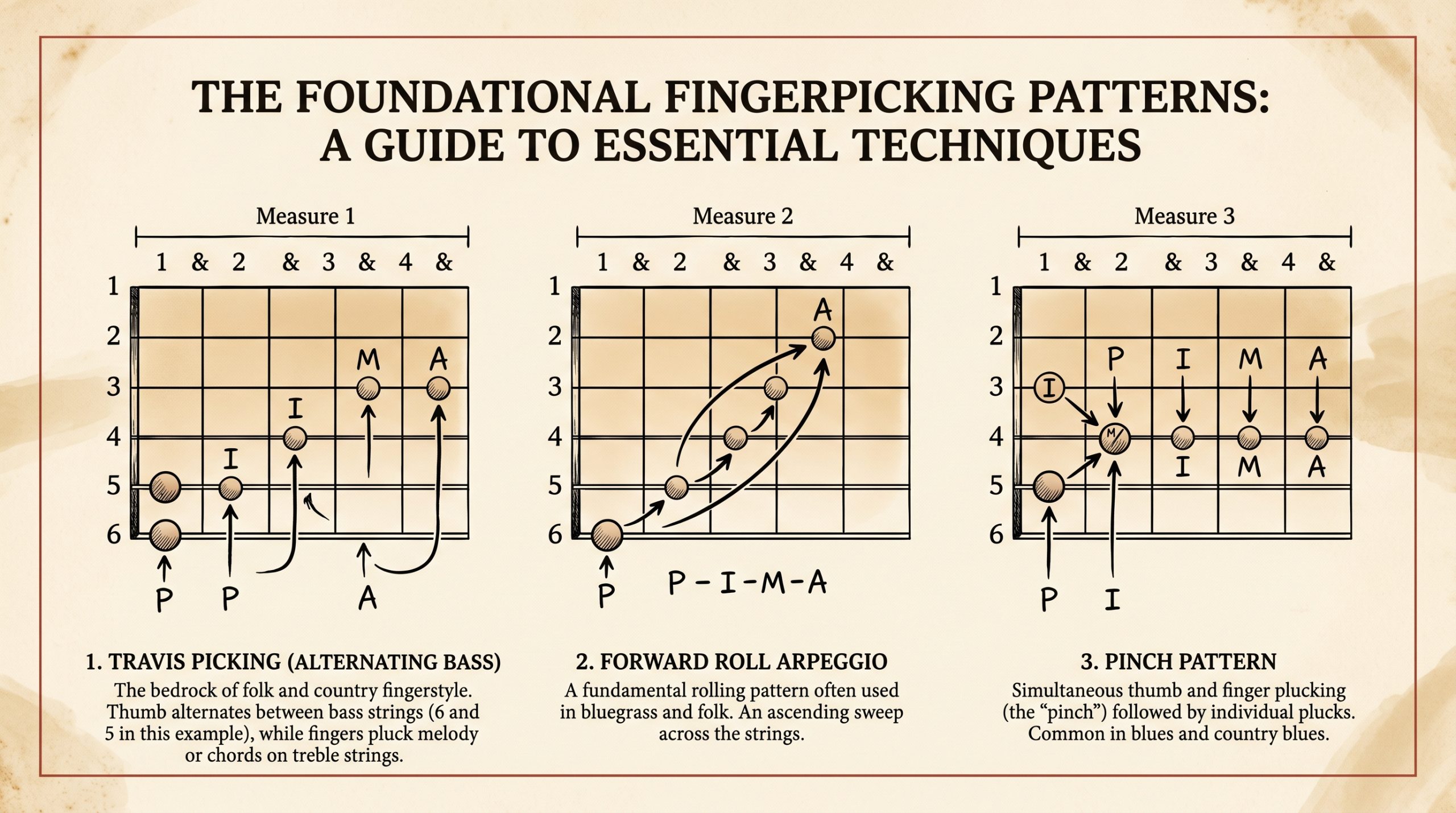
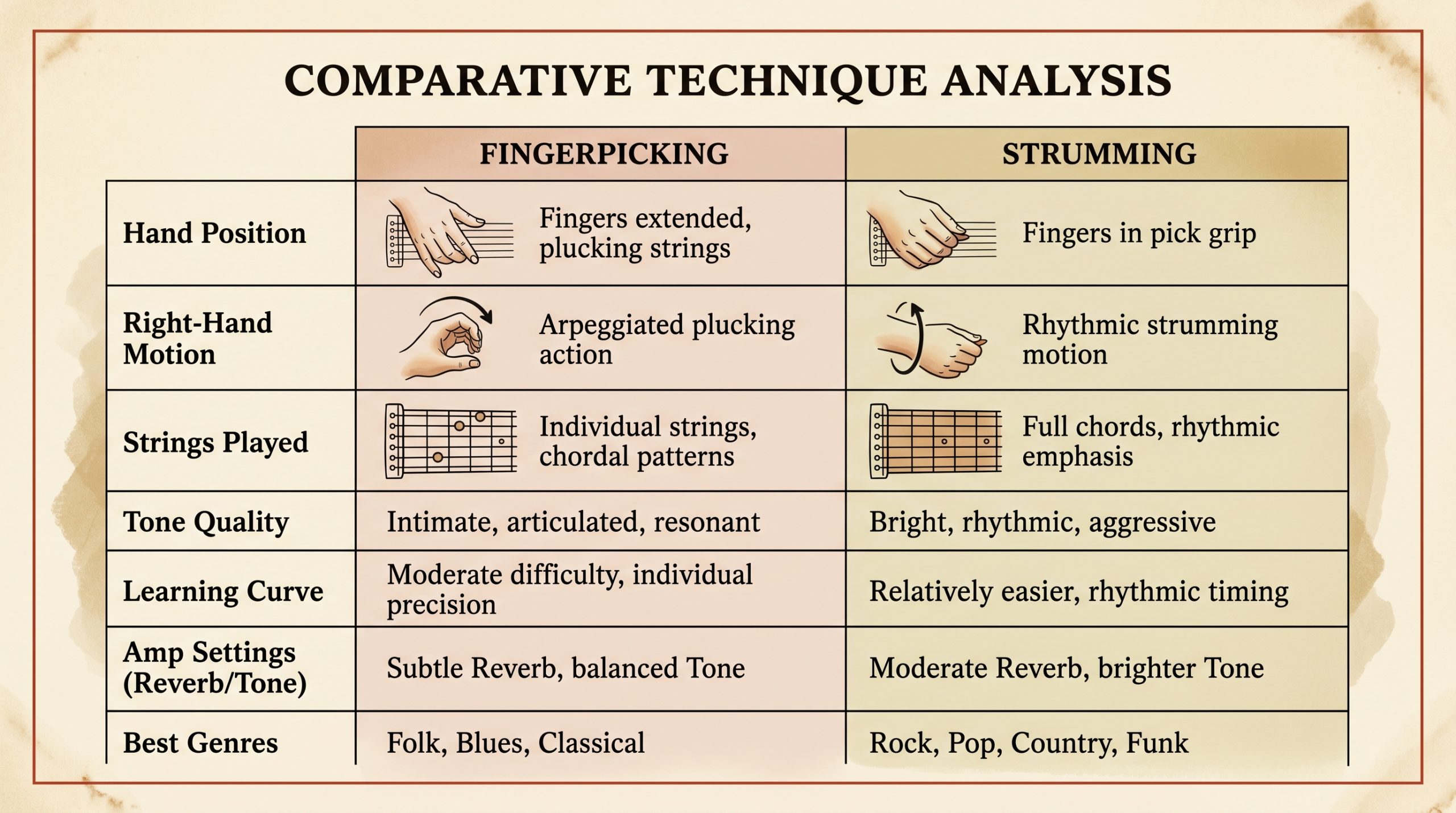
Almost every song below is built on one of three right-hand patterns. Learning these three patterns first — before tackling any specific song — turns the rest of this list into recognisable variations rather than thirty separate things to memorise.

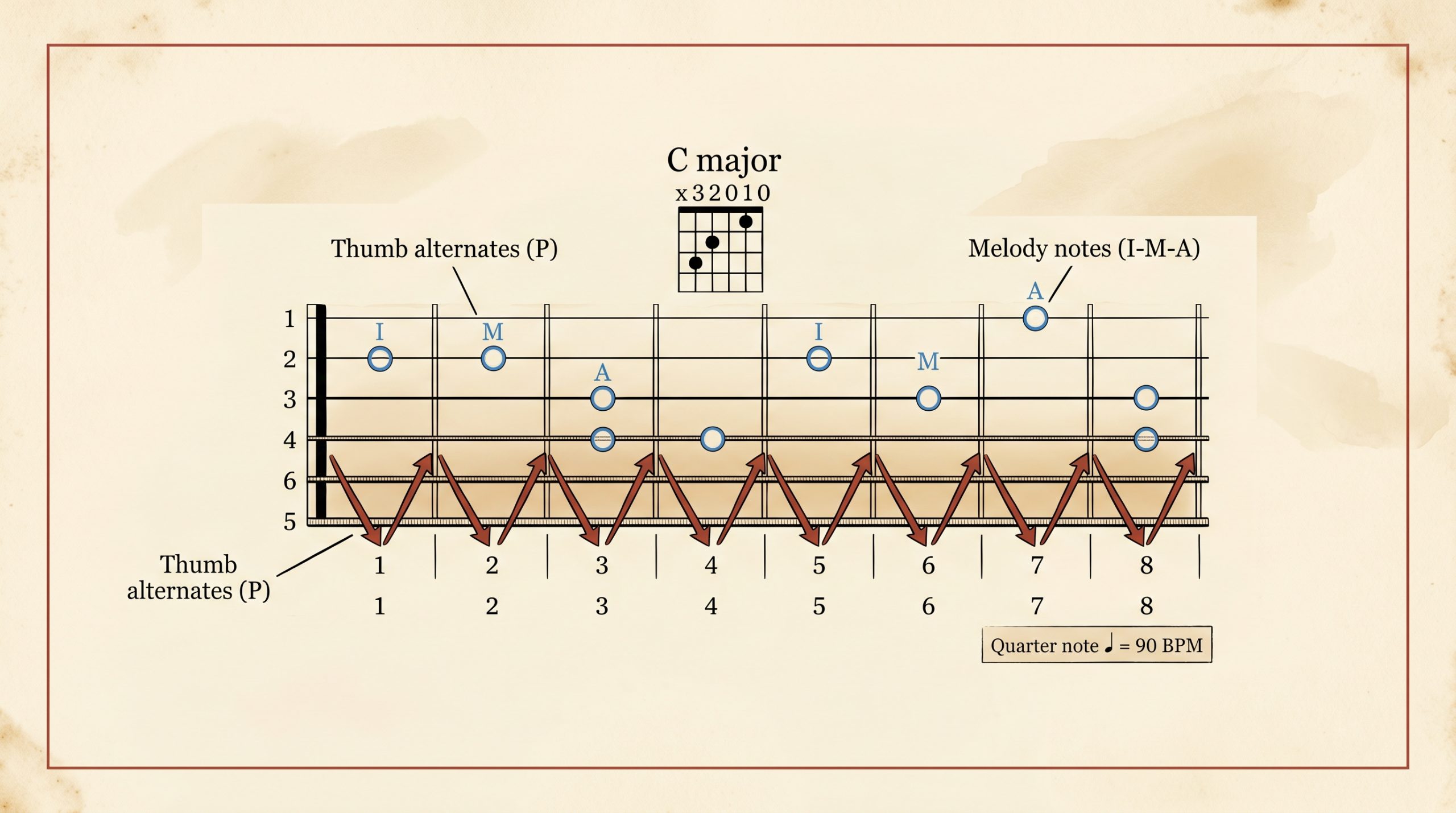
Travis picking (alternating bass). Named after country virtuoso Merle Travis. The thumb plays a steady alternating bass on two strings while the fingers handle the melody on top. The thumb never stops — that is the engine of the pattern. It is the foundation of “Freight Train”, “Dust in the Wind”, “Landslide”, and most American folk fingerstyle.
Forward roll (arpeggio). Single ascending sweep through the notes of a chord, no alternating bass. Easier to learn than Travis picking and the gateway to fingerstyle for most beginners. Heard in “House of the Rising Sun”, the “Stairway to Heaven” intro, and the “Nothing Else Matters” intro.
Pinch (thumb + finger simultaneously). The thumb plays a bass note at the same instant a finger plays a treble note. Combined with single-finger plucks in between, the pinch gives the syncopated bounce heard in “Hey There Delilah” and McCartney’s playing on “Blackbird”.
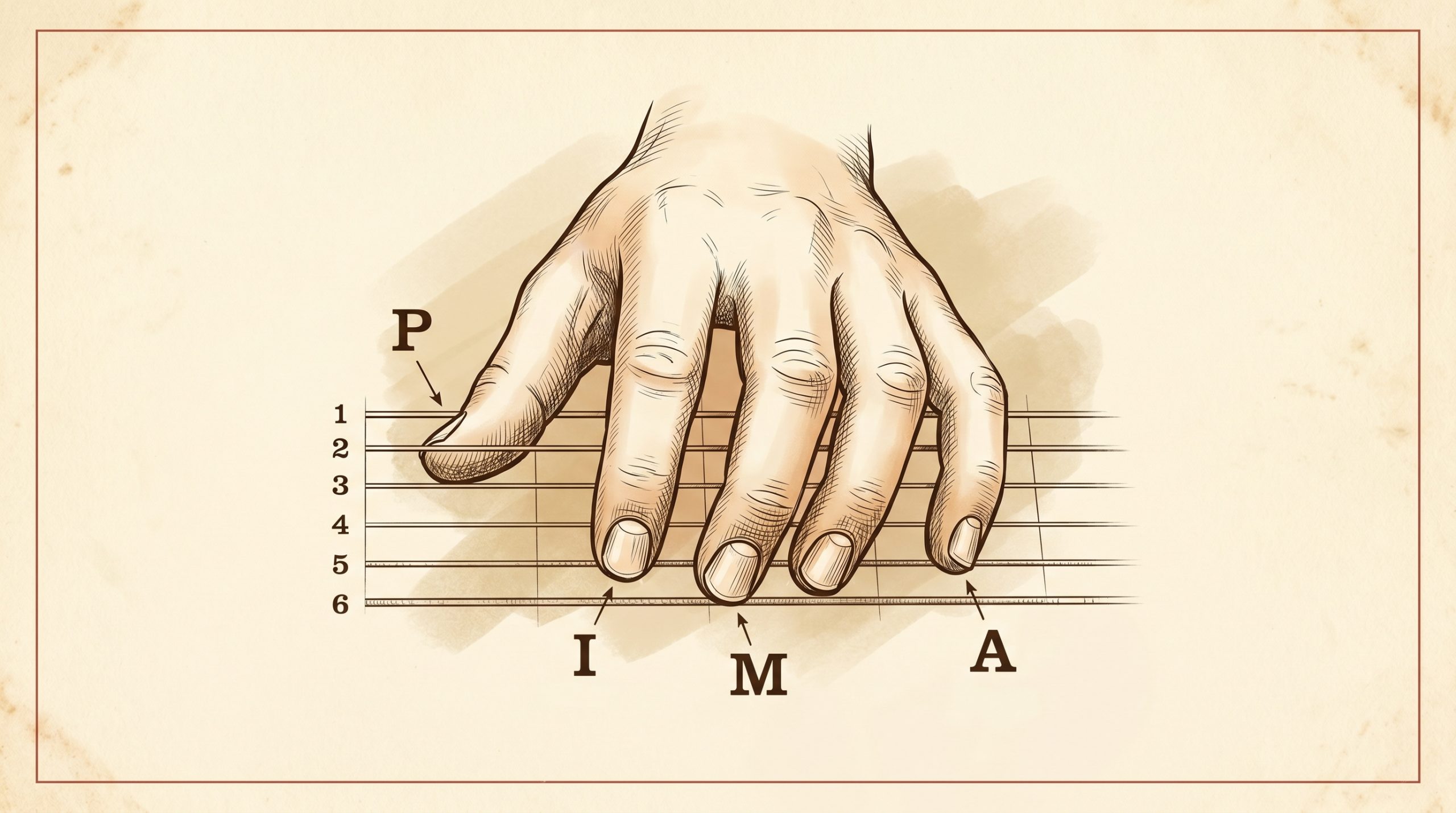
The PIMA notation used throughout this guide comes from classical guitar: P = thumb, I = index, M = middle, A = ring. The pinky is almost never used for plucking.
Beginner Travis-picking songs
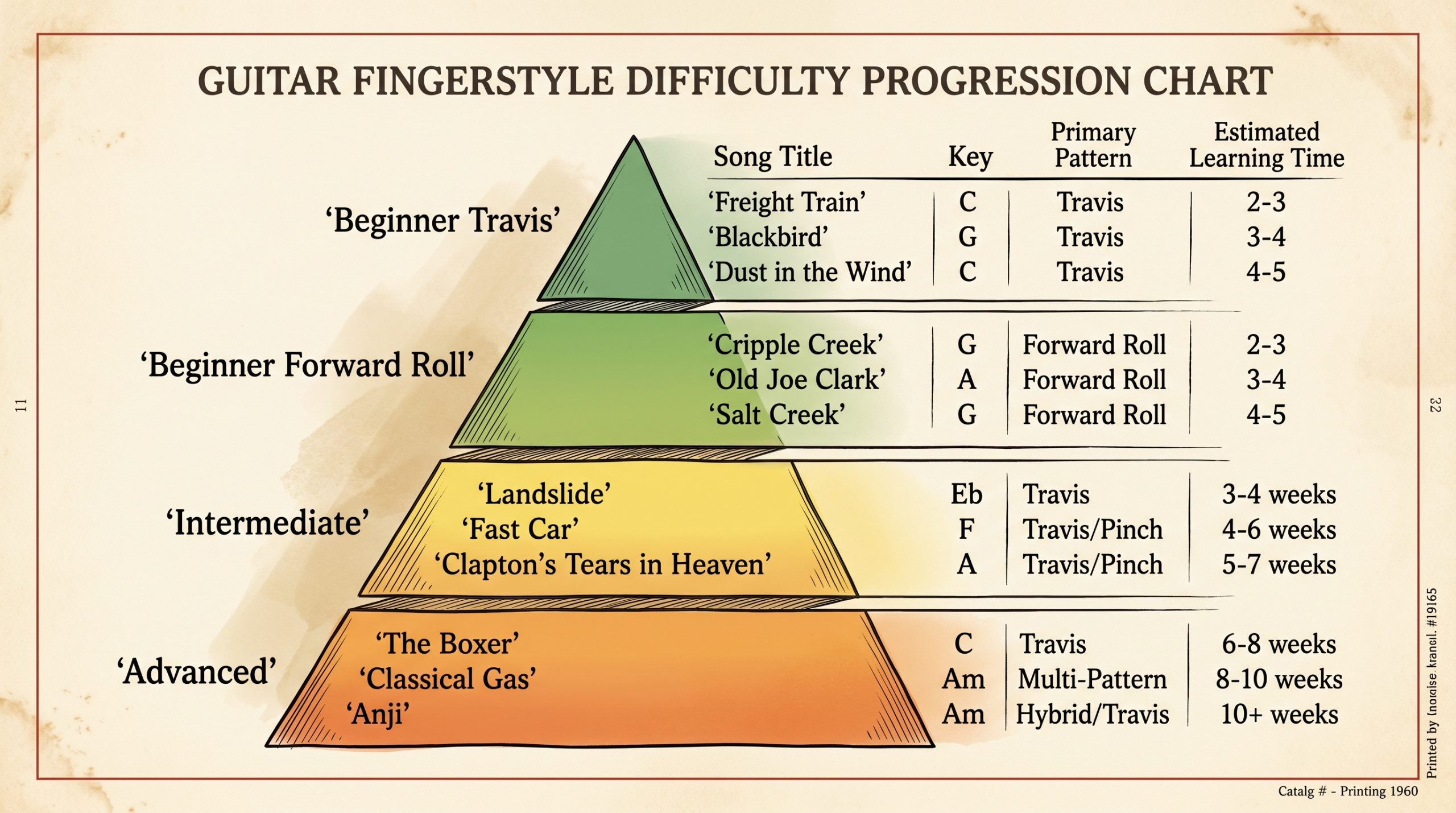
Start here. These seven songs use the simplest version of the alternating-bass pattern and a small handful of open chords. Each one sounds substantial enough to play for friends within a few weeks of consistent practice.
1. “Freight Train” — Elizabeth Cotten (1957)
The foundational fingerpicking piece in American folk repertoire, written by Cotten around 1904 when she was eleven or twelve years old and not recorded until the late 1950s when the Seeger family discovered her playing. The song is in C, built on a thumb-alternating bass pattern that became known as “Cotten picking” — she played left-handed on a right-strung guitar, picking the bass with her index finger and the melody with her thumb. Most modern players learn it standard, but the pattern works the same in either configuration.
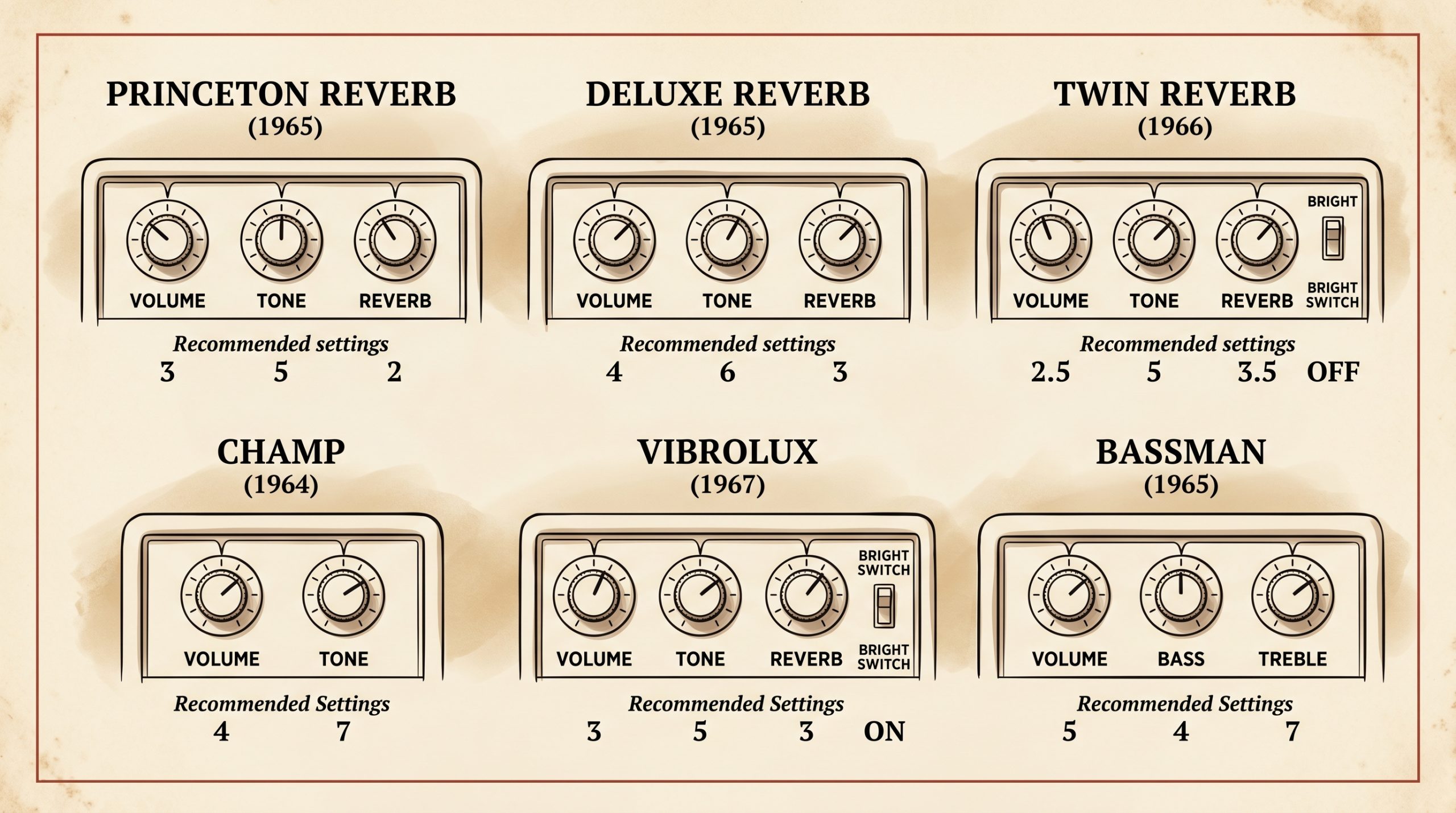
Fender pairing: Princeton Reverb at volume 3, reverb at 2, bright switch off. The Princeton’s slightly softer top end is forgiving on the upper-string melody work that comes later in the piece.
2. “Landslide” — Fleetwood Mac (1975)
Written by Stevie Nicks in Aspen during a period of personal crossroads and recorded for the 1975 self-titled Fleetwood Mac album. Lindsey Buckingham played acoustic guitar on the track using a Travis-style pattern. The song is fingered in C with the capo at the third fret, sounding in E-flat — an unusual key choice for rock that gives the song its distinctive brightness. The picking pattern is shorter than classic Travis and lighter on alternating bass, which makes it easier than “Freight Train” to get under your fingers despite the song sounding more complex.
Fender pairing: Deluxe Reverb at volume 3 with the bright switch off. The slight extra headroom over the Princeton lets the high notes sustain through the chord changes.
3. “Dust in the Wind” — Kansas (1977)
Kerry Livgren wrote the song as a fingerpicking exercise to improve his acoustic technique — his wife heard him playing it, suggested he turn it into a song, and Kansas released it on 1977’s Point of Know Return. The recording features two acoustic guitars in standard tuning and Nashville high-strung tuning playing the same part, creating a twelve-string effect. The picking pattern stays consistent across the whole song, which is unusual and makes it an exceptional learning piece — once you have the pattern you can play the entire arrangement.
Fender pairing: Princeton Reverb at volume 3, reverb at 3. The chord progression sits in C and Am with simple voicings that benefit from a bit more reverb than usual.
4. “Hey There Delilah” — Plain White T’s (2006)
A pinch-pattern song rather than Travis — the thumb plays a steady bass note while the index and middle fingers pluck the higher strings together. Written by Tom Higgenson and released in 2006, the song uses a single repeating fingerpicking pattern across the entire piece, alternating between D and F-sharp minor. The Bm barre chord in the verse is the one challenge for a complete beginner; with that under your fingers the rest of the song falls into place.
Fender pairing: Princeton Reverb at volume 3 with reverb at 2 and treble at 4. The pinch pattern needs a touch less treble than Travis-style picking to keep the chord pinches from sounding harsh.
5. “Wish You Were Here” (intro) — Pink Floyd (1975)
David Gilmour’s acoustic intro is one of the most recognisable fingerpicked passages in rock. The piece is in G major and uses an arpeggio pattern across G, Em7, and A7sus4 voicings, with a lead guitar fill weaving over the top — tracked on a Martin D12-28 twelve-string on the original recording. The full song is intermediate; the intro alone is genuinely beginner-friendly and rewarding to play.
Fender pairing: Deluxe Reverb at volume 3, reverb at 2–3, bright off. The slight midrange of the Deluxe pairs well with the warmth of the open chord voicings.
6. “House of the Rising Sun” — Traditional / The Animals (1964)
The traditional folk song that The Animals made famous in 1964 uses a forward-roll arpeggio pattern in 6/8 time, in A minor. The right hand plays P–I–M–A–M–I through each chord — thumb on the bass, then up and back through the high strings — which gives the song its characteristic rolling feel. The chord progression (Am, C, D, F, Am, E) is straightforward open chords.
Fender pairing: Vibrolux Reverb with the tremolo set slow and shallow. The tremolo’s gentle swell pairs almost cinematically with the song’s brooding mood.
7. “Tears in Heaven” — Eric Clapton (1992)
Written by Clapton in the wake of his son’s death and recorded for the 1991 Rush soundtrack, then made famous in the 1992 Unplugged sessions with Andy Fairweather Low on a second nylon-string acoustic. The song is in A major (with a brief modulation to G in the bridge) and uses a hybrid of pinch and arpeggio picking with descending bass lines through E/G#, F#m, and D/F# inversions. The chord changes happen at a moderate clip and the song requires reasonable dynamic control to do justice to.
Fender pairing: Deluxe Reverb at volume 3, reverb at 3, bright off. The song was tracked on nylon-string acoustic, but the chord voicings translate well to a clean Fender electric voice with a touch of compression to even out the dynamics.
Easy fingerstyle classics
The next eight songs are the canonical fingerstyle repertoire — the pieces every fingerpicker eventually learns. They are not all technically harder than the beginner list, but each demands a bit more control or a small new technique.
8. “Blackbird” — The Beatles (1968)
Paul McCartney recorded “Blackbird” alone on a Martin D-28 on 11 June 1968 for the White Album. The technique is unusual: rather than classical Travis picking, McCartney plays the bass and melody as two-note pinches on the A and B strings, an octave (or tenth) apart, with the open G string ringing through between pinches as a pedal tone. He cited Bach’s Bourrée in E minor as the inspiration for the contrapuntal feel. The song is in G major.
Fender pairing: Deluxe Reverb at volume 3 with the bright switch off. The open G pedal tone needs warmth, not sparkle — bright switch on will make the constant high G string fatiguing.
9. “Don’t Think Twice, It’s All Right” — Bob Dylan (1963)
The standard alternating-bass folk pattern that every fingerpicker eventually learns, recorded by Dylan for The Freewheelin’ Bob Dylan in 1963. Most players learn it with C-shape chords and a capo at the fourth fret to match the recorded key of E. The picking pattern itself is straightforward Travis; the challenge is keeping the bass smooth across the chord changes, particularly the C–G transition that recurs throughout the song.
Fender pairing: Vibrolux Reverb with tremolo at a slow, shallow swell. The mid-1960s folk feel calls for tremolo more than reverb.
10. “Fire and Rain” — James Taylor (1970)
James Taylor’s right-hand technique is one of the most studied in popular music. “Fire and Rain”, from his 1970 album Sweet Baby James, uses a Travis-style pattern with occasional flatpicked accents, played with a relaxed time feel that is harder to imitate than it looks. The song is in A and the chord voicings include a few unusual shapes (A7sus4, E7sus4) that give the song its distinctive harmonic colour.
Fender pairing: Deluxe Reverb at volume 3, reverb at 2. Taylor’s electric tones throughout his career have leaned on clean Fender voices, often with light compression to even out his dynamic, fingernail-driven attack.
11. “Anji” — Davey Graham (1962)
The folk-baroque guitar instrumental that defined the British fingerstyle revival. Graham wrote and recorded “Anji” in 1962 on his EP 3/4 AD when he was 19, and the piece spread through a generation of British and American fingerpickers — Bert Jansch recorded it on his 1965 debut, and Paul Simon’s version on Sounds of Silence in 1966 brought it to American ears. The song is fingered in A minor shapes with the capo at the third fret, sounding in C minor on the original recording. Built on a descending chromatic bass line and bluesy ornaments on the high strings, it is the canonical “rite of passage” piece for serious fingerpickers.
Fender pairing: Princeton Reverb at volume 3, reverb at 2. The piece is intricate and needs the amp to stay completely transparent — no extra colour.
12. “Greensleeves” — Traditional (16th century)
The traditional English melody, first registered as a broadside ballad by Richard Jones at the London Stationers’ Company in 1580, makes a beautiful fingerstyle piece because the melody and chord progression sit naturally on the guitar in A minor. The arrangement uses classical PIMA arpeggios — thumb on the bass, then I–M–A in sequence on the high strings — with the melody falling on either the thumb or the ring finger depending on which note of the chord carries it. Useful as a study piece because the picking pattern stays consistent while the melody moves between voices.
Fender pairing: Princeton Reverb with reverb at 3 and tremolo off. The slight cathedral effect of more reverb fits the period feel.
13. “Scarborough Fair” — Traditional / Simon and Garfunkel (1966)
The traditional English ballad that Paul Simon arranged for Simon and Garfunkel’s Parsley, Sage, Rosemary and Thyme in 1966. The fingerpicked version uses a simple arpeggio pattern in A minor or D minor (depending on the recording you reference), with the melody on top of slowly changing modal chords. The chord voicings are open and the picking pattern repeats — an excellent piece for a beginner working on consistency.
Fender pairing: Vibrolux Reverb with tremolo slow and reverb at 2. The modal harmony benefits from a bit of motion in the amp.
14. “Stairway to Heaven” (intro) — Led Zeppelin (1971)
Jimmy Page’s acoustic intro to “Stairway to Heaven” uses a descending chromatic arpeggio pattern in A minor, played on a Harmony Sovereign H1260 acoustic on the original recording. The right hand is straightforward fingerstyle — thumb on the bass, fingers on the high strings — while the left hand handles the descending bass line that gives the passage its character. Most players learn the first 24 bars and stop there.
Fender pairing: Deluxe Reverb at volume 3, reverb at 3. The descending bass line carries the harmonic motion, so the amp should provide presence without colouring the chord voicings.
15. “Nothing Else Matters” (intro) — Metallica (1991)
James Hetfield wrote the song in 1990 over a phone call to his then-girlfriend Kristen Martinez, plucking the four open strings of a standard E-minor chord with one hand. It was recorded for Metallica’s 1991 self-titled album, known as the Black Album. The intro is an open-string arpeggio in E minor played fingerstyle — striking for Metallica and a turning point for the band as a power ballad. The picking pattern is simple but the left-hand position shifts up the neck require precision, and the rhythm sits a touch behind the beat in a way that takes practice to capture.
Fender pairing: Twin Reverb at low volume (2–3), bright off. The piece sounds particularly good with a touch of plate or hall reverb in addition to the spring tank — a small pedalboard helps.
Intermediate and iconic fingerpicked pieces
The next five songs need more right-hand control, position shifts, or pattern variations within the same piece. None are out of reach for an advancing player who has the beginner list under their fingers.
16. “Sultans of Swing” (intro and verse) — Dire Straits (1978)
Mark Knopfler’s fingerpicked approach to electric guitar defined an era. The intro and verse of “Sultans of Swing”, from Dire Straits’ 1978 self-titled debut, remain a benchmark for clean fingerpicked electric playing. Knopfler famously plays without a pick, using his thumb and first two fingers on a 1961 Stratocaster into a clean Fender amp — the song he originally wrote on a National Steel guitar in open tuning suddenly came alive on the Strat. The piece is in D minor and the right-hand work is “circular” thumb-index-middle, which Knopfler describes as the engine of his attack.
Fender pairing: Vibrolux Reverb or Twin Reverb. Knopfler’s tone is the single best argument for using a vintage Fender clean specifically for fingerpicking on electric guitar — without the pick, the amp has to do more of the articulation, and that is exactly what these amps were built to deliver.
17. “Never Going Back Again” — Fleetwood Mac (1977)
Lindsey Buckingham’s technically demanding solo from Rumours, played on a small-bodied acoustic with three fingers plus thumb on the right hand. Original recording is in drop-D tuning (D–A–D–G–B–E) with the capo at the fourth fret (some sources cite the sixth fret on alternate sessions), and Buckingham simplified the picking on later live performances. The song’s bouncy feel comes from the steady alternating thumb against rapid sixteenth-note finger work on the high strings — very difficult to play cleanly at the recorded tempo.
Fender pairing: The song was tracked on acoustic, but it transfers to a clean electric well with a Princeton Reverb or small-bodied Fender combo, reverb at 2 and treble at 4.
18. “Time in a Bottle” — Jim Croce (1972)
Jim Croce’s 1972 fingerpicked ballad from You Don’t Mess Around with Jim, written about his son Adrian. The piece is in D minor in the verse, moving to D major in the chorus, and uses a combination of pinch and Travis-style picking with melody notes sustained through chord changes. Croce played the recording on a Martin D-21 with light gauge strings. The chord voicings include a few uncommon shapes that take time to learn but make the song rewarding to play.
Fender pairing: Deluxe Reverb at volume 3, reverb at 2. The minor-to-major shift in the chorus benefits from a transparent amp that doesn’t add harmonic colour.
19. “Classical Gas” — Mason Williams (1968)
Mason Williams’ instrumental hit from 1968 reached #2 on the Billboard Hot 100 and won three Grammy Awards. The piece is in A minor and uses a hybrid fingerstyle approach — pure classical PIMA technique in some sections, more rock-influenced strums and rapid arpeggios in others. The full piece is technically advanced and shifts between 3/4, 4/4, 5/4 and 6/4 time signatures; the opening 16 bars are within reach of an intermediate player and worth learning even if you stop there.
Fender pairing: Twin Reverb at low volume with reverb at 2. The piece is busy enough that a transparent, headroomy amp serves it best.
20. “Hotel California” (intro) — Eagles (1976)
On the original recording, Don Felder played the 12-string acoustic part on a Takamine F385 while Joe Walsh and Felder added nylon-string acoustic parts and Glenn Frey played a 12-string capo’d at the second fret. The track was recorded in B minor, but the 12-string fingering uses E-minor shapes with a capo at the seventh fret — so the chord shapes you play are Em, B7, D, A, C, G, Am, B7, sounding as Bm, F#7, A, E, G, D, Em, F#7. Played on a single six-string acoustic, the arpeggio reads as an intermediate roll pattern; the difficulty is the precision needed to play the chord changes cleanly with the capo so high on the neck.
Fender pairing: Deluxe Reverb at volume 3, reverb at 3. A touch more reverb than usual helps simulate the lushness of the twelve-string sound on a single guitar.
Country and folk fingerpicking
The American country and folk tradition is where Travis picking was born — Merle Travis, Chet Atkins, Doc Watson, and the Carter Family established the patterns that everything else on this list descends from. These five songs are the canonical entry points.
21. “Wagon Wheel” (fingerpicked arrangement) — Old Crow Medicine Show (2004)
Old Crow Medicine Show’s Ketch Secor finished a song Bob Dylan had left as a chorus sketch in 1973 during the Pat Garrett and Billy the Kid sessions, releasing their version in 2004. Darius Rucker’s 2013 country cover took the song to mainstream country radio. The chord progression (C, G, Am, F or G, D, Em, C depending on the key you sing in) makes an excellent Travis-picking exercise for beginners. Open chords, a steady chord rhythm, and a melody that sits naturally on top of the alternating bass.
Fender pairing: Princeton Reverb at volume 3 with tremolo off. The song’s pop-country feel sits well on a clean Princeton.
22. “Tennessee Stud” — Doc Watson (1966)
Written by Jimmie Driftwood in 1958, “Tennessee Stud” became one of Doc Watson’s most celebrated performances after he first recorded it on his 1966 album Southbound and later for the 1972 Will the Circle Be Unbroken sessions with the Nitty Gritty Dirt Band. The song is in D and uses a steady alternating-bass Travis pattern under a sung melody. Watson’s playing was extraordinarily clean; the song works equally well played at moderate tempo by a learner. The chord progression is simple open chords (D, A, G, Em, A7).
Fender pairing: Deluxe Reverb at volume 3 with reverb at 2. The song was recorded acoustic, but it translates beautifully to a clean Fender electric voice.
23. “Cripple Creek” — Traditional Appalachian
The traditional Appalachian fiddle and banjo tune, played fingerstyle on the guitar in A with a thumb-driven alternating bass. The melody falls on the high strings while the thumb keeps a steady 4/4 pulse on the low strings. The piece is short and repetitive, which makes it useful as a Travis-picking workout — you can play it for ten minutes straight while building thumb independence.
Fender pairing: Princeton Reverb at volume 3, reverb at 2. The fiddle-tune character benefits from the Princeton’s slightly compressed midrange.
24. “Will the Circle Be Unbroken” — Carter Family (1935)
The Carter Family recorded their version of the 1907 Ada Habershon hymn (with music by Charles H. Gabriel) in 1935 as “Can the Circle Be Unbroken (By and By)”, and it has been a foundation of American country and gospel ever since. The fingerpicked arrangement is in G or C, depending on which key suits your voice, and uses a basic alternating-bass pattern that any beginner can pick up in a single sitting. Three chords, steady thumb, melody on top.
Fender pairing: Deluxe Reverb at volume 3 with reverb at 3. The song calls for a touch of period reverb to evoke the gospel-quartet feel of the early recordings.
25. “Deep River Blues” — Doc Watson (1964)
Doc Watson learned the song from the Delmore Brothers and made it a standard of country-blues fingerstyle. The piece is in E and uses a thumb-driven blues pattern: the thumb plays a strong alternating bass while the fingers fill in blues licks on the high strings. The right-hand work is harder than the chord progression suggests — the thumb has to swing while the fingers play behind the beat in places.
Fender pairing: Vibrolux Reverb with the tremolo set medium-slow. The slight Doppler effect of the tremolo helps imitate the country-blues feel of the original recording.
Get the free reference sheet
The companion PDF contains the full 25-song list with key, capo position, picking pattern, and difficulty rating; the three picking patterns laid out as guitar tab; recommended starting settings for six common vintage Fender amps; and practice notes covering thumb independence, finger anchoring, and the nails-or-skin question.
Download the 25 Easy Fingerpicking Songs reference sheet (PDF, 4 pages)
Vintage Fender amp settings for fingerstyle
The whole point of fingerpicking on a vintage Fender clean tone is to hear every nuance of the right hand. That means keeping the amp out of compression and letting the tubes work at their most open and articulate point — fingerpicked dynamics get crushed when the amp goes into compression, the loud notes stop getting louder and the soft notes disappear.
The Fender Princeton Reverb remains the most-recommended amp in the vintage Fender catalog for fingerstyle — small enough to use at home volumes, with reverb and tremolo that suit the style perfectly. The Deluxe Reverb offers similar character with a bit more headroom for situations where you need to be heard alongside another player. For larger spaces or louder fingerpickers, the Twin Reverb delivers the same clean voice with substantially more power, though it’s overkill for solo practice. For the smallest home setups, the Vibro Champ covers the bedroom-volume end of the same tonal family.
Across all three amps the same principle applies: find the volume at which the amp sounds like itself — clean, with the speaker just starting to bloom on the loudest notes — then leave the dial alone and play the dynamics with your fingers. The right hand is the volume control. For dating and identifying the specific model and year of any of these amps, see the complete Fender amp serial number guide or use the quick dating cheatsheet if you just need the year.
Frequently asked questions
What is the easiest fingerpicking song for a complete beginner?
"Freight Train" by Elizabeth Cotten is the most-recommended first fingerpicking piece because the alternating-bass pattern stays simple, the chord changes are slow, and the song sounds substantial enough to be satisfying within a week of practice. "Landslide" and the intro to "Wish You Were Here" are good follow-ups.
How long does it take to learn fingerpicking?
The basic Travis-picking pattern — thumb alternating on two bass strings while the fingers handle treble notes — takes most beginners two to four weeks of consistent daily practice to play smoothly on a single chord. Adding chord changes adds another month. Playing songs from this list at the recorded tempo with proper dynamics takes six months to a year of regular work.
Do I need long fingernails to fingerpick?
No. Some of the most influential fingerstyle players use only the skin of their fingertips — Mark Knopfler is the canonical example. Pure skin gives a warmer, quieter tone and never breaks. Nails are louder and more articulate but need maintenance. James Taylor uses nails; Chet Atkins used a thumbpick and nail combination. Try both for a week each before deciding which suits your hands and your music.
Can you fingerpick on an electric guitar?
Yes — and a vintage Fender clean tone is the ideal voice for it. Mark Knopfler built an entire career on fingerpicked electric guitar through a clean Fender amp on "Sultans of Swing" and most of the Dire Straits catalogue. The amp needs to stay in its clean range so that the dynamic detail of the right hand comes through; an overdriven amp will compress the picking and make every note the same volume.
What is the best vintage Fender amp for fingerpicking?
The Princeton Reverb is the most recommended choice for home and small-room fingerstyle. It has enough headroom to stay clean at usable volumes, the reverb and tremolo suit the style, and the amp is small enough that it doesn't dominate a quiet acoustic instrument. The Deluxe Reverb is the next step up for players who need more headroom or play in louder rooms.
Is Travis picking hard to learn?
The thumb-and-fingers coordination is the hardest part. Most beginners practise the thumb alone — alternating bass on a single chord at 60 BPM — for at least a week before adding the fingers. Once the thumb runs on autopilot the fingers fall into place quickly. The most common beginner mistake is rushing the tempo before the thumb is steady.