Contents
- 01A Brief History of the Fender Vibrolux (1956–Present)
- 02Fender Vibrolux Specifications: The Numbers That Matter
- 03What Does a Fender Vibrolux Sound Like? Tone Character Explained
- 04The Fender Vibrolux Reverb Schematic: Circuit Deep Dive
- 05How Much Does a Fender Vibrolux Weigh? Giggability Assessed
- 06Modern Versions: Reissues, Customs, and the 68 Custom
- 07Buying Guide: Vintage vs. Reissue vs. Custom
- 08The Vibrolux vs. Its Blackface Siblings: Where It Fits
- 09Unique Angles: What the Competitors Missed
- 10FAQ
- 11What You Should Do
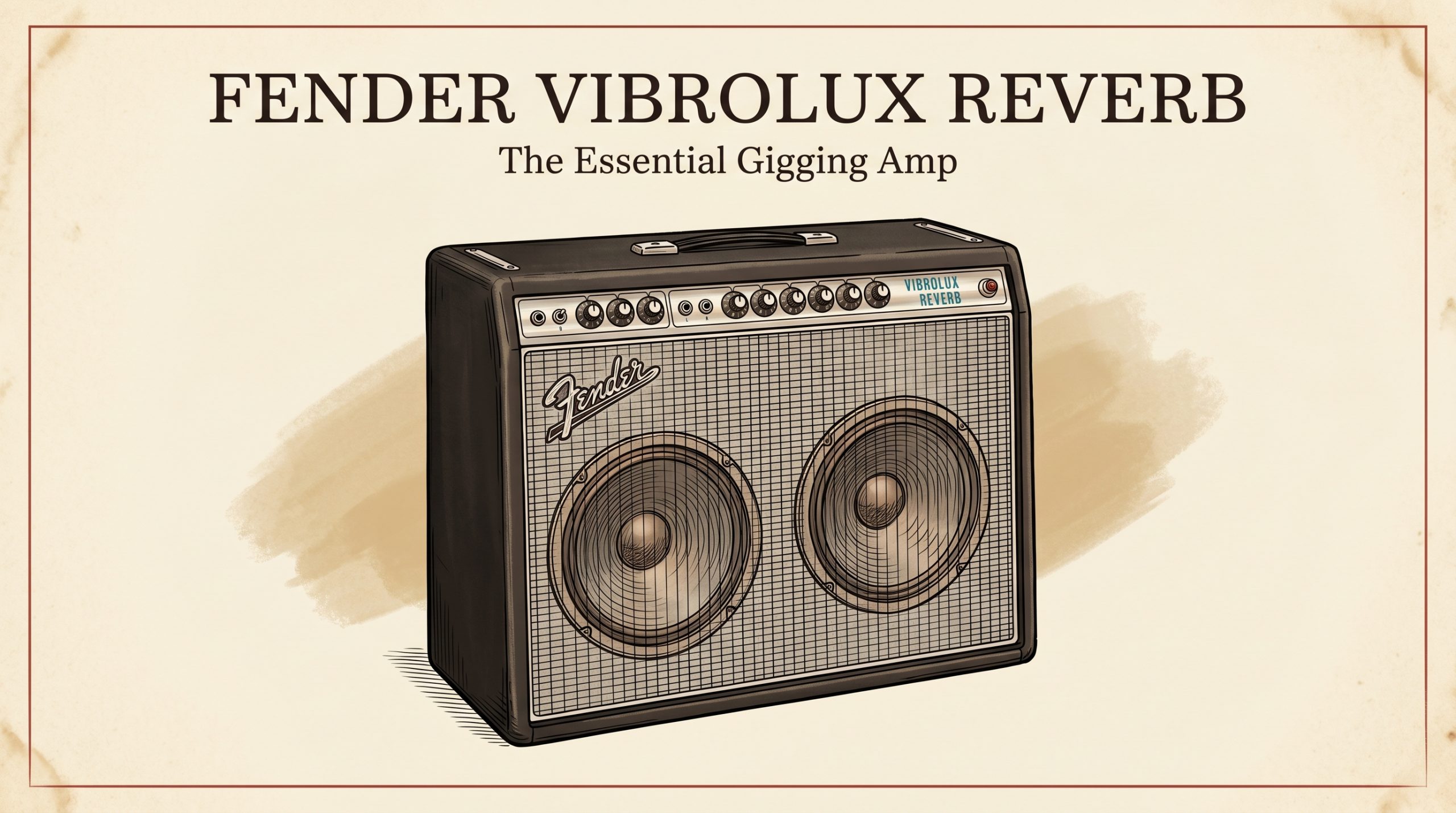
You’re standing at rehearsal, staring down a room that’s too loud for a Deluxe Reverb to cut through but too small to justify hauling a Twin Reverb up two flights of stairs. The drummer is already hitting too hard. You need clean headroom, real spring reverb, and an amp that doesn’t require a roadie. That situation is exactly what the Fender Vibrolux Reverb was built for.
The Vibrolux rarely gets the headline billing of its blackface siblings. The Deluxe Reverb gets the boutique player press. The Twin gets the stadium rock love. But working guitarists who’ve actually spent time with an AA964 Vibrolux Reverb know it hits a sweet spot that neither amp can replicate: 35 watts of 6L6 headroom through a 2×10″ cabinet that’s genuinely gig-portable. This guide covers the full production history from the tweed 5F11 through the current 68 Custom Vibrolux Reverb, every significant circuit variant, tone character, weight, and a buying guide built on circuit specifics rather than forum hype.
A Brief History of the Fender Vibrolux (1956–Present)
The Vibrolux name first appeared in 1956, which means it predates Fender’s reverb technology by nearly a decade. It went through four distinct cosmetic and circuit eras before arriving at the form most players recognize today.
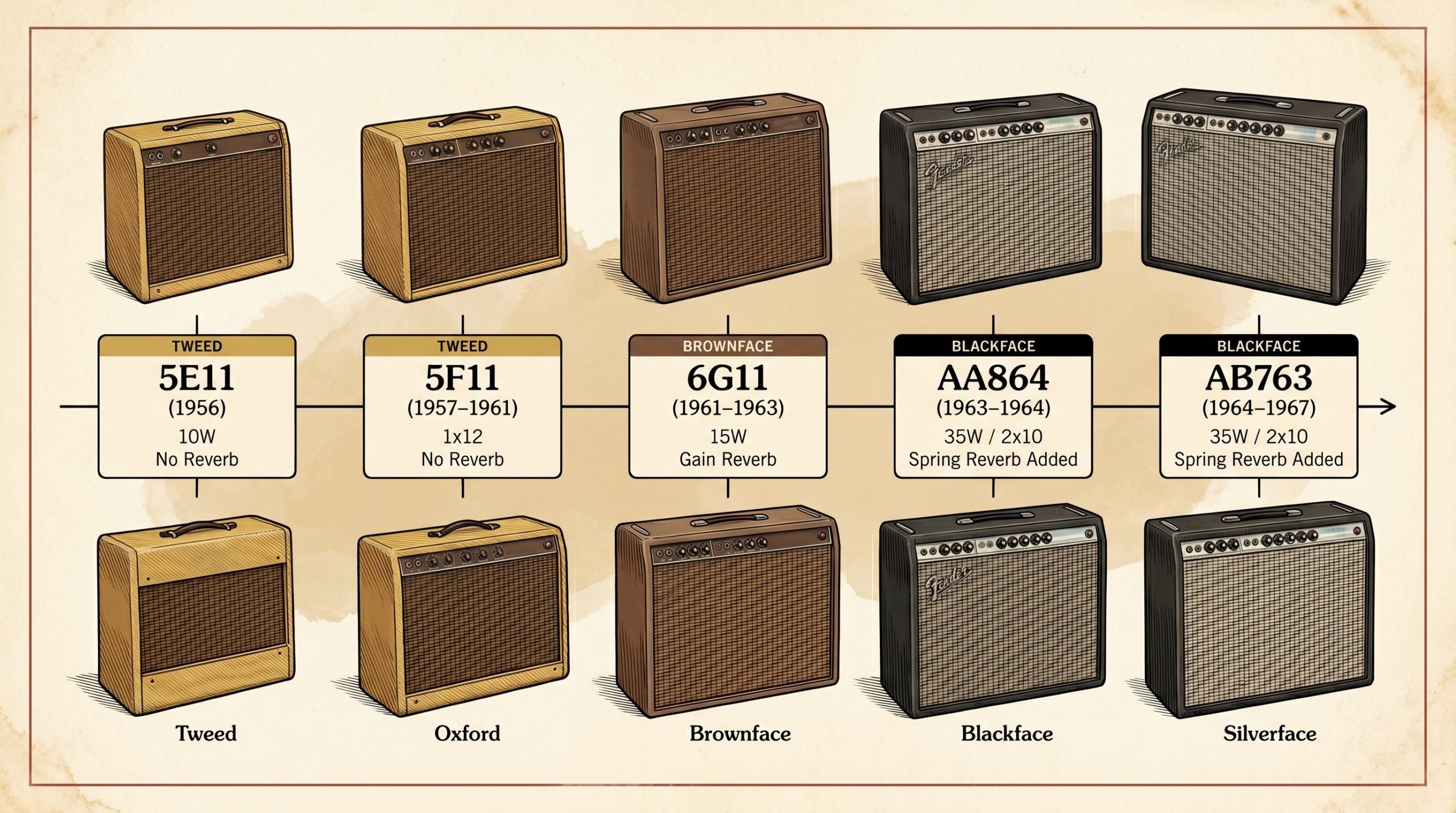
The Tweed Vibrolux (1956–1961): Circuits 5E11, 5F11, and 6G11
The original Vibrolux launched as a narrow-panel tweed combo in 1956 under the 5E11 circuit designation, then transitioned to the wide-panel 5F11 around 1957. Both ran a single 12-inch speaker, produced approximately 10 watts RMS from a pair of 6V6 power tubes, and used a long-tailed-pair phase inverter. No reverb. Vibrato only. That distinction matters when you’re searching for one.
The 5F11 configuration is what separates the tweed Vibrolux from the larger tweed amps in the Fender catalog. Those 6V6s run hot and produce harmonic saturation at usable volumes. Not stage-loud by modern standards, but rich in the midrange where the breakup happens.
The brownface transition brought the 6G11 circuit in 1961, which bumped output to approximately 15 watts and introduced a different bias arrangement. Still a single 12-inch driver. Still no reverb. The brownface era is short-lived and the 6G11 units are relatively uncommon. If you’re searching specifically for a fender tweed vibrolux, the 5F11 is the version most often discussed on vintage forums, and prices reflect that.
The Blackface Vibrolux and Vibrolux Reverb (1963–1967): Circuits AA864 and AA964
This is the version most people mean when they say “Vibrolux.” The blackface era brought a complete redesign: the cabinet jumped to a 2×10″ open-back configuration, power output nearly tripled to approximately 35 watts through a pair of 6L6GC tubes, and the cosmetics shifted to the familiar black tolex with silver grillcloth and brushed aluminum control panel.
The non-reverb AA864 circuit ran from 1963 to 1964. It carries the blackface tone character without the spring reverb section, which means one fewer 12AX7 in the chain and a slightly simpler preamp. Then the AA964 Vibrolux Reverb arrived in 1964 and stayed in production through 1967, adding a two-spring Accutronics reverb pan and an additional recovery/driver stage. The AA964 is the version that shows up in every serious discussion of the model.
Original speaker complement in the AA964: Jensen C10N or Oxford 10L5, both 10-inch drivers in an 8-ohm configuration, wired series-parallel for an 8-ohm output transformer load. The Oxford 10L5 is documented in production units from 1964, as confirmed by period chassis data and EIA code research. A negative feedback loop via a 47-ohm resistor from the output transformer secondary gives the AA964 its tighter, stiffer feel compared to the no-NFB brownface units.
To date a specific unit from this run, the Fender tube amp serial number and dating guide covers the tube chart stamp system in detail. Pull the chassis and look for the ink-stamped circuit code and a two-character date code on the tube chart. The letter indicates year, the number indicates week of production.
The 1966 Fender Vibrolux Reverb sits squarely in the most desirable window of AA964 production, before any silverface transitional changes crept into late-1967 units.
The Silverface Vibrolux Reverb (1968–1979)
The silverface transition brought cosmetic changes first: the aluminum control panel got a blue sparkle stripe and the circuit designation shifted. Early transition units from 1968 and 1969 are sonically very close to the blackface originals. The circuit changes that silverface collectors actually worry about came later, particularly the addition of a bright cap on the Volume control and, in the 1977-onward units, pull-boost and master volume controls.
Documentation at fenderguru.com’s Vibrolux Reverb reference page lists the silverface production circuits as AB568 and AA270, running from 1967 through 1978, with a final silverface configuration carrying through to approximately 1982. That extended production window is wider than many players expect. If you pick up a silverface Vibrolux Reverb dated 1968 or 1969, you may have a unit that differs from a late blackface only in grillcloth and control panel aesthetics.
Undervalued on the used market relative to blackface examples. Worth considering if you’re on a budget and know what to look for.
Fender Vibrolux Specifications: The Numbers That Matter
| Model | Years | Circuit | Power (RMS) | Speakers | Reverb | Era |
|---|---|---|---|---|---|---|
| Vibrolux (narrow panel) | 1956–1957 | 5E11 | ~10W | 1×12″ | No | Tweed |
| Vibrolux (wide panel) | 1957–1960 | 5F11 | ~10W | 1×12″ | No | Tweed |
| Vibrolux (brownface) | 1961–1963 | 6G11 | ~15W | 1×12″ | No | Brownface |
| Vibrolux (blackface) | 1963–1964 | AA864 | ~35W | 2×10″ | No | Blackface |
| Vibrolux Reverb | 1964–1967 | AA964 | ~35W | 2×10″ | Yes | Blackface |
| Vibrolux Reverb | 1968–1979 | AB568 / AA270 | ~35W | 2×10″ | Yes | Silverface |
| Custom Vibrolux Reverb | 2001–2006 | Custom (Zinky) | ~40W | 2×10″ | Yes | Reissue |
| 68 Custom Vibrolux Reverb | 2013–present | Modified SF | ~35W | 2×10″ | Yes | Modern |
Note on power ratings: the 1970 Fender catalog lists the Vibrolux Reverb as a 40-watt amp, which likely reflects nominal rather than conservative RMS measurement. The AA964 power section with two 6L6GC tubes typically measures 35–40 watts depending on B+ voltage and bias point. Either figure is accurate depending on how you define it.
What Does a Fender Vibrolux Sound Like? Tone Character Explained
The 2×10″ speaker configuration is the defining factor in the Vibrolux’s sound. Two 10-inch drivers in an open-back cabinet produce faster transient response and a wider spread than a single 12-inch. The bass response is tighter, less “bloomy” than what you’d get from a Deluxe Reverb’s single 12. If you’ve ever found the low end of a blackface Deluxe a little round and pillowy, the Vibrolux corrects that without going thin.
The 6L6GC power section delivers clean headroom that 22 watts of 6V6 simply can’t touch. You can push the Vibrato channel to 5 or 6 on a strong-signal humbucker and still have clean tone with just enough spongy compression at the front edge of notes. Back the guitar volume down to 7 and the amp cleans up immediately. That dynamic range is the feature, not an accident.
Single-coil Strat and Tele pickups produce the spanky attack the Vibrolux is most associated with. But ES-335 and semi-hollow players who need controlled warmth without getting muddy benefit from the tighter bass response just as much. Documented gear use from session contexts confirms this versatility: the Vibrolux handles clean blues, R&B, and roots country without adjustment between songs.
The negative feedback loop in the AA964 contributes a stiff, articulate quality to the attack. That’s the “tight” feel players reference when comparing it to the Custom Vibrolux Reverb’s looser, faster breakup. Neither is wrong. They’re different tools.
According to the Ask Amp Man column at Premier Guitar, targeted modifications to the Vibrolux Reverb can increase warmth and compression while maintaining the tightness and power of the output stage. That’s good news for players who want to nudge the character without compromising the fundamental circuit.
The Fender Vibrolux Reverb Schematic: Circuit Deep Dive
The AA964 Vibrolux Reverb shares its preamp architecture with the AB763 circuit family — Deluxe Reverb, Super Reverb, Pro Reverb, and Bandmaster Reverb — effectively component-for-component identical despite the different code designation. A technician familiar with any of those amps will navigate the Vibrolux schematic without difficulty.
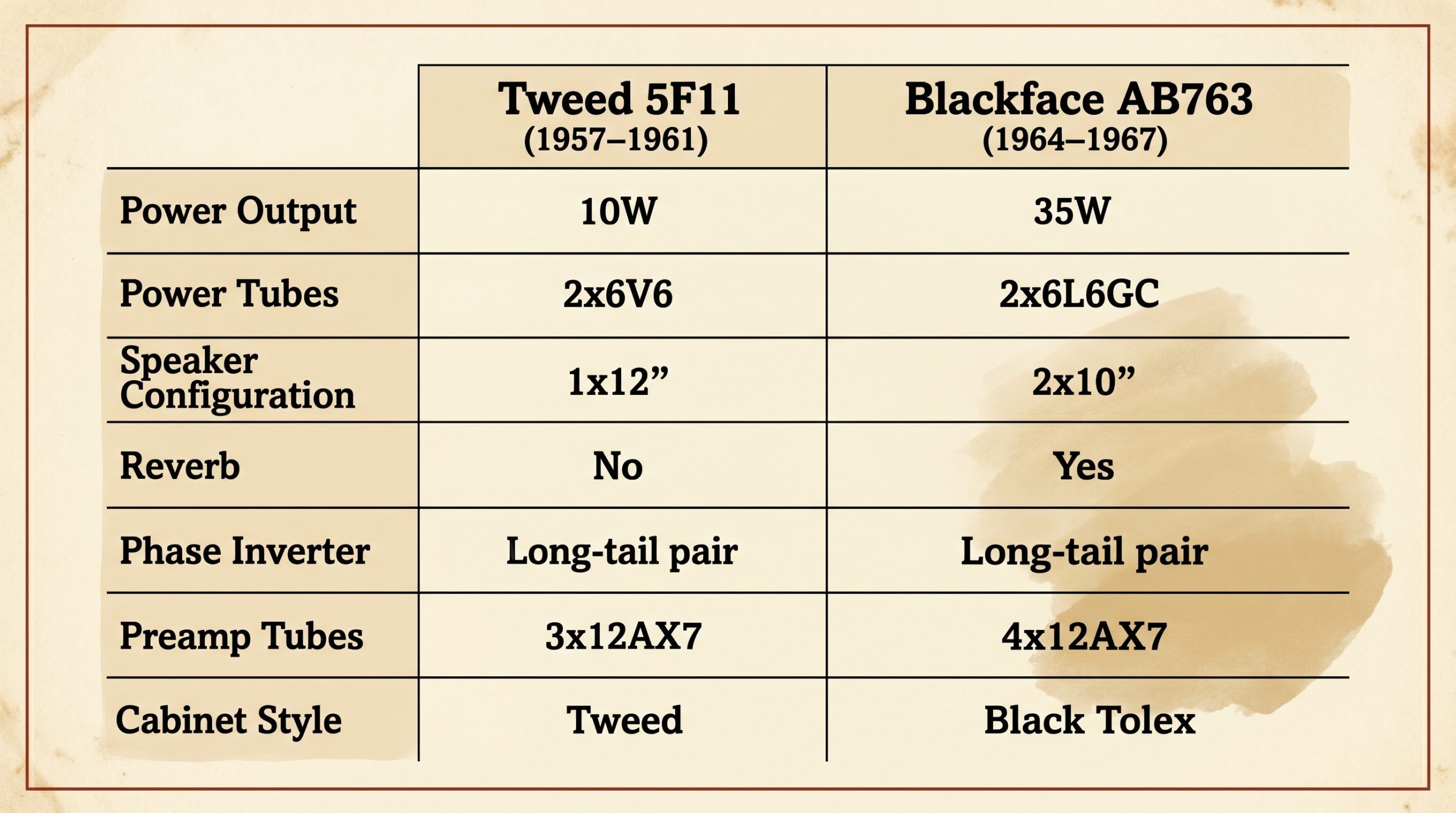
The preamp complement runs four 12AX7 dual triodes and two 12AT7 tubes. The 12AT7s handle reverb driver duty (V3) and phase inversion via long-tail pair (V6) respectively — the same dual-12AT7 topology as the rest of the blackface reverb family. Power section: two 6L6GC tubes in fixed bias configuration. Rectification uses a GZ34/5AR4 tube rectifier, the same rectifier type used in the Deluxe Reverb and Princeton Reverb. Total: nine tubes. That’s an important distinction when you’re verifying an original chassis or sourcing correct replacement components.
Output transformer in original production is typically the Schumacher (EIA code 606-) unit, 4-ohm and 8-ohm secondary taps. Power transformer carries the 125P series designation. The 47-ohm negative feedback resistor from the output transformer secondary is present in the AA964 and absent in the brownface 6G11 units, which is the single circuit element most responsible for the sonic difference between those two eras.
The reverb pan is an Accutronics two-spring Type 4 unit, the same as used across the blackface reverb family. Long reverb pan, genuine spring character, not the tight sound of a shorter tank.
The non-reverb AA864 circuit from 1963 to 1964 predates the reverb recovery stage entirely. If you’re evaluating an AA864, you’ll see the simpler preamp and you won’t find the reverb send/return loop. Don’t mistake it for a modified unit.
Official schematics are available through Fender’s service documentation library. The AA964 circuit code confirms the chassis family membership immediately.
How Much Does a Fender Vibrolux Weigh? Giggability Assessed
This question comes up constantly and the available published information is scattered. So here are the numbers collected from spec sheets and documented sources.
A vintage blackface Vibrolux Reverb (1964–1967) runs approximately 42 to 45 pounds in original condition. That’s an open-back pine cabinet with two 10-inch drivers and a standard AA964 chassis. The Fender 68 Custom Vibrolux Reverb weighs approximately 42 pounds (41.8 lbs per manufacturer specifications), slightly lighter than the vintage range and consistent with the shared cabinet architecture. The Custom Vibrolux Reverb from the Zinky era comes in at approximately the same range.
For context: the Deluxe Reverb reissue runs around 33 pounds. The Super Reverb reissue is approximately 55 pounds. The Vibrolux Reverb sits squarely between them, which matches its position in the lineup in every other dimension too.
One practical note. Tolex handles on original 1960s units often show fatigue after decades of use. Before gigging a vintage Vibrolux Reverb regularly, inspect the handle attachment points. An aftermarket strap-style handle rated for the weight is inexpensive and prevents a dropped chassis situation. Not great to find out the handle is pulling at load-in.
Modern Versions: Reissues, Customs, and the 68 Custom
Fender Custom Vibrolux Reverb (2001–2006): The Controversial One
Designer Bruce Zinky built the Custom Vibrolux Reverb (CVR) as a deliberate departure from the AA964 circuit, not a clone of it. This is where most forum confusion begins. The CVR carries blackface cosmetics, but the circuit philosophy is closer to brownface and tweed voicing: no negative feedback loop, reverb available on both channels, and a modified tone stack. The result is a spongier, more forgiving amp that breaks up earlier and more gradually than a true blackface unit.
Forum scorn toward the CVR is largely unwarranted, and it typically comes from players who expected a budget blackface clone and got something different instead. The CVR is a purpose-built design. Turn the volume to about 5, work the guitar’s volume knob, and you have a wide range from warm clean tones to lightly crunchy territory that responds to picking dynamics. That’s a feature, not a defect.
The known criticisms are valid but manageable. Background hiss from reverb on both channels is real, though not excessive in a live context. The reverb character reads as slightly muted to players accustomed to the AA964 reverb circuit’s more pronounced splash. Power output runs approximately 40 watts through two Eminence 10-inch drivers.
Used market pricing for the CVR has ranged from $550 to $900 depending on condition and region. That puts it well below vintage blackface pricing for a giggable 2×10″ amp with a genuinely useful tonal character.
Fender Vibrolux Reverb Reissue
Fender’s reissue history for the Vibrolux is thinner than the Deluxe Reverb’s. The Vibrolux Reverb Reissue produced in the mid-1990s was part of the same production wave as other blackface reissues, but it never achieved the sustained catalog presence of the Deluxe Reverb Reissue. Units do appear on the used market, and they generally track closer to the AA964 circuit topology than the CVR does. If you find one in good condition, it’s worth evaluating against a CVR and the 68 Custom as a buying option.
Fender 68 Custom Vibrolux Reverb (2013–Present)
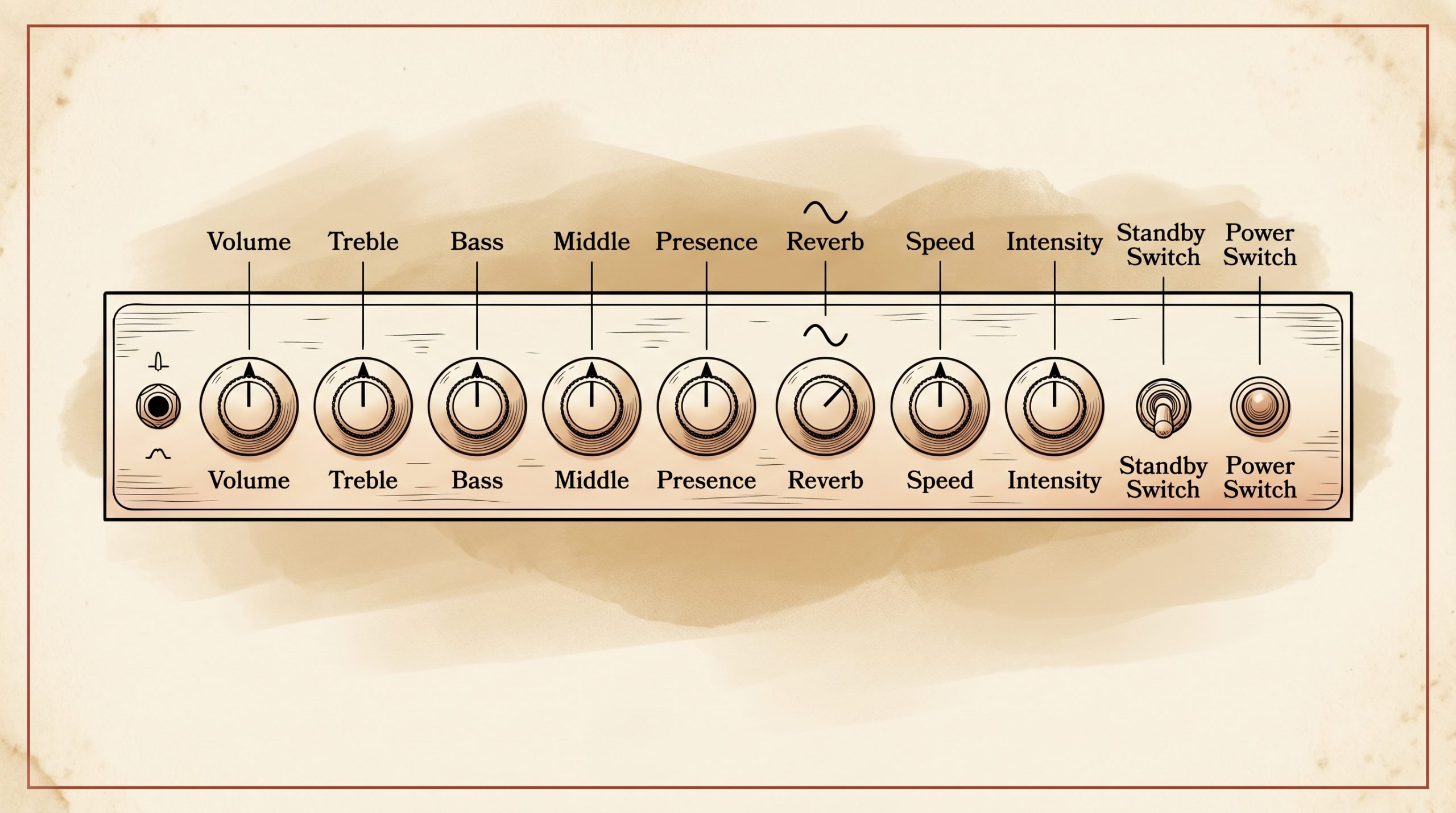
The 68 Custom Vibrolux Reverb is the current production model. It runs silverface cosmetics with a circuit that borrows a page from Zinky’s CVR philosophy: the Modified Reverb channel removes the negative feedback loop to produce earlier, more expressive breakup, while the Normal channel retains the standard AA964-style feedback for a cleaner, tighter response. Two channels, two different personalities in one cabinet.
Speakers are Celestion Ten 30 units, two 10-inch drivers at 30 watts each. The Celestion Ten 30 produces a slightly more present midrange and less scooped character than the original Jensen or Oxford drivers. This generates debate, particularly among players who want the vintage 2×10″ texture. Speaker swaps are common in these units.
The fender 68 custom vibrolux reverb sells new in the $1,099 to $1,199 range depending on dealer and region. For a 35-watt tube amp with genuine spring reverb and two voiced channels, that’s competitive against boutique alternatives. The main buying question is whether you want the Celestions or plan to re-speaker immediately, and whether the no-NFB Modified channel voicing matches what you’re after.
Buying Guide: Vintage vs. Reissue vs. Custom
| Version | Approx. Price (2024) | Best For | Watch Out For |
|---|---|---|---|
| Tweed 5F11 (vintage) | $2,500–$5,000+ | Collectors, low-volume blues | Recapped? Original transformers? |
| Blackface AA864 (non-reverb) | $2,000–$3,500 | Purists, studio use | No reverb onboard |
| Blackface AA964 Vibrolux Reverb | $2,500–$4,500+ | Best vintage tone, gigging | Silverface conversion, re-tolex |
| Silverface (1968–1972 transition) | $1,200–$2,000 | Budget blackface alternative | Post-1972 circuit changes |
| Custom Vibrolux Reverb (Zinky) | $600–$1,000 | Blues and roots with early breakup | Forum reputation (circuit is misunderstood) |
| 68 Custom Vibrolux Reverb | $1,099–$1,199 new | Modern player, vintage feel | Celestion speakers (swap debate) |
When evaluating a vintage blackface Vibrolux Reverb, the original transformers are the first thing to verify. Output transformer EIA codes carry the 606- prefix for Schumacher units original to the chassis. Power transformer is the 125P series. Any replacement transformer affects both tone and collector value.
Speaker EIA codes to look for: Oxford drivers carry the 465- prefix, Jensen drivers carry 220-, and CTS speakers carry 137-. These codes are stamped on the speaker frame and can be decoded with a production date down to the week. Original Oxford 10L5 drivers in a 1964 unit are documented as factory-correct. Mismatched or replaced speakers aren’t disqualifying, but they affect pricing.
For the tube chart circuit stamp, the chassis needs to come out of the cabinet for a clear read. A genuine AA964 Vibrolux Reverb will show that circuit code with the ink-stamp date code beside it. If the stamp reads a non-reverb circuit code and someone has added reverb components, you’re looking at a modified unit, not an original AA964.
The full methodology for reading EIA codes, transformer date codes, and tube chart stamps is documented in the Fender tube amp dating guide, which covers the complete decoding system across all production eras.
The Vibrolux vs. Its Blackface Siblings: Where It Fits
| Model | Circuit | Watts | Speakers | Weight | Reverb |
|---|---|---|---|---|---|
| Princeton Reverb | AA1164 | 12W | 1×10″ | ~28 lbs | Yes |
| Deluxe Reverb | AB763 | 22W | 1×12″ | ~33 lbs | Yes |
| Vibrolux Reverb | AA964 | 35W | 2×10″ | ~44 lbs | Yes |
| Pro Reverb | AB763 | 40W | 2×12″ | ~52 lbs | Yes |
| Super Reverb | AB763 | 40W | 4×10″ | ~56 lbs | Yes |
| Twin Reverb | AB763 | 85W | 2×12″ | ~67 lbs | Yes |
The Vibrolux Reverb lands between the Deluxe Reverb and the Pro Reverb in every measurable category: power, speaker surface area, and weight. That positioning isn’t accidental. It’s the reason the amp’s secondary market value consistently underperforms relative to its tonal quality. Buyers default to the Deluxe Reverb’s name recognition or the Super Reverb’s 4×10″ reputation. The Vibrolux Reverb gets overlooked, which keeps prices lower than they should be for what you get.
The 2×10″ format produces a tonal texture distinct from both 1×12″ and 4×10″ configurations. Two tens give you more surface area and stereo-spread character than the Deluxe’s single 12, but the bass response stays tighter than a Super Reverb’s four-driver wall of low end. For drive pedals, that tighter bass response is a direct benefit: fuzzes and overdrives track cleanly through the Vibrolux where they can get flubby through a more bass-forward 12-inch cabinet. The 35-watt clean headroom means the amp isn’t clipping prematurely under pedal signal, so the overdrive character you dial into the pedal is what actually comes out the speaker. Predictable. Useful.
For more context on the blackface reverb circuit family that the Vibrolux Reverb shares with several of its siblings, the Fender Deluxe Reverb guide covers the circuit architecture in depth, including the differences between the AB763 variants across models.
Unique Angles: What the Competitors Missed
The Vibrolux as the Ideal Pedal Platform
Thirty-five clean watts is the relevant specification here. Drive pedals, and fuzzes in particular, need an amp that isn’t adding its own clipping at the same time the pedal is doing its work. A Deluxe Reverb pushing 22 watts can start contributing amp compression and saturation at moderate stage volumes, which muddles the pedal’s character. The Vibrolux Reverb holds cleaner longer, so the drive pedal tracks exactly as dialed.
The 2×10″ speaker response adds to this. Tighter bass response equals better fuzz tracking. No flubby low end. The Super Reverb’s four 10-inch drivers do similar work but at stage volumes that require more amplification before they wake up. The Vibrolux sits at a lower overall SPL ceiling, which makes it appropriate for theaters, studios, and house-of-worship environments where volume control matters and a 40-watt Super Reverb is simply too much amp for the room.
Speaker Swapping: The Most Popular Upgrades
The stock Oxford and Jensen drivers in vintage units age, and replacements are common. The most period-correct reissue option is the Jensen C10Q, which replicates the general character of the original ceramic-magnet drivers without requiring NOS hunting. For players who want more low-mid warmth, the Eminence Legend 1058 is a frequently cited upgrade that retains sensitivity while adding body.
The 68 Custom’s Celestion Ten 30 stock drivers lean toward a more present, forward midrange character compared to the vintage Jensen/Oxford voicing. Swapping them for Jensen C10Qs or equivalent drivers is the most common first modification on the 68 Custom.
One critical specification: the Vibrolux Reverb runs two 8-ohm drivers wired series-parallel, which produces an 8-ohm nominal cabinet load. Any replacement pair must maintain that configuration. Running mismatched impedances into the AA964 output transformer is a mismatch that stresses the output stage over time. Match the output transformer tap to the cabinet load. Every time.
The Vibrolux in Recording Sessions
The Vibrolux Reverb’s lower SPL ceiling compared to a Super Reverb or Pro Reverb makes room mic placement straightforward. The 6L6 power section at 35 watts produces natural compression that hits microphones at levels that work without significant pad. The two-spring reverb pan is short enough to sit behind a dry signal without washing out the transient, which means you can use the onboard reverb in a tracked session without it becoming a room-mic problem. Studio engineers who’ve worked with the amp in tracked contexts often keep one around specifically for this reason.
What You Should Do
If you’re a vintage purist after the best-available blackface 2×10″ tone, target a 1964 to 1967 AA964 Vibrolux Reverb with original transformers and verifiable tube chart circuit stamp. Budget-conscious players who want the 2×10″ format with earlier breakup should look seriously at the Custom Vibrolux Reverb in the $600 to $900 used range. The forum criticism is largely misinformed. If you want a new amp off the floor with vintage character and two voiced channels, the 68 Custom Vibrolux Reverb at around $1,100 delivers a genuinely useful tool, Celestion Ten 30 debate aside. For additional context on the broader blackface reverb family and how the Fender Super Reverb compares at the louder end of the lineup, that model guide covers the 4×10″ configuration in detail. The Vibrolux doesn’t get the press it deserves. That’s your advantage on the used market.
Frequently asked questions
What is the difference between the Fender Vibrolux and the Fender Vibrolux Reverb?
The non-reverb Vibrolux ran the AA864 circuit from 1963 to 1964. Same 2x10" cabinet and 6L6 power section as the later Vibrolux Reverb, but without the spring reverb circuit, reverb pan, or associated preamp tube stages. The AA964 Vibrolux Reverb appeared in 1964 and added a two-spring Accutronics reverb pan, reverb driver and recovery stages, and the reverb control on the Vibrato channel. The AA864 is less common and commands collector interest, but it's a different amp for gigging purposes if reverb is part of your live sound.
Is the Fender Custom Vibrolux Reverb a true blackface amplifier?
No. It carries blackface cosmetics but the circuit designed by Bruce Zinky is closer to brownface and tweed voicing. The negative feedback loop present in the AA964 is absent in the Custom Vibrolux Reverb, which produces earlier, spongier breakup and a more forgiving feel under picking dynamics. Reverb appears on both channels, which differs from the AA964's single-channel reverb implementation. This is a deliberate design decision, not a manufacturing shortcut. Players who understand what the CVR is built to do generally appreciate it. Players expecting a blackface clone are disappointed. Worth knowing before you buy.
What years were Fender Vibrolux Reverb amps made?
The blackface AA964 Vibrolux Reverb ran from 1964 through 1967. The silverface versions continued from approximately 1967 through the late 1970s, with circuit variants (AB568, AA270) through that span. The Fender Custom Vibrolux Reverb was produced from roughly 2001 to 2006. The 68 Custom Vibrolux Reverb entered production in 2013 and remains in the current Fender catalog. A 1966 Fender Vibrolux Reverb falls in the middle of the most desirable blackface production window.
How heavy is a Fender Vibrolux Reverb?
A vintage blackface Vibrolux Reverb runs approximately 42 to 45 pounds in original condition. The 68 Custom Vibrolux Reverb weighs approximately 42 pounds (41.8 lbs per manufacturer specifications). Both figures are consistent with a standard open-back 2x10" cabinet with full AA964-type chassis. For comparison, a Deluxe Reverb reissue is around 33 pounds and a Super Reverb reissue is approximately 55 pounds. The Vibrolux is manageable for a single person at a standard load-in, but check those handle attachment points on vintage units before you trust them.
Where can I find the Fender Vibrolux Reverb schematic?
The official schematic is available through Fender's service documentation resources. The circuit designation is AA964, which shares identical architecture with the AB763 circuit used by the Deluxe Reverb, Super Reverb, Pro Reverb, and Bandmaster Reverb. Any technician with access to AB763 family documentation can work directly from those schematics with the Vibrolux Reverb — the circuits are component-for-component identical despite the different designation. The non-reverb AA864 predates the reverb recovery stage and has a shorter signal path through the preamp section.