Contents
- 01The Complete History of the Fender Bassman (1952–Present)
- 02Era-by-Era Fender Bassman Model Guide (1960–2024)
- 03The Fender Bassman Schematic and Circuit Deep Dive
- 04Fender '59 Bassman Reissues, The LTD and Standard Models
- 05Fender Bassman Cabinet Guide
- 06Is the Fender Bassman Actually Good for Bass?
- 07Fender Bassman Buying Guide, Vintage, Used, and New
- 08Fender Bassman vs. The Competition
- 09Frequently Asked Questions About the Fender Bassman
- 10Which Bassman Should You Choose
The circuit code is 5F6-A. Four inputs, two channels, four Jensen P10Rs in a lacquered tweed cabinet. Forty-five watts from a pair of 5881s. That single design, finalized in 1958 and built through 1960, spawned more clones, derivatives, and reverential copies than arguably any other amplifier in history. Jim Marshall financed its reverse-engineering. Ken Bran and Dudley Craven built the result. Keith Richards plugged into it. Boutique builders still chase it.
The Bassman’s story runs from 1952 through the present day, covering tweed combos, blackface heads, silverface workhorses, modern hybrid bass rigs, and a reissue program that’s been running for over 30 years. This guide covers every era, every major model, the circuit details that matter, and what to look for whether you’re buying a vintage 1959 narrow-panel or a new Super Bassman head.
- Production start: 1952, originally designed for the Fender Precision Bass
- Most famous circuit: 5F6-A (narrow-panel tweed, 1958–1960), 45W, 4×10″ combo with a pair of 5881 output tubes
- Marshall JTM45 lineage: the early JTM45 followed the 5F6-A schematic closely, with relatively few component-value changes plus a different first-stage tube (12AX7 vs 12AY7) and KT66 outputs
- Silverface era models: Bassman head (50W), Bassman 50, 70, 100, 135, plus the Bassman 10 combo, spanning 1968–1983
- Modern flagship: Super Bassman 300W (6× 6550) and Bassman 800 hybrid
- Verified 1959 originals: $4,500–$7,500+ at auction (2023–2024); replaced transformers reduce value $500–$1,000
- ’59 Bassman LTD reissue MSRP: $2,199.99 (Fender model #2171000010); used reissues run $900–$1,400
- Speaker code fraud: reissue Jensen P10Rs have been swapped into vintage cabs and presented as original, always verify EIA codes (220 = Jensen, format: manufacturer + year + week)
- The Bassman 135 has documented issues with its bias balance circuit, screen-grid resistor failure, and high plate voltages — a tech inspection is mandatory before purchase
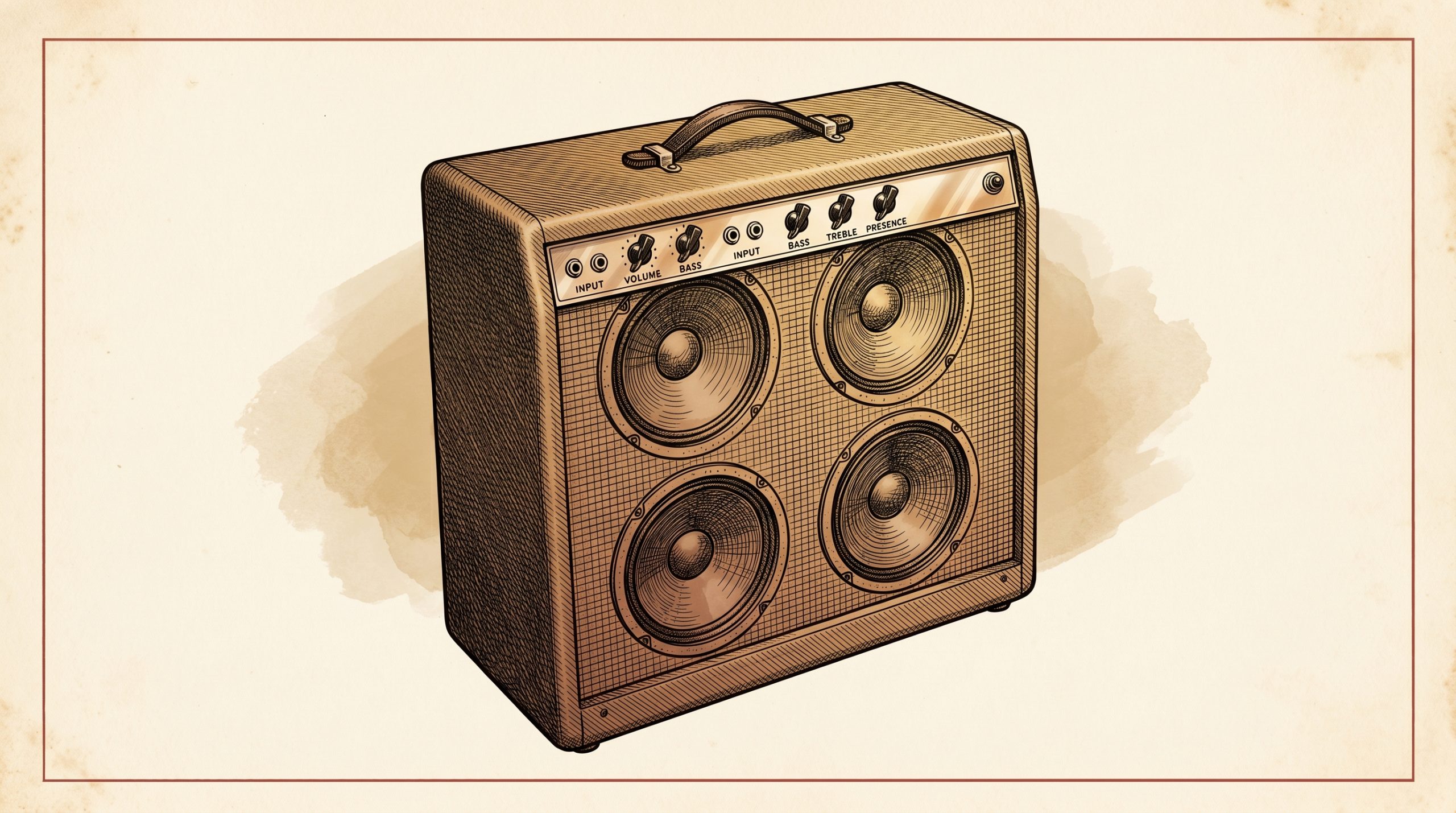
The Complete History of the Fender Bassman (1952–Present)
1952–1954: The TV-Front Era and the Industry’s First Dedicated Bass Amp
The Bassman launched alongside the Precision Bass in 1952. Fender needed an amplifier that could handle the electric bass guitar’s output, and the result was the 5B6, a relatively simple design using a 5U4G rectifier, a pair of 5881 (or 6L6) output tubes, and a 1×15″ Jensen P15N speaker in a closed-back cabinet with two rear ports — the first Fender amp with a closed-back design, built specifically to enhance low-frequency response. Output was roughly 26 watts. The control panel was two-knob: Volume and Tone. Not complicated. But genuinely purpose-built for a new instrument that had no amplification standard yet.
The 5B6 stayed in production from 1952 through 1954 with only minor revisions, and these TV-front cosmetic units are rare today. The chassis stamps and Fender tube amp serial number system from this period are less standardized than later production, making dating more dependent on transformer and speaker date codes than serial numbers alone. The 5B6 is historically significant but rarely gigged, it’s collector territory.
1954–1957: The First 4×10″ Bassman and the Wide-Panel-to-Narrow-Panel Transition
The 5D6 arrived in fall 1954 and represents the single most important format change in Bassman history: Fender abandoned the 1×15″ design in favor of a 4×10″ configuration with four Jensen P10R speakers, in response to complaints that the original 1×15 couldn’t sufficiently handle low frequencies. The 5D6 ran approximately 40 watts and used the narrow-panel tweed cabinet style that would define the rest of the tweed era. The 5D6-A followed in 1955 with minor revisions, while the cabinet styling transitioned away from the older wide-panel TV-front look.
The 5E6 and 5E6-A followed from 1955 through 1957, with the 5E6-A in particular running through most of the mid-fifties. Power was in the 30-watt range, the chassis got a Presence control, and the 5E6-A introduced a cathode-follower tone stack arrangement that many techs regard as a direct preview of the narrow-panel sound to come. While the 5E6-A is overshadowed by the 5F6-A in collector conversation, it represents a genuinely transitional circuit. Worth knowing if you’re dating an amp from this period.
1957–1960: The 5F6 and 5F6-A Era
This is the one. The 5F6 appeared in 1957 with a 3-knob tone stack (Bass, Middle, Treble) and a long-tailed pair phase inverter, and the 5F6-A followed in 1958 with refinements that locked in the version everyone now obsesses over. The 5F6-A, built into a narrow-panel lacquered tweed 4×10 combo from 1958 through 1960, is the most analyzed, most cloned, and most discussed guitar amp circuit in history. The 1959 Fender Bassman is the peak collectible year, but the circuit ran into 1960 with consistent specs.
Output: approximately 45 watts from a pair of 5881 tubes (a military-spec 6L6 variant), with a GZ34/5AR4 rectifier. Four inputs across two channels (Normal and Bright). Control panel: shared Treble, Bass, Middle, Presence, with individual Volume controls per channel. The output transformer spec is the 125A24B. Speakers are 4× Jensen P10R in a 4×10 combo cabinet with rear-mounted port panels (production also shipped some 1959 examples with Jensen P10Q speakers, which handle more power and produce cleaner tones, so an original 4× P10R quad is not the only correct configuration for that year).
The circuit’s key architecture: a long-tailed pair (LTP) phase inverter, a cathode-follower passive tone stack with a Middle control, a fixed-bias output stage, and a Presence control that feeds back from the output transformer secondary. Jim Marshall and his shop repairman Ken Bran chose the 5F6-A as the template for what would become the JTM45, with electronics apprentice Dudley Craven doing the actual circuit design work and Ken Underwood joining for final assembly. The first JTM45 prototype followed the 5F6-A schematic almost to the letter, with a handful of intentional changes (British-made transformers and capacitors, an ECC83/12AX7 in the first preamp position where Fender used a 12AY7, and significantly more negative feedback in the Presence loop). KT66 outputs replaced the 5881s shortly after, defining the British-amp character that followed.
Why it sounds the way it does: the interaction between the 5881 plate voltage, output transformer saturation characteristics, and the GZ34 rectifier’s sag creates the compression and harmonic texture that guitarists have chased for 65 years. At moderate volumes it’s clean with stiff bass response and spanky attack. Push it and it barks in a way that no solid-state circuit has convincingly replicated.
Verified 1959 Fender Bassman 4×10 combos have sold for $4,500–$7,500+ at auction in 2023–2024 sales data. Condition, originality of transformers, and speaker date codes drive that range considerably. A unit with the original 125A24B output transformer and Jensen P10Rs (or period-correct P10Qs) with EIA codes matching 1959 production is worth meaningfully more than an otherwise identical example with a replaced power transformer.
Era-by-Era Fender Bassman Model Guide (1960–2024)
After 1960, Fender made a format-defining decision: the Bassman became a separate head and cabinet. That shift changed the amp’s identity from an integrated combo to a modular system, and it’s the format that most vintage buyers encounter today.
1960–1964: Brownface and Blonde Bassman
Circuits 6G6, 6G6-A, and 6G6-B, with a rare 6G6-C transitional variant appearing in 1964. This is the first appearance of the Fender Bassman head configuration, a standalone amplifier chassis designed to drive a separate Fender Bassman cabinet. Power was approximately 50 watts from a pair of 5881 (or 6L6GC) output tubes — not four, despite the higher wattage rating. A Presence control was added. Brown tolex cosmetics appeared on the earliest 6G6 units, transitioning to a blond aesthetic with oxblood grille cloth from 1962 through 1964.
The 6G6-B introduced revisions that moved the Treble control back one full gain stage in the circuit, changing the way the tone stack interacted with the overall gain structure. The standard cabinet was a 2×12″ piggyback configuration. These are less collectible than the 5F6-A but genuinely interesting amps — the brownface and blonde era is underappreciated partly because it sits between two more famous chapters. The 6G6-B has its own devoted following thanks to Brian Setzer using one as his primary amp for decades, and the Beatles cutting more sessions through blonde Bassmans than Vox AC30s.
1964–1967: Blackface Bassman
Circuit AA864, followed by AA165 and AB165. Black tolex, silver grille, black knobs. This is the classic blackface format: 50 watts from a pair of 6L6 output tubes (not four — Fender’s wattage ratings climbed through circuit revisions and tube selection, not by adding tubes), clean headroom, tight bass response, in a 2×12″ piggyback cabinet. The 1964 Fender Bassman with the AA864 circuit is the most collectible blackface year, pre-CBS, with full Fender quality control before the January 1965 CBS acquisition introduced management and parts-sourcing changes.
The 1966 Fender Bassman falls in the transition zone. CBS acquired Fender in January 1965, but circuit changes weren’t immediate or uniform — the AA864 was replaced by the AA165 in early 1965 and then the AB165 from mid-1965 onward. Chassis stamps from 1966 production show a mix of pre-CBS and CBS-era parts, and identification requires checking transformer codes, tube chart dates, and potentiometer codes together rather than relying on any single marker. The Fender amp dating quick-reference covers the transformer and pot code reading method for this era in detail.
1968–1983: Silverface Bassman Era
The silverface era covers multiple distinct circuits and wattage variations across the head lineup, plus a separate combo. The transition year 1968 Fender Bassman used drip-edge grille cosmetics with AA864-derived parts still appearing in some builds, making it a hybrid cosmetic/circuit transition. The AA371 arrived during 1968–1969 with revisions to the negative feedback loop and bias arrangement compared to the AA864.
The silverface era produced four distinct head models plus the Bassman 10 combo worth knowing:
The Fender Bassman 50 (circuit AC568, approximately 1972–1976) runs 50W from a pair of 6L6 output tubes. The Bassman 50 head is one of the most practical vintage tube heads for budget-conscious guitar players today. Earlier breakup than the higher-wattage models, more dynamic at lower volumes. Used pricing runs $600–$900 in functional condition. If signal-path problems crop up on a vintage purchase, see our Fender amp no-sound troubleshooting guide for the standard diagnostic sequence.
The Fender Bassman 70 (1977–1983) replaced the Bassman 50 in the lineup, pushing to 70W with an ultra-linear output transformer, a master volume circuit, and pull-bright switches. Still 2× 6L6 in the power section — the wattage bump came from circuit revisions and the new output transformer, not extra tubes. More headroom than the 50, less than the 100. It occupies a useful middle ground for players who find the 50 a bit soft on a loud stage but don’t need 100 clean watts.
The Fender Bassman 100 (approximately 1972–1979) was Fender’s silverface workhorse at 100W from 4× 6L6 output tubes. Originally paired with a 4×12″ ported cabinet. More headroom than any previous Bassman except the 135, genuinely useful for bass in a loud band context.
The Fender Bassman 135 (1977–1983) is the top of the vintage silverface hierarchy: 135 watts from 4× 6L6, ultra-linear output section, pull-boost switches, and a mid control on the bass channel. Widely regarded as the best vintage Bassman head for actual bass use, it provides headroom that earlier models simply can’t match. The Bassman 135 has documented service issues that any used purchase should account for: the bias balance circuit is notoriously fussy, the original screen-grid resistors are prone to cooking under modern tubes, and the high plate voltage that Fender designed for the now-obsolete Philips STR 6L6 stresses contemporary tube production. A tech inspection before gigging is mandatory, not optional.
The Fender Bassman 10 (also referenced as the Fender Bassman Ten) was the silverface combo answer, running approximately 50W from a pair of 6L6 through four 10″ speakers in a closed-back cab — a nod to the original 4×10 format but with a very different cabinet design and tonal character. Produced from roughly 1971 through 1979.
| Model | Years | Circuit | Power | Output Tubes | Best Use |
|---|---|---|---|---|---|
| Bassman 50 | 1972–1976 | AC568 | 50W | 2× 6L6 | Guitar / Low-vol bass |
| Bassman 70 | 1977–1983 | Ultralinear MV | 70W | 2× 6L6 | Guitar / Bass |
| Bassman 100 | 1972–1979 | Bassman 100 | 100W | 4× 6L6 | Bass / Guitar |
| Bassman 135 | 1977–1983 | Ultralinear | 135W | 4× 6L6 | Bass, high headroom |
| Bassman 10 (combo) | 1971–1979 | Silverface combo | 50W (later 70W) | 2× 6L6 | Studio / Low-vol gig |
1980s–1990s: Bassman 20 and Bassman 25
The post-CBS fragmentation period eventually produced smaller, more accessible Bassman variants aimed at the practice and entry-level market. The Fender Bassman 20 and Fender Bassman 25 were solid-state designs at 20W and 25W respectively, with 1×10″ speakers and tilt-back cabinets — Fender’s attempt to capture entry-level bass players. These are often overlooked in collector conversation but represent a genuine design evolution toward affordability. The Bassman 25 in particular packed a surprising feature set for the price: 3-band EQ, XLR line out, headphone jack, FX loop, and an Enhance switch for mid-frequency contouring.
1990s–2000s: The High-Wattage Modern Bass Era
As bass amplification standards rose with louder stages and extended-range instruments, the Bassman line expanded into territory far beyond its tweed roots. The Fender Bassman 60 offered a 60W solid-state 1×12″ combo for entry-level gigging. The Fender Bassman 150 followed at 150W with a neo speaker in a 1×12 cabinet. The Fender Bassman 200 pushed further. The Fender Bassman 250 (available as a 1×15 or 2×10 combo at 250W) and Fender Bassman 400 (400W bi-amp capable head) served touring players. The Fender Bassman 500 introduced a hybrid architecture, tube preamp driving a Class D solid-state power section, at 500W, a format that proved popular enough to influence the next generation of Bassman heads.
The Fender Bassman 300 Pro stands apart from this group: a 300W all-tube head running 6× 6550 output tubes. It was Fender’s most powerful all-tube bass amp and remains competitive with boutique options on the used market at $900–$1,200.
| Model | Power | Type | Tubes | Approx. Street Price (used) |
|---|---|---|---|---|
| Bassman 250 | 250W | Solid-state | None | $250–$350 |
| Bassman 500 | 500W | Hybrid (tube pre / Class D) | 2× 12AX7 pre | $400–$550 |
| Bassman 800 | 800W | Hybrid (tube pre / Class D) | 2× 12AX7 pre | $650–$800 |
| Bassman 300 Pro | 300W | All-tube | 6× 6550 | $900–$1,200 |
The Super Bassman, Bassman 800, and Bassman 100T (2010s–Present)
The Fender Super Bassman, introduced around 2013, represents Fender’s clearest statement of intent for the modern all-tube bass market: 300W from six 6550 output tubes, with two 12AX7 preamp tubes plus a 12AX7 and a 12AT7 in the power-amp section. Two channels (Vintage, with a passive tone stack, and Overdrive, with an active tone stack), automatic bias monitoring, and 4/8/16Ω output options. It pairs with Fender’s 6×10 and 2×15 Neo Fender Bassman cabinets. Stage-loud, high-headroom, and capable of the kind of clean low-end extension that the tweed-era combos physically couldn’t manage.
The Fender Bassman 800, introduced around 2016, went a different direction: 800W from a Class D power section with a tube preamp front end, built-in compressor, and DI output. It’s aimed at modern touring bass players who need maximum output with minimum weight. Not a tube purist’s choice, but practical at a level the all-tube options can’t match.
The Fender Bassman 100T (introduced around 2012) is the most interesting for guitar players: a 100W all-tube head with 4× 6L6 output tubes, a switchable 25W mode, and a Vintage/Overdrive two-channel layout. At the boutique-adjacent price tier, it’s the most direct modern descendant of the Bassman head format as a guitar amplifier. The 25W mode gives it bedroom-friendly volume options that the original silverface heads could never offer. Players cross-shopping it against the broader Fender tube combo lineup should also weigh the Fender Hot Rod Deluxe at a much lower price point, since the two amps occupy genuinely different ends of the modern Fender voicing spectrum.
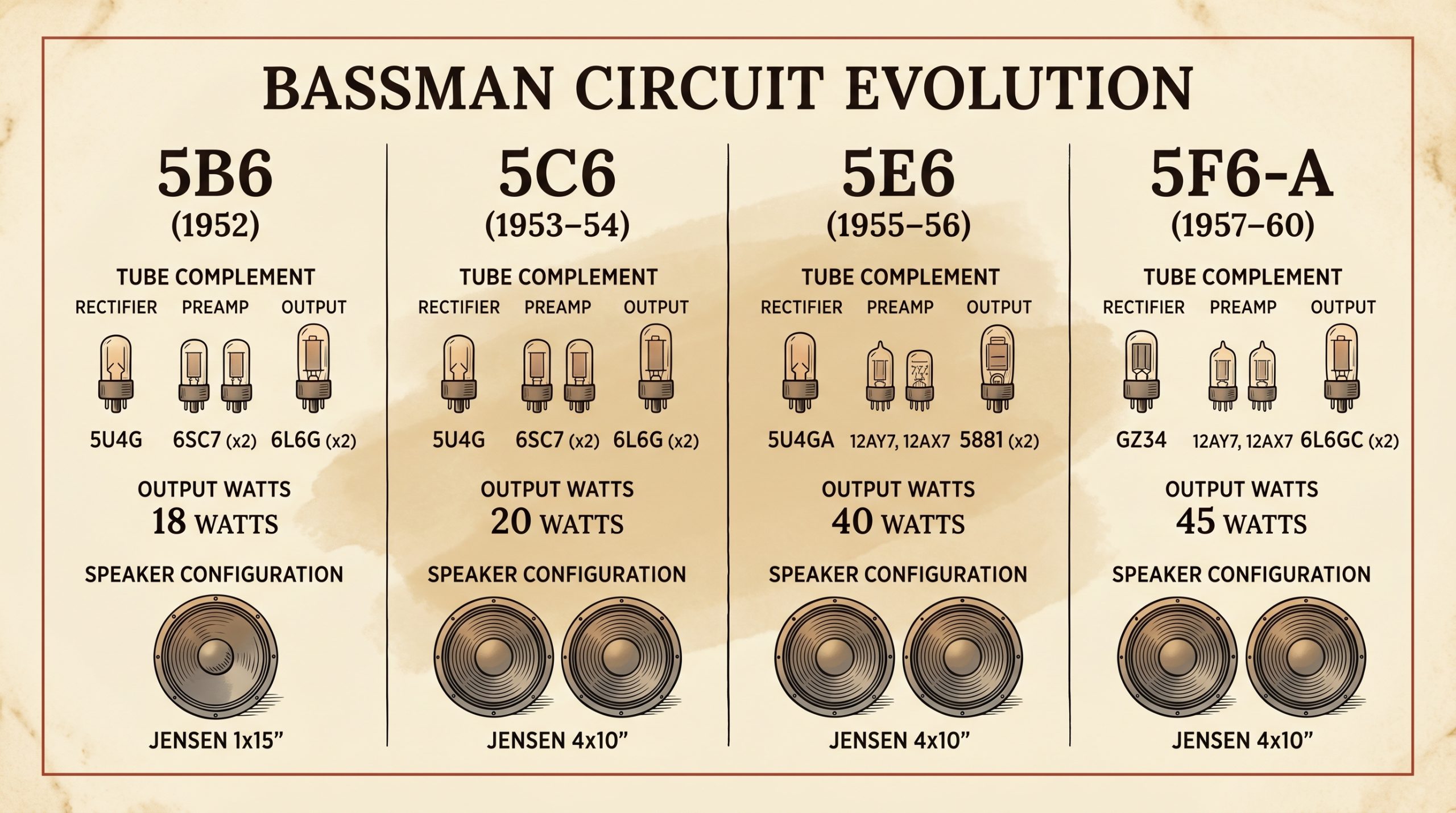
The Fender Bassman Schematic and Circuit Deep Dive
The 5F6-A Schematic, Why It Changed Everything
The Fender Bassman schematic for the 5F6-A is available via Schematic Heaven’s Fender amp archive and is one of the most studied documents in amplifier history. Its architecture breaks down into four sections worth understanding:
Long-tailed pair phase inverter: The LTP topology uses a shared cathode resistor between two triode sections to create a balanced push-pull signal. Marshall carried this directly into the JTM45. It’s tighter and more dynamic than the cathodyne (split-load) inverter used in earlier Fender designs like the 5B6 and 5D6.
Cathode-follower tone stack: A passive network with Bass, Middle, and Treble controls preceded by a cathode-follower buffer. The cathode follower provides low output impedance, which means the tone controls interact less with the preceding gain stage. The Middle control is the feature that most distinguishes the 5F6-A from simpler Fender circuits of the same period.
Fixed-bias output stage: Unlike cathode-biased designs that self-adjust, the 5F6-A uses a fixed negative grid bias voltage. This means bias drifts with tube age and must be checked and set. It also means the output tubes run harder and the amp’s character changes as the bias shifts, contributing to the “break-in” quality that players notice in original examples.
Presence control feedback loop: The Presence control varies a capacitor in the negative feedback network from the output transformer secondary, selectively reducing feedback at high frequencies. Increasing Presence adds high-frequency information without boosting treble at the preamp stage, a subtle but audible difference that contributes to the 5F6-A’s clarity when pushed.
The Marshall JTM45 differences from the 5F6-A have been documented by amp historians and are confirmed in comparative schematics: a 12AX7 in V1 where Fender used a 12AY7, KT66 output tubes (after early prototypes with 5881s), British-made transformers and capacitor values, a different output transformer impedance, and substantially more negative feedback in the Presence circuit. The fundamental architecture, particularly the LTP inverter and cathode-follower tone stack, is essentially identical.
Silverface Circuit Changes Worth Knowing
The transition from AA864 through AA165 and AB165 (1965–1968) involved changes to the bias arrangement and the wiring of the second preamp tube, which the AB165 routed through both channels. Later silverface production added master volume circuits with pull-boost switching (Bassman 70). The Bassman 135’s circuit introduced additional output tube headroom with an ultra-linear output section that performed well on paper but pushed plate voltages high enough to stress modern tubes, contributing to the well-known reliability quirks that any competent Fender tech can address, but worth knowing before you hand over cash for one.
Fender ’59 Bassman Reissues, The LTD and Standard Models
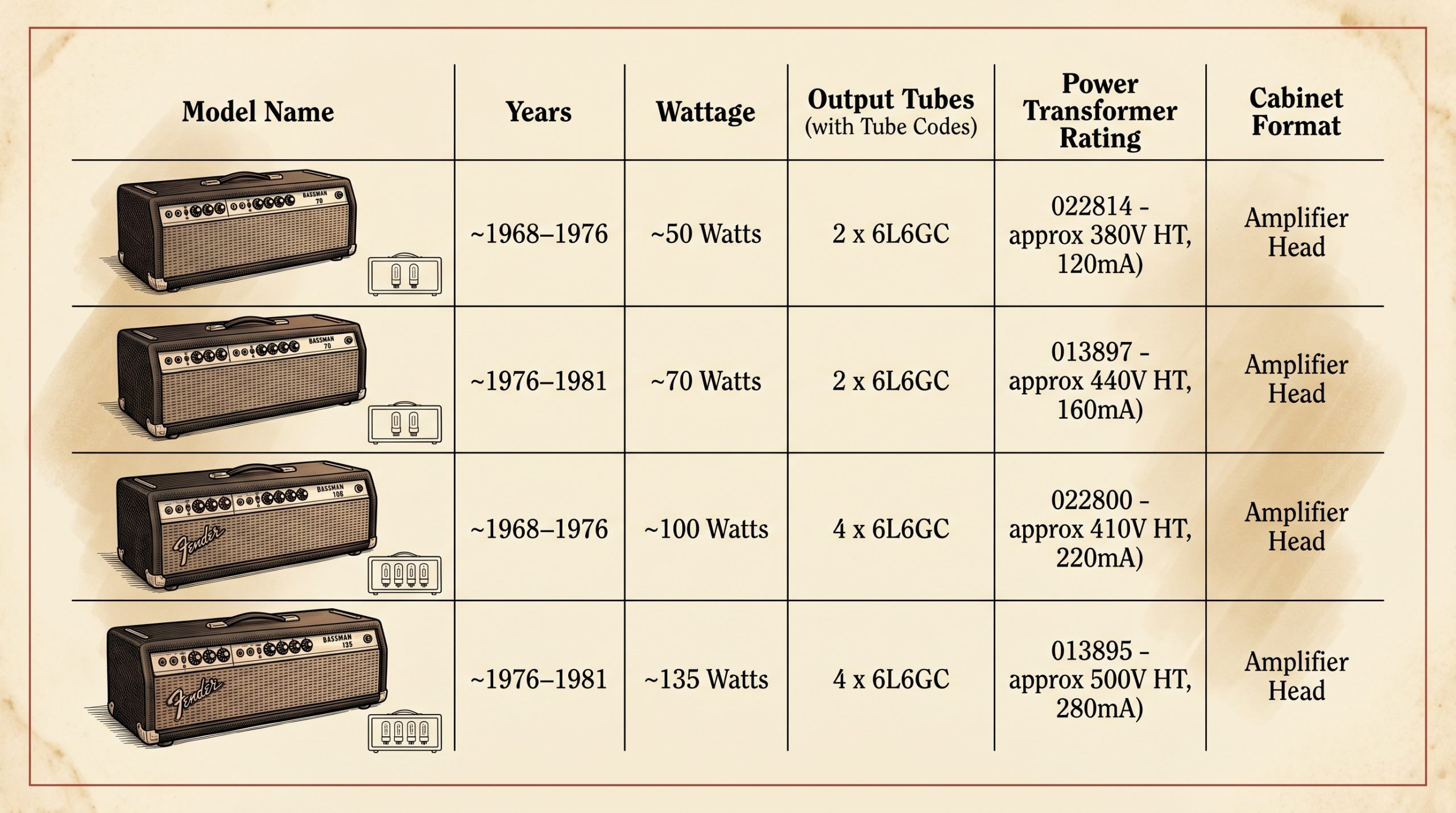
The Fender ’59 Bassman Reissue (1990–Present)
Fender launched the ’59 Bassman reissue around 1990 as part of the Vintage Reissue series. The circuit is a faithful reproduction of the 5F6-A: 4× Jensen P10R (reissue) speakers in a 4×10 lacquered tweed combo cabinet, approximately 45W from a pair of 6L6 output tubes, with three 12AX7 preamp tubes and a 5AR4 rectifier. Point-to-point wiring on a turret board rather than the original hand-wired terminal strip construction.
The Fender ’59 Bassman LTD is the premium variant. Fender’s current model number is 2171000010 with an MSRP of $2,199.99 (2026 pricing, with street prices typically running $1,899–$2,099 at major retailers). The LTD version uses higher-grade transformers and improved capacitor specifications compared to the standard reissue run. The lacquered tweed covering in the LTD is closer to the original in texture and adhesion than earlier reissue runs.
At full output the reissue’s 45 watts provide clean tones capable of holding their own next to a drummer, with beautiful tube saturation when pushed. Assessments of the LTD specifically note it as a bright and punchy amp where the punch can occasionally feel overdone relative to what players expect from a warm tweed character, worth auditioning before buying if you’re expecting a compressed, dark-sounding amp.
Original 1959 vs. ’59 Bassman LTD Reissue: Spec Comparison
| Feature | 1959 Original (5F6-A) | ’59 Bassman LTD Reissue |
|---|---|---|
| Circuit | 5F6-A (hand-wired terminal strip) | 5F6-A (faithful repro, turret board) |
| Output Tubes | 2× 5881 (vintage NOS) | 2× 6L6 (current production) |
| Preamp Tubes | 2× 12AX7, 1× 12AY7 | 3× 12AX7 |
| Rectifier | GZ34 / 5AR4 | 5AR4 |
| Speakers | Jensen P10R or P10Q (vintage original) | Jensen P10R (reissue) |
| Output Transformer | Original 125A24B (Schumacher or Triad) | Fender-spec reissue |
| Tweed | Original lacquered | Lacquered (LTD grade improved) |
| Price (2026) | $4,500–$7,500+ | ~$2,200 MSRP / $1,899 street / $900–$1,400 used |
| Collectibility | High | Low to moderate |
Fender Bassman Cabinet Guide
The Fender Bassman cabinet has appeared in more configurations than almost any other Fender cabinet line. Matching the right cab to the right head matters, both sonically and for impedance safety.
The 1952 5B6 used a single 1×15″ Jensen P15N in a closed-back, ported cabinet. The 1954–1960 tweed era moved to a 4×10″ open-back combo housing four Jensen P10R speakers (and on some 1959 examples, P10Qs). The brownface and blonde head era introduced 2×12″ piggyback cabs as the standard. Blackface production retained the 2×12″ format, while silverface production expanded into 2×15″ configurations (Bassman 50/70 era), 4×12″ (Bassman 100), and the closed-back 4×10″ of the Bassman 10 combo. Oxford 12T6, Utah, Rola, and JBL D120/D140 speakers all appeared depending on production date and model.
Modern Fender Bassman cabinets for the Super Bassman and Bassman 800 era come in 6×10 Neo and 2×15 Neo formats. The Neo speakers reduce weight substantially while maintaining sensitivity ratings comparable to the older paper-cone designs.
Impedance matching quick reference:
| Head Model | Output Impedance Options | Compatible Cab |
|---|---|---|
| Bassman 50 (silverface) | 4Ω | Standard 2×15 silverface cab |
| Bassman 100 (silverface) | 4Ω | Standard 4×12 silverface cab |
| Bassman 135 | 4Ω (main) / 8Ω (ext) | 2×15 or 4×12 cab |
| Super Bassman | 4Ω / 8Ω / 16Ω | 6×10 Neo / 2×15 Neo |
| Bassman 800 | 4Ω / 8Ω | 4×10 Neo / 6×10 Neo |
| ’59 Bassman LTD (combo) | 2Ω (internal 4×10) | Integrated only |
Is the Fender Bassman Actually Good for Bass?
The original irony: Fender built the Bassman for bass players, guitarists hijacked it, and for decades the conventional wisdom treated it as a guitar amp that happened to have a bass-friendly name. The real answer is more specific than that.
The Jensen P10R has a free-air resonant frequency (Fs) of approximately 97Hz, with the P10R-F Fender-spec reissue measuring closer to 87Hz. On a 34-inch scale bass, the fundamental of the open E string is roughly 41Hz — well below the speaker’s resonant frequency in either case. The P10R can reproduce bass fundamentals, but cone excursion limits at high volumes and the speaker’s limited low-frequency extension mean the 1959 4×10 combo starts to compress and lose definition well below 100Hz when pushed. At moderate volumes, it works. Stage-loud? Not ideal for bass.
Model-by-model verdict for bass use:
- 1959 tweed (5F6-A): Capable at moderate volumes. Jensen P10Rs struggle in the low end when pushed. Excellent with a pick and midrange-focused playing. Not a modern bass rig.
- Bassman 50/70: Good low-to-mid volume bass amp. Lacks modern low-end extension but works for rehearsal and smaller stages.
- Bassman 100/135: Best vintage options for bass players. The 135 especially, with its headroom and ultra-linear output section, is a genuine gigging bass amp.
- Bassman 300 Pro / Super Bassman: Modern workhorses. Fully competitive with boutique bass amps at their price points.
For guitar players, the calculus is reversed: the 5F6-A’s sag, compression, and harmonic richness from the fixed-bias 5881 interaction is precisely what makes it so sought after. The low-frequency cone behavior that limits its bass use contributes to the tight, articulate bottom end that makes a tweed Bassman so satisfying with a Telecaster or ES-335.
Fender Bassman Buying Guide, Vintage, Used, and New
What to Look For in a Vintage Bassman
Transformer codes are the first thing to check on a vintage Bassman. The output transformer code 125A24B should be present on an original 5F6-A. EIA codes on transformers follow the format: manufacturer code (3 digits), year (1 digit), week (2 digits). For Fender’s post-tweed period, the dominant transformer manufacturer is Woodward-Schumacher, with EIA code 606. Triad-built transformers also appear on some tweed-era amps. A code reading “606-9-32,” for instance, would indicate a Schumacher transformer made in week 32 of 1959 (or 1969 — context of the amp narrows the decade). A replaced output transformer reduces value by $500–$1,000 on an otherwise clean example.
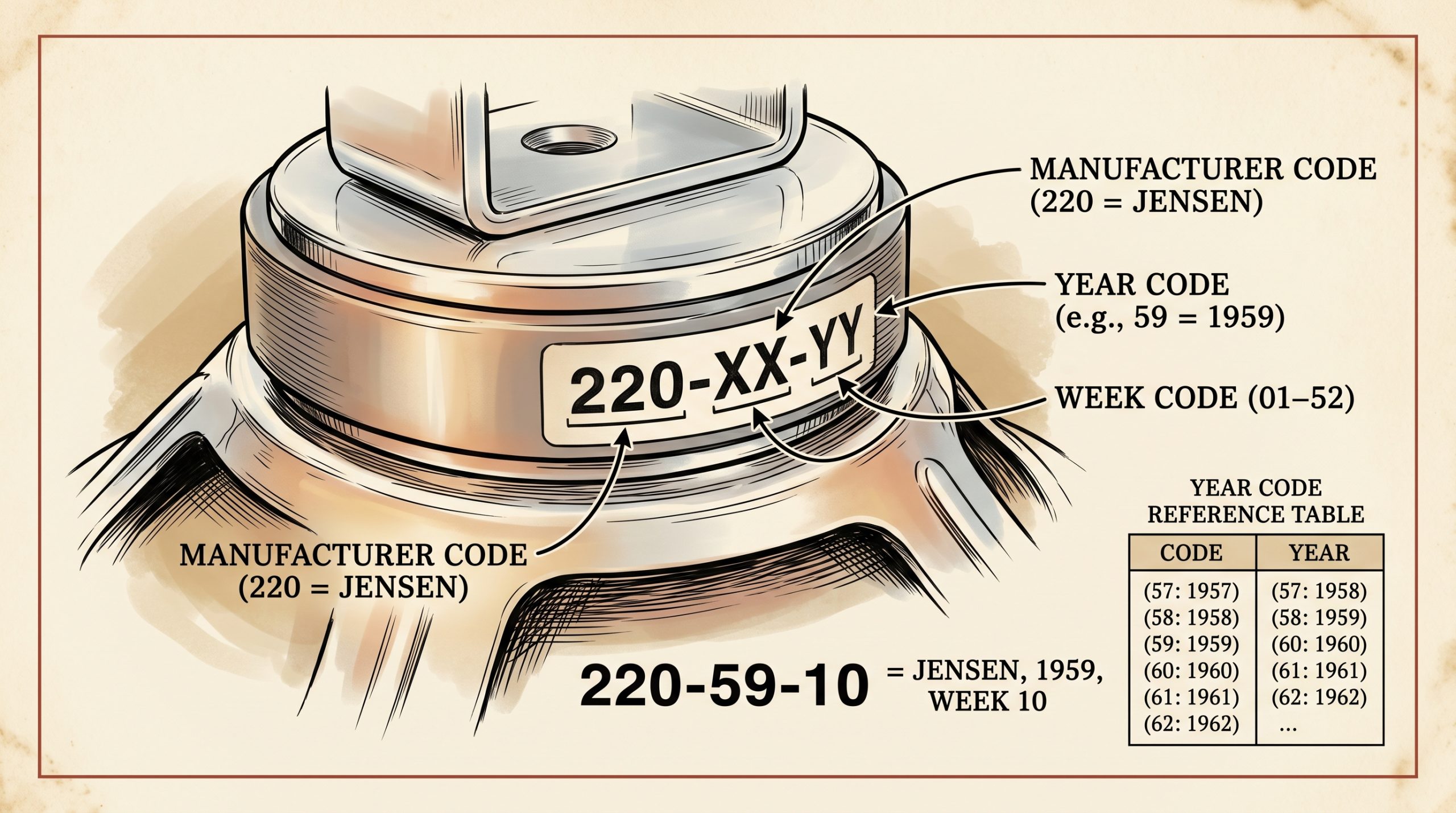
Speaker EIA codes use the same format. Common manufacturer codes: 220 = Jensen, 465 = Oxford, 137 = CTS, 328 = Utah. A Jensen P10R date code of 220-944 reads as: Jensen (220), 1959 (9), week 44. Mixed-date speaker quads are common on vintage examples and don’t automatically signal fraud, but a quad of obvious reissue speakers presented as original is the most common form of misrepresentation. That kind of date-code documentation is what responsible vintage selling looks like, and it’s what you should expect to receive or replicate when buying.
Re-covering and re-lacquering by a professional shop is generally acceptable to vintage buyers as long as it’s disclosed. DIY recovers typically reduce value. “All original” means original transformers, speakers, chassis hardware, and cosmetics, each component category affects valuation independently.
For the 1964 Fender Bassman versus 1966 Fender Bassman decision: the pre-CBS 1964 unit with the AA864 circuit commands a premium for parts quality and collector appeal. The 1966 CBS-era unit (typically AB165 by then) is functionally comparable but sits in an uncertain place regarding originality of parts. Checking potentiometer date codes (format: manufacturer + year + week, same EIA convention) and comparing them to the expected production year is the most reliable way to identify parts-correct examples. The Fender tube amp serial number and date code guide covers the full transformer, pot, and speaker code reading method for every production era.
Fender Bassman Reissue, Used Market Buying Guide
Used ’59 Bassman reissues appear regularly on Reverb and Guitar Center Used in the $900–$1,400 range. What to check before buying: filter capacitors should be replaced every 20–25 years, so any reissue from the early 1990s production runs is likely overdue for a re-cap. Bias should be checked and set, the fixed-bias circuit drifts with tube age and a used amp bought without a bias check is an unknown quantity. Ask for documentation of recent service or factor in a tech visit at purchase. Tubes are the cheapest variable: a fresh set of matched 6L6GCs from a reputable supplier like Tung-Sol or JJ is $60–$80 and worth doing on any used tube amp. If the amp powers on but stays quiet, our no-sound diagnostic guide walks through the signal-path checks before you hand it to a tech.
Modern Fender Bassman, Which One to Buy New?
Budget-focused bass player: the Fender Bassman 60 or Bassman 25 cover practice and small-room use without breaking $400 used. Mid-range touring bassist: the Bassman 800 at $650–$800 used delivers 800W with a tube preamp front end, compressor, and DI output in a lightweight package. Premium tube tone for bass: the Super Bassman or Bassman 300 Pro, both available used in the $900–$1,200 range. Guitar player who wants authentic tweed tones without $5,000–$7,500 vintage prices: the ’59 Bassman LTD is the direct answer. It’s not a perfect substitute for an original, but at $2,200 MSRP (with street pricing closer to $1,900) or $900–$1,400 used, it’s an honest reproduction of a circuit that no other production amp at the price matches.
Fender Bassman vs. The Competition
| Amp | Power | Type | Key Tone Character | Price (New / Used) |
|---|---|---|---|---|
| Fender ’59 Bassman LTD | 45W | All-tube | Warm clean tones, saggy compression, harmonic breakup when pushed | $2,200 MSRP / $900–$1,400 used |
| Marshall JTM45 Reissue | 30W | All-tube | Tighter, punchier, slightly brighter, the 5F6-A’s direct descendant | $2,500 / $1,200–$1,800 |
| Victoria Bassman Clone | 40W | All-tube point-to-point | Closest to original 5F6-A construction and voicing | $3,000+ / Rare |
| Two-Rock Studio Pro 35 | 35W | All-tube | Clean headroom, high-fidelity, less sag | $3,800+ new |
The Marshall JTM45 comparison is the most relevant for 5F6-A buyers. The circuit lineage is documented, the JTM45 is a direct derivative, but the voicing differences are real. The Marshall tends toward a tighter, punchier character with slightly more ice-pick treble potential at high volumes, while the Bassman’s spongy compression and warm clean tones at moderate volume reflect the GZ34 rectifier’s sag contribution. Victoria’s Bassman-derivative builds offer point-to-point construction closer to the original than the Fender LTD reissue, but the price premium is significant and availability is limited. For the 12AX7 preamp tube complement in any of these amps, tube choice affects the character of each input gain stage and is worth researching before settling on a replacement set.
Which Bassman Should You Choose
The Bassman’s arc from 1952 to today covers more ground than almost any other amplifier series: the industry’s first dedicated bass amp, the guitar amp that inspired Marshall, the silverface workhorse that gigged through the 1970s and 1980s, and the modern Super Bassman handling touring stages in 2026. The circuit code 5F6-A connects a 1959 narrow-panel combo to a current LTD reissue and, one step removed, to every JTM45 derivative ever built. Whether the specific need is a vintage 1964 Bassman head, a usable tweed-tones reissue, or a stage-loud modern hybrid, the bloodline is documented and the options are genuine. Start with identifying which era and format match your actual use case, then use transformer and speaker date codes to verify what you’re actually buying. The Fender amp dating quick-reference table covers those code systems for every era from the 5B6 through the silverface period, and it’s worth keeping open when inspecting any vintage Bassman purchase.
Frequently asked questions
What is the difference between the Fender Bassman 50 and the Fender Bassman 100?
The Bassman 50 runs 50W from a pair of 6L6 on the AC568 circuit, with earlier breakup and more dynamic response at lower volumes, it's the more guitar-friendly of the two. The Bassman 100 runs 100W from 4× 6L6, with significantly more clean headroom thanks to the doubled output-tube count and a larger output transformer. For bass players, the 100 is the more practical choice. For guitar players who want usable overdrive at moderate stage volumes, the 50 gets there faster. Used prices reflect this: the 50 runs $600–$900, the 100 typically $700–$1,000 depending on condition.
Is the Fender '59 Bassman LTD reissue worth the money?
For a player who wants authentic tweed tones without paying $4,500–$7,500 for an original, yes. The LTD version is the better-specified buy within the reissue line, higher-grade transformers and improved capacitor spec compared to the standard reissue runs. It won't match the component-level character of a properly serviced original, particularly in the output transformer saturation behavior, but the 5F6-A circuit is faithfully reproduced and it's the most direct production route to that topology. The standard reissue (non-LTD) is acceptable but transformer quality has varied across production runs, inspect before buying used.
What is the Fender Tone Master Bassman?
The Tone Master Bassman is a digital modeling version in Fender's Tone Master DSP platform lineup, running Class D power amplification with Fender's amp modeling technology. It's part of the growing Tone Master series that also includes the Deluxe Reverb, Twin Reverb, Princeton Reverb, and Super Reverb in digital format. The Tone Master approach uses high-power solid-state amplification with digital preamp modeling to replicate tube amp behavior without tubes, relevant for players who want the tone without the maintenance or the weight.
Which Fender Bassman is best for guitar players?
The 5F6-A-based amps, original 1959 or the '59 Bassman LTD reissue, are the clear answer for vintage tweed tones. The Bassman 100T is the best modern option for guitar players wanting tube tones in a head format, with switchable 25W and 100W modes and a circuit that draws from Bassman-lineage DNA with modern refinements. On a budget, a silverface Bassman 50 at $600–$900 used delivers usable guitar tones with enough character to be worth the investment over a modern solid-state alternative.
What is the circuit number for the 1959 Fender Bassman schematic?
5F6-A. It's the most referenced and most cloned guitar amp circuit in history. The Marshall JTM45 traces directly to it, as do the Trainwreck Express and dozens of boutique designs. Original Fender service documentation for the 5F6-A is archived and widely available through amp tech resources including Schematic Heaven's Fender archive. If a builder, seller, or tech references "the Bassman circuit" without specifying 5F6-A, that's the circuit they mean.